Yaacov Agam is an Israeli sculptor and experimental artist who redefined how we experience visual art. His work demands that viewers move. Stand still, and you miss the point entirely.
Born in 1928 in Rishon LeZion, then British Mandate Palestine, Agam belongs to the postwar generation that shattered static conventions. He sits at the intersection of optical art and kinetic sculpture, two movements that prioritize perception and physical engagement over passive observation.
His career spans seven decades. More than 4,000 works have appeared at auction. The Yaacov Agam Museum of Art opened in his hometown in 2018. He remains the highest-selling Israeli artist in history.
Identity Snapshot
Full Name: Yaacov Gibstein (later Agam)
Hebrew: יעקב אגם
Born: May 11, 1928, Rishon LeZion, Mandate Palestine (now Israel)
Primary Roles: Sculptor, painter, printmaker, installation artist
Nationality: Israeli
Schools: Ecole de Paris, Bauhaus influence
Movements: Kinetic Art, Op Art, Geometric Abstraction
Mediums: Oil on corrugated aluminum, lenticular prints (Agamographs), stainless steel sculpture, silkscreen on PVC, mixed media installations
Signature Traits: Triangular relief structures, high-chroma palette, viewer-dependent imagery, lenticular transformation
Iconography: Stars of David, Hebrew letters, geometric progressions, rainbow spectrums
Geographic Anchors: Rishon LeZion (birthplace), Jerusalem (Bezalel training), Zurich (color studies), Paris (primary studio since 1951)
Mentors: Johannes Itten, Max Bill, Mordecai Ardon
Collections: Museum of Modern Art (New York), Centre Pompidou (Paris), Guggenheim Museum, Hirshhorn Museum, Metropolitan Museum of Art
Market Signals: Record auction $698,500 (Growth, 2010). Common formats include Agamographs (editions of 99-180), serigraphs on aluminum relief, kinetic polymorphs.
What Sets Agam Apart
Most artists ask you to look. Agam asks you to walk.
His corrugated surfaces hold multiple images simultaneously. Shift your position and the composition transforms. What appeared as circles becomes squares. Blues morph into reds.
This is not trickery for its own sake. It reflects his Kabbalistic upbringing, where truth reveals itself in stages, never all at once.
Where Victor Vasarely created static optical puzzles, Agam made temporal ones. His works exist in four dimensions: height, width, depth, and time.
The viewer completes the artwork. Without movement, an Agam piece remains incomplete.

Origins and Formation
Early Life (1928-1949)
Born to Rabbi Yehoshua Gibstein, a Kabbalist scholar. Religious upbringing forbade graven images. This restriction shaped everything.
Instead of depicting the physical world, Agam learned to suggest transformation. The infinite. The unknowable.
He trained at Bezalel Academy of Art and Design in Jerusalem under Mordecai Ardon. Geometric abstraction took root here.
Zurich Period (1949-1951)
Moved to Switzerland at age 21. Enrolled at Kunstgewerbe Schule.
Studied color theory under Johannes Itten, the legendary Bauhaus instructor. This transformed his approach to hue relationships and spectral progressions.
Max Bill’s constructivist sculptures influenced his three-dimensional thinking. Architecture historian Sigfried Giedion encouraged him to break from static painting conventions.
Paris Breakthrough (1951-1955)
Arrived in Paris in 1951. Still lives there.
First solo exhibition at Galerie Craven in 1953. Every work was kinetic, movable, transformable. This was the first one-person show in art history devoted entirely to kinetic art.
Exhibited at the historic Le Mouvement show at Galerie Denise Rene in 1955. Shared walls with Alexander Calder, Jean Tinguely, and Jesus Rafael Soto.
The kinetic art movement had arrived. Agam stood at its center.
Movement and Context
Position Within Kinetic Art
Kinetic art splits into two camps: works that physically move (motors, wind, viewer manipulation) and works that appear to move through optical effect.
Agam bridges both. His polymorphic paintings create perceptual motion. His fountains and sculptures incorporate actual movement.
Comparative Analysis
Agam vs. Vasarely: Both Hungarian-connected artists pursued optical effects. Vasarely worked flat. Single viewpoint. Retinal vibration. Agam added physical depth through corrugated surfaces. Multiple images layered on triangular ridges. The viewer must move; Vasarely’s viewer stands still.
Agam vs. Calder: Calder’s mobiles move through air currents. Passive viewer, active artwork. Agam reverses this. His reliefs stay fixed; the viewer provides all motion.
Agam vs. Bridget Riley: Riley creates surface oscillation through precise stripe intervals. High color contrast, flat canvas. Agam’s visual rhythm comes from physical structure, not painted illusion alone.
Materials, Techniques, and Process
Supports and Structures
Corrugated aluminum is his signature substrate. Triangular ridges at precise angles (typically 45 degrees) create the polymorphic effect.
Also works on folded PVC, stainless steel, and traditional canvas when appropriate.
The Agamograph Technique
His most recognizable invention. Uses lenticular printing (barrier-grid animation) to present completely different images depending on viewing angle.
Multiple images are sliced into strips and interlaced. A ridged plastic overlay reveals one image from the left, another from the right, and a fragmented composite from center.
Editions typically range from 99 to 180 prints.
Palette Approach
High saturation across the full spectrum. Rainbow progressions appear frequently. He exploits complementary color relationships to maximize visual vibration between viewing positions.
Cool grays rarely appear. Warm-to-cool transitions create thermal movement across surfaces.
Studio Practice
Precise mathematical planning precedes execution. Each viewing angle requires separate compositional consideration.
Silkscreen application on relief structures. No alla prima spontaneity here. Every stroke serves the polymorphic system.
Themes, Subjects, and Iconography
Recurring Motifs
Stars of David appear throughout his work, reflecting his Orthodox Jewish heritage.
Hebrew letters and biblical references surface in commissioned religious works. The menorah he created for Fifth Avenue in New York stands 32 feet tall.
Concentric circles, radiating lines, and geometric patterns dominate secular pieces.
Compositional Schemes
Grid structures allow systematic transformation between images. Radial compositions create centrifugal visual energy.
Visual rhythm through repetition of triangular elements. The physical relief creates literal geometric shapes that cast shadows and define viewing angles.
Spiritual Underpinnings
Kabbalah teaches that divine truth cannot be perceived all at once. Reality reveals itself in stages.
Agam’s polymorphic works embody this philosophy. No single viewpoint captures the whole. You must move through the work to approach understanding.
The prohibition against graven images led him to non-figurative abstraction. Nothing static. Nothing fixed. Always becoming.
Notable Works
Double Metamorphosis III (1965)

Medium: Oil on corrugated aluminum relief Size: 124 x 186 cm (approximately 8’10” x 13’2″) Location: Musee National d’Art Moderne, Centre Pompidou, Paris
Visual Signature: Multiple geometric themes painted across triangular ridges. From one angle, circular forms dominate. From another, rectangular grids emerge. The center view shows fragmented interference between both systems.
Significance: His most recognized painting. Demonstrates mature polymorphic technique at monumental scale. Acquired by the French state in 1976.
Fire and Water Fountain (1986)

Medium: Kinetic fountain with fire elements Location: Dizengoff Square, Tel Aviv, Israel
Visual Signature: Polychrome rotating rings. Water jets. Actual flame elements. The entire structure moves on a programmed cycle.
Significance: Major public commission in Israel’s cultural capital. Combines kinetic sculpture with environmental design.
La Defense Fountain (1975)

Medium: Monumental kinetic fountain Location: La Defense district, Paris
Significance: Positioned Agam as a major figure in French public art. The work interacts with the surrounding modernist architecture.
Complex Vision (1969)

Medium: Lenticular mural Size: 30 feet square (9.1 meters) Location: Callahan Eye Foundation Hospital, Birmingham, Alabama
Significance: Demonstrates the Agamograph technique at architectural scale. Appropriately installed on an eye hospital. The work changes completely as viewers approach.
Growth (1972)

Medium: Oil on relief Size: 42.5″ x 172″ x 3″
Market Note: Sold for $698,500 at Sotheby’s New York in 2010. Current auction record for the artist.
Exhibitions, Collections, and Provenance
Major Retrospectives
Musee National d’Art Moderne, Paris (1972). First major museum survey.
Solomon R. Guggenheim Museum, New York (1980). Cemented international reputation.
Museum of Geometric and MADI Art, Dallas (2016). “The Magic of Yaacov Agam” exhibition.
Permanent Collections
Museum of Modern Art, New York holds Double Metamorphosis II (1964). Mildred Lane Kemper Art Museum. Hirshhorn Museum and Sculpture Garden. Centre Pompidou. Metropolitan Museum of Art.
Key Galleries

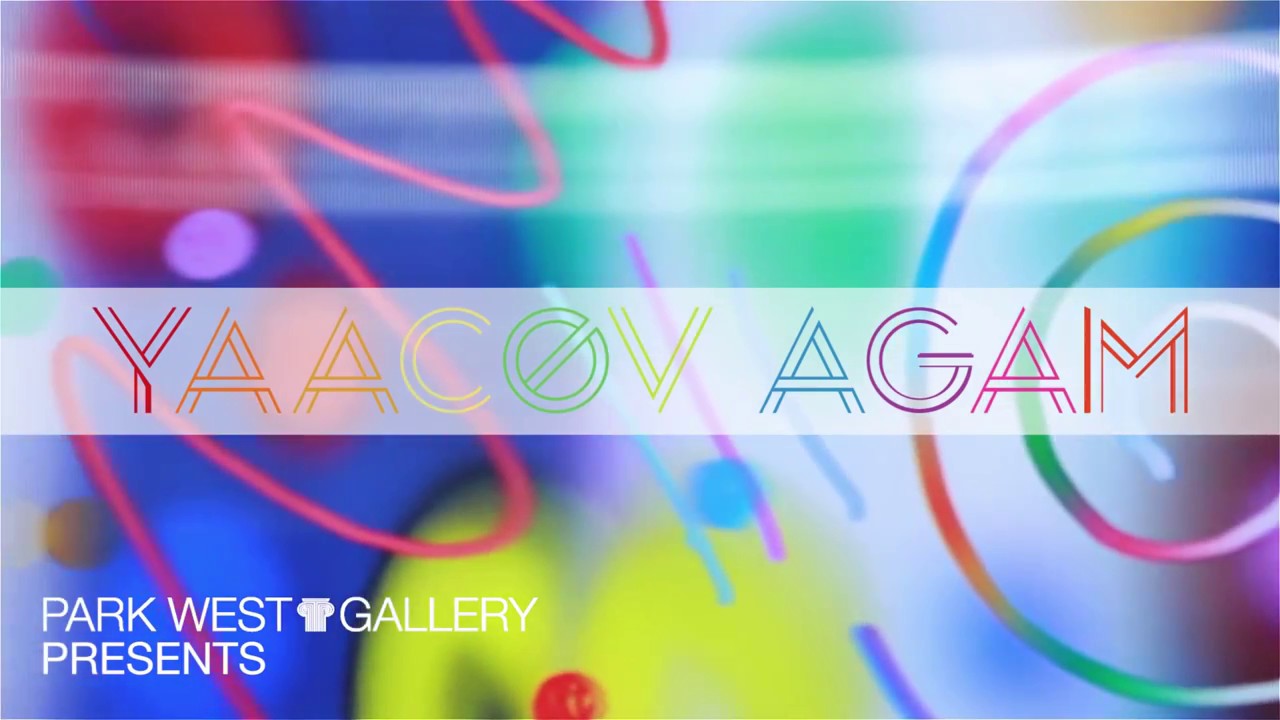
Galerie Denise Rene (Paris, New York) represented him from the 1950s. Park West Gallery maintains a long partnership, beginning in 1974. Circle Fine Art Galleries distributed his work across the United States.
Documentary Record
Warren Forma directed two films: “Possibilities of Agam” (1967) and “Agam and…” (1980). These remain primary documentation of his working process.
Market and Reception
Auction Performance
Record sale: $698,500 for “Growth” (Sotheby’s New York, 2010).
Works have appeared at auction over 20,000 times since 1998. Prices range from $10 to nearly $700,000 depending on medium, size, and period.
Paintings average approximately $14,500 in recent years. Sculptures average around $7,500. Agamographs and serigraphs trade at lower price points, making his work accessible to broader collector bases.
Authentication Considerations
Signed works typically bear “Agam” signature. Edition numbers appear on multiples (e.g., “87/99”).
High volume of editions means careful provenance research matters. The artist’s long career and prolific output require attention to period and authenticity.
Market Position
Highest-selling Israeli artist. Active secondary market with 33% sell-through rate at recent auctions.
Work appeals to both fine art collectors and design-oriented buyers due to strong visual impact and interactive qualities.
Influence and Legacy
Upstream Influences
Johannes Itten’s color theories provided systematic foundation. Wassily Kandinsky’s spiritual abstraction resonated with his Kabbalistic worldview.
Piet Mondrian’s geometric reduction informed his non-figurative approach. Futurist interest in depicting motion influenced his temporal concerns.
Downstream Impact
The Agamograph technique influenced commercial lenticular printing. Sports cards, novelty items, and advertising adopted his barrier-grid principles.
Interactive and participatory art movements trace lineage through his viewer-dependent works.
His UNESCO-recognized visual education method (“Agam Method”) teaches children through geometric and chromatic exercises. Implemented in Israeli preschools and kindergartens.
Cross-Domain Echoes
Architecture: Environmental installations influenced how architects consider viewer movement through space.
Design: His chromatic progressions appear in graphic design and digital interfaces.
Education: The Jan Amos Comenius Medal (UNESCO, 1996) recognized his visual teaching methodology.
How to Recognize an Agam at a Glance

- Corrugated surface: Triangular ridges visible from side angles. If the surface is flat, it’s likely not an Agam relief.
- Rainbow spectrum: High-saturation progressions through primary, secondary, and tertiary colors.
- Image transformation: Move side to side. If the composition changes dramatically, you’re likely looking at Agam.
- Geometric vocabulary: Circles, squares, stars, Hebrew letters. No figurative imagery.
- Lenticular prints (Agamographs): Ridged plastic surface that reveals different images from different angles.
- Signature placement: Typically lower edge. “Agam” in simple lettering.
- Common sizes: Agamographs often 14″ x 14″ or similar. Relief paintings range to monumental scale.
- Bright, clean color: No muddy tones. Pure chromatic intervals.
- Edition numbering: Multiples marked with edition size (e.g., “15/99” or “AP 12/25”).
- No atmospheric effects: Hard edges throughout. No blending, no sfumato, no gradation through atmospheric means.
FAQ on Yaacov Agam
Who is Yaacov Agam?
Yaacov Agam is an Israeli sculptor and experimental artist born in 1928 in Rishon LeZion. He pioneered kinetic art and optical illusion techniques. His work transforms as viewers move, creating multiple images on single surfaces through corrugated aluminum reliefs and lenticular prints.
What is an Agamograph?
An Agamograph is a lenticular print invented by Agam. It uses barrier-grid animation to display completely different images depending on viewing angle. The technique layers sliced images under ridged plastic. Editions typically range from 99 to 180 signed prints.
What art movement does Yaacov Agam belong to?
Agam is a founding figure of the kinetic art movement. He also connects to optical art and geometric abstraction. His 1955 exhibition at Galerie Denise Rene alongside Jean Tinguely and Carlos Cruz-Diez established kinetic art internationally.
Where can I see Yaacov Agam’s artwork?
Major collections include the Museum of Modern Art in New York, Centre Pompidou in Paris, and the Guggenheim Museum. The Yaacov Agam Museum of Art opened in his hometown of Rishon LeZion, Israel in 2018. Public fountains exist in Tel Aviv and Paris.
How much is Yaacov Agam’s art worth?
Auction prices range from under $100 for small prints to $698,500 for major paintings. That record came from “Growth” selling at Sotheby’s in 2010. Agamographs typically sell between $500 and $5,000. Original relief paintings command significantly higher prices.
What materials does Yaacov Agam use?
His signature material is corrugated aluminum with triangular ridges painted in oil. He also works with stainless steel, folded PVC, silkscreen on various substrates, and lenticular plastic. Public sculptures incorporate water, fire, and motorized elements.
Is Yaacov Agam still alive?
Yes. Born May 11, 1928, Agam continues working from his Paris studio. He has lived in France since 1951. His career spans over seven decades, making him one of the longest-active artists in contemporary art history.
What is Yaacov Agam’s most famous work?
Double Metamorphosis III (1965) is his most recognized painting. It hangs in Centre Pompidou, Paris. The Fire and Water Fountain in Tel Aviv’s Dizengoff Square and the La Defense fountain in Paris are his most famous public installations.
Why is Yaacov Agam’s art significant?
Agam transformed art from passive viewing to active participation. His polymorphic technique requires viewer movement to complete the work. He proved that paintings could exist in time, not just space. UNESCO recognized his visual education method in 1996.
Where did Yaacov Agam study art?
He trained at Bezalel Academy of Art and Design in Jerusalem under Mordecai Ardon. Then moved to Zurich’s Kunstgewerbe Schule, studying color relationships with Johannes Itten. Max Bill’s constructivist work also shaped his approach to three-dimensional form.
Conclusion
Yaacov Agam changed what art could be. He made viewers move. He made paintings exist in time.
His polymorphic reliefs and Agamographs demand participation. Stand still and you see nothing complete. Walk past and the work reveals itself in stages.
From his Orthodox Jewish upbringing to Bauhaus training under Johannes Itten, every influence shaped his non-figurative vision. The Guggenheim retrospective, UNESCO recognition, and record auction prices confirm his place among modern art pioneers.
Seven decades later, his transformable paintings still challenge how we see.