Gustav Klimt covered a canvas in gold leaf and changed how the world thought about decorative painting. That was 1907. Over a century later, famous Art Nouveau paintings still stop people in their tracks.
The Art Nouveau movement lasted roughly from 1890 to 1910, producing some of the most visually striking artwork in European history. Artists like Alphonse Mucha, Aubrey Beardsley, and Henri de Toulouse-Lautrec pushed painting, poster art, and illustration into territory nobody had seen before. Flowing lines, organic forms, floral motifs, and bold experiments with color defined the era.
This article covers 10 of the most significant Art Nouveau paintings and the stories behind them. You’ll find details on each work’s technique, symbolism, and where to see it today. Some of these you’ll recognize instantly. Others might surprise you.
Famous Art Nouveau Paintings
The Kiss by Gustav Klimt (1907-1908)

Year and Background
Gustav Klimt painted The Kiss at the peak of what scholars call his “Golden Period,” between 1907 and 1908.
It came right after his Vienna Ceiling paintings, which were trashed by critics as pornographic. The backlash shook him. But The Kiss? The Austrian government bought it before he even finished it. That’s how fast the reception turned around.
The sale price of 25,000 crowns (roughly $240,000 today) was five times higher than any painting previously sold in Vienna.
Visual Description
Two lovers kneel at the edge of a flower-covered meadow, locked in an embrace. The man’s face bends down to press a kiss to the woman’s cheek while his hands cradle her face. Her eyes are closed, one arm around his neck.
The figures stand against a flat, shimmering gold background. Their robes blend into each other, almost dissolving the boundary between the two bodies.
Style and Technique
The painting uses oil paint combined with gold leaf, silver, and platinum on canvas. It measures roughly 6 by 6 feet.
Klimt’s father was a gold engraver, but the real spark came from a trip to Ravenna in 1903. The Byzantine mosaics in the Church of San Vitale hit him hard. He started applying wafer-thin gold leaf directly onto canvas after that, and it changed everything about his work.
The man’s robe features geometric rectangles. The woman’s dress has soft floral patterns. That contrast between hard geometry and organic shapes is pure Art Nouveau, and it’s one of the reasons this piece still looks so distinctive.
Symbolism and Meaning
Many believe the couple is Klimt himself with his lifelong partner Emilie Floge. Klimt never confirmed it.
The gold wrapping around the lovers suggests something almost sacred. Byzantine influences, medieval gold-ground paintings, and the decorative spirals from Bronze Age art all show up here. The couple kneels on the edge of a cliff, which some read as love being both beautiful and precarious.
Post-Victorian society actually considered it pornographic, even though both figures are fully clothed. That tells you a lot about the era.
Why It Matters
This is the single most recognized painting from the Art Nouveau movement. It represents the climax of Klimt’s golden phase and the Vienna Secession at its most confident.
Its influence stretches into fashion, film, and popular culture globally. It has been referenced, parodied, and reinterpreted countless times.
Where to See It
Osterreichische Galerie Belvedere, Vienna, Austria.
Portrait of Adele Bloch-Bauer I by Gustav Klimt (1907)
Year and Background
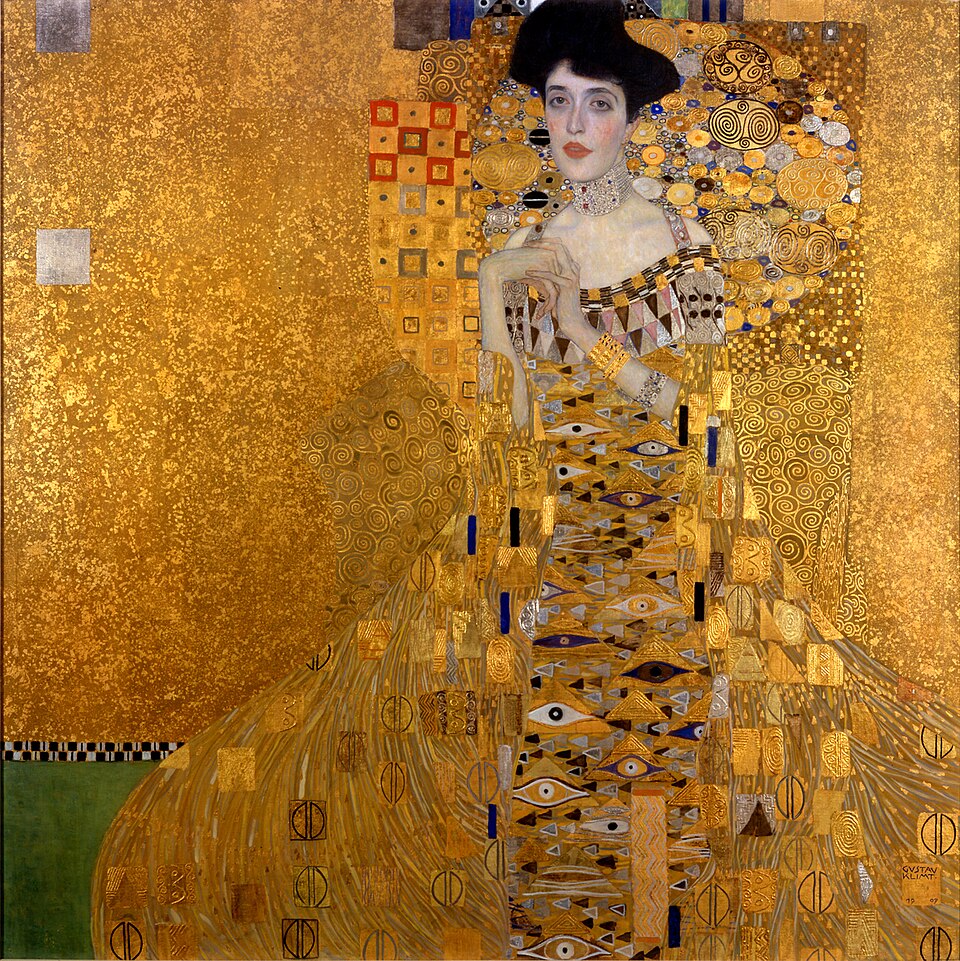
Ferdinand Bloch-Bauer, a wealthy Viennese banker, commissioned Klimt to paint his wife Adele in 1903. It was supposed to be an anniversary gift for Adele’s parents. Klimt was notoriously slow with portraits. It took four years and over 100 preparatory sketches before the final work appeared in 1907.
Visual Description
Adele sits (or stands, it’s ambiguous) on what appears to be a golden throne. A golden halo of spirals and ornamental shapes frames her face. Her cheeks are flushed, lips vivid red.
Her hands clasp together in an unusual way. She was hiding a deformed finger she felt self-conscious about. She wears a diamond choker, a wedding gift from Ferdinand, and a tight golden dress covered in eye motifs set within triangles.
Style and Technique
Oil paint with gold and silver leaf on canvas, measuring 138 by 138 cm. Klimt also used gesso for bas-relief decorative motifs. The frame itself was designed by architect Josef Hoffmann and covered in gold leaf.
The painting blends realistic rendering of skin and hands with completely flat ornamental surfaces. Only Adele’s face and hands look three-dimensional. Everything else dissolves into decorative color and texture. It includes references spanning Byzantine, Egyptian, African, and Asian art traditions.
Symbolism and Meaning
The all-seeing eye motifs on Adele’s dress carry Egyptian roots. The golden halo gives her an almost saintly appearance. Some art historians believe the egg shapes scattered through the ornament reference Adele’s personal tragedies, including a stillborn daughter in 1903 and the loss of her infant son in 1904.
A critic at the time quipped the painting was “more brass than Bloch.”
Why It Matters
In 2006, Ronald Lauder purchased it for $135 million, making it the most expensive painting ever sold at that time. But the story behind the sale matters more. The Nazis seized it in 1941. It was renamed “Woman in Gold” to hide Adele’s Jewish identity. Decades of legal battles followed before heir Maria Altmann successfully reclaimed it.
The 2015 film “Woman in Gold” brought this story to a wide audience.
Where to See It
Neue Galerie, New York, USA.
The Tree of Life, Stoclet Frieze by Gustav Klimt (1909)
Year and Background
Belgian financier Adolphe Stoclet and his wife Suzanne hired architect Josef Hoffmann and the Wiener Werkstatte collective to design their Brussels mansion. Klimt was brought in to create a series of mosaics for the dining room. He worked on the project from 1905 to 1911.
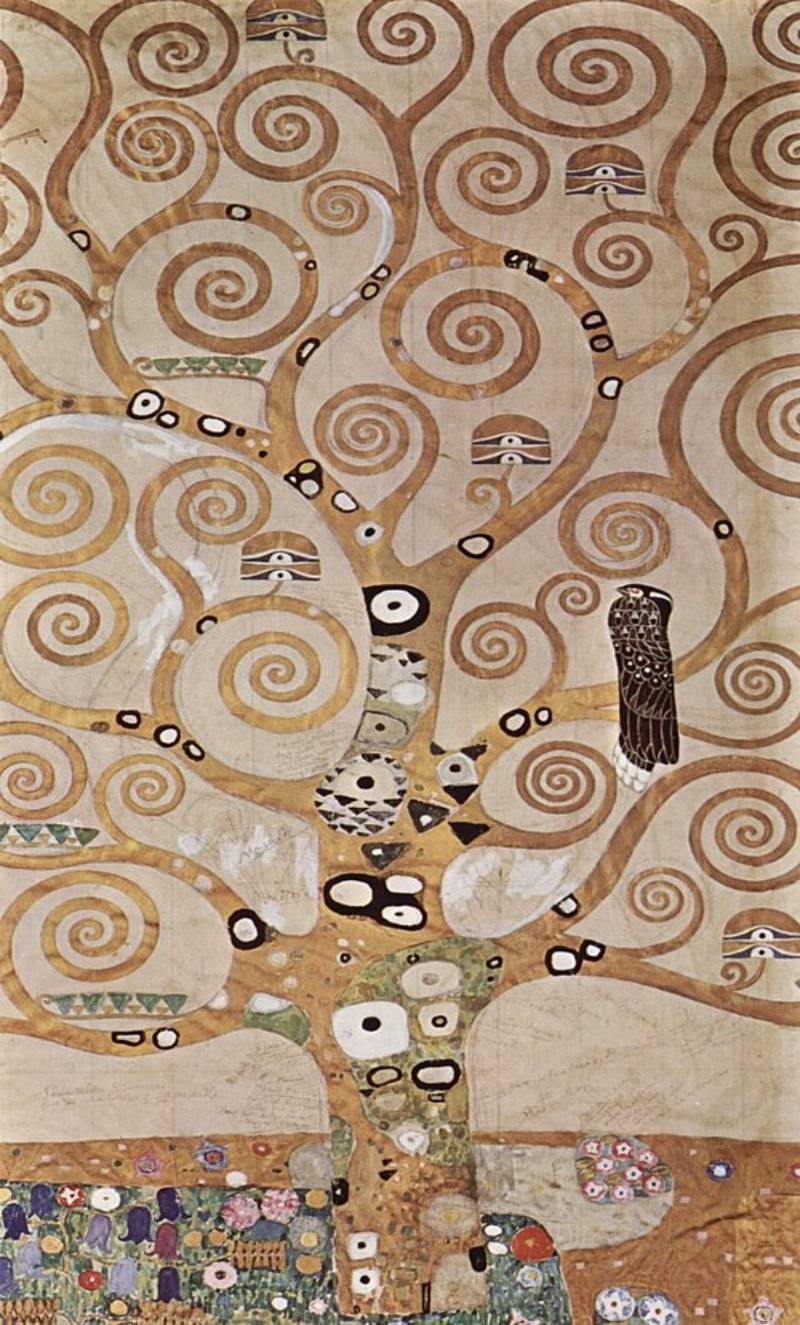
The preparatory painting was completed in 1909. Klimt spent over six years on the golden tree that became the central motif.
Visual Description
A golden tree with spiraling, curling branches fills the composition. The branches twist and undulate across the surface, decorated with stylized birds, butterflies, and floral motifs. A single black bird sits on a lower branch.
The frieze spans three walls. The two side panels each center on a Tree of Life. Flanking figures include a standing woman called “Expectation” and an embracing couple known as “Fulfillment.”
Style and Technique
The preparatory study uses oil and gold leaf on canvas, measuring 195 by 102 cm. The final mosaics incorporated marble, ceramic, gilded tiles, enamel, pearls, and semi-precious stones. All crafted by artisans under Leopold Forstner, following Klimt’s detailed instructions.
It’s the only landscape Klimt created during his golden phase. The flat, ornamental surface with swirling organic lines is Art Nouveau at its most decorative.
Symbolism and Meaning
The tree of life is a concept found across religions, philosophies, and mythologies. It connects heaven, earth, and the underworld. Klimt’s version uses the spiraling branches to suggest life’s complexity and continuation.
The black bird? Many cultures read it as a symbol of death. It sits right in the middle of all that golden life energy, a quiet reminder that everything ends.
Why It Matters
The Stoclet Palace became a UNESCO World Heritage Site in 2009. The mosaics remain privately owned and closed to the public. But the preparatory drawings survived and became some of Klimt’s most reproduced works globally.
Where to See It
The preparatory painting is at the Museum of Applied Arts (MAK), Vienna, Austria. The actual mosaics are inside the Palais Stoclet in Brussels, which is not open to visitors.
Gismonda by Alphonse Mucha (1894)
Year and Background
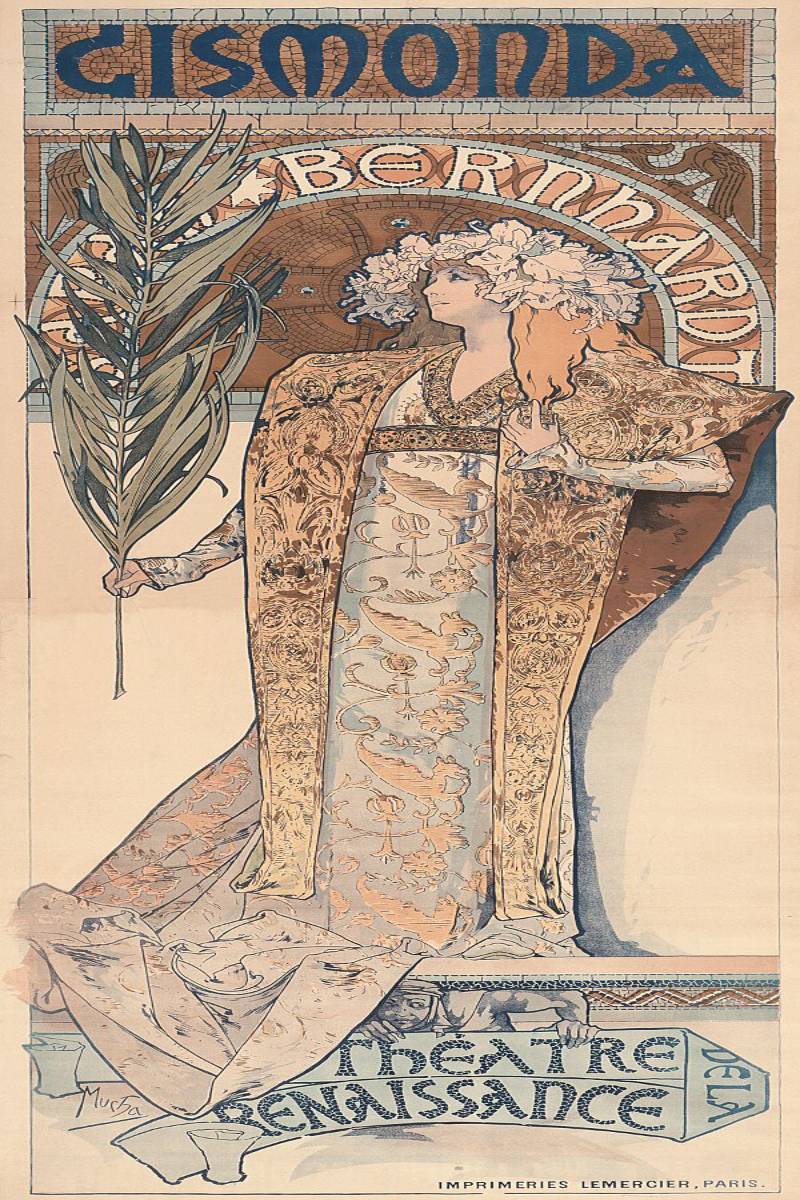
This is the poster that started everything for Mucha. And it happened by accident.
On December 26, 1894, Mucha was the only artist working at Lemercier’s print shop in Paris. Sarah Bernhardt, the most famous actress of the era, called in needing a poster for her production of Gismonda. Nobody else was available. Mucha took the job.
When the poster appeared on Parisian streets, it caused an immediate sensation. Bernhardt signed Mucha to a six-year contract on the spot.
Visual Description
Bernhardt stands life-size, over six and a half feet tall, wearing an elaborate Byzantine costume from the play’s final act. She holds a palm branch and wears an orchid headdress. A mosaic arch frames her figure from above.
The color palette is soft and muted. Golds, blues, and greens. Nothing like the bold, flat colors other poster artists like Toulouse-Lautrec were using at the time.
Style and Technique
Color lithograph, 216 by 74.2 cm. Mucha treated the composition architecturally. He built a pedestal for the actress, a doorway to frame her, and a tympanum above covered in Byzantine-style mosaic patterns. The typography blends elements of Lombardic Capitals with Insular Majuscule, the script style seen in the Book of Kells.
The fusion of Japanese influence (from the unusual low-angle perspective) with Slavic folk motifs created something entirely new.
Symbolism and Meaning
The poster almost looks like a religious icon. The mosaic halo, the Byzantine cross in the background, Bernhardt’s pious expression. It transforms a theater advertisement into something close to sacred art.
Mucha was a Freemason who genuinely believed beauty could spark spiritual development. Even his commercial work carried that conviction.
Why It Matters
Gismonda launched the Art Nouveau poster movement. Overnight, posters were discussed seriously as fine art in circles that had previously dismissed them entirely. “Le style Mucha” became synonymous with Art Nouveau itself, and his ideas on composition and decoration were taught in every art school in Europe.
Where to See It
Various prints exist in museum collections worldwide. The Mucha Foundation Art Museum in Prague’s Savarin Palace opened in early 2025 and holds an extensive collection of Mucha’s work.
The Slav Epic by Alphonse Mucha (1910-1928)
Year and Background
Mucha considered this his life’s work. Not the posters. Not the advertisements. This.
He dreamed of the project since the turn of the century but lacked funding. In 1909, American philanthropist Charles Richard Crane agreed to sponsor the massive undertaking. Mucha rented part of a castle in Zbiroh, western Bohemia, where the rooms were large enough to accommodate the enormous canvases. He spent 18 years painting.
Visual Description
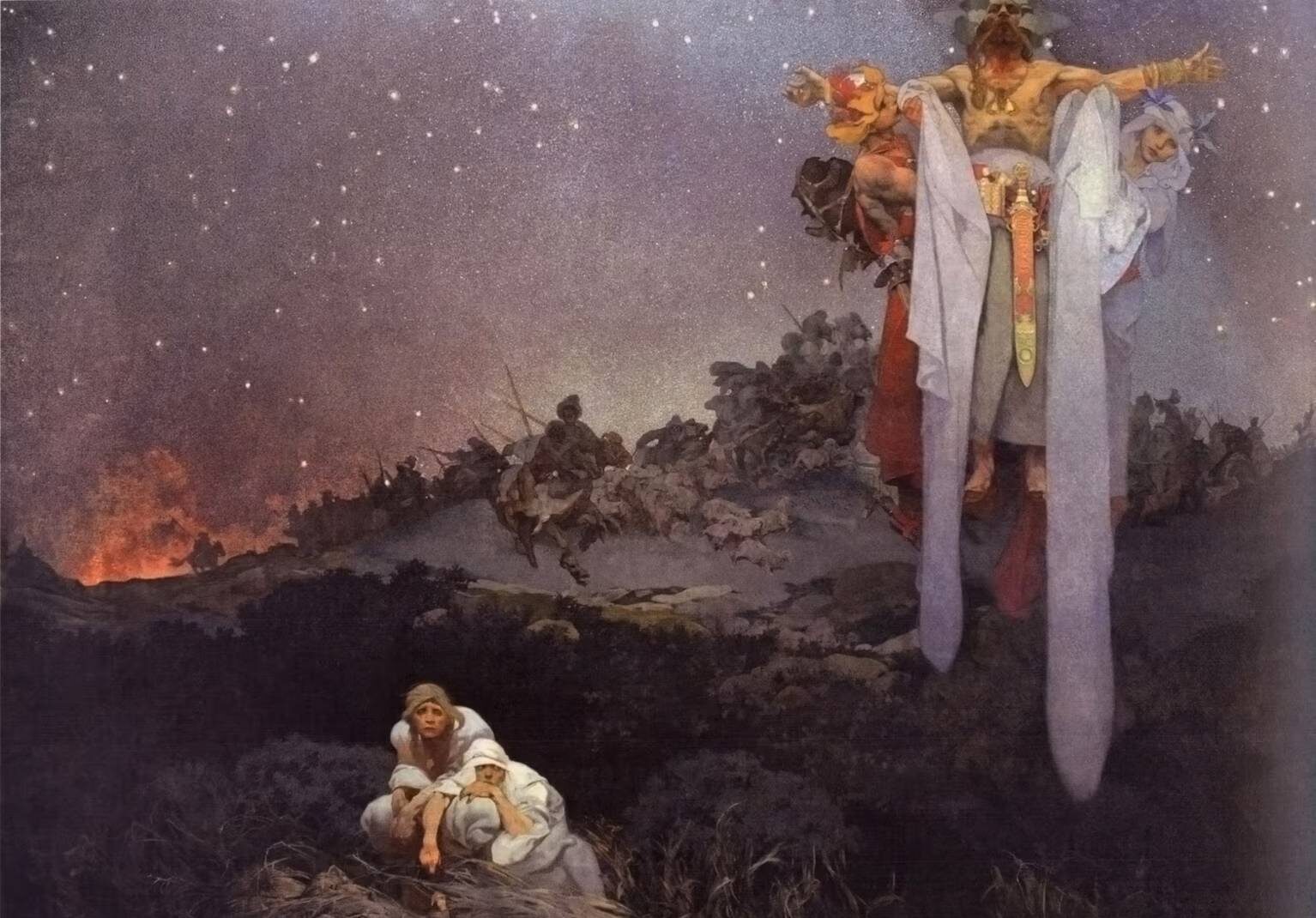
Twenty monumental canvases depicting the history of the Slavic peoples, from the 5th century through independence in 1918. The largest paintings measure over 6 by 8 meters (roughly 20 by 26 feet). Ten focus on Czech history, ten on broader Slavic events.
The final canvas, “The Apotheosis of the Slavs,” shows soldiers returning from World War I, greeted by youngsters waving branches. A Christ-like figure watches from above as Slavic nations step into a new era of freedom.
Style and Technique
Oil and egg tempera on canvas. This was a dramatic shift from Mucha’s commercial poster work. The style is much more painterly and historically detailed. He traveled across Russia, Poland, and the Balkans, consulting historians and visiting the locations he intended to depict.
The pastel tones remain, but the scale and ambition are closer to history painting than to the decorative Art Nouveau style Mucha was famous for. There’s a raw emotional weight here that his poster art never carried.
Symbolism and Meaning
Mucha said the mission of the Epic was to announce to the world “who we were, who we are, and what we hope for.” Each canvas represents a turning point in Slavic civilization. Pagan rituals, religious conversions, invasions, cultural achievements, and ultimately independence.
Why It Matters
Mucha donated the complete cycle to Prague in 1928, on the 10th anniversary of Czechoslovakia’s independence. When the Nazis invaded in 1939, Mucha was among the first arrested. His spirit was broken after the interrogation, and he died shortly after. Over 100,000 Czechs attended his funeral despite the Nazis ordering that only immediate family could come.
The paintings were hidden under a pile of coal during the war to prevent Nazi seizure.
Where to See It
The Slav Epic has been displayed at the chateau in Moravsky Krumlov. A permanent home designed by Thomas Heatherwick is planned at the Savarin Palace development in central Prague, with hopes of housing the full cycle by 2028.
At the Moulin Rouge by Henri de Toulouse-Lautrec (1892-1895)
Year and Background
Toulouse-Lautrec lived in Montmartre and frequented the Moulin Rouge cabaret, which had opened in 1889. The club’s owner had already bought one of his paintings for the foyer. This was Lautrec’s world, and he painted it from the inside.
Visual Description
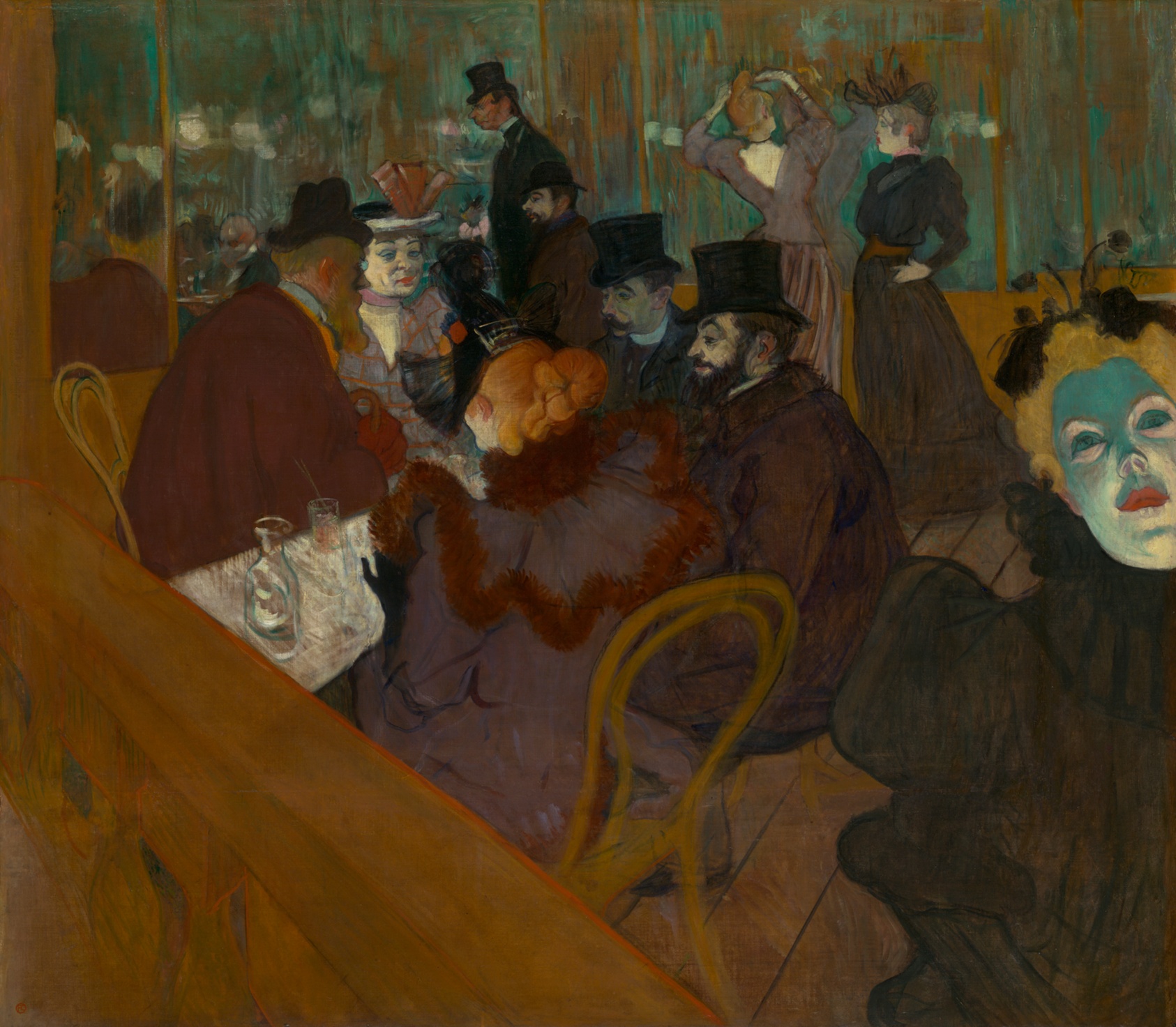
A group of five people sit around a table on the cabaret floor. The focal point is dancer Jane Avril, recognizable by her flaming red-orange hair. Writer Edouard Dujardin, dancer La Macarona, and photographers Paul Secau and Maurice Guibert surround her.
In the center background, Toulouse-Lautrec himself appears, a short figure walking beside his much taller cousin, physician Gabriel Tapie de Celeyran. La Goulue fixes her hair in the background.
The most striking figure? English singer May Milton on the far right, her face lit acid green from a gaslight below. She’s the only person looking at the viewer.
Style and Technique
Oil on canvas, 123 by 141 cm. The asymmetrical composition is influenced by Japanese prints, with a severe diagonal cutting across the lower left corner. The unusual cropping of Milton’s face on the right edge of the canvas was a bold choice.
At some point, either Lautrec or his dealer actually cut the canvas to remove Milton entirely. Maybe her strange appearance made it harder to sell. By 1914, the section was reattached.
Symbolism and Meaning
This isn’t idealized nightlife. The artificial lighting, the odd greenish glow on Milton’s face, the crowded but somehow disconnected figures. It captures the excitement and loneliness of Belle Epoque Paris at the same time.
Lautrec didn’t flatter anyone. He painted what he saw, which made his work feel authentic but also unsettling.
Why It Matters
Toulouse-Lautrec was the first artist to make advertising and poster art something fine art circles took seriously. His Moulin Rouge posters and paintings helped blur the line between decorative arts and gallery art, which was the whole point of Art Nouveau as a movement.
Where to See It
Art Institute of Chicago, USA. Part of the Helen Birch Bartlett Memorial Collection.
Moulin Rouge: La Goulue by Henri de Toulouse-Lautrec (1891)
Year and Background
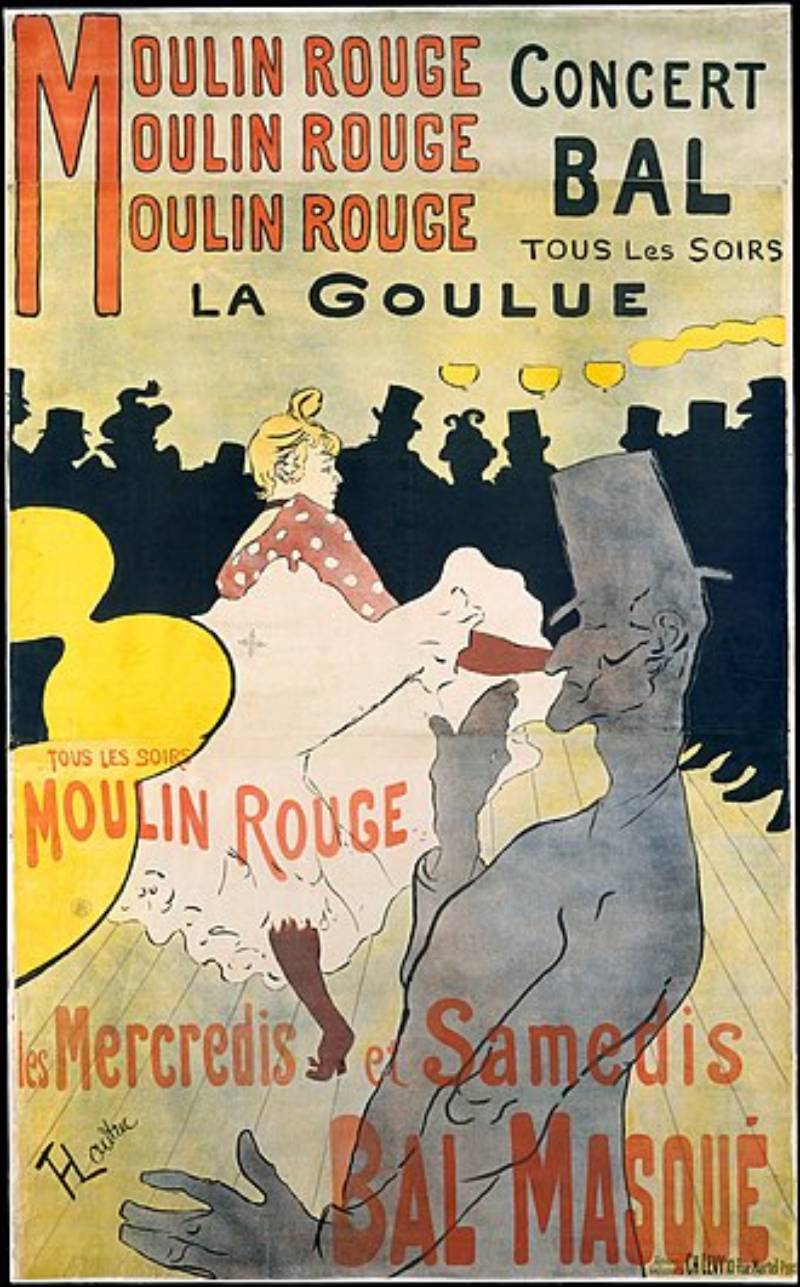
When the Moulin Rouge opened, the owners needed promotional material. They asked Toulouse-Lautrec. The result became one of the most recognized posters in art history.
La Goulue (“The Glutton”) was the stage name of Louise Weber, the club’s star cancan dancer. Her partner Valentin le Desosse (“the Boneless”) was known for his impossibly flexible dancing.
Visual Description
La Goulue dominates the center in a white blouse and skirt, mid-dance. Valentin le Desosse appears as a dark, elongated silhouette in the foreground. Behind them, a row of spectators rendered as flat black silhouettes watches the performance.
Bold, flat areas of color contrast fill the composition. Yellow, black, white, and red dominate.
Style and Technique
Color lithograph. Lautrec used spattered ink techniques called “crachis” to create texture. The design borrows heavily from Japanese woodblock prints, with flat colors, strong outlines, and directional lines that control how the eye moves through the image.
The lettering is integrated directly into the design rather than slapped on top. That was new for poster art.
Symbolism and Meaning
The poster captures the raw energy of Montmartre’s nightlife without romanticizing it. The silhouettes feel voyeuristic. You’re watching people watch someone perform. The layers of looking mirror the cabaret experience itself.
Why It Matters
This poster single-handedly elevated lithographic poster design to fine art status. Collectors started pulling posters off walls almost immediately. It influenced graphic design for decades. You can draw a straight line from this poster to modern advertising aesthetics.
Where to See It
Multiple prints exist in various institutions. Notable collections include the Musee d’Orsay in Paris and the Metropolitan Museum of Art in New York.
The Peacock Skirt by Aubrey Beardsley (1893)
Year and Background
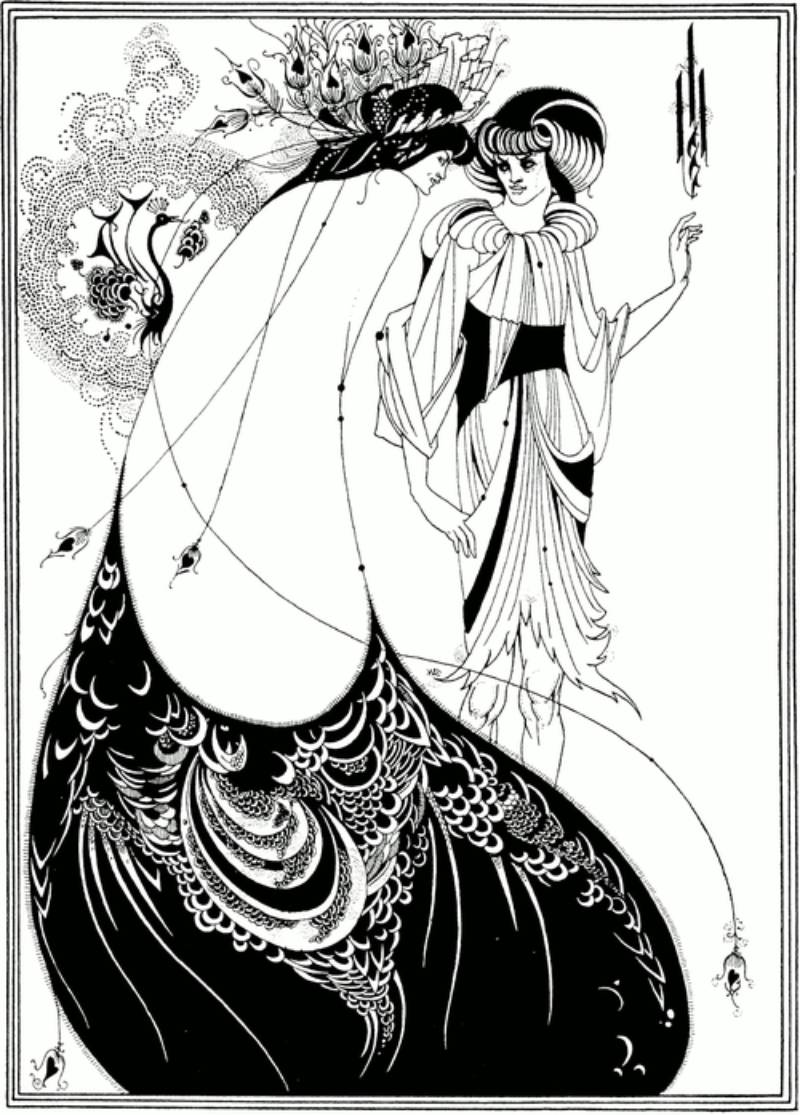
Aubrey Beardsley created this illustration for the first English edition of Oscar Wilde’s play “Salome” in 1894. But the drawing itself was done in 1893.
Wilde had written Salome in French. When he saw Beardsley’s earlier illustration inspired by the play’s Paris release, he was excited enough to invite the young artist to illustrate the English translation. The relationship between the two had its tensions. Beardsley even snuck caricatures of Wilde into several of the Salome illustrations.
Visual Description
Salome stands viewed from the rear, wearing a long, flowing robe decorated with stylized peacock feather patterns. Her elaborate headdress also features peacock feathers trailing down her back. A peacock’s head appears over her left shoulder.
A second figure, likely the “Young Syrian” from the play, stands to the right with an androgynous face and pleated tunic. The entire composition uses only black ink on white paper. No gray tones. No shading. Just crisp, bold lines.
Style and Technique
Pen and ink on white wove paper, 23 by 16.8 cm. The drawing was originally reproduced as a wood engraving. Later editions used photo-mechanical line block printing.
Beardsley drew direct inspiration from James McNeill Whistler’s Peacock Room (1876-77) and from Japanese woodblock prints. The flat two-dimensionality, the arabesque forms, and the high value contrast between black and white are all characteristic of early Art Nouveau illustration.
Symbolism and Meaning
Peacocks are traditionally linked to pride, vanity, and beauty. In Wilde’s play, Herod offers Salome fifty white peacocks. Beardsley dresses Salome in peacock imagery to visually connect her to the objects of desire that surround her throughout the story.
The Decadent movement valued artificiality and explored the erotic and perverse. This illustration sits right at that intersection, something both beautiful and unsettling.
Why It Matters
Beardsley died at 25. His career lasted barely five years. Yet The Peacock Skirt and the other Salome illustrations made him one of the most controversial and influential artists of the Art Nouveau movement. His black-and-white graphic style influenced generations of illustrators and graphic designers.
Publisher John Lane was so nervous about some of the illustrations that he censored details and rejected two drawings entirely from the first edition.
Where to See It
The original pen and ink drawing is at the Fogg Art Museum, Harvard University, Cambridge, USA. Prints are held at the V&A in London and the Metropolitan Museum of Art in New York.
The Beethoven Frieze by Gustav Klimt (1901)
Year and Background
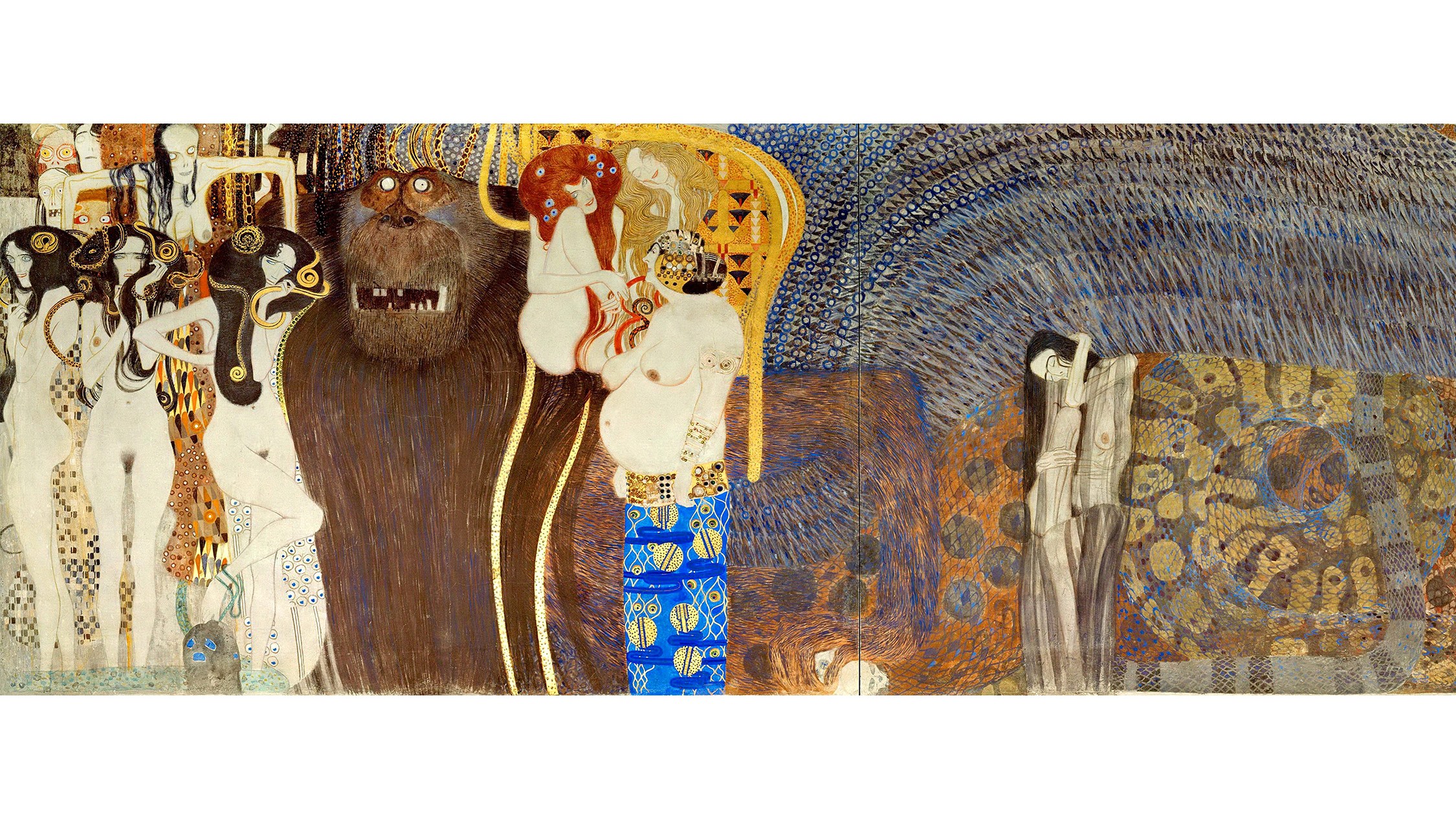
Klimt created this monumental frieze for the 14th Vienna Secession exhibition in 1902, which was entirely dedicated to Beethoven. The centerpiece of the exhibition was Max Klinger’s statue of the composer, and Klimt’s frieze was intended to wrap around the walls above it.
It was originally meant to be temporary. The materials were lightweight because nobody expected to keep it. But it survived, and now it’s one of the most recognized Klimt works outside of his golden phase portraits.
Visual Description
The frieze stretches over 34 meters across three walls. It interprets Beethoven’s Ninth Symphony through visual allegory. Floating female figures represent the longing for happiness. A knight in golden armor stands for strength. Hostile forces, including a giant ape-like figure representing Typhon, block the path to joy.
The final section shows the “Kiss for the Whole World,” an embracing couple surrounded by a choir of angels. That scene clearly foreshadows The Kiss, which Klimt would paint six years later.
Style and Technique
Casein paint on stucco with inlays of gold, semi-precious stones, mother-of-pearl, and other materials applied over light plaster. The technique mixes flat decorative surfaces with more naturalistic figurative sections.
Large stretches of the wall are left empty, just plain white plaster. That negative space forces attention onto the figures and ornamental passages. It’s a strategy that makes the decorative elements feel even more intense by contrast.
Symbolism and Meaning
The frieze follows a narrative arc based on Richard Wagner’s interpretation of Beethoven’s Ninth. Humanity longs for happiness, faces hostile forces (disease, madness, death), and ultimately finds salvation through art and love.
It’s heavy-handed allegory but it works. The “Kiss for the Whole World” section, in particular, shows Klimt working through ideas about love, redemption, and art that would define his later career.
Why It Matters
Critics at the time were divided. Some called it brilliant. Others said it was obscene and ugly. That pattern followed Klimt for most of his career. The frieze shows the Vienna Secession at its most ambitious, blending architecture, music, and painting into a single experience.
Where to See It
Secession Building, Vienna, Austria. It’s been permanently installed in a dedicated basement room since 1986.
Reclining Woman with Green Stockings by Egon Schiele (1917)
Year and Background
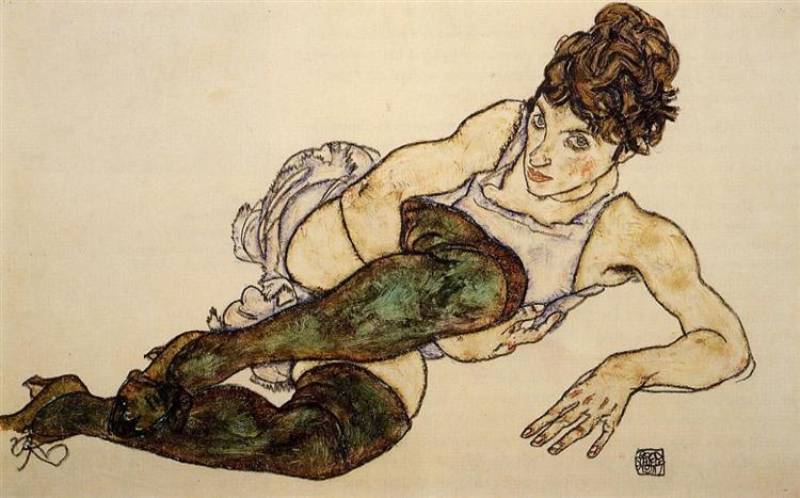
Egon Schiele painted this just one year before his death at age 28 during the Spanish Flu pandemic. By 1917, his style had matured. The raw, almost aggressive figure drawings of his earlier years had softened slightly, though his work remained provocative.
Schiele had been briefly imprisoned in 1912 over his depictions of young female models. That experience shaped him, but it didn’t stop him.
Visual Description
A woman reclines with her legs apart, wearing green stockings and little else. Her body is rendered with Schiele’s characteristic distortion: elongated limbs, angular poses, visible bones and tendons. The skin tones range from raw pinks to muted yellows.
Her expression is direct and unapologetic. This isn’t a passive figure being observed. She’s looking back.
Style and Technique
Gouache and black crayon on paper. Schiele’s contour lines are jagged and expressive, closer to expressionism than to the smooth, flowing curves typically associated with Art Nouveau. But his work grew out of the Vienna Secession, and the decorative elements in his backgrounds and the flattened spatial treatment connect him directly to that tradition.
Symbolism and Meaning
Schiele’s female figures challenge conventional ideas of beauty and propriety. The green stockings are both a decorative element and a signal of modernity. The open pose was deliberately confrontational for 1917 audiences.
His work sits at the transition point between Art Nouveau’s decorative idealism and expressionism’s psychological intensity.
Why It Matters
Schiele pushed the boundaries of what Art Nouveau could contain. His raw, psychologically charged figures brought a new kind of honesty to the movement. Along with Klimt, who was his mentor, Schiele defined what the Vienna Secession looked like at its most personal and uncomfortable.
He died in October 1918 at 28. Three days after his pregnant wife Edith died of the same flu. He left behind over 3,000 works on paper and around 300 paintings.
Where to See It
Private collection. Similar Schiele works from this period are held at the Leopold Museum in Vienna and the Albertina Museum.
FAQ on Famous Art Nouveau Paintings
What is Art Nouveau in painting?
Art Nouveau is a decorative style from roughly 1890 to 1910. It’s defined by flowing lines, organic forms, and floral motifs. Artists rejected historical styles and drew from nature, Japanese prints, and symbolism to create something entirely new.
Who are the most famous Art Nouveau painters?
Gustav Klimt, Alphonse Mucha, Henri de Toulouse-Lautrec, Aubrey Beardsley, and Egon Schiele are the most recognized. Klimt led the Vienna Secession. Mucha defined the poster art side of the movement. Each brought a different approach to the Art Nouveau style.
What is the most famous Art Nouveau painting?
The Kiss by Gustav Klimt (1907-1908) is widely considered the most iconic. Painted with oil and gold leaf during his golden phase, it hangs at the Belvedere Museum in Vienna and remains the single most reproduced Art Nouveau artwork globally.
What makes Art Nouveau different from other painting styles?
Art Nouveau rejected the rigid academic traditions that came before it. Unlike realism or neoclassicism, it focused on curvilinear design, decorative surfaces, and blurring the line between fine art and applied arts.
Where can I see famous Art Nouveau paintings in person?
Key locations include the Belvedere Museum and MAK in Vienna, the Mucha Foundation Art Museum in Prague, the Art Institute of Chicago, and the Musee d’Orsay in Paris. The Neue Galerie in New York holds Klimt’s Portrait of Adele Bloch-Bauer I.
Did Art Nouveau artists only paint?
No. Most worked across multiple disciplines. Mucha designed posters, jewelry, and furniture. Klimt created mosaics and murals. The movement valued unity between fine and decorative arts, so artists routinely worked in architecture, glass, and graphic design.
How did Art Nouveau influence modern art?
Art Nouveau opened the door for expressionism, futurism, and Art Deco. Its flat decorative patterns and rejection of academic rules gave later movements permission to experiment. Graphic design and advertising still borrow from Mucha’s compositions today.
Why did Art Nouveau artists use gold leaf?
Klimt popularized gold leaf after visiting Byzantine mosaics in Ravenna, Italy, in 1903. The technique connected his modern work to medieval and Byzantine traditions. It added a luminous, almost sacred quality to paintings like The Kiss and the Stoclet Frieze.
What is the difference between Art Nouveau and Art Deco?
Art Nouveau (1890-1910) favors organic, curving lines inspired by nature. Art Deco (1920s-1930s) uses geometric shapes, bold colors, and streamlined forms. Think flowing vines versus sharp zigzags. Art Deco was partly a reaction against Art Nouveau’s ornamentation.
Are Art Nouveau paintings valuable today?
Extremely. Klimt’s Portrait of Adele Bloch-Bauer I sold for $135 million in 2006. Mucha’s lithograph posters regularly sell for tens of thousands at auction. The movement’s popularity with collectors has only grown, making original works among the most expensive paintings on the market.
Conclusion
These famous Art Nouveau paintings represent a period when artists refused to separate beauty from function. Klimt’s golden phase works, Mucha’s lithograph posters, Beardsley’s ink illustrations, and Toulouse-Lautrec’s cabaret scenes each redefined what painting could look like between the 1890s and early 1900s.
The Vienna Secession and the Jugendstil movement gave artists permission to merge fine art with decorative design. That idea still shapes how we think about painting styles today.
What stands out most is how personal the work feels. Klimt painted love and loss with gold leaf. Mucha spent 18 years on a cycle about his people’s history. Schiele confronted audiences with raw psychological honesty.
These aren’t just fin de siecle relics. They’re still some of the most visited, most reproduced, and most emotionally direct paintings in any museum collection worldwide.