Some paintings don’t just hang on walls. They start revolutions, redefine identity, and force entire generations to see the world differently.
Famous Hispanic paintings have done exactly that. From the Spanish Golden Age to the Mexican muralism movement, Hispanic artists produced some of the most influential artwork in history. Picasso fractured reality with Cubism. Kahlo turned personal pain into cultural symbols. Goya painted war without flinching. Rivera put politics on public walls and dared the powerful to tear them down.
This guide covers the most iconic paintings by Hispanic and Latin American artists, including what makes each one significant, the techniques behind them, and where you can see them today.
Famous Hispanic Paintings That Shaped Art History
Guernica by Pablo Picasso, 1937

Historical Background
On April 26, 1937, German warplanes from the Condor Legion bombed the Basque town of Guernica during the Spanish Civil War. The attack lasted roughly two hours and destroyed most of the town.
Pablo Picasso was living in Paris at the time. He’d been loosely working on a commission for the Spanish Pavilion at the 1937 Paris International Exposition. But when news of the bombing broke, he scrapped his original concept and started painting Guernica just days later.
He finished it in about 35 days. And it changed everything.
Subject and Visual Description
The painting is massive. 3.49 meters tall and 7.76 meters wide, all oil on canvas. Picasso stripped away all color, working only in black, white, and grey. That choice gives it a raw, documentary feel, almost like a newspaper photograph.
A gored horse stumbles at the center. A bull looms on the left. A wailing mother clutches her dead child. Dismembered limbs scatter across the composition. A single bare light bulb burns overhead while a woman extends a lamp into the chaos.
Nothing about this scene is quiet.
Artistic Style and Techniques
Guernica is peak Cubism applied to political art. Picasso fragments every figure into angular, overlapping planes. The spatial arrangement feels deliberately disorienting, which mirrors the confusion of a bombing.
The monochromatic palette functions like grisaille, a technique used in classical painting that relies on shades of grey. Combined with the contrast between sharp whites and deep blacks, Picasso creates extreme visual tension without a single drop of color.
Cultural and Political Significance
This isn’t just a painting about one bombing. It became the single most recognized anti-war image in modern art history. Picasso refused to let it return to Spain as long as Franco remained in power.
It stayed at MoMA in New York for decades, and only went back to Spain in 1981, six years after Franco’s death. The painting directly influenced later famous war paintings and protest art worldwide.
Where to See It Today
Museo Nacional Centro de Arte Reina Sofia, Madrid, Spain.
Why It Matters in Hispanic Art
Guernica proved that Latin American and Spanish artists could produce work with global political impact. It’s the painting most people think of first when they hear “famous Hispanic paintings,” and for good reason. Picasso took personal grief and turned it into something universal.
The Two Fridas by Frida Kahlo, 1939

Historical Background
Frida Kahlo painted this double self-portrait in 1939, the same year she divorced Diego Rivera. It’s her largest work, measuring 173 x 173 cm, and it was created during what she described as one of the most painful periods of her life.
The painting was first shown at the International Surrealist Exhibition in Mexico City in January 1940. Andre Breton had labeled her work as surrealist two years earlier, though Kahlo pushed back against that classification.
Subject and Visual Description
Two versions of Frida sit side by side on a bench, holding hands. Both have their hearts exposed.
The Frida on the right wears a traditional Tehuana dress (the kind Rivera loved) and holds a small portrait of Diego as a child. The Frida on the left wears a European-style white lace dress. A blood vessel connects their two hearts, but the European Frida has cut her artery with surgical scissors. Blood drips onto her white skirt.
Behind them, a stormy sky. No comfort anywhere in the frame.
Artistic Style and Techniques
Kahlo was largely self-taught. Her style pulls from Mexican folk art traditions, pre-Columbian symbolism, and religious colonial imagery. The flat forms, bright colors, and direct frontal perspective all come from that tradition.
The fantastical elements, like exposed hearts and visible blood vessels, feel dreamlike. But Kahlo always insisted she painted her reality, not dreams.
Cultural and Political Significance
The Two Fridas is a statement about identity. The dual figures represent her mixed heritage: European (her father was German) and Mexican Indigenous (her mother’s side). It became a key work in feminist art and a symbol of cultural identity struggles across Latin America.
Kahlo received 4,000 pesos for it in 1947. The highest price she was ever paid during her lifetime.
Where to See It Today
Museo de Arte Moderno, Mexico City, Mexico.
Why It Matters in Hispanic Art
This painting made Frida Kahlo more than a self-portrait artist. It turned her into a cultural icon. Among Frida Kahlo’s famous paintings, The Two Fridas remains the most discussed and reproduced, a touchstone for Hispanic identity in art.
The Persistence of Memory by Salvador Dali, 1931

Historical Background
Salvador Dali painted this when he was just 27. The Surrealist movement was at its peak, and Dali had recently developed his “paranoiac-critical method,” a technique where he’d self-induce hallucinations to generate imagery for his work.
The painting was first shown at the Julien Levy Gallery in 1932. It sold for $250.
Subject and Visual Description
Three soft watches melt across a barren landscape. One drapes over a dead tree branch. Another slides off a rectangular platform. A third hangs from an amorphous, flesh-colored figure that looks like a distorted self-portrait of Dali himself.
A fourth watch, rigid and orange, sits face-down and crawling with ants. The cliffs in the background are the coast of Catalonia, Dali’s homeland.
The whole thing measures just 24.1 x 33 cm. Smaller than a sheet of printer paper. Yet it’s one of the most recognized images in modern art.
Artistic Style and Techniques
Dali called his works “hand-painted dream photographs.” The texture is precise and realistic, every shadow rendered with care, which makes the impossible subject matter even more unsettling.
This tension between technical realism and surreal content is what makes Dali’s approach so effective. The melting clocks look like they could melt that way. That’s the trick.
Cultural and Political Significance
The painting is widely read as a meditation on the fluidity of time, influenced by Einstein’s Theory of Relativity. It became the defining image of the Surrealist movement and helped push surrealist paintings into mainstream culture.
Dali himself claimed the melting watches were inspired by Camembert cheese melting in the sun. Whether that’s true or just Dali being Dali, who knows.
Where to See It Today
Museum of Modern Art (MoMA), New York City, USA.
Why It Matters in Hispanic Art
The Persistence of Memory showed the world that Hispanic artists weren’t confined to political murals or religious art. Dali proved a Spanish painter could define an entire international art movement. Among Salvador Dali’s famous paintings, this one remains his most iconic.
Las Meninas by Diego Velazquez, 1656

Historical Background
Diego Velazquez painted Las Meninas during the Spanish Golden Age while serving as court painter to King Philip IV. He’d held that position for nearly 40 years by this point. The painting was created in his studio inside the Royal Alcazar of Madrid.
It was originally called “La Familia” (The Family). The name “Las Meninas” (The Ladies-in-Waiting) wasn’t used until 1843.
Subject and Visual Description
Five-year-old Infanta Margaret Theresa stands at the center, flanked by her ladies-in-waiting, two dwarfs, and a large mastiff. Velazquez himself appears on the left, standing at a large canvas. In the background, a mirror reflects King Philip IV and Queen Mariana.
The oil on canvas measures 318 x 276 cm. The room is the Cuarto del Principe in the Alcazar, rendered with careful linear perspective leading to a single vanishing point at the open doorway in the back.
Artistic Style and Techniques
Velazquez used loose, almost impressionistic brushstrokes centuries before Impressionism existed. His handling of light through the room, the way it falls on the Infanta and fades toward the back wall, is considered some of the finest chiaroscuro work in Baroque painting.
The pictorial space plays tricks on the viewer. Who is Velazquez actually painting on that big canvas? Us? The king and queen? It’s a question art historians have debated for nearly 400 years.
Cultural and Political Significance
Baroque painter Luca Giordano called it “the theology of painting.” It’s considered one of the most analyzed works in Western art history. The complex layering of gazes and visual hierarchy challenges what a portrait can be.
Picasso later created 58 variations of Las Meninas in 1957 as a tribute.
Where to See It Today
Museo Nacional del Prado, Madrid, Spain.
Why It Matters in Hispanic Art
Las Meninas is the foundation stone. Before Picasso, before Kahlo, before Dali, there was Velazquez rewriting the rules of European painting from Madrid. Among famous Spanish paintings, this one sits at the very top.
The Third of May 1808 by Francisco Goya, 1814

Historical Background
In 1808, Napoleon invaded Spain. On May 2nd, civilians in Madrid revolted against French troops. The next day, French soldiers executed hundreds of suspected rebels near Principe Pio Hill.
Francisco Goya witnessed the war’s aftermath firsthand. Six years later, in 1814, he proposed painting two large canvases to commemorate the uprising. The Spanish government agreed.
Subject and Visual Description
A man in a bright white shirt throws his arms wide, facing a line of French soldiers with raised rifles. His pose echoes a crucifixion. Around him, other prisoners react differently. Some cover their faces. Some stare at the ground. A pile of bloodied corpses lies at their feet.
The oil on canvas measures 268 x 347 cm. A single lantern on the ground provides the only light source, creating brutal tenebrism that separates victims from executioners.
Artistic Style and Techniques
This painting broke with the Neoclassical tradition of depicting war heroes as dignified and bloodless. Goya’s brushwork is raw and expressive, closer to Expressionism than anything being painted in 1814.
The soldiers are faceless, a dehumanizing choice that makes them into a killing machine rather than individuals. Meanwhile, every victim’s face is unique and full of emotion.
Cultural and Political Significance
Art scholars often call this the first modern painting and the first modern depiction of war. It directly influenced Edouard Manet’s Execution of Emperor Maximilian and, later, Picasso’s Guernica.
Goya didn’t romanticize conflict. He showed its ugliness. That was new, and it changed how painters approached the subject forever.
Where to See It Today
Museo Nacional del Prado, Madrid, Spain.
Why It Matters in Hispanic Art
Goya bridged the gap between the Old Masters and modern art. The Third of May 1808 stands as one of the most powerful famous paintings of people in crisis, and it set the template for political art that Hispanic painters would follow for the next two centuries.
Man at the Crossroads by Diego Rivera, 1933

Historical Background
In 1932, the Rockefeller family commissioned Diego Rivera to create a mural for the lobby of the RCA Building at Rockefeller Center in New York. The theme was “Man at the Crossroads Looking with Hope and High Vision to the Choosing of a New and Better Future.”
Rivera was paid $21,000 for the project. The original fresco measured 63 by 17 feet.
It was destroyed before it was ever completed.
Subject and Visual Description
A worker stands at the center, controlling machinery. Four propeller-like shapes extend outward from him, depicting scenes of science, industry, and social life. Telescopes and microscopes frame cosmic and biological imagery.
On one side: wealthy society women playing cards. On the other: Vladimir Lenin holding hands with workers of different races. That’s where the trouble started.
Artistic Style and Techniques
Rivera worked in fresco, painting directly onto wet plaster. This meant the mural couldn’t be removed or relocated. His style combined Mexican muralism’s bold scale with social realist figuration.
The balance of the composition was deliberate: capitalism on one side, socialism on the other, with a worker controlling the future at the center. Every element served Rivera’s political vision.
Cultural and Political Significance
When Nelson Rockefeller asked Rivera to remove Lenin’s portrait, Rivera refused. He was fired, paid in full, and the mural was chiseled off the wall in February 1934.
Rivera recreated it at the Palacio de Bellas Artes in Mexico City under the new title “Man, Controller of the Universe.” In the new version, he added a portrait of Rockefeller’s father drinking in a nightclub. Revenge through art.
The incident became a defining moment for artistic freedom and one of the most famous clashes between wealth and creative expression in the 20th century.
Where to See It Today
The original was destroyed. The recreation is at Palacio de Bellas Artes, Mexico City, Mexico.
Why It Matters in Hispanic Art
Man at the Crossroads proved that Mexican muralism was not just local art. It was powerful enough to threaten one of the wealthiest families in America. Rivera’s stand became a symbol of artistic integrity across Latin America, and his role in the Mexican Muralist Movement shaped Diego Rivera’s most famous paintings for decades after.
The Harlequin’s Carnival by Joan Miro, 1925

Historical Background
Joan Miro painted The Harlequin’s Carnival in his Paris studio between 1924 and 1925. He was broke at the time, barely eating. In interviews, he later said the hallucinations from hunger partly inspired the imagery.
The painting was shown at the Peinture Surrealiste exhibition in Paris in 1925, Miro’s first major group show with the Surrealists. It launched his career.
Subject and Visual Description
The scene bursts with bizarre, playful creatures. A guitar-playing figure with a round head and mustache. Insects, fish, cats, ladders, and musical notes all float in a confined room. An ear pops out of nowhere. A globe sits on a table. Everything vibrates with movement.
The oil on canvas measures 66 x 90.5 cm. Despite the chaos, every element is placed with care.
Artistic Style and Techniques
Miro blended Surrealism with a childlike visual language. The lines are thin and whimsical. The shapes are biomorphic, halfway between recognizable objects and pure invention.
The whole composition fights against emptiness. There’s barely a blank spot on the canvas. Miro called this approach automatism, letting the unconscious mind guide the brush.
Cultural and Political Significance
Miro was fiercely Catalan. He ensured much of his work stayed in Barcelona. The Harlequin’s Carnival helped define a lighter, more playful branch of Surrealism that contrasted with Dali’s heavier, more precise approach.
Where to See It Today
Albright-Knox Art Gallery, Buffalo, New York, USA.
Why It Matters in Hispanic Art
Miro showed that Hispanic art could be joyful and strange at the same time. His influence on famous abstract paintings and later abstract art is hard to overstate. Without Miro, the playful side of modern art would look completely different.
Self-Portrait with Thorn Necklace and Hummingbird by Frida Kahlo, 1940

Historical Background
Kahlo painted this self-portrait in 1940, just one year after completing The Two Fridas and during the same period of her divorce from Diego Rivera. They would remarry later that year, but the emotional weight of this painting is unmistakable.
Subject and Visual Description
Kahlo faces the viewer directly, wearing a thorn necklace that digs into her neck and draws blood. A dead hummingbird hangs from the necklace like a pendant. A black cat crouches on one shoulder, and a monkey sits on the other, pulling at the thorns.
Behind her, large green leaves fill the background, creating a jungle-like setting. Butterflies rest in her hair.
Artistic Style and Techniques
Like most of Kahlo’s self-portraits, the focal point is her face. The flat, folk art-influenced style uses vivid hues and minimal shading. Each animal and object carries symbolic weight rooted in Mexican indigenous culture and Catholic imagery.
The thorns reference Christ’s crown of thorns. The dead hummingbird, in Mexican folk tradition, is a good luck charm for finding love.
Cultural and Political Significance
This painting has become one of the most reproduced images in 20th-century art. It encapsulates Kahlo’s ability to turn personal suffering into powerful visual storytelling. The blend of Catholic and pre-Columbian symbols makes it deeply rooted in Mexican cultural identity.
Where to See It Today
Harry Ransom Center, University of Texas at Austin, USA.
Why It Matters in Hispanic Art
This self-portrait captures everything people associate with Kahlo: pain, beauty, defiance, and cultural pride. It remains one of the most widely recognized famous portrait paintings by any artist, Hispanic or otherwise.
The Man of Fire by Jose Clemente Orozco, 1939
Historical Background
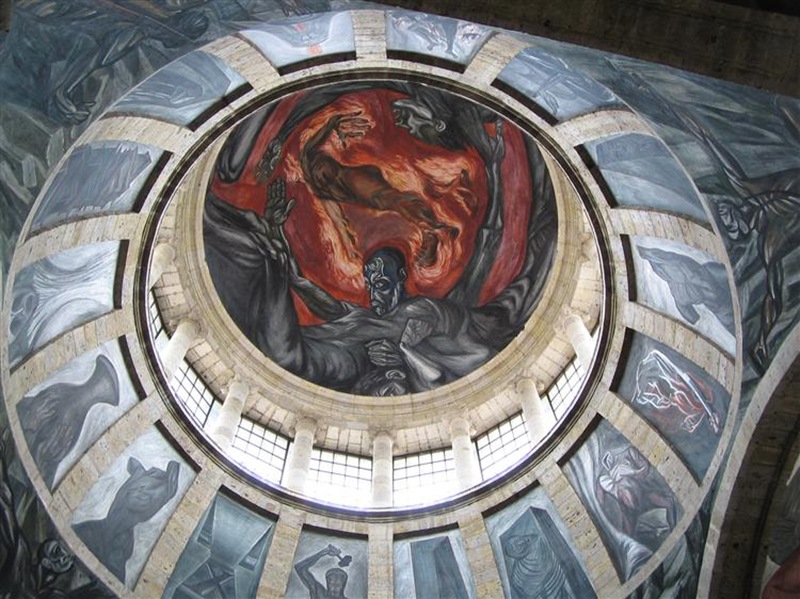
Jose Clemente Orozco painted The Man of Fire (El Hombre de Fuego) in 1939 on the dome of the Hospicio Cabanas in Guadalajara, Mexico. Orozco was one of the “Big Three” Mexican muralists, alongside Diego Rivera and David Alfaro Siqueiros.
The Hospicio Cabanas, originally an orphanage built in the early 1800s, became Orozco’s largest and most ambitious canvas.
Subject and Visual Description
A human figure engulfed in flames rises through the center of the dome. The figure references the Greek myth of Prometheus, who stole fire from the gods to give to humanity. The composition has a 36-foot diameter.
Surrounding the central figure, Orozco painted 57 additional frescoes throughout the building’s vaults and walls, covering themes of conquest, mechanization, and the human condition.
Artistic Style and Techniques
Orozco worked in fresco, applying pigment directly to wet plaster. His style is more angular and aggressive than Rivera’s. The value contrasts are extreme, with deep shadows and hot orange-red highlights that make the figure appear to truly burn.
The foreshortening of the central body, visible from below when standing inside the dome, creates a powerful three-dimensional effect.
Cultural and Political Significance
Social injustice and the liberation of the working class were constant themes in Orozco’s murals. The Man of Fire is a symbol of human progress through sacrifice. It’s considered the crown jewel of Mexican muralism.
The Hospicio Cabanas became a UNESCO World Heritage Site in 1997, largely because of Orozco’s work there.
Where to See It Today
Instituto Cultural Cabanas (formerly Hospicio Cabanas), Guadalajara, Mexico.
Why It Matters in Hispanic Art
Orozco doesn’t get the same mainstream attention as Rivera or Kahlo, but many art historians consider his Cabanas murals to be technically superior. The Man of Fire stands as proof that the Mexican mural movement produced more than just political posters. It produced masterpieces.
Swan Reflecting Elephants by Salvador Dali, 1937

Historical Background
Dali painted Swan Reflecting Elephants in 1937, the same year Picasso completed Guernica. While Picasso responded to the Spanish Civil War directly, Dali was pushing further into surrealist optical illusions and double images.
Subject and Visual Description
Three swans float on a glassy lake. Their reflections in the water, though, are not swans. The reflected shapes form elephants with elongated legs, a recurring motif in Dali’s work. Dead, leafless trees surround the lake in a barren canyon landscape.
The oil painting plays with tonal shifts between the real and reflected worlds. Look at it one way, and it’s swans. Turn it upside down, and elephants emerge.
Artistic Style and Techniques
This is Dali’s “paranoiac-critical method” at its finest. He built double images where two completely different subjects occupy the same space. The technical precision is extraordinary, every reflection measured to create the illusion.
The color contrast between the warm, sunlit foreground and the cooler reflected tones adds to the dreamlike quality.
Cultural and Political Significance
While less overtly political than some of his contemporaries’ work, Swan Reflecting Elephants represents the height of Surrealist visual innovation. It pushed the boundaries of what painting could do as an optical experience.
Where to See It Today
The Cavalier Ketchum Collection (private collection). It has been exhibited at various galleries over the years.
Why It Matters in Hispanic Art
This painting is a reminder that Hispanic art isn’t all politics and pain. Sometimes it’s pure visual brilliance, the kind of thing that makes you stand in front of a canvas and question what your eyes are actually seeing. Dali pushed art into territory that still feels fresh almost 90 years later.
FAQ on Famous Hispanic Paintings
What is the most famous Hispanic painting?
Guernica by Pablo Picasso is widely considered the most famous Hispanic painting. Created in 1937 during the Spanish Civil War, this Cubist masterpiece is housed at the Museo Reina Sofia in Madrid and remains the most recognized anti-war artwork ever made.
Who are the most famous Hispanic painters?
The most recognized include Pablo Picasso, Frida Kahlo, Salvador Dali, Diego Rivera, Francisco Goya, Diego Velazquez, Joan Miro, and Jose Clemente Orozco. They span centuries of art history, from the Spanish Golden Age to modern Latin American art.
What painting styles did Hispanic artists use?
Hispanic artists worked across many styles including Baroque, Cubism, Surrealism, Realism, and Mexican muralism. Velazquez pioneered loose brushwork centuries before Impressionism. Picasso co-founded Cubism. Dali became the face of the Surrealist movement.
Where can I see famous Hispanic paintings in person?
Key locations include the Museo del Prado in Madrid, Museo Reina Sofia in Madrid, MoMA in New York, Museo de Arte Moderno in Mexico City, and the Palacio de Bellas Artes in Mexico City. Most major museums hold Hispanic works.
Why is Frida Kahlo’s art so famous?
Kahlo’s self-portraits blend Mexican folk art, pre-Columbian symbolism, and raw personal emotion. Her work explores identity, pain, and cultural heritage. Paintings like The Two Fridas became global icons of feminist and Latin American art.
What makes Mexican muralism important in art history?
Mexican muralism brought art to public spaces. Diego Rivera, Jose Clemente Orozco, and David Alfaro Siqueiros painted large-scale frescoes addressing social injustice, indigenous heritage, and political struggle. The movement influenced public art worldwide.
What is the most expensive Hispanic painting ever sold?
Picasso’s Les Femmes d’Alger (Version “O”) sold for $179.4 million in 2015 at Christie’s. Several other Picasso works also rank among the most expensive paintings in the world, consistently setting auction records.
Did Hispanic artists influence modern art?
Absolutely. Picasso’s Cubism reshaped 20th-century painting. Dali defined Surrealism visually. Velazquez’s brushwork influenced the Impressionists. Goya’s raw depictions of war set the template for Expressionism. Hispanic artists built the foundations of modern art.
What is the difference between Spanish and Latin American art?
Spanish art refers to work from Spain, rooted in European traditions like Baroque and Renaissance painting. Latin American art draws from indigenous, African, and colonial influences. Both fall under the broader category of Hispanic art.
Are there famous Hispanic paintings by women artists?
Yes. Frida Kahlo is the most well-known, but Remedios Varo produced significant Surrealist work in Mexico. Contemporary Hispanic women artists like Ana Mendieta and Doris Salcedo have also gained international recognition through painting, sculpture, and installation art.
Conclusion
Famous Hispanic paintings are more than museum pieces. They reshaped how the world understands art, politics, and cultural identity.
Velazquez challenged portraiture during the Baroque period. Goya documented the horrors of conflict with unflinching honesty. Picasso broke visual language apart and rebuilt it. Kahlo and Rivera turned personal and national struggles into oil on canvas masterworks that still resonate today.
These paintings span centuries, from 17th-century Madrid to 20th-century Mexico City. They cross every major art movement. And they prove that Hispanic artists didn’t just participate in art history. They defined large parts of it.
Whether you’re studying Latin American art or just looking for your next gallery visit, these works deserve a closer look. Start with one. You won’t stop there.