Geoff McFetridge is a Canadian contemporary artist and graphic designer who bridges the gap between fine art and commercial design. His visual language strips human experience down to flat geometric forms, matte colors, and clean contours.
Working primarily in acrylic on canvas, McFetridge creates paintings that function like logos for human emotion. His figures float against solid backgrounds, sometimes melting into each other, sometimes leaping across heads like stepping stones.
Born in 1971, he emerged from the West Coast skateboard scene of the 1980s and has since become one of the most influential visual communicators of his generation. His work appears everywhere. Apple Watch faces. Spike Jonze films. Nike shoes. Gallery walls in Copenhagen, Tokyo, and New York.
Identity Snapshot
Full Name: Geoffrey McFetridge
Also Known As: Geoff McFetridge
Lifespan: 1971 – present
Primary Roles: Painter, Graphic Designer, Illustrator, Animator, Art Director
Nationality: Canadian (Chinese-Canadian heritage)
Movements: Post-contemporary, Beautiful Losers, West Coast Design
Mediums: Acrylic on canvas, gouache on paper, acrylic on aluminum, pencil on vellum
Signature Traits: Flat color planes, matte finish, simplified human figures, clean contour lines, geometric reduction
Iconography/Motifs: Human figures, hands, geometric shapes, interconnected bodies, looping strings
Geographic Anchors: Calgary (birthplace), Los Angeles (studio), Atwater Village neighborhood
Studio: Champion Graphics / Champion Studio
Education: BFA from Alberta College of Art and Design (1993), MFA from California Institute of the Arts (1995)
Major Awards: Cooper-Hewitt Smithsonian National Design Award (2016), AIGA Medal (2019)
Key Collections/Museums: MoCA Los Angeles, Walker Art Center, Yale University Art Museum, Vancouver Art Gallery, Santa Monica Museum of Art
Market Signals: Auction record $16,510 for “The Shape of Sleep” at Phillips New York (2024)
What Sets Geoff McFetridge Apart
His paintings look like they could be advertisements for something you cannot buy.
That is the trick. McFetridge borrows the visual economy of corporate logos and applies it to abstract emotional states. “My paintings are as rooted in logos as they are in art history,” he has said.
Where most contemporary painters add complexity, McFetridge subtracts. His figures have no faces, no individual features. They exist as silhouettes in grays, blues, whites, and pinks against flat tonal backgrounds.
The result sits somewhere between a 1970s transit poster and a meditation on human connection. Unlike Andy Warhol‘s appropriation of consumer imagery or Keith Haring‘s graffiti-influenced outlines, McFetridge’s work feels quieter. More internal.
He competes with no one and copies nothing. That is what makes him hard to place and impossible to ignore.

Origins and Formation
Early Years in Calgary
McFetridge grew up in a Chinese-Canadian family in Calgary, Canada. He spent his days skateboarding. His nights drawing.
The skateboard culture of the 1980s shaped everything. Surfing was “cool-guy culture,” and he dressed like a surfer before ever touching a board. Graphics on decks and t-shirts became his first design education.
Art School Training
He earned his BFA from the Alberta College of Art and Design in 1993.
Two years later, he completed his MFA in Graphic Design at the California Institute of the Arts. CalArts changed how he thought. “Everything that matters is what something looks like,” he believed before arriving. The school replied: “No, all we care about is how you think.”
That tension between concept and craft defines his practice to this day.
Move to Los Angeles
The move to L.A. was not just about art school. It was about weather, surfing, skateboarding, and a different pace.
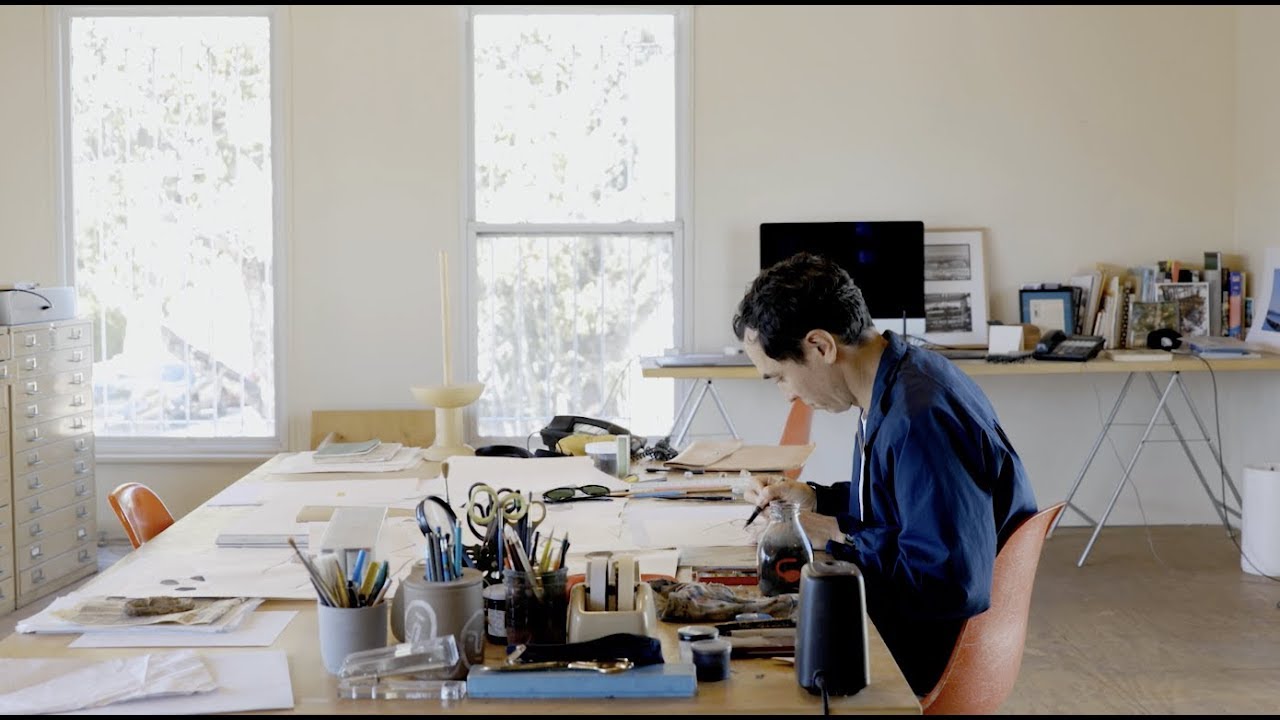
He settled in the Atwater Village neighborhood, where he still maintains a light-filled studio. Stacks of sketchbooks, over five feet tall, line the shelves.
First Professional Work
While still freelancing for skateboard brands, McFetridge landed a job as art director for Grand Royal magazine, the Beastie Boys’ publication. He did not work in their offices. He rented a rotting storefront across the street.
Around this time, he began designing graphics for Sofia Coppola’s fashion line Milk Fed, which led to his first film title sequence for The Virgin Suicides in 1999.
Movement and Context
Beautiful Losers Connection
McFetridge was part of the Beautiful Losers exhibition, which premiered in downtown New York in 1991 and toured internationally. The show documented West Coast skate art and design culture.
Aaron Rose curated it. Ed Templeton, Barry McGee, and other skater-artists appeared alongside McFetridge. The 2008 documentary of the same name featured his work.
Comparative Position
Against Julian Opie, McFetridge’s figures feel warmer. Opie’s portraits reduce faces to geometric formulas. McFetridge’s silhouettes suggest community rather than isolation.
Compared to KAWS, his palette runs cooler. Where KAWS uses bold primaries and cartoon references, McFetridge sticks to muted tones and faceless forms.
Next to Alex Katz, who also flattens figures against solid backgrounds, McFetridge strips away even more. No portraits. No specific identities. Just bodies in relationship to each other and to shape.
Design Versus Art

He refuses the boundary. “Design language, which has a relationship with abstraction, is very accessible to me,” he has explained.
His paintings borrow from urban signage, transit maps, and corporate identity systems. But they communicate something that cannot be sold.
Materials, Techniques, and Process
Supports and Grounds
McFetridge works primarily on canvas, both raw and gessoed. He also uses aluminum panels, wood, and vellum paper for drawings.
The choice depends on the project. Aluminum creates a different surface tension than raw canvas.
Paint and Application
Acrylic paint is his primary medium. Gouache appears in smaller works on paper.
He applies paint in flat, matte layers. No visible brushwork. No texture. The surface reads as smooth and mechanical, even though everything is done by hand.
Drawing Process
Every painting begins as a drawing. Then another drawing. Then another.
“One thing leading to the next to the next to the next,” he describes. His sketchbooks show slight progressions between each panel. Sometimes a tiny detail changes. Sometimes a major concept shifts.
He scans drawings and works on them digitally before returning to canvas. “The paintings are done in a process of putting pieces together, like a puzzle.”
Palette Archetype
Grays, blues, whites, and pinks dominate. Occasionally warm earth tones or muted oranges appear.
The color choices feel deliberate but not loud. They suggest calm rather than excitement. The limited palette connects to his design background, where restraint signals sophistication.
Studio Practice
McFetridge’s studio sits in Atwater Village, Los Angeles. He works alone most days.
He is an ultra-marathon runner. By mile 40, he says, his head disappears. The same thing happens when drawing. Hand moves without thought.
Themes, Subjects, and Iconography
Human Figures
Bodies without faces. Silhouettes in solid colors. People leaning on each other, melting together, or floating in empty space.
McFetridge’s figures represent the collective rather than the individual. They suggest social mechanisms, community, and interdependence.
Geometric Forms
Circles, rectangles, and organic shapes appear as objects that figures interact with. Sometimes people hold them. Sometimes they become them.
Titles like “Us Experiencing Geometry” and “Experiencing a Hexagon” make the relationship explicit.
Looping Strings
Thread or string weaves through many compositions. It loops through fingers, connects bodies, passes between geometric forms.
This motif speaks to interconnectedness. Thought made visible. Relationship made physical.
Hands
Isolated hands appear in patterned formations. They grasp, point, and hold invisible things.
The hand represents agency without identity. Action without face.
Conceptual Approach
“It should feel like something, rather than look like something,” McFetridge has said.
His paintings aim for emotional resonance through visual reduction. The composition works like a sentence. Simple. Direct. Complete.
Notable Works
The Shape of Sleep

Medium: Acrylic on canvas
Current Location: Private collection (sold at Phillips New York, 2024)
Visual Signature: Flat color planes, simplified human form, matte surface
Why It Matters: Achieved auction record of $16,510, confirming market interest in McFetridge’s fine art practice separate from commercial work
A Positive Future Built of Incremental Change (2019)

Dimensions: 85.3 x 73.6 inches
Medium: Acrylic on gessoed canvas
Location: Exhibited at Cooper Cole, Toronto
Visual Signature: Large scale, interconnected figures, muted palette
Why It Matters: Title reflects McFetridge’s philosophical approach to collective human progress
Us Experiencing Geometry (2019)

Dimensions: 51.3 x 40.5 inches
Medium: Acrylic on raw canvas
Visual Signature: Figures interacting with geometric shapes
Why It Matters: Crystallizes his ongoing investigation of form and feeling
Us as a Measure of Openness
Location: LA Metro public art installation
Medium: Large-scale mural
Visual Signature: Bold flat colors, communities interacting with abstract shapes
Why It Matters: Demonstrates translation of gallery practice to public space
Her Interface Design (2013)
Medium: Digital, screen graphics
Client: Spike Jonze film Her
Visual Signature: Flat design, warm colors, hand-drawn feeling in digital interface
Why It Matters: Anticipated flat design trend in technology. Credited as “Graphical Futurist” on the film.
Exhibitions, Collections, and Provenance
Key Gallery Exhibitions
The Organic Interface, V1 Gallery, Copenhagen (2023)
Nature Mart, Cooper Cole, Toronto (2023)
Rust Drinkers, Louis Buhl & Co., Detroit (2022)
It’s Weird to Disappear, V1 Gallery, Copenhagen (2021)
Outside Experience, Half Gallery, New York (2024)
It Looks Like It Says, Joshua Liner Gallery, New York (2015)
Museum Exhibitions
Walker Art Center, Minneapolis
Vancouver Art Gallery, Vancouver
Yale University Art Museum, New Haven
Contemporary Calgary, Calgary
The Geffen Contemporary at MoCA, Los Angeles
Santa Monica Museum of Art, Santa Monica
Major Galleries

V1 Gallery (Copenhagen), Cooper Cole (Toronto), Half Gallery (New York), Gallery Target (Tokyo), PlayMountain (Tokyo), Heath Gallery (Los Angeles), Louis Buhl & Co. (Detroit)
Public Collections
Work appears in permanent collections at several institutions including the Cooper Hewitt, Smithsonian Design Museum.
Market and Reception
Auction Performance
Prices range from $121 to $16,510 depending on medium and size.
Record sale: “The Shape of Sleep” at Phillips New York in 2024.
Critical Reception
The 2023 documentary Geoff McFetridge: Drawing a Life by Dan Covert received critical acclaim at SXSW. Spike Jonze served as executive producer.
Sofia Coppola and other collaborators appear in the film, describing his influence on contemporary visual communication.
Design Awards
2016: Cooper-Hewitt Smithsonian National Design Award in Communications Design
2019: AIGA Medal
Multiple D&AD Awards for animation, design, and art direction (2001-2015)
Influence and Legacy
Upstream Influences
Skateboard graphics of the 1980s shaped his early visual vocabulary.
Matisse appears in his work through simplified forms and bold color relationships. His 2018 exhibition “Tables, Pots & Plants – A Song for Matisse” made the connection explicit.
s advertising and transit design inform his flat, poster-like compositions.
Downstream Influences
His interface design for Her predicted and shaped the flat design movement in technology that Apple adopted in iOS 7.
Younger illustrators working in reduced palettes and simplified figures often cite his work as foundational.
The Beautiful Losers movement, which he helped define, influenced how galleries and institutions think about skateboard culture as fine art.
Cross-Domain Impact
Film: Title sequences for Sofia Coppola and Spike Jonze films (The Virgin Suicides, Adaptation, Her, Where the Wild Things Are)
Technology: Apple Watch faces, interface design
Fashion: Collaborations with Hermes, Vans, Patagonia
Architecture: Murals for LA Metro, SOFI Stadium, Ottawa subway, The Standard Hotel
How to Recognize a Geoff McFetridge at a Glance

Flat color planes with no visible brushwork or gradation
Matte surface finish that reads as smooth and mechanical
Simplified human figures without facial features
Palette of grays, blues, whites, and pinks with occasional earth tones
Figures interacting with geometric shapes or each other
Clean contour lines defining silhouettes
Solid, unmodulated backgrounds in single colors
Looping string or thread connecting elements
Philosophical or conceptual titles that add meaning (e.g., “A Positive Future Built of Incremental Change”)
Hands in isolation appearing as repeated motifs
Canvas sizes typically ranging from 30×26 inches to 85×73 inches
Acrylic on canvas, raw canvas, or aluminum as primary supports
FAQ on Geoff McFetridge
Who is Geoff McFetridge?
Geoff McFetridge is a Canadian contemporary artist and graphic designer born in Calgary in 1971. He works across painting, illustration, animation, and commercial design. His Los Angeles-based studio, Champion Graphics, has produced work for major brands and filmmakers.
What is Geoff McFetridge known for?
He is known for minimalist paintings featuring flat color planes and simplified human figures. His commercial work includes title sequences for Spike Jonze films and Apple Watch face designs. The Beautiful Losers exhibition helped establish his reputation.
What painting style does Geoff McFetridge use?
McFetridge uses a graphic, flat style with matte surfaces and clean contour lines. His work sits between minimalism and figurative art. Bold color palettes of grays, blues, whites, and pinks dominate his canvases.
What films has Geoff McFetridge worked on?
He designed title sequences for The Virgin Suicides, Adaptation, Where the Wild Things Are, and Her. For Her, he served as “Graphical Futurist,” creating all computer interfaces and screen graphics. Sofia Coppola and Spike Jonze are frequent collaborators.
What is Champion Graphics?
Champion Graphics is McFetridge’s design studio in Los Angeles. Founded after his CalArts graduation, it handles commercial projects including brand identity, film graphics, and animation. The studio has worked with Nike, Patagonia, Apple, and Hermes.
Where did Geoff McFetridge study art?
He earned his BFA from Alberta College of Art and Design in Calgary. His MFA in Graphic Design came from California Institute of the Arts in 1995. CalArts shifted his focus from aesthetics to conceptual thinking.
What awards has Geoff McFetridge won?
He received the Cooper-Hewitt Smithsonian National Design Award in 2016. The AIGA Medal followed in 2019. Multiple D&AD Awards recognize his animation and design work spanning two decades of commercial practice.
What brands has Geoff McFetridge collaborated with?
Major collaborations include Nike, Vans, Patagonia, Burton Snowboards, Apple, Pepsi, and Hermes. He art-directed Grand Royal magazine for the Beastie Boys. Pattern and textile work extends to fashion and product design.
Where can you see Geoff McFetridge’s art?
His work appears at V1 Gallery in Copenhagen, Cooper Cole in Toronto, and Half Gallery in New York. Museum exhibitions include MoCA Los Angeles, Walker Art Center, and Yale University Art Museum. Public murals exist at LA Metro stations.
What themes appear in Geoff McFetridge’s paintings?
Human connection and collective experience dominate. Figures without faces lean on each other or melt together. Geometric shapes and looping strings suggest unity and interdependence. His conceptual titles add philosophical layers to visual simplicity.
Conclusion
Geoff McFetridge proves that the line between commercial illustration and fine art painting does not have to exist. His work at Champion Graphics and in gallery exhibitions shares the same visual language.
From skateboard graphics in Calgary to title sequences in Hollywood, his creative process has stayed consistent. Draw, refine, repeat.
The Cooper-Hewitt award and AIGA Medal confirm what the art world already knew. This Los Angeles artist turned line and form into something that communicates before you even know what you are looking at.