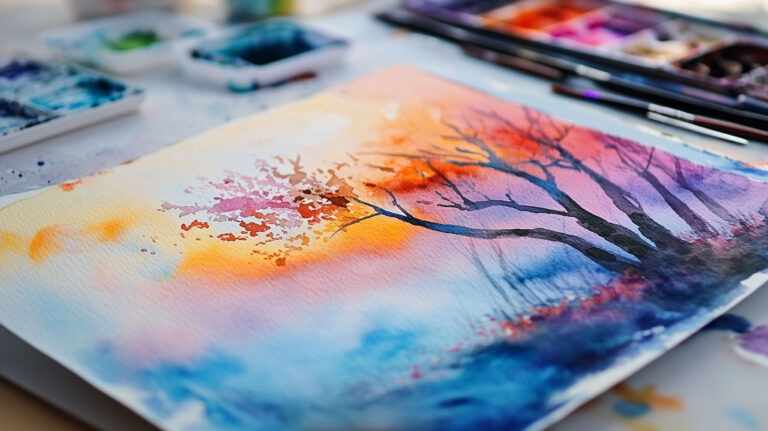
Not all watercolor paints are the same, and picking the wrong format can make a genuinely good technique feel broken.
The types of watercolor paints available today range from compressed pan sets and moist tubes to liquid concentrates, watercolor pencils, and small-batch handmade colors. Each one handles differently on paper, suits different techniques, and comes with real trade-offs worth understanding before spending money.
This guide covers the full range: what separates student grade from artist grade, how paint format affects pigment load and consistency, and how to match your paint type to your paper surface and working method.
By the end, you’ll know exactly which format fits your practice.
What Are Watercolor Paints

Watercolor paint is pigment suspended in a water-soluble binder, most commonly gum arabic. Add water, and the binder releases the pigment onto paper. That’s the whole mechanism.
Transparency is the defining trait. Unlike oil or acrylic, watercolor relies on the white of the paper showing through the paint layers to create luminosity. Remove that transparency and you’ve got gouache, not watercolor.
The binder-to-pigment ratio is what separates a flat, chalky wash from a rich, glowing one. Higher pigment concentration means more intensity with less paint. Lower concentration means more water is needed, which can reduce color saturation and lift more easily when dry.
Watercolor sits within a broader family of painting mediums that includes oil, acrylic, gouache, and tempera. What sets it apart is the combination of water solubility, transparency, and the way pigment particles interact with paper fiber during drying.
One thing most beginners don’t realize: the same pigment behaves differently depending on its format. A cadmium yellow in a pan, in a tube, and in liquid form can look and handle quite differently, even from the same brand.
The global watercolor paint market was valued at approximately $4.8 billion in 2024, according to Exactitude Consultancy, reflecting how widely used this medium has become across professional, student, and hobbyist segments.
Pans vs. Tubes
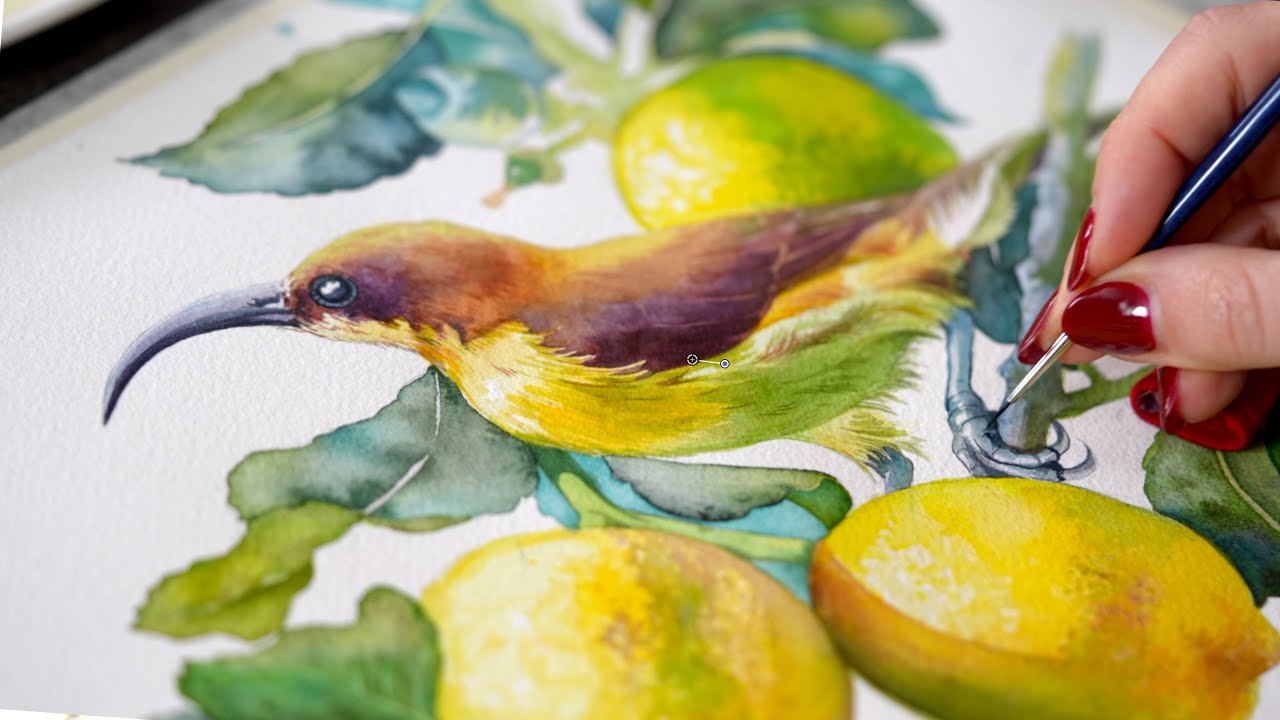
These are the two formats most painters work with. The choice affects how you set up, how much paint you use, and what techniques are practical.
Pan Paints
Compressed, dry cakes of pigment that activate with a wet brush. Half pans measure roughly 19mm x 13mm. Full pans are double that size.
- Portable and ready to use with no setup
- Slower to load onto a brush than tube paint
- Better suited for fine detail and controlled washes
- Popular for en plein air painting where compactness matters
The main limitation with pans is loading large amounts of pigment quickly. Wet-on-wet work with big washes gets tricky when you’re scrubbing a brush over a tiny cake trying to pick up enough color.
Tube Paints

Moist, concentrated paint in metal tubes. Squeeze a small amount onto a palette, add water, and you’ve got instant, high-pigment color.
Better for large washes and wet-on-wet technique. The paint activates immediately without the re-wetting time pans require. Most studio painters prefer tubes for exactly this reason.
One practical note: tube paint left to dry in a palette pan behaves almost identically to commercial pan paint. Many artists buy tubes specifically to fill empty pans and build a custom palette.
| Format | Best For | Main Drawback |
|---|---|---|
| Half Pans | Travel & Detail: Perfectly suited for urban sketching, field notes, and precision painting. | Efficiency: It is difficult to load a large brush with enough pigment for a massive, uniform wash. |
| Full Pans | Studio Versatility: Offers a larger surface area for medium-sized brushes while remaining “set.” | Portability: Sets become significantly heavier and bulkier than their half-pan counterparts. |
| Tubes | Large Washes: The only real choice for “juicy” wet-on-wet techniques and large-scale studio work. | Waste Potential: Pigment can dry out on the palette or be wasted if too much is squeezed out at once. |
Cost-per-use tends to favor tubes for studio work. You use less paint to achieve the same saturation compared to constantly scrubbing at a dried pan.
Student Grade vs. Artist Grade
The quality split in watercolor is real and it matters. This isn’t just marketing language.
What the Grades Actually Mean
Pigment load is the core difference. Artist grade paints contain significantly higher concentrations of pure pigment, often twice the amount found in student grade equivalents, according to Sennelier’s published formulation data.
Student grade paints compensate for lower pigment content by adding fillers and extenders. The colors work, but they appear flatter, mix less cleanly, and in many cases fade faster because the pigments used are less lightfast.
Artist grade paints carry ASTM lightfastness ratings, usually printed on the label as I (excellent) or II (very good). Many student grade colors skip this entirely or use pigments rated III and below.
Brand Examples
Winsor and Newton’s Cotman range is the most recognized student grade line. Their Professional Watercolour sits at the artist grade tier. The pigment count per color is noticeably different between the two, and the mixing behavior reflects that gap.
Daniel Smith Extra Fine Watercolors is a strong artist grade choice, particularly for its range of granulating pigments and mineral-based colors. Schmincke Horadam is another benchmark brand at the professional tier, known for consistency across its full range.
- Student grade: single price point for all colors, 30-60 color range, fillers present
- Artist grade: tiered pricing by pigment cost, 100+ color ranges, minimal fillers
The tiered pricing in artist grade exists because rare pigments cost more to source. Cobalt blue costs more than phthalo blue. That difference gets passed on directly in series pricing.
Worth saying plainly: starting on student grade is fine. But upgrading to artist grade tends to change how people experience the medium. The paint simply responds differently.
Liquid Watercolors
Liquid watercolor is pre-dissolved pigment or dye in water. No re-wetting, no scrubbing. Open the bottle, dilute if needed, paint.
The dye vs. pigment distinction matters a lot here. Most liquid watercolors on the market are dye-based, which means brilliant color but poor lightfastness. They’ll fade significantly with UV exposure. Not a good choice for work meant to last.
Dr. Ph. Martin’s Hydrus is the notable exception. It uses genuine pigments rather than dyes, making it one of the few liquid watercolor options that holds up long-term. Ecoline by Royal Talens is popular for illustration and design work but is dye-based, so it’s better suited to reproduction work than original fine art.
| Type | Example Brands | Lightfastness | Best Use |
|---|---|---|---|
| Dye-Based Liquid | Ecoline, Dr. Ph. Martin’s Radiant | Poor: Prone to fading when exposed to UV light over time. | Digital reproduction, graphic design, and fashion illustration. |
| Pigment-Based Liquid | Dr. Ph. Martin’s Hydrus | Good: Uses fine ground minerals; archival and resistant to fading. | Fine art, calligraphy, and professional airbrushing. |
Liquid watercolors dry faster on paper than pan or tube equivalents. That speed is useful for tight deadlines and for illustration workflows, but it reduces the window for wet-on-wet blending.
One practical advantage: consistent color with every brushstroke. Mixing in a palette introduces variation. Liquid color straight from the bottle gives a uniform, repeatable hue, which matters a lot in commercial illustration and lettering work.
Watercolor Pencils and Sticks
Both are dry watercolor formats that activate when wet. They occupy a space between drawing tools and paint, which makes them genuinely useful in specific workflows rather than just gimmicks.
Watercolor Pencils
Dry drawing tool first, paint second. Draw on dry paper, wet the marks with a brush, and the pigment dissolves into a wash. Or wet the paper first and draw directly for immediate blending.
Faber-Castell Albrecht Durer and Caran d’Ache Museum Aquarelle are the benchmarks. Both use genuine watercolor pigments rather than inferior dye-based cores, which is why they’re pricier than most craft-store alternatives.
These work well for:
- Fine detail over dried washes (line work that won’t dissolve)
- Quick location sketches that can be activated later
- Mixed media work alongside traditional watercolor painting
Watercolor Sticks
Solid pigment in stick form, essentially pan paint compressed into a crayon shape. Wet the tip, draw directly on paper, or use them dry and blend with a wet brush afterward.
Less precise than pencils. Better for broad color application and gestural marks. Daniel Smith makes a well-regarded version using the same pigment formulations as their tube paints.
The real limitation of both formats compared to traditional tubes or pans is control over water ratio. With a brush and palette, water content is adjustable at every stage. With pencils and sticks, the dissolved pigment concentration depends on how wet the paper or brush is, which takes time to calibrate.
Transparent vs. Opaque Watercolors
Not all watercolor pigments behave the same on paper. Transparency is a property of the pigment itself, not just how much water you add.
Pigment particle size and mineral content determine opacity. Fine organic pigments tend to be transparent. Earth pigments and heavy mineral pigments, like cerulean blue or Naples yellow, are naturally more opaque. Diluting an opaque pigment with water doesn’t make it transparent. It just makes it lighter.
This matters for glazing. Glazing in watercolor relies on laying transparent color over dried layers without muddying what’s underneath. Use an opaque pigment for a glaze and you’ll cloud the layer below rather than enrich it.
Reading the Label
Most quality watercolor brands print a transparency rating on the label or tube. The standard symbols are:
- Open square = fully transparent
- Half-filled square = semi-transparent
- Filled square = opaque
The pigment code (such as PB29, PY150, PW6) tells you exactly what’s in the paint. PW6 is titanium white, which is highly opaque. PB29 is ultramarine blue, which is transparent. Cross-referencing these codes on the Color Index removes guesswork entirely.
Gouache sits at the fully opaque end of the watercolor family. It uses the same gum arabic binder but with a much higher pigment load plus added white pigment for opacity. Some artists treat it as a separate medium entirely. Technically, it’s just watercolor pushed to the opaque extreme.
Mixing transparent and opaque pigments in the same wash produces unpredictable results. The opaque particles settle differently from the transparent ones during drying, sometimes creating streaks or uneven texture. Worth testing before relying on a mix in finished work.
Handmade and Artisan Watercolors
The handmade watercolor segment has grown noticeably over the past decade. Mark Wide Research identified the increasing popularity of handmade and artisanal paints as a key market trend in 2024, driven largely by online art communities and social media.
What actually separates handmade watercolors from mass-produced options is formulation control. Small-batch makers can source unusual pigments, adjust binder ratios for each color individually, and skip the synthetic fillers that keep large-scale production costs down.
What Makes Them Different
Pigment sourcing is the main differentiator. Artisan brands regularly use mineral pigments, genuine earth colors, and mica-based granulating pigments that major manufacturers either don’t stock or use only in limited ranges.
Greenleaf and Blueberry, based in the US, is one of the more recognized names in this space. Their formulations use high-purity pigments with minimal additives, and their color behavior on paper tends to differ noticeably from standard artist grade lines.
Beam Paints focuses on natural and mineral pigments sourced from specific geographic deposits. The color range is narrower than a mainstream brand, but the granulation and sediment behavior in wet washes is distinct.
Granulating Pigments and Visual Texture
Granulation is where artisan watercolors often shine. When heavy mineral pigments separate and settle into paper texture during drying, they create a mottled, textured appearance that flat synthetic pigments simply don’t produce.
Common granulating pigments in artisan lines:
- Ultramarine blue (PB29)
- Lunar black (PBk11, iron oxide)
- Sleeping beauty turquoise (natural mineral)
- Various genuine ochres and raw umbers
The visual effect pairs well with landscape work and loose [watercolor painting techniques] where texture adds rather than distracts.
Price is the honest trade-off. A single handmade half pan can cost two to four times the equivalent from Winsor and Newton’s professional range. Most buyers in this segment are experienced painters who already know what they want from a pigment.
Watercolor Mediums and How They Change Paint Behavior
Most painters treat watercolor as a two-ingredient system: paint and water. Watercolor mediums are the third variable, and they can shift how paint flows, dries, lifts, and sits on paper in ways water alone can’t achieve.
The range of available mediums is narrower than what exists for acrylics or oils. But that’s fine. Each one does something specific.
| Medium | What It Does | When to Use It |
|---|---|---|
| Ox Gall | Flow Enhancer: Breaks the surface tension of water, allowing it to “wet” the paper instantly. | Use on heavily “sized” papers where paint “beads up,” or for ultra-smooth wet-on-wet transitions. |
| Granulation Medium | Texture Catalyst: Forces pigment particles to clump together in the paper’s valleys. | When you want a mottled, organic look for stone, sand, or atmospheric depth in a flat wash. |
| Lifting Preparation | Erasability Shield: Pre-coats paper fibers so pigment can’t “stain” as deeply. | Essential when using staining colors (like Phthalo Blue) or if you anticipate making corrections. |
| Gum Arabic | Binder Boost: Increases the “gloss” and transparency while slowing the paint’s spread. | Ideal for the final “glazing” layers to add depth or for crisp, controlled detail work. |
Ox Gall
Three to four drops per cup of water is the standard ratio, according to Bromleys Art Supplies. More than that and the paint becomes unpredictable, spreading beyond the intended area.
It works by breaking down surface tension on the paper, which matters most on hard-sized hot press sheets where paint tends to bead rather than flow. On softer cold press papers, ox gall is less critical but still useful for smooth gradients.
QoR (Golden Artist Colors) produces a synthetic ox gall that works similarly to the animal-derived version, which matters for artists avoiding animal products.
Granulation Medium
Winsor and Newton’s granulation medium can give any pigment a mottled, settling appearance on paper, including non-granulating colors like phthalo blue.
The effect is texture-dependent. Granulation only reads clearly on cold press or rough paper. On hot press, the pigment has nowhere to settle unevenly, so the visual result is minimal.
Worth knowing: some pigments granulate naturally without any medium. Ultramarine, cerulean, and most genuine earth colors do this on their own. Adding granulation medium to an already-granulating pigment exaggerates the effect dramatically.
Gum Arabic as an Additive
Adding extra gum arabic to paint increases gloss on the dried surface and slows how quickly pigment spreads in a wet wash.
Artists Network notes that gum arabic as an additive makes paint less prone to spreading during wet-on-wet work, which is the opposite of what most people assume. It also makes lifting harder once dry, so it is better suited to final detail layers than to underpainting.
The line between “useful” and “overcomplicated” with mediums is thin. Experienced painters tend to use one or two consistently and leave the rest on the shelf.
Choosing Watercolor Paints by Paper and Technique

Paint format and paper surface interact directly. The same color in a tube behaves differently depending on whether it lands on cold press cotton or hot press cellulose.
According to research cited by the Russell Collection’s guide on cold press vs hot press watercolor paper, paint absorption rates differ by roughly 30% between paper types. That gap affects every decision from wash size to how long the lifting window stays open.
Matching Paint Type to Technique
Wet-on-wet: Tube paints are the clear choice. The high pigment concentration and moist consistency allow fast loading of large washes before the paper dries.
Dry brush: Pan paints work well here. Picking up a small amount of semi-dry pigment from a pan and dragging it across rough paper creates the broken-edge effect that defines the [dry brush technique in watercolor].
Glazing: Transparent tube or pan paints only. Opaque pigments applied as a glaze cloud the layer below. The whole point of [layering in watercolor] is that each wash modifies but doesn’t obscure what’s underneath.
Paper Surface and Paint Behavior
Cold press is used by most painters as the general-purpose surface. Its texture holds water longer than hot press, which extends the working time for blending and color mixing. Rough paper amplifies granulation and creates natural dry brush effects with minimal technique.
Hot press changes the rules considerably. Paint sits on the surface longer before absorbing, giving extended blending time. But marks stay crisp and edges stay hard, which suits detailed illustration more than loose landscape work.
| Paper | Best Paint Format | Technique Match |
|---|---|---|
| Cold Press | Tubes or Pans: The most versatile surface; it handles the “juice” of tubes and the precision of pans equally well. | General Washes: The moderate grain holds water long enough for soft transitions while still allowing for lifting. |
| Hot Press | Tubes: Since paint sits on top, the high pigment load of fresh tube paint helps prevent “streaking” on the smooth surface. | Controlled Detail: Ideal for “glazing” and fine-liner work where you don’t want the texture to break your lines. |
| Rough | Tubes or Pans: Excellent for both; pans allow for “dryer” picking of pigment for texture. | Dry Brush: Specifically designed to catch pigment on the “peaks,” leaving the white “valleys” empty for a sparkling effect. |
Famous watercolor artists have always matched their materials to their methods. J.M.W. Turner used block-form watercolors he is believed to have made himself, working wet-on-wet across large sheets and regularly scratching back into wet paint to lift highlights. His use of granulating pigments like cobalt blue and natural earth oxides was deliberate, not incidental.
Plein Air vs. Studio Setup

Plein air painters almost universally prefer pan sets. Compact, no mixing required, no risk of squeezing too much paint out in the field.
Studio painters lean toward tubes because scale changes. A 15ml tube of Daniel Smith ultramarine blue supports much more work than a half pan of the same color.
The setup also shapes what brushes make sense. Plein air work with pans pairs well with a travel [watercolor brush] that holds enough water to activate pan paint quickly. Studio work with tubes calls for larger round or mop brushes that can carry generous washes across full sheets.
Most experienced painters end up with both formats. Tubes in the studio, pans in the bag. That’s not indecision. That’s the practical answer.
FAQ on Types Of Watercolor Paints
What are the main types of watercolor paints?
The main types are tube paints, pan paints, liquid watercolors, watercolor pencils, and watercolor sticks. Each format differs in pigment concentration, consistency, and how it activates. Tubes and pans are the most widely used by both beginners and professional artists.
What is the difference between pan and tube watercolor paint?
Pan paints are compressed and dry, activated with a wet brush. Tube paints are moist and highly concentrated, better suited for large washes. Tubes load pigment faster, while pans are more portable and practical for plein air painting.
What is the difference between student grade and artist grade watercolor?
Artist grade watercolor contains higher pigment concentration, better lightfastness ratings, and minimal fillers. Student grade uses cheaper pigments and more binders, producing flatter, less vibrant color. The difference in mixing behavior and long-term color permanence is significant.
Are liquid watercolors the same as tube watercolors?
No. Liquid watercolors are pre-dissolved and ready to use straight from the bottle. Most are dye-based with poor lightfastness. Tube paints use genuine pigments and perform better for fine art. Dr. Ph. Martin’s Hydrus is a pigment-based exception.
What are watercolor pencils used for?
Watercolor pencils are used for detailed linework, location sketching, and mixed media. Draw dry on paper, then activate the marks with a wet brush to dissolve the pigment into a wash. Brands like Faber-Castell Albrecht Durer use genuine watercolor pigment cores.
What does pigment transparency mean in watercolor?
Transparency refers to how much light passes through the dried paint layer to reflect off the paper. Transparent pigments allow luminous glazing and clean color mixing. Opaque pigments block that reflection, producing chalky results when layered. The label usually shows a transparency symbol.
What is granulation in watercolor paint?
Granulation happens when heavy pigment particles separate and settle unevenly into paper texture as the wash dries. It creates a natural, mottled surface effect. Mineral pigments like ultramarine blue and genuine earth colors granulate without any medium added.
What are handmade watercolors and are they worth buying?
Handmade watercolors are small-batch paints formulated with unusual mineral pigments and fewer synthetic additives. Brands like Greenleaf and Blueberry and Beam Paints are well-regarded in this space. They cost significantly more but offer distinct granulation and color behavior not found in mass-produced lines.
Which type of watercolor paint is best for beginners?
A student grade pan set works well for learning basic watercolor techniques. Once fundamentals are solid, upgrading to artist grade tube paints, like Winsor and Newton Professional or Daniel Smith Extra Fine, makes a noticeable difference in color quality and mixing.
How do watercolor mediums change paint behavior?
Watercolor mediums adjust flow, texture, drying time, and lifting ability. Ox gall improves paint spread on hard-sized papers. Granulation medium adds texture to flat washes. Gum arabic as an additive increases gloss and slows pigment spread during wet-on-wet work.
Conclusion
This conclusion is for an article presenting the full spectrum of watercolor paint types, from compressed pans and pigment-loaded tubes to liquid concentrates, artisan handmade colors, and dry formats like watercolor pencils.
The right choice comes down to three things: your working method, your paper surface, and how much pigment load your technique actually needs.
Student grade gets you started. Artist grade keeps you there long-term, with better lightfastness ratings, cleaner color mixing, and single-pigment transparency that holds up through multiple wash layers.
Mediums like ox gall and granulation medium extend what’s possible without changing the fundamental nature of the paint.
Understanding pigment concentration, binder ratios, and opacity before buying saves money and frustration. Pick the format that fits how you actually paint.