Most watercolor problems come from too much water. The dry brush technique flips that entirely.
It is one of the most direct methods in watercolor painting for creating raw, textured brushstrokes, the kind that suggest fur, bark, rough stone, or sparkling water without laboring over detail.
But it is also one of the most misunderstood. The brush is not actually dry. The paper choice matters more than most beginners expect. And pressure control separates a broken, expressive mark from a flat wash that looks like everything else.
This guide covers what the dry brush technique in watercolor painting actually is, how it physically works on paper, which tools produce the best results, and how painters like Andrew Wyeth built entire bodies of work around it.
What Is Dry Brush Technique in Watercolor Painting

Dry brush is a watercolor painting method where a brush loaded with concentrated pigment and almost no water is dragged across textured paper.
The bristles skim the raised surface of the paper, depositing pigment only on the peaks while leaving the valleys untouched. The result: a broken, rough-edged stroke with small flecks of white showing through.
That skip effect is the whole point. It is not a mistake or a sign of too little paint. It is the technique working exactly as intended.
The name causes confusion. The brush is not completely dry. It holds a small amount of moisture, just enough to carry pigment to the paper surface. “Dry brush” refers to the minimal water-to-pigment ratio, not a bone-dry tool.
Three variables control every dry brush stroke:
- Water load: Less water means more broken texture. More water collapses the effect into a flat wash.
- Brush pressure: Too much pressure pushes bristles into the paper valleys, filling them in and killing the skip.
- Paper surface: Rough or cold press paper amplifies the effect. Hot press paper, which is smooth, almost eliminates it.
Dry brush sits at the driest end of the watercolor techniques spectrum. On one end you have wet-on-wet, where both brush and paper are saturated and edges bleed softly. Wet-on-dry sits in the middle, giving cleaner edges on dry paper. Dry brush goes further still, trading fluid washes for deliberate, controlled texture.
At its core, this is a technique about restraint. The less you load the brush, the more the paper does the work.
How Dry Brush Works on Paper

The physical interaction between bristle, pigment, and paper surface is what produces the dry brush effect. Understanding it makes the technique far less tricky to control.
Watercolor paper has texture, referred to as “tooth” or grain. Under a brush loaded with minimal moisture, that texture acts as a filter. Pigment catches on the raised bumps. The recessed grooves stay white.
The result is those characteristic white paper “freckles” spread across the stroke.
Paper Type and the Tooth Factor
Rough paper has deep grooves and high peaks. The bristles skip dramatically, leaving bold broken marks. Good for expressive, large-scale texture work.
Cold press paper has moderate texture. The most common choice. It gives reliable dry brush results without being too unpredictable.
Hot press paper is smooth. The bristles have nothing to skip over. You can still use dry brush on it, but you have to move fast and use very stiff bristles to get any broken effect at all. Most artists don’t bother.
Arches 140lb cold press is a standard go-to for most dry brush work. Fabriano Rough is popular when painters want more dramatic texture variation in a single stroke.
What the Bristles Actually Do
When a brush is loaded with very little moisture and dragged across rough paper, the bristles spread and fan out under light pressure. Each individual bristle contacts only the tops of the paper bumps.
Between the bristle tips, the paper surface drops away into grooves. Pigment never reaches those low points. That gap is the white fleck.
Brush speed matters here too. A slow, deliberate drag gives the bristles time to settle and pick up more texture detail. A fast swipe keeps contact minimal, which can produce a lighter, more ghostly broken mark.
Layer dry brush strokes on top of each other and the white flecks gradually fill in. This is how painters build up rich tonal depth without losing surface texture entirely.
Tools and Materials That Affect the Result

The wrong brush on the wrong paper with the wrong paint consistency will produce nothing useful. Getting the materials right cuts the learning curve significantly.
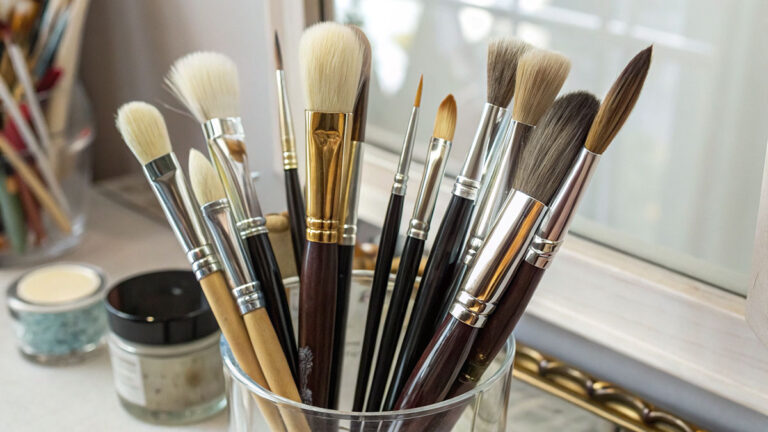
Brush Types for Dry Brush
| Brush Type | Why It Works | Best For |
|---|---|---|
| Flat Brush | Edge Control: The wide, straight edge allows you to “skid” across the paper’s peaks without dipping into the valleys. | Broad textured passages, shimmering water, and architectural “weathering.” |
| Fan Brush | Splayed Bristles: The wide-set hairs naturally create “broken” marks that mimic organic clusters. | Field grass, distant pine forests, animal fur, and hair textures. |
| Hake Brush | Coarse Fiber: Typically made of sheep or goat hair, these brushes hold a large amount of water but maintain a “scratchy” quality when dry. | Large-scale atmospheric texture, sand dunes, and “moody” background washes. |
| Round Brush (Splayed) | Pressure Sensitivity: By pressing the “belly” sideways, you can force the hairs to separate and catch the paper grain. | Precision texture work like tree bark, rock crevices, and detailed stone surfaces. |
Stiff bristles are a consistent theme. Soft brushes, like the kind used for smooth washes, bend into the paper grooves and fill them in. That is the opposite of what dry brush needs.
Natural vs. synthetic bristles behave differently here. Natural hair brushes (sable, squirrel) release paint more gradually and hold a stroke longer. Synthetic brushes release paint faster, which makes moisture control trickier but can produce sharper, more immediate texture.
Paint Consistency
Tube watercolor paint works better than pan paint for dry brush. Tubes let you control the exact thickness of your mixture without needing to add water to activate the pigment.
The target consistency is thick and paste-like, much closer to the paint straight from the tube than anything you would use for a wash. Daniel Smith and Winsor & Newton both perform reliably at this low moisture level without becoming gummy or cracking on the paper.
Pan paints require water to activate, which introduces moisture before you have even touched the brush to paper. Not impossible to manage, but harder to control.
Paper Weight and Surface
Paper weight matters because dry brush puts mechanical stress on the surface. Thin paper pills and tears when a stiff brush is dragged across it repeatedly. 140lb (300gsm) as a minimum is a practical rule. Heavier paper like 300lb holds up better for multi-layer dry brush work without warping.
See the comparison between cold press and hot press watercolor paper for a more detailed breakdown of how surface texture changes paint behavior across all watercolor techniques.
When Painters Use Dry Brush

Dry brush is a selective tool. Most watercolor painters use it for specific passages in a painting, not as the primary method across the whole surface.
Texture Rendering
This is where dry brush earns its reputation. Certain subjects are very hard to render convincingly with smooth washes alone.
- Grass and dry vegetation, where individual blades break apart visually
- Animal fur and hair, where the broken stroke mimics the direction and separation of individual strands
- Weathered wood grain and rough stone
- Sandy or rocky ground planes
- Tree bark, especially on older or gnarled specimens
The broken stroke does the descriptive work that a smooth wash simply cannot. It tells the viewer “this surface is rough” without requiring precise detail.
Atmospheric and Lighting Effects
Dry brush is also useful for creating the impression of light catching a surface.
Sparkling water, sunlit snow on mountain peaks, mist on distant hills, highlights on hair. In each case, the technique works the same way: a lightly loaded brush is swept quickly over a dried underpainting, and the white flecks that appear read as reflected light.
Applied over a darker wet-on-wet underpainting, dry brush adds a finishing layer of luminosity that wet-on-wet alone cannot produce. The contrast between the soft background and the crisp broken overlay gives the painting visual depth.
This layered approach is common in landscape watercolor work. Painters like Joseph Zbukvic use wet-on-wet for atmospheric backgrounds and bring dry brush in during later stages to define edges, add texture, and push the sense of light.
Final Layer Detail
Many painters reserve dry brush for the last stage of a painting, after all washes are dry. At this point the technique adds:
- Crisp surface texture over soft background areas
- Tonal depth through layered broken strokes
- Definition in passages that need more edge presence without hard outlines
The layering technique in watercolor works closely alongside dry brush at this stage. The two approaches complement each other directly.
Dry Brush vs. Other Watercolor Techniques
Dry brush is easier to understand when you see where it sits relative to other methods. The main distinction is always moisture level, and moisture level determines everything else.
| Technique | Moisture Level | Edge Type | Best Use |
|---|---|---|---|
| Wet-on-Wet | Very High: Both the paper and the brush are saturated with water. | Soft & Bleeding: Colors diffuse into one another without a clear boundary. | Dreamy skies, soft-focus backgrounds, and “blooming” atmospheric effects. |
| Wet-on-Dry | Medium: A damp brush is applied to bone-dry paper. | Clean & Hard: The edge of the stroke follows the exact path of the bristles. | Architectural lines, botanical veins, and precise structural details. |
| Dry Brush | Very Low: A “thirsty” brush with high pigment load and minimal water. | Broken & Textured: The paint only catches the high points of the paper’s grain. | Sparkling light on water, weathered wood, and gritty surface textures. |
| Scumbling | Low to Medium: Applying a thin, “dryish” layer of color over a dry, already-painted area. | Irregular & Broken: Allows the underlying color to “peek through” the top layer. | Optical color mixing, creating “vibrant” shadows, and complex foliage layers. |
Scumbling and dry brush look similar in the finished result. The difference is mostly in pressure and intent. Scumbling uses a scrubbing motion. Dry brush is a drag or swipe. Both produce broken marks, but dry brush is more directional.
Wet-on-wet is the technique painters most often combine with dry brush. A soft wet-on-wet underpainting creates the atmosphere. Dry brush comes in later to add surface texture and crisp detail on top. Neither works as well alone for complex, textured subjects.
The glazing technique can also be layered over or under dry brush. Glazing builds up transparent color depth, while dry brush contributes physical texture. Together they produce complex, multi-dimensional surfaces.
Common Mistakes and How to Fix Them
Most dry brush problems trace back to one root cause: too much water on the brush. Everything else is secondary.
The Stroke Fills In as a Flat Wash
This is the most common issue. The stroke looks like a regular wet wash with no broken texture.
Cause: Too much water in the brush bristles. The excess moisture bridges the paper grooves and delivers pigment evenly across the surface.
Fix: Blot the loaded brush on a paper towel before touching the paper. Keep blotting until the stroke starts to break apart on the paper towel itself. That is the right moisture level.
Too Much Pressure Kills the Skip Effect
When the brush is pressed firmly into the paper, the bristles splay and push down into the paper valleys. Pigment fills the grooves. The white flecks disappear and the stroke looks like wet-on-dry.
The fix is counterintuitive: use less pressure, not more. Let the bristle tips do the work. The goal is skimming the surface, not pressing into it.
Working on the Wrong Paper Surface
Hot press paper is smooth. On smooth paper, dry brush produces a weak, inconsistent broken mark at best, and a flat smear at worst. Some painters try to compensate with faster strokes or stiffer brushes, but the technique simply works against smooth paper’s surface properties.
Switching to cold press or rough paper solves the problem immediately, without changing anything else about technique or materials.
Over-Working the Area
Dry brush requires confidence and speed. Hesitating mid-stroke, or going back over the same area repeatedly while the paint is still wet, lifts pigment and flattens the texture. The surface becomes muddy and the broken quality is lost.
Each stroke should be decisive. One pass, then leave it. If the result is not dark enough, wait for the area to dry completely before adding another dry brush layer on top.
This is actually one of the reasons beginners find dry brush tricky. It rewards commitment. The instinct to fix things mid-stroke is what causes the most damage to the surface texture.
For more on how texture works as an element in art more broadly, and how painters control it across different mediums and surfaces, that context is worth exploring alongside dry brush practice.
Practice Exercises for Building Dry Brush Control
Dry brush control is almost entirely muscle memory. Reading about the technique is useful. Doing these drills for twenty minutes is more useful.
The global online art courses market reached USD 2.34 billion in 2024, according to Business Research Insights, which reflects just how many people are actively working to build skills like these. Most of the instruction, though, still comes down to deliberate repetition on actual paper.
The Loading Test
Do this before every dry brush session.
Load your brush with pigment-rich paint. Blot it firmly on a paper towel. Drag the brush across the towel itself. When the stroke on the towel starts to break apart and skip, showing white gaps, the moisture level is right for the paper.
If the stroke on the towel is solid and smooth, keep blotting. The brush is still too wet.
This one habit eliminates most dry brush failures before you even touch the painting surface.
Straight-Line Pressure Drills
Pull a flat brush in a single horizontal drag across rough paper. Vary only the pressure between each pass.
- Light pass: maximum skip, lots of white paper showing
- Medium pass: partial texture, some connected pigment areas
- Firm pass: mostly filled, barely any skip effect remaining
Do ten rows. The goal is not to make them look good. The goal is to feel the exact pressure point where the skip effect switches on and off.
Most beginners discover their “firm pass” is actually medium pressure. The technique needs less force than feels instinctive.
The Layering Sequence Exercise
This one takes patience but teaches how dry brush works in a finished painting.
Step 1: Lay a soft wet-on-wet wash across the paper. Let it dry completely.
Step 2: Apply one dry brush pass on top. Same direction as the wash.
Step 3: Let dry. Apply a second dry brush pass at a 45-degree angle.
By the third layer, the surface has depth. The wet-on-wet background reads as atmosphere. The dry brush layers read as physical texture sitting in front of it. This is the structure most landscape painters use for foliage, distant treelines, and rough ground.
Texture Replication Drills
Pick one subject. Spend a full session on just that subject.
- Bark: Short vertical strokes with a splayed round brush, varying pressure mid-stroke
- Dry grass: Fan brush, upward flicking motion, very light touch at the tip of each stroke
- Rough stone: Flat brush dragged diagonally, layered in two directions
The point is not finished artwork. It is developing a physical vocabulary, knowing exactly which brush, angle, and pressure combination produces each texture without having to think about it during an actual painting session.
For a broader look at how watercolor painting tools interact with different techniques, including which brush types handle specific mark-making approaches best, that reference is worth keeping nearby.
Dry Brush in the Work of Notable Watercolor Painters
Studying how established painters use dry brush is one of the fastest ways to understand what the technique can and cannot do. Each of the artists below used it differently, and those differences are instructive.
Andrew Wyeth
Wyeth is the painter most closely associated with dry brush as a primary method. Most painters use it selectively. He built entire paintings around it.
His process involved splaying the bristles and squeezing most of the moisture out before nearly every stroke, then building up layers slowly. He described the result as a “weaving process,” and you can see it in works like “Winter Fields” (1942) where individual blades of grass are rendered through dozens of accumulated dry brush passes.
What it demonstrates: Dry brush is capable of photographic detail and tonal complexity when used with patience and layering. It is not only a texture shortcut. It is a complete approach to surface building.
Wyeth’s preference for this method over looser wash techniques was deliberate. He said he turned to dry brush “when my emotions get deep enough into a subject.” The technique’s slowness forced close observation.
Winslow Homer
Homer used dry brush selectively, not as a primary method.
In his coastal watercolors, applying paint to a dry paper surface caused tiny white flecks to appear, creating a sparkling quality that strengthened the sense of light on water, according to research by Artists Network. He combined this with wet washes, gouache, and scraping to produce surfaces with multiple layers of visual information.
His 1880s Bahamas and Caribbean watercolors show this clearly. The water passages shift between flat wash and broken dry brush marks, which creates the illusion of light moving across the surface.
What it demonstrates: Dry brush works best as one layer in a mixed-technique approach. Homer never relied on it alone. The broken texture reads most effectively when placed over or next to areas of smooth wash.
Joseph Zbukvic
Zbukvic’s work is worth studying because his use of dry brush is restrained and placed with intention.
He builds paintings in two broad stages: loose wet-on-wet washes for atmosphere and large shapes, then precise brushwork for definition and texture. Dry brush appears in the second stage, used to add edge quality, surface texture, and calligraphic detail marks. The California Watercolor Association notes that his workshops specifically teach dry brush in combination with wet-on-wet as complementary methods, not separate ones.
What it demonstrates: Knowing when NOT to use dry brush is as valuable as knowing how to use it. Zbukvic uses it to finish passages, not to start them.
| Painter | Dry Brush Role | Key Subjects |
|---|---|---|
| Andrew Wyeth | Primary Method: Used almost exclusively to “weave” a painting together using thousands of tiny, hatched strokes. | Parched grass, winter fields, weathered wood, and intimate portraits. |
| Winslow Homer | Selective Contrast: Mixed heavy, “juicy” washes with dry brush to define the ruggedness of the coast. | Coastal light, crashing surf, and the raw texture of Atlantic rocks. |
| Joseph Zbukvic | Calligraphic Detail: Used as a final “jewelry” layer to add energy and focus to a soft-focus scene. | Urban figures, architectural silhouettes, and the “shimmer” of city streets. |
The online art courses market growing to USD 2.34 billion in 2024 (Business Research Insights) reflects a real appetite for technique-specific learning. Painters like Wyeth and Zbukvic are consistently among the most-studied subjects on platforms like Domestika and Skillshare, largely because their work makes the connection between technique and result visible and learnable.
Dry brush is one of the older, more established methods in watercolor painting materials practice. It appears across centuries of work from different traditions, and its continued relevance comes from the fact that no other technique produces quite the same combination of broken edge quality and tonal depth.
Painters interested in exploring where watercolor sits among other painting mediums, and how its properties compare to oil or acrylic approaches to texture, will find the contrast useful context for understanding why dry brush is specific to water-based media.
For those interested in the broader range of famous watercolor artists who have shaped how the medium is practiced, dry brush appears throughout that history as a recurring and adaptable tool, not a niche specialty.
FAQ on What Is Dry Brush Technique In Watercolor Painting
What is the dry brush technique in watercolor painting?
Dry brush is a watercolor method where a brush loaded with concentrated pigment and minimal water is dragged across textured paper. The bristles skip over the surface, leaving broken, rough-edged marks with white paper showing through the gaps.
Why is it called “dry brush” if the brush is not completely dry?
The name refers to the low water-to-pigment ratio, not a bone-dry tool. The brush holds just enough moisture to carry pigment. Compared to standard watercolor washes, the brush feels almost dry, which is where the name comes from.
What paper works best for dry brush watercolor?
Rough and cold press watercolor paper work best. Both have enough tooth for bristles to skip across. Hot press paper is too smooth and mostly kills the broken-stroke effect. Arches 140lb cold press is a reliable starting point.
Which brushes are best for the dry brush technique?
Flat brushes, fan brushes, and hake brushes all work well. Stiff bristles are the key factor, not brush size or brand. Soft wash brushes bend into the paper grooves and fill them, which removes the texture effect entirely.
How do I know if my brush has the right moisture level?
Blot the loaded brush on a paper towel and drag it across the surface. When the stroke on the towel starts to break apart and skip visibly, the moisture level is correct. If the stroke is solid, keep blotting.
What subjects suit the dry brush technique?
Grass, animal fur, tree bark, rough stone, weathered wood, and sparkling water all suit dry brush well. Any subject that needs broken texture or the appearance of light catching a rough surface is a good candidate for this approach.
Can dry brush be combined with other watercolor techniques?
Yes, and it usually should be. Most painters layer dry brush over a wet-on-wet underpainting, using the soft background for atmosphere and dry brush on top for surface texture and definition. Glazing also pairs with it effectively.
What are the most common mistakes beginners make with dry brush?
Too much water on the brush is the most common issue, which turns the stroke into a flat wash. Excess pressure is second. Pushing bristles into the paper valleys fills them in and removes the broken, skip effect completely.
Did famous watercolor artists use the dry brush technique?
Andrew Wyeth used it as a primary method, building entire paintings through layered dry brush passes. Winslow Homer used it selectively in coastal scenes. Joseph Zbukvic applies it in final stages to add edge quality and surface texture.
Is dry brush suitable for watercolor beginners?
Yes, with caveats. The loading test drill, blotting until the stroke breaks on a paper towel, is simple to practice. Brush control and paper choice take time to learn, but the technique itself is accessible from the first session.
Conclusion
This conclusion is for an article presenting the dry brush technique in watercolor painting as a method built on restraint, paper tooth, and deliberate pigment load control.
Get those three variables right and the broken stroke follows naturally.
Cold press or rough paper, stiff bristles, tube paint mixed thick. That combination does most of the work before you even make a mark.
Painters from Winslow Homer to Joseph Zbukvic have used it selectively, layered over wet washes, to add surface texture and push the sense of light in a finished piece.
Start with the loading test drill. Blot until the stroke skips on the paper towel. Build from there.
The technique rewards practice more than theory.