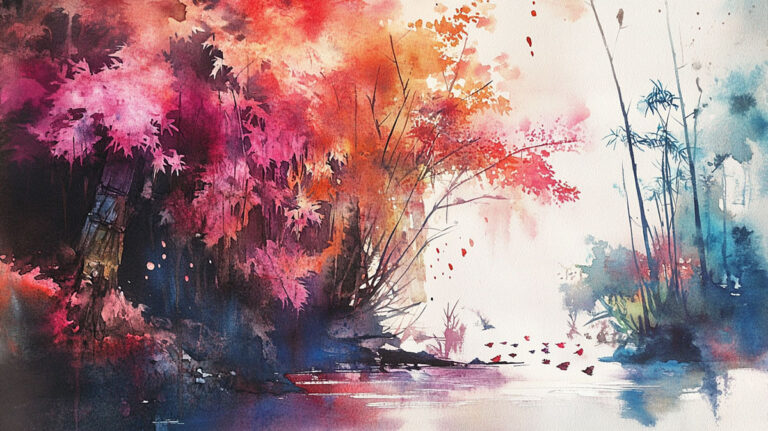
Paint a sky without a single hard edge. No brushwork, no blending, just pigment moving through water on its own terms.
That is what the wet-on-wet technique in watercolor painting makes possible. It is one of the most fundamental methods in the medium, and the one most responsible for the soft color diffusion and atmospheric effects that define classic watercolor work.
This guide covers how the technique works, what drives pigment movement on wet paper, which materials actually matter, and the most common mistakes that kill a wash before it dries.
By the end, you will know how to control wet-on-wet with intent, not just hope.
What Is Wet-on-Wet Technique in Watercolor Painting

Wet-on-wet is the application of wet, pigment-loaded paint directly onto a surface that is already wet or damp. Both the paper and the paint carry water at the same time.
This simultaneous wetness is what makes the technique distinct. Paint does not sit or hold on the surface. It moves, spreads, and bleeds outward through the water already present in the paper fibers.
The result is soft, diffused edges with no hard lines. Color transitions happen organically, driven by water movement rather than deliberate brushwork.
Watercolor painting has dozens of techniques, but wet-on-wet is the one most closely tied to the medium’s identity. The blooms, soft gradients, and atmospheric color diffusion that define classic watercolor work almost always come from this method.
It is the opposite of wet-on-dry, where paint applied to a dry surface stays where you place it, producing crisp edges and defined shapes. Wet-on-wet gives up that control entirely in exchange for fluid, expressive movement.
How It Differs from Wet-on-Dry

| Aspect | Wet-on-Wet | Wet-on-Dry |
|---|---|---|
| Surface Condition | Pre-Saturation: The paper is treated with a clear wash of water before any pigment is introduced. | Bone Dry: No moisture is present on the paper fibers, allowing the brush to make a direct “imprint.” |
| Edge Quality | Soft & Diffused: Often called “lost edges,” where colors bleed into each other without a visible border. | Hard & Precise: “Found edges” that create a sharp silhouette or a crisp, technical line. |
| Paint Behavior | Capillary Action: The water on the paper pulls the pigment outward in unpredictable, organic patterns. | Static: The pigment binds to the fibers exactly where the bristles of the brush touch down. |
| Best Use | Atmospheric skies, misty backgrounds, soft shadows, and “blushing” skin tones. | Botanical veins, architectural edges, facial features, and final textural “pops.” |
| Control Level | Low (Co-Creation): You manage the water, but the paper dictates the final spread. | High (Authority): You have total command over the shape, saturation, and placement of the stroke. |
Most finished watercolor painting techniques combine both approaches. Wet-on-wet typically handles the early, large-scale layers. Wet-on-dry comes in later for details and corrections.
How Wet-on-Wet Works

The physical behavior behind this technique comes down to two forces: capillary action and pigment concentration gradients. Neither requires a chemistry degree to understand, but knowing what drives the paint helps you predict where it will go.
When paper is wetted, water fills the spaces between cellulose fibers. Those fibers are hydrophilic, meaning they attract and hold water. When wet paint touches a wet surface, the pigment follows the existing water pathways through those fiber channels.
Capillary action pulls liquid through narrow spaces against gravity. In paper, this means wet paint migrates from wetter areas toward drier ones. A drop of concentrated pigment placed onto a damp surface will travel outward along the moisture gradient until the water levels equalize.
Heavier pigments settle faster and travel less. Lighter, staining pigments travel farther and tend to push to the outer edges of a bloom. This is why two colors dropped onto wet paper often separate and create unexpected layering.
Timing matters more than any other variable. Glossy-wet paper allows rapid spread and maximum bloom. As the surface moves toward a satin sheen, spread slows and control increases. Once the paper loses its sheen entirely, wet-on-wet is no longer possible without rewetting.
What the Paper Does to the Paint
Cotton paper and wood pulp paper behave very differently when wet. Cotton cellulose fibers are stronger, more flexible, and naturally acid-free, according to watercolor paper research. They hold water longer and allow more controlled pigment movement than wood pulp alternatives.
Wood pulp paper absorbs unevenly and dries faster, which creates patchy results with wet-on-wet. It also buckles more aggressively under heavy wetting.
Key differences by paper type:
- 100% cotton paper holds moisture longer, giving more working time
- Cold press texture creates subtle channels that guide pigment flow
- Hot press surface resists spreading, producing tighter blooms
- Rough paper produces pronounced texture but less predictable spread
The fine art watercolor paints market was valued at USD 3,670 million in 2024 and is projected to reach USD 5,477 million by 2031 (Proficient Market Insights). Growing demand for quality cotton paper and professional-grade pigments drives much of that growth.
Paper Wetness Levels and What They Change
The wetness of your paper at the moment you apply paint is the single biggest variable in wet-on-wet. Get this wrong and nothing else compensates for it.
There are three practical stages to know:
- Glossy-wet: Water pools visibly on the surface. Paint spreads fast and wide with minimal control. Good for loose, atmospheric backgrounds.
- Satin-wet: Surface reflects light evenly but no pooling is visible. This is the optimal zone. Paint spreads softly but stays roughly where you place it.
- Nearly dry: Sheen is fading unevenly. Applying paint now causes backruns at the edges where moisture levels vary sharply.
Most experienced painters work in the satin-wet stage for the majority of wet-on-wet passages. Glossy-wet is useful for intentional bleeds and large sky washes where exact placement does not matter.
How to Pre-wet Paper Correctly
Uneven pre-wetting is the most common beginner mistake. Dry patches create moisture imbalances that cause unintended backruns and hard edges mid-wash.
Flat wash method: Use a large, clean mop brush or hake brush loaded with plain water. Work in overlapping horizontal strokes from top to bottom. Check for dry spots by holding the paper at an angle under light.
Spray bottle method: A fine-mist spray bottle produces more even coverage on large sheets, especially 300 gsm or heavier paper. Useful for plein air work where time is limited.
Stretching paper before wetting it prevents buckling and keeps the surface flat. Unstretched paper below 300 gsm will warp significantly when saturated, creating uneven pooling and drying that breaks up the wash.
Tools and Materials That Affect the Outcome
The global watercolor market was valued at USD 4.45 billion in 2023 and is projected to reach USD 9.35 billion by 2032 at a 7.4% CAGR (DataIntelo). That growth is partly driven by increasing demand for professional-grade materials that actually perform reliably under techniques like wet-on-wet.
Because here is the thing: cheap materials actively fight this technique. Student-grade paper dries too fast. Low-quality pigments granulate unpredictably. The wrong brush holds too little water to maintain a consistent wet surface.
Paper
Paper selection is not optional when it comes to wet-on-wet. It is the foundation.
| Paper | Surface | Best for Wet-on-Wet |
|---|---|---|
| Arches 300gsm (140 lb) | Cold Press: 100% cotton with a professional, balanced grain. | Excellent: The internal and external sizing allows water to sit on the surface longer, giving you the maximum “working window” for soft blends. |
| Fabriano Artistico | Cold or Hot: High-performance cotton paper known for its brilliant white point. | Yes: Highly consistent absorption prevents “dry spots” and allows for predictable, even color dispersal. |
| Strathmore 400 | Wood Pulp: A sturdy, affordable option for students and daily practice. | Limited: Wood pulp fibers are more “thirsty” than cotton; they drink the water quickly, causing washes to dry unevenly and create “hard” edges too soon. |
| Hot Press (General) | Smooth: A flat, plate-like finish with zero texture. | Moderate: Because there is no “tooth” to trap the water, the paint slides easily. This results in very tight, sharp-edged “blooms” that are great for abstract effects but difficult for smooth skies. |
Cold press cotton paper is the standard recommendation for wet-on-wet work. Its surface texture creates small channels that guide pigment movement in a way that hot press simply does not replicate. For a detailed breakdown, cold press vs hot press watercolor paper covers how each surface type changes paint behavior at a practical level.
Brushes
Water-holding capacity is the main factor. A brush that cannot carry enough water to stay wet across a large passage will drag dry streaks through your wash.
- Mop brush: Ideal for pre-wetting and broad wet-on-wet washes. Holds a large water reservoir. The mop brush in watercolor work is almost irreplaceable for this technique.
- Hake brush: Wide, soft, excellent for even water application across large sheets
- Round brush (size 10-14): Useful for placing concentrated pigment drops into wet areas
Natural hair brushes like squirrel mops hold significantly more water than synthetics. That said, synthetic rounds from brands like Princeton or da Vinci perform well for wet-on-wet at a lower cost. Choosing the right brushes for watercolor painting makes a real difference to how long your wet surface stays workable.
Pigments
Not all watercolor pigments behave the same on wet paper. This trips up a lot of painters who assume the technique works uniformly across all colors.
Granulating pigments (like Ultramarine Blue, Burnt Sienna, and many of Daniel Smith’s mineral-based colors) settle into the paper texture and create visible grain. On wet paper, this produces textured, almost grainy blooms. Useful for rocks, atmospheric skies, and organic textures.
Non-granulating, staining pigments (like Phthalo Blue and Quinacridone Magenta) spread more evenly and travel farther on a wet surface. They are harder to lift once dry and tend to push to the outer edge of a bloom.
Winsor and Newton, Daniel Smith, and Schmincke are the three brands most consistently used for professional wet-on-wet work. Their pigment concentration is high enough that even diluted paint retains visible color when spread across wet paper.
What You Can Paint with Wet-on-Wet
Wet-on-wet is not a universal solution for every subject. It performs best where soft edges, color diffusion, and atmospheric effects are actually desirable.
Trying to use it for precise subjects like architectural detail or botanical illustration usually ends in frustration. The technique does not naturally support hard lines or exact placement.
Subjects That Work Well
Skies and clouds are the most common application, and for good reason. The soft transitions between sky tones, the diffused edges of clouds, and the gradual shift from one color temperature to another all happen naturally on wet paper without any manual blending.
J.M.W. Turner used wet-on-wet extensively to create the atmospheric haze his seascapes and landscapes are known for. According to records from the Tate and the Wallace Collection, Turner would plunge paper into water and drop color directly onto the wet surface, then tilt the board to guide pigment flow. His mature practice reportedly involved working on several sheets simultaneously, moving between them as each reached the right moisture stage.
Other subjects where wet-on-wet delivers strong results:
- Water reflections and still-water surfaces
- Soft backgrounds behind a sharper focal subject
- Loose foliage masses and organic textures
- Skin tones in portraiture, where hard edges look unnatural
- Fog, mist, and atmospheric perspective effects in landscape work
When to Avoid It
Wet-on-wet is the wrong tool when precision matters. Fine botanical illustration, architectural subjects, hyperrealism, and any subject requiring sharp, defined edges will not benefit from this technique.
Combining wet-on-wet backgrounds with wet-on-dry detail work in the same painting is how most painters actually use it. The background wash goes in wet-on-wet while the paper is damp. Once fully dry, detail layers are added wet-on-dry on top. This combination gives you the soft atmospheric quality of the technique without sacrificing control over the focal elements.
Controlling Wet-on-Wet (As Much As It Can Be Controlled)
This is where most beginners get discouraged. The technique feels random, and early results look like accidents. Honestly, that reaction is normal. Wet-on-wet takes longer to feel intuitive than most other watercolor skills because the feedback loop is slow. You make a mark, and you do not know what it became until the paper dries.
But the movement is not random. It follows physical rules. Once you understand those rules, you can work with them rather than against them.
Practical Control Methods

Tilt the board. Gravity moves water downward. Tilting your painting surface guides where wet paint flows. A slight tilt creates directional gradients. A steeper tilt creates more dramatic runs and streaks useful for rain, waterfalls, and abstract texture.
Control pigment concentration. Diluted paint spreads far on wet paper. Concentrated paint stays closer to the point of contact. Dropping thick, dark pigment into a very wet wash produces the characteristic dark-center, light-edge bloom shape. Dropping diluted paint into a slightly damp surface produces softer, more even diffusion.
Use a dry brush to absorb excess water. Before adding paint, press a barely damp brush lightly onto areas that are too wet. This reduces the moisture level locally and slows spread in that zone. Useful when you want more control over one area while leaving adjacent areas very wet.
Work fast. There is a working window between glossy-wet and dry during which wet-on-wet is possible. In a dry environment, that window can be as short as 90 seconds for lighter paper. Make decisions before applying paint, not during.
Backruns and Blooms
Backruns happen when wetter paint pushes into a drier area of your wash. The wetter area displaces pigment outward and deposits it along a hard, irregular edge as it dries. The result is a dark, cauliflower-shaped outline with a lighter interior.
What causes them:
- Adding wet paint to a surface that has already started drying unevenly
- Returning to a wash after it has left the glossy-wet stage
- Touching a nearly dry wash with a water-loaded brush
Backruns are worth understanding because they are not always problems. Many painters use them deliberately to create organic texture in foliage, rock surfaces, and abstract backgrounds. The technique of intentional blooming, where you drop clean water or diluted paint into a drying wash, produces the same effect on purpose.
Avoiding accidental backruns comes down to one rule: do not touch a wash once it has started to dry. Leave it alone until the surface is completely matte and dry, then work on top of it with a fresh layer if needed. The backwash and bloom effects technique in watercolor is worth studying separately once you are comfortable with basic wet-on-wet behavior.
Fixing backruns after they dry is tricky. Lifting with a damp brush can soften the hard edge slightly, but the displaced pigment is rarely fully recoverable. Prevention is easier than correction.
Wet-on-Wet vs. Wet-on-Dry

Most paintings use both. That is the honest answer. Painters who commit to only one approach end up with work that either feels too controlled or too loose, depending on which one they stuck with.
Wet-on-wet handles the parts of a painting where hard edges would look wrong: skies, water surfaces, backgrounds, soft shadow gradients. Wet-on-dry takes over where precision matters: foreground details, sharp edges, lettering, botanical line work.
| Quality | Wet-on-Wet | Wet-on-Dry |
|---|---|---|
| Edge Type | Soft & Feathered: Creates “lost edges” where the paint dissolves into the paper or adjacent colors. | Hard & Crisp: Creates “found edges” that define shapes with surgical precision. |
| Color Movement | Active: Pigment travels via capillary action, following the path of the water on the surface. | Static: The pigment binds to the paper fibers exactly where the brush makes contact. |
| Lifting Paint | High Erasability: While the surface is wet, you can “thirstily” suck up pigment with a dry brush easily. | Low Erasability: Once the binder (gum arabic) sets into the fibers, removing color often requires “scrubbing.” |
| Typical Use | Establishing the “mood”: skies, soft-focus backgrounds, and base skin tones. | Establishing the “focus”: silhouettes, facial features, textures, and dark accents. |
Knowing when to switch between the two is a skill that takes time to build. Took me a while to stop thinking of them as competing methods and start treating them as stages in a single process.
Layering Both Techniques in the Same Painting
Standard workflow for most watercolor subjects:
- First layer: wet-on-wet background wash, soft color diffusion, no detail
- Second layer: wet-on-dry once the paper is fully dry, building mid-tones with some edge definition
- Final layer: wet-on-dry for sharpest details, darkest values, precise marks
Watercolor glazing technique typically happens in the wet-on-dry phase. Transparent layers of color are applied over dried washes to deepen tone and color saturation without disturbing the soft wet-on-wet passages underneath.
The key rule: never apply a wet-on-dry layer over a wet-on-wet wash that is still damp. The moisture mismatch creates backruns at every edge. Wait for complete drying, not just surface dryness. Paper can feel dry on top while retaining moisture deeper in the fibers, especially on thick cotton stock.
When Each Technique Fits Different Painting Styles
Impressionism-influenced work relies heavily on wet-on-wet. Loose, atmospheric color mixing and soft light effects are almost impossible to achieve any other way.
Realism and hyperrealism in watercolor lean toward wet-on-dry for the majority of the work. Wet-on-wet may appear only in large background passages or sky areas where hard edges would be distracting.
Abstract watercolor work often uses wet-on-wet exclusively, sometimes pushing it further with alcohol drops, salt, and tilting to generate unplanned compositions from pigment movement.
Common Mistakes and How to Avoid Them
These are not theoretical errors. They are the specific things that come up again and again when people are learning wet-on-wet, and most of them trace back to one underlying issue: wrong water levels.
Uneven Pre-wetting
Dry patches left on the paper before painting create moisture imbalances. When wet paint hits a dry zone mid-wash, the paint stops spreading and forms a hard edge right where you do not want one.
How to check before you start: Hold the paper at an angle under a light source. The entire surface should reflect light evenly with a consistent sheen. Any dull patches are dry spots that need more water before you add any paint.
Working on unstretched paper below 300 gsm makes this worse. The paper buckles as it absorbs water, creating elevated ridges and low valleys where pigment pools unevenly. Stretching paper first (or using a watercolor block) keeps the surface flat and the moisture level consistent.
Adding Paint to a Surface That Has Already Started Drying
This is the most common cause of unintended backruns. Beginners often spend too long mixing color while the paper dries, then drop the mixed paint onto a surface that has left the glossy-wet stage.
Fix: Mix all colors before wetting the paper. Have everything ready before the brush touches water. The working window on lightweight paper in a dry room can be under two minutes.
Working on two sheets simultaneously, alternating between them as each dries, is how many painters extend their productive wet-on-wet time without rushing.
Too Little Pigment Concentration
Diluted paint dropped onto wet paper becomes extremely pale as it spreads. Beginners who mix light washes expecting vibrant results usually end up with near-invisible color once it dries.
Watercolor dries significantly lighter than it looks when wet. On a wet surface, the drying-lightening effect is even more pronounced because the pigment spreads and dilutes further as it travels.
Use paint that is noticeably darker than your intended final color. The difference is larger than most people expect, especially with student-grade pigments that have lower pigment load to begin with.
Wrong Paper Choice
Wood pulp paper: Dries too quickly, absorbs unevenly, buckles under heavy wetting. Poor results with wet-on-wet regardless of skill level.
Hot press cotton paper: Works for wet-on-wet but produces tighter, less expansive blooms. Less forgiving than cold press for beginners because the smooth surface gives less time to work before drying.
Cold press cotton (140 lb or 300 gsm): The standard choice. Holds moisture longer, handles repeated wetting, and produces the characteristic soft diffusion most painters are aiming for.
Student-grade paper is not just a quality difference. It actively changes what is physically possible with wet-on-wet technique, and no amount of skill compensates for paper that dries in seconds.
Learning Wet-on-Wet: Exercises to Build the Skill
Wet-on-wet takes longer to feel consistent than most watercolor skills. The feedback loop is slow. You make a mark, and you do not see what it became until the paper dries, sometimes ten minutes later. Deliberate, structured practice shortens that gap.
Watercolor is a common medium used in art therapy precisely because it builds problem-solving skills through the interpretation of unpredictable results (UC Davis Aggie, 2023). The same quality that makes wet-on-wet useful therapeutically is what makes it hard to learn mechanically. You have to observe, not just execute.
Starting Point: Water-to-Pigment Ratio Practice
Before anything else, you need to know how your specific paint behaves at different dilutions on wet paper.
Exercise: Wet a small section of cotton paper. Drop one stroke of highly concentrated pigment, one at medium dilution, and one at high dilution into the wet area. Watch how far each travels and how light each becomes when dry. Repeat with a second color that behaves differently (try a granulating pigment like Ultramarine Blue next to a staining pigment like Phthalo Green).
Do this exercise five or six times across different paper wetness stages. By the third session, most painters have a reliable feel for their materials that no written description can give them.
Sky and Gradient Studies
Skies are wet-on-wet’s most natural subject. They require a broad, even wash, color transitions without hard edges, and occasionally soft cloud shapes.
- Pre-wet the full paper sheet with a mop brush
- Load a round brush with a sky blue and work in horizontal strokes from the top down
- Drop a second color into the lower portion while still glossy-wet
- Tilt the board slightly toward you to let colors blend downward
- Leave it alone until fully dry
Do ten of these in a row on the same day. Not because the first few will be good, but because you are observing and adjusting between each one. By number eight, most people start seeing what they expected on the paper.
Texture Experiments on Wet Washes
Once the basic wet-on-wet behavior feels familiar, experimenting with additives on a wet surface builds both skill and a personal vocabulary of effects.
Salt: Sprinkle table salt or sea salt onto a damp wash (satin-wet stage, not glossy). Salt pulls water toward itself, displacing pigment outward and leaving lighter crystalline shapes behind. Coarse sea salt creates larger, more dramatic patterns. Fine table salt creates small, speckled highlights. Useful for foliage texture, water reflections, and star fields. The salt texture technique in watercolor pairs naturally with wet-on-wet because the paper needs to be damp for it to work at all.
Plastic wrap: Crumple plastic wrap and press it onto a glossy-wet wash. Leave it until the paint dries completely, then peel. The wrap creates geometric, irregular patterns in the pigment that look like cracked stone, ice, or dense foliage depending on the colors used.
Alcohol drops: Rubbing alcohol dropped onto a damp wash repels the pigment outward, leaving a lighter, soft-edged circle. Unlike salt, the effect is immediate and visible while the paper is still wet. Good for bubble effects, water reflections, and abstract texture.
Keeping a Practice Record
Track these variables for each exercise sheet:
- Paper brand and weight
- Paper wetness stage when paint was applied
- Pigment brand and color
- Room humidity (dry or humid day makes a real difference)
- Result: what worked, what did not
This sounds tedious. It is not. After a month of practice sheets with notes, you will have a personal reference that tells you exactly what to expect from your specific materials under your specific conditions. No two painters use the same paper, paints, and studio environment, so no general guide fully substitutes for your own recorded observations.
The watercolor market is growing at a CAGR of around 5.9% through 2035 (Wise Guy Reports), with much of that growth coming from hobbyists and beginners accessing online learning. If you are starting now, there has never been more structured content available to support wet-on-wet practice. But the core skill still comes from repetition with real materials, not from watching videos.
For a broader view of how wet-on-wet fits within watercolor painting techniques as a whole, studying the full range of approaches alongside this one gives context for when and why to reach for each method. Wet-on-wet is foundational, but it is one tool among many in a complete watercolor painting practice.
FAQ on What Is Wet-On-Wet Technique In Watercolor Painting
What is the wet-on-wet technique in watercolor painting?
Wet-on-wet means applying wet, pigment-loaded paint onto paper that is already damp or wet. The water already in the paper fibers pulls the pigment outward through capillary action, creating soft edges and color diffusion you cannot achieve any other way.
How is wet-on-wet different from wet-on-dry?
Wet-on-dry means applying paint to completely dry paper, producing hard, defined edges. Wet-on-wet produces soft, feathered edges and free paint movement. Most finished watercolor paintings use both, with wet-on-wet handling backgrounds and wet-on-dry handling detail.
What paper works best for wet-on-wet watercolor?
100% cotton cold press paper at 140 lb or 300 gsm is the standard choice. It holds moisture longer and allows more controlled pigment spread. Wood pulp paper dries too fast and produces uneven results regardless of skill level.
How do you pre-wet paper correctly for this technique?
Use a large mop brush or hake brush with clean water, working in even overlapping strokes. Check for dry spots by angling the paper under light. The surface should show a consistent sheen with no dull patches before you add any paint.
What causes watercolor blooms and backruns?
Backruns happen when wetter paint touches a drying area. The moisture imbalance pushes pigment outward, leaving a hard, irregular edge. They are caused by returning to a wash after it has left the glossy-wet stage. Avoid touching a wash once it starts drying.
Which brushes are best for wet-on-wet painting?
A mop brush is the most useful tool. It holds a large water reservoir and covers paper evenly without dragging. Large round brushes in sizes 10 to 14 work well for dropping concentrated pigment into wet areas with some placement control.
How do you control paint spread in wet-on-wet?
Tilt the board to guide flow with gravity. Use more concentrated pigment to reduce spread. Press a barely damp brush onto areas that are too wet to slow movement locally. Work quickly before the paper dries past the satin-wet stage.
Does pigment type affect wet-on-wet results?
Yes, significantly. Granulating pigments like Ultramarine Blue settle into paper texture and create grainy blooms. Staining pigments like Phthalo Blue travel farther and push to the outer edge of a wash. Mixing both in the same wet area produces natural, layered separation.
What subjects suit wet-on-wet technique?
Skies, clouds, soft backgrounds, water reflections, loose foliage, and skin tones in portraiture. Any subject where soft color diffusion and feathered edges look natural. Avoid it for architectural detail, sharp lettering, or subjects that require precise edge placement.
How long does it take to learn wet-on-wet watercolor?
Expect several weeks of structured practice before results feel consistent. The main challenge is the slow feedback loop: you paint, then wait for drying to see the result. Keeping a practice record of paper type, wetness stage, and pigment used speeds up the learning curve noticeably.
Conclusion
This conclusion is for an article presenting the wet-on-wet technique in watercolor painting, a method built on understanding how pigment movement and paper wetness interact.
Get the moisture level right, choose cotton paper, and mix your colors before the brush hits water. Those three things alone solve most of the problems beginners face.
The soft color diffusion, watercolor blooms, and atmospheric gradients this technique produces are not accidents. They follow predictable physical rules once you have observed them enough times.
Practice the sky studies. Track your results. Give the paint time to dry before judging it.
Wet-on-wet rewards patience more than precision. That is exactly what makes it worth learning.