The raw emotional power of Expressionism transformed art history, breaking from tradition to reveal inner truths.
Born in early 20th century Germany, Expressionism artists rejected academic realism, instead using distorted forms, vivid colors, and bold brushstrokes to express psychological states.
These pioneering painters created works of startling intensity.
Artists like Ernst Ludwig Kirchner captured urban alienation through angular figures, while Edvard Munch explored existential anxiety with swirling, atmospheric compositions.
The movement split into two influential groups: Die Brücke in Dresden and Der Blaue Reiter in Munich.
What drove these revolutionary artists? Their work responded to rapid industrialization, social upheaval, and the looming specter of war.
Through primitive influences and exaggerated techniques, they created a visual language of profound emotional depth.
This article explores the most significant Expressionism artists, their distinctive styles, and how their psychological approach to painting continues to influence contemporary art today.
Expressionism Artists
Ernst Ludwig Kirchner (1880-1938)

Nationality: German
Art Movement(s): Expressionism, Die Brücke
Mediums: Oil on canvas, woodcut prints, lithography, sculpture
Artistic Signature
Kirchner’s work features jagged brushstrokes, angular figures, and unnatural, vibrant colors. His metropolitan scenes utilize distorted perspective and flattened space and balance to heighten emotional intensity.
Recurring Themes & Motifs
Urban alienation, sexuality, and psychological anxiety dominate his street scenes and nudes. His later Swiss landscapes reflect inner turmoil against pastoral backdrops.
Influences & Training
Though formally educated in architecture, Kirchner developed his artistic style through self-study, African and Oceanic tribal art, and by co-founding the Die Brücke group with fellow artists.
Notable Works
- Street, Dresden (1908) – Oil on canvas
- Street, Berlin (1913) – Museum of Modern Art, New York
- Self-Portrait as a Soldier (1915) – Allen Memorial Art Museum
Role in Art History
As a founding member of Die Brücke, Kirchner helped establish German Expressionism, rejecting academic tradition for emotional authenticity and primitivist energy that influenced generations of artists.
Edvard Munch (1863-1944)

Nationality: Norwegian
Art Movement(s): Expressionism, Symbolism
Mediums: Oil painting, lithography, woodcut
Artistic Signature
Munch employed sinuous lines, flat areas of intense color, and dramatic simplification to create psychologically charged images. His distinctive brushwork ranges from thin washes to thick, nervous strokes.
Recurring Themes & Motifs
His work explores death, illness, anxiety, and turbulent relationships, often featuring isolated figures in landscapes that reflect their emotional states through color psychology.
Influences & Training
After traditional training at the Royal School of Art in Oslo, Munch absorbed Post-Impressionist techniques in Paris and developed his style under the influence of Symbolism and his own psychological struggles.
Notable Works
- The Scream (1893) – National Gallery, Oslo
- The Dance of Life (1899-1900) – National Museum of Art, Oslo
- Madonna (1894-95) – Munch Museum, Oslo
Role in Art History
Munch’s intensely personal, emotionally raw imagery prefigured Expressionism and influenced later movements like German Expressionism and Abstract Expressionism.
Wassily Kandinsky (1866-1944)

Nationality: Russian
Art Movement(s): Expressionism, Der Blaue Reiter, Abstract
Mediums: Oil on canvas, watercolor, printmaking
Artistic Signature
Kandinsky progressed from vibrant landscapes to non-objective compositions featuring dynamic shapes, lines, and bold color contrast. His mature style balances geometric precision with lyrical, biomorphic forms.
Recurring Themes & Motifs
Spiritual awakening, synaesthetic relationships between color and music, and cosmic or apocalyptic imagery recur throughout his work.
Influences & Training
Abandoning a law career at 30, Kandinsky studied at Munich’s Academy of Fine Arts, drawing inspiration from Russian folk art, theosophy, and music theory.
Notable Works
- Composition VII (1913) – Tretyakov Gallery, Moscow
- Yellow-Red-Blue (1925) – Centre Pompidou, Paris
- Several Circles (1926) – Guggenheim Museum, New York
Role in Art History
Kandinsky pioneered pure abstraction, developing theories about color and form that profoundly influenced art education and practice throughout the 20th century.
Franz Marc (1880-1916)
Nationality: German
Art Movement(s): Expressionism, Der Blaue Reiter
Mediums: Watercolor painting, oil on canvas, printmaking
Artistic Signature
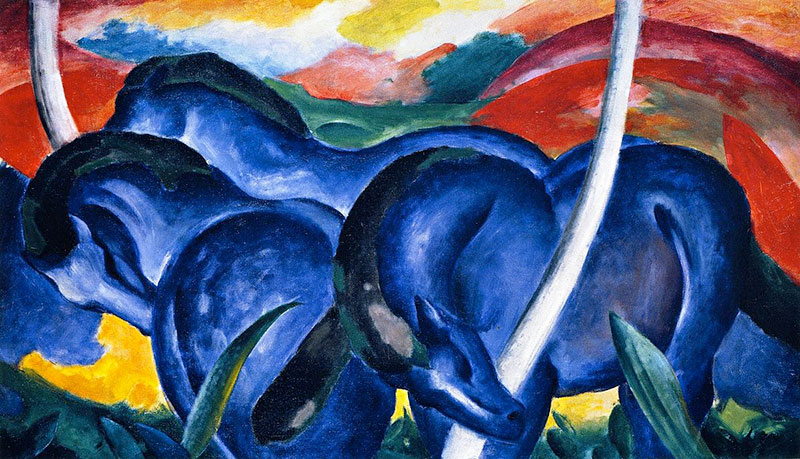
Marc’s painting style features simplified, rounded animal forms bathed in prismatic color harmony. His compositions balance dynamic movement with crystalline structure.
Recurring Themes & Motifs
Animals, particularly horses, served as symbols of purity and spirituality in Marc’s work. He explored harmony between creatures and nature through symbolic color systems.
Influences & Training
Academically trained in Munich, Marc was influenced by Parisian Post-Impressionism and developed his mature style through collaboration with Kandinsky in Der Blaue Reiter.
Notable Works
- Blue Horses (1911) – Walker Art Center, Minneapolis
- The Fate of the Animals (1913) – Kunstmuseum Basel
- The Tower of Blue Horses (1913) – Lost during WWII
Role in Art History
Marc’s spiritually-charged animal paintings exemplify German Expressionism’s search for authentic experience. His color theories influenced later abstract movements before his premature death in WWI.
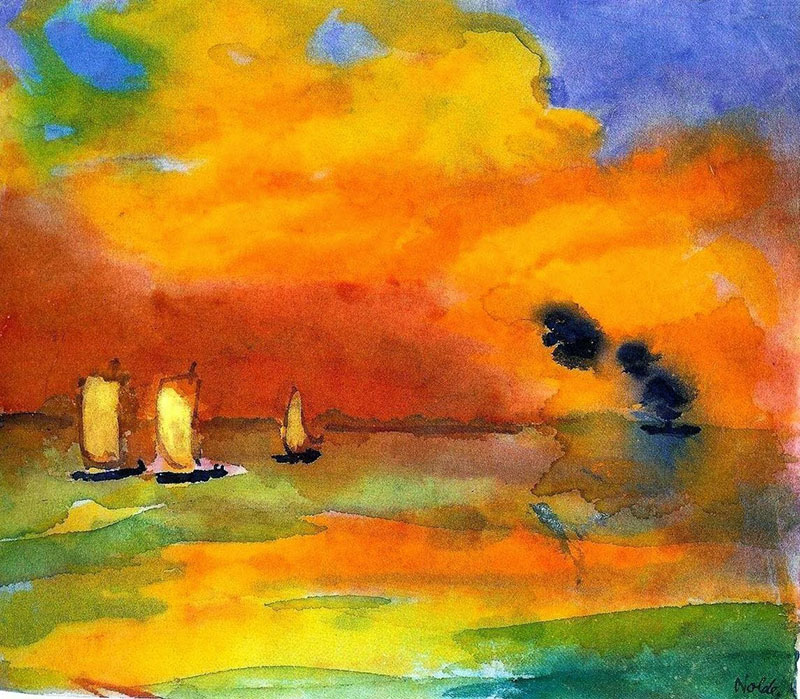
Emil Nolde (1867-1956)
Nationality: German-Danish
Art Movement(s): Expressionism, Die Brücke (briefly)
Mediums: Oil on canvas, watercolor, printmaking
Artistic Signature
Nolde’s style features intense, saturated primary colors and thick, spontaneous brushwork. His distorted figures and landscapes vibrate with emotional and spiritual energy.
Recurring Themes & Motifs
Religious imagery, stormy seascapes, exotic tribal figures, and garden flowers populate his works, often conveying both ecstatic spirituality and primal darkness.
Influences & Training
Largely self-taught, Nolde worked as a furniture carver before studying art. His travels to the South Pacific and exposure to primitive art profoundly shaped his approach.
Notable Works
- The Last Supper (1909) – Statens Museum for Kunst, Copenhagen
- Mask Still Life III (1911) – Nelson-Atkins Museum of Art, Kansas City
- Sea and Light Clouds (1935) – Nolde Foundation, Seebüll
Role in Art History
Despite brief association with Die Brücke, Nolde developed independently as one of Germany’s most important Expressionists, particularly noted for revolutionary watercolor techniques and spiritual intensity.
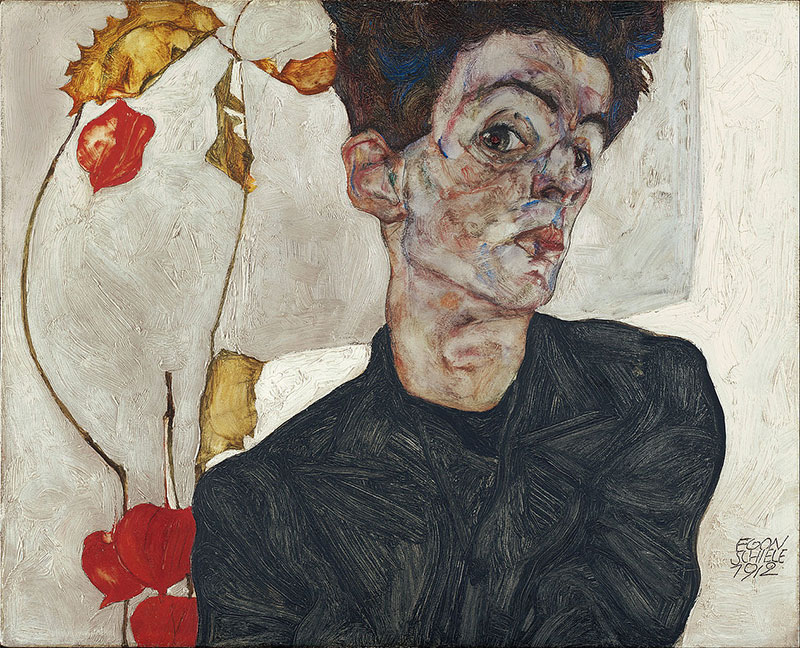
Egon Schiele (1890-1918)
Nationality: Austrian
Art Movement(s): Expressionism, Vienna Secession
Mediums: Oil on canvas, gouache, watercolor, drawings
Artistic Signature
Schiele’s nervous, angular line work creates contorted figures with expressive hands and emaciated bodies. His use of negative space and unconventional cropping emphasizes psychological emphasis and tension.
Recurring Themes & Motifs
Self-portraits, explicit sexuality, death, and isolation dominate his work, with figures often depicted in awkward, vulnerable poses against empty backgrounds.
Influences & Training
A protégé of Gustav Klimt at the Vienna Academy of Fine Arts, Schiele synthesized Viennese Secession decorative elements with raw expressionist distortion.
Notable Works
- Self-Portrait with Physalis (1912) – Leopold Museum, Vienna
- Death and the Maiden (1915-16) – Österreichische Galerie Belvedere, Vienna
- The Family (1918) – Österreichische Galerie Belvedere, Vienna
Role in Art History
Despite his brief career, cut short by Spanish flu, Schiele’s unflinching exploration of human sexuality and psychological states profoundly influenced figurative art and mid-century Neo-Expressionism.
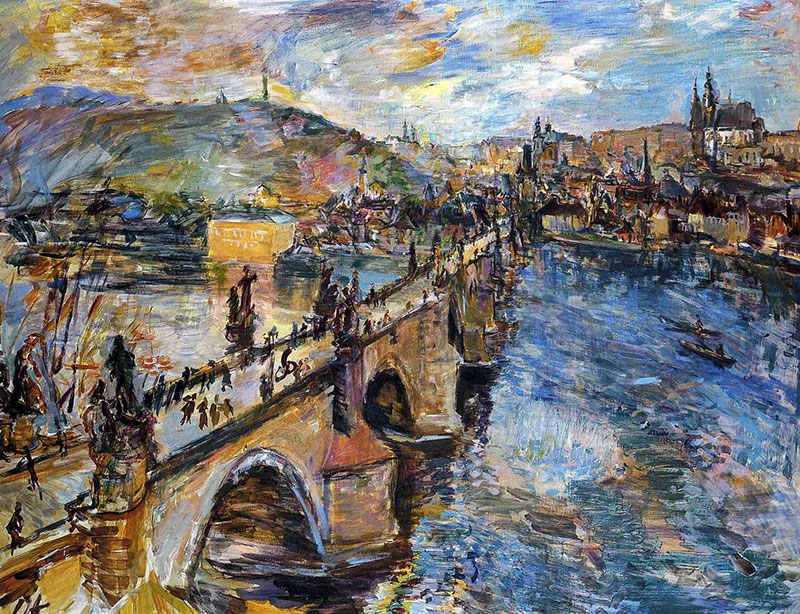
Oskar Kokoschka (1886-1980)
Nationality: Austrian
Art Movement(s): Expressionism
Mediums: Oil on canvas, lithography, drawings
Artistic Signature
Kokoschka’s style features nervous, scratchy brushwork and transparent layers of paint creating turbulent surfaces. His portraits capture psychological states through distorted features and atmospheric color wheel manipulations.
Recurring Themes & Motifs
Psychological portraiture, city landscapes as emotional states, and allegorical scenes tackling love, violence, and political turmoil dominate his extensive body of work.
Influences & Training
Educated at Vienna’s School of Arts and Crafts, Kokoschka drew inspiration from children’s art, primitive sources, and his own emotional experiences, particularly his tumultuous relationship with Alma Mahler.
Notable Works
- The Tempest (Bride of the Wind) (1914) – Kunstmuseum Basel
- Prague, Charles Bridge (1934) – National Gallery of Art, Washington D.C.
- Anschluss, Alice in Wonderland (1942) – University of Glasgow
Role in Art History
One of Expressionism’s longest-lived practitioners, Kokoschka maintained emotional intensity while adapting to changing times, influencing Neo-Expressionism and contemporary figurative art.
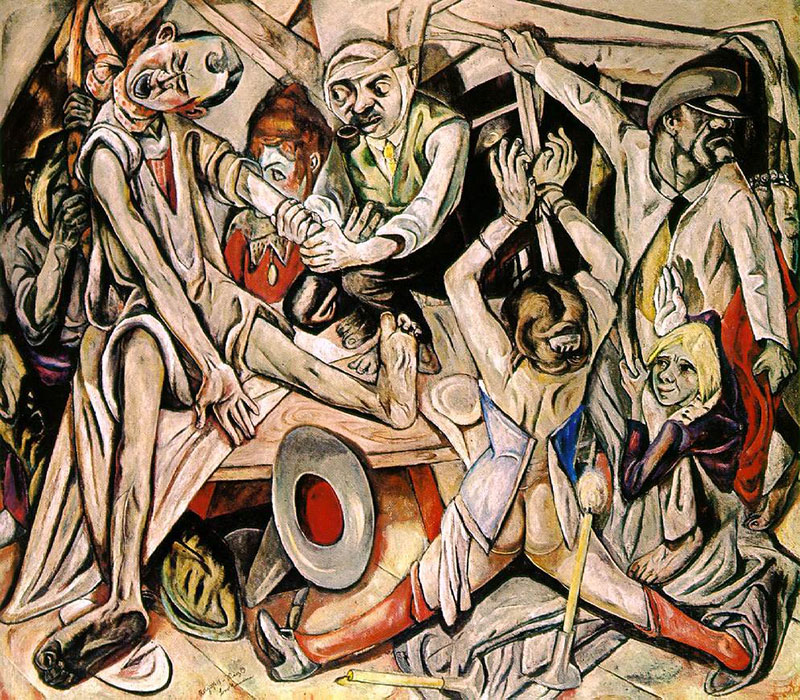
Max Beckmann (1884-1950)
Nationality: German
Art Movement(s): Expressionism, New Objectivity
Mediums: Oil on canvas, printmaking, sculpture
Artistic Signature
Beckmann employed compressed space, harsh black outlines, and complex compositional arrangements. His figures appear monumentally solid yet distorted, with flattened perspective.
Recurring Themes & Motifs
Circus performers, musicians, mythological scenes, and self-portraits recur throughout his work, exploring human cruelty, resilience, and transcendence through symbolic narratives.
Influences & Training
Classically trained at the Weimar Academy, Beckmann’s experiences as a medical orderly in WWI transformed his initially naturalistic style into something more brutally expressive.
Notable Works
- The Night (1918-19) – Kunstsammlung Nordrhein-Westfalen, Düsseldorf
- Beginning (1949) – Metropolitan Museum of Art, New York
- Self-Portrait with Horn (1938) – Neue Galerie, New York
Role in Art History
Beckmann’s psychologically complex work bridges German Expressionism and New Objectivity, maintaining figurative painting’s relevance during the rise of abstraction through mythic density and social critique.
Otto Dix (1891-1969)

Nationality: German
Art Movement(s): Expressionism, New Objectivity, Dadaism
Mediums: Oil and tempera on wood, printmaking, watercolor
Artistic Signature
Dix combined Old Master painting techniques with biting caricature and unflinching realism. His works feature meticulous detail, grotesque exaggeration, and acidic complementary colors.
Recurring Themes & Motifs
War trauma, social inequality, and Weimar Republic decadence appear repeatedly in his work, often juxtaposing glamour with corruption through brutal satire.
Influences & Training
After traditional training at the Dresden School of Arts and Crafts, Dix’s combat experience in WWI and exposure to Italian Renaissance masters shaped his technically precise yet emotionally savage style.
Notable Works
- The War Triptych (1929-32) – Galerie Neue Meister, Dresden
- Portrait of the Journalist Sylvia von Harden (1926) – Centre Pompidou, Paris
- Metropolis (1927-28) – Kunstmuseum Stuttgart
Role in Art History
Dix’s unflinching documentation of war’s horrors and Weimar society’s contradictions exemplifies art’s potential for social criticism, influencing later politically engaged artists.
George Grosz (1893-1959)

Nationality: German-American
Art Movement(s): Expressionism, New Objectivity, Dada
Mediums: Oil on canvas, watercolor, drawings
Artistic Signature
Grosz developed a brittle linear style with graphic precision and monochromatic color schemes. His caricatural figures and architectural settings often create theatrical, nightmarish scenarios.
Recurring Themes & Motifs
Corrupt officials, bloated capitalists, and war-damaged veterans populate his scathing critiques of Weimar Germany’s social hypocrisy and political violence.
Influences & Training
Trained at Dresden Academy of Fine Arts and Berlin School of Arts and Crafts, Grosz synthesized elements from political cartoons, cabaret art, and advertising in his uncompromising social satire.
Notable Works
- Metropolis (1916-17) – Museo Thyssen-Bornemisza, Madrid
- Eclipse of the Sun (1926) – Heckscher Museum of Art, New York
- The Pillars of Society (1926) – Nationalgalerie, Berlin
Role in Art History
Grosz’s incisive political critiques established him as one of art’s most powerful social commentators, connecting Expressionism to Dada and influencing later political art and illustration.
Käthe Kollwitz (1867-1945)

Nationality: German
Art Movement(s): Expressionism, Social Realism
Mediums: Printmaking, drawing, sculpture
Artistic Signature
Kollwitz mastered stark black and white contrasts using simplified forms and powerful gestural lines. Her work conveys profound emotion through minimal means, emphasizing scale and proportion for maximum impact.
Recurring Themes & Motifs
Working-class struggles, maternal grief, death, war, and sacrifice recur throughout her work, often depicted through protective maternal figures and suffering children.
Influences & Training
Trained at the Women’s Art School in Berlin and in Paris, Kollwitz drew inspiration from naturalist literature, medieval German art, and her own experiences as a doctor’s wife in a working-class district.
Notable Works
- The Weavers’ Revolt (1893-98) – Print cycle
- Woman with Dead Child (1903) – Käthe Kollwitz Museum, Cologne
- The Grieving Parents (1932) – Vladslo German war cemetery, Belgium
Role in Art History
Kollwitz’s emotionally powerful work established her as Expressionism’s conscience, demonstrating art’s capacity for social advocacy without sacrificing formal quality or universal empathy.
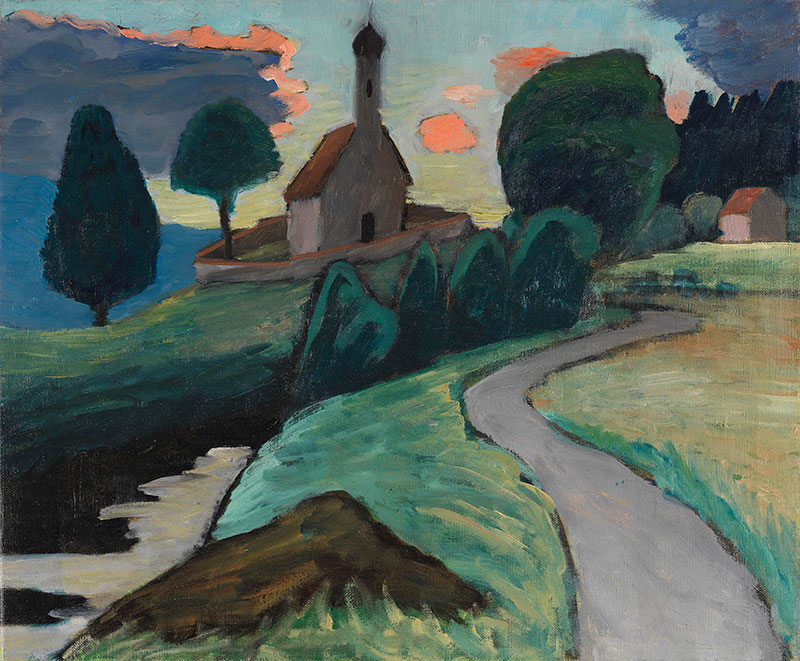
Gabriele Münter (1877-1962)
Nationality: German
Art Movement(s): Expressionism, Der Blaue Reiter
Mediums: Oil painting, printmaking, glass painting
Artistic Signature
Münter developed a bold style featuring simplified forms, strong outlines, and vibrant flat areas of pure color. Her work achieves emotional resonance through economy of means and rhythmic composition.
Recurring Themes & Motifs
Alpine landscapes, intimate domestic scenes, and folk-influenced portraits reflect her interest in capturing psychological essence through color and simplified form.
Influences & Training
After studying at ladies’ art schools, Münter developed her mature style through her relationship with Kandinsky and interaction with folk art traditions around Murnau, Bavaria.
Notable Works
- Landscape with Church (1910) – Milwaukee Art Museum
- Still Life with St. George (1911) – Städtische Galerie im Lenbachhaus, Munich
- Portrait of Marianne von Werefkin (1909) – Private Collection
Role in Art History
Long overshadowed by male colleagues, Münter’s vital contributions to Der Blaue Reiter and German Expressionism showcase her pioneering approach to color and form, preserved through her protection of the group’s artworks during WWII.
Alexej von Jawlensky (1864-1941)

Nationality: Russian
Art Movement(s): Expressionism, Der Blaue Reiter, New Artists’ Association of Munich
Mediums: Oil on board, oil on canvas
Artistic Signature
Jawlensky’s distinctive style features bold, non-naturalistic colors with heavy black outlines. He progressively simplified forms towards icon-like abstraction, creating meditative faces with asymmetrical balance.
Recurring Themes & Motifs
Stylized portraits, mystical heads, and abstract facial constructions dominate his oeuvre, exploring spirituality through serial variations on limited themes.
Influences & Training
After military academy, Jawlensky studied at the St. Petersburg Academy of Arts before moving to Munich, where he absorbed Fauvism and developed his unique approach through spiritual studies.
Notable Works
- Schokko with Wide-Brimmed Hat (1910) – Private Collection
- Abstract Head: Light, Life, Joy (1926) – Museum Wiesbaden
- Meditation (1934) – Norton Simon Museum, Pasadena
Role in Art History
Jawlensky’s evolution from colorful expressionism to serene abstraction demonstrates Expressionism’s spiritual dimensions and connection to Russian icon traditions that influenced abstract portraiture.
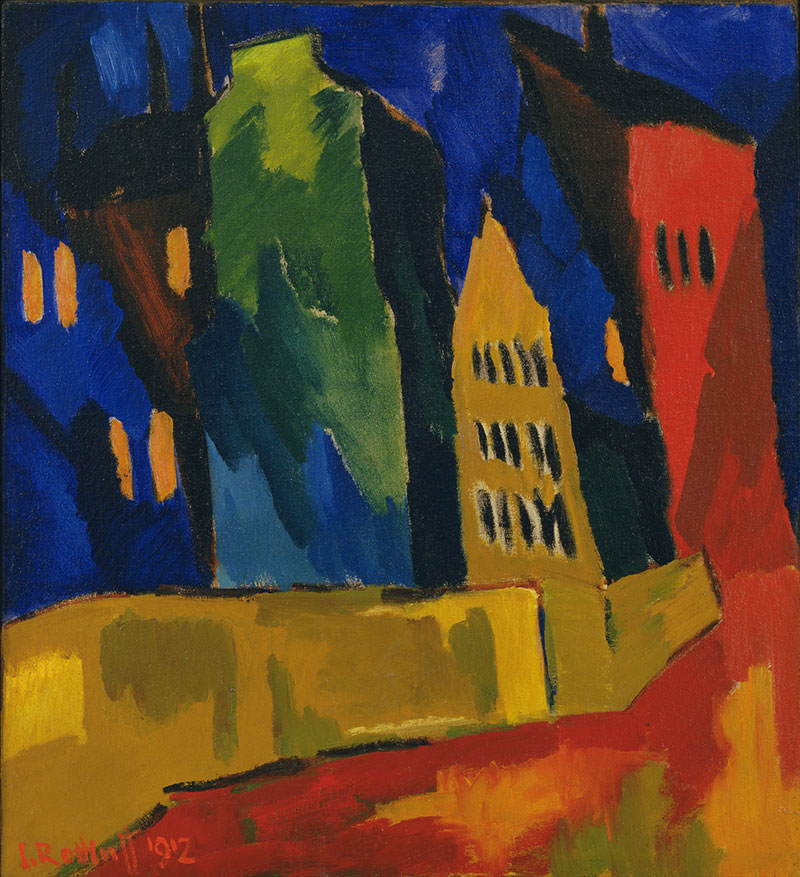
Karl Schmidt-Rottluff (1884-1976)
Nationality: German
Art Movement(s): Expressionism, Die Brücke
Mediums: Oil on canvas, woodcut prints, sculpture
Artistic Signature
Schmidt-Rottluff’s angular, geometric simplification creates powerfully direct images. His bold painting styles feature flat planes of unmixed color with rough textures and jagged forms.
Recurring Themes & Motifs
Rugged landscapes, primitive-inspired nudes, and mask-like portraits reveal his interest in non-Western art forms and spiritual directness.
Influences & Training
Self-taught as an artist while studying architecture, Schmidt-Rottluff co-founded Die Brücke with Kirchner and developed his style through engagement with African and Oceanic tribal art.
Notable Works
- Houses at Night (1912) – Museum of Modern Art, New York
- Self-Portrait with Monocle (1910) – Brücke Museum, Berlin
- Pharisees (1912) – Museum Ludwig, Cologne
Role in Art History
As a Die Brücke founder, Schmidt-Rottluff’s bold formal innovations advanced Expressionism’s aesthetic revolution, particularly in printmaking where his woodcuts show unparalleled directness and force.
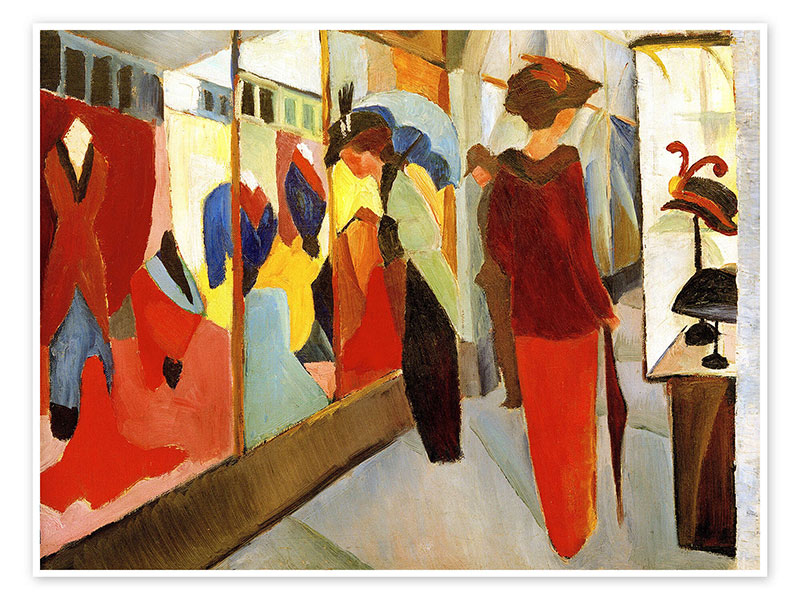
August Macke (1887-1914)
Nationality: German
Art Movement(s): Expressionism, Der Blaue Reiter
Mediums: Oil on canvas, watercolor, prints
Artistic Signature
Macke combined expressionist color with more harmonious composition than his contemporaries. His technique features luminous, transparent color relationships and rhythmic arrangements of simplified forms.
Recurring Themes & Motifs
Urban leisure scenes, couples strolling in parks, fashion shops, and zoo animals appear frequently, transforming everyday life through prismatic color and gentle abstraction.
Influences & Training
After academic training in Düsseldorf and Berlin, Macke synthesized influences from Robert Delaunay’s Orphism, Cubism, and Islamic art observed during travels in Tunisia.
Notable Works
- Fashion Shop (1913) – Sprengel Museum, Hanover
- Zoological Garden I (1912) – Städtische Galerie im Lenbachhaus, Munich
- Turkish Cafe (1914) – Städtische Galerie im Lenbachhaus, Munich
Role in Art History
Despite his tragically short career, cut off in WWI, Macke’s joyful, harmonious approach to Expressionism bridges German and French modernism, demonstrating the movement’s lyrical possibilities.
FAQ on Expressionism Artists
Who were the most influential Expressionism artists?
The movement’s giants include Edvard Munch, Ernst Ludwig Kirchner, Emil Nolde, and Wassily Kandinsky.
Key figures also emerged from two main groups: Die Brücke (Kirchner, Karl Schmidt-Rottluff, Erich Heckel) and Der Blaue Reiter (Kandinsky, Franz Marc, Gabriele Münter). Their bold brushstrokes and emotional intensity revolutionized modern art.
What distinguishes Expressionism from other modern art movements?
Expressionism prioritizes emotional truth over visual accuracy. Unlike Impressionism (capturing light effects) or Cubism (analyzing form), Expressionists use distorted shapes, vivid tertiary colors, and dynamic compositions to express inner psychological states.
This spiritual and emotional focus sets them apart from more analytical movements.
When and where did Expressionism develop?
Expressionism emerged primarily in Germany between 1905-1925. The movement took shape through Die Brücke (founded 1905 in Dresden) and Der Blaue Reiter (established 1911 in Munich).
While predominantly German, the movement’s roots trace to Norwegian painter Edvard Munch and influenced artists across Europe during the turbulent pre-war and interwar periods.
What themes did Expressionist artists commonly explore?
Expressionist work frequently addresses anxiety, alienation, and spiritual yearning. Artists depicted urban isolation, psychological distress, and existential themes through symbolic imagery.
Many explored primitive influences and non-Western art while rejecting industrialization. Their bold artistic expression often featured raw emotional content confronting mortality, sexuality, and social criticism.
How did World War I affect Expressionist artists?
The war profoundly transformed Expressionism. Several key figures died in combat (Franz Marc, August Macke) while others experienced trauma that darkened their work.
Otto Dix and George Grosz developed brutally satirical styles documenting war’s horrors.
The conflict intensified the movement’s emphasis on human suffering and societal critique with heightened psychological intensity.
What techniques and painting mediums did Expressionists favor?
Expressionists often used thick application of oil painting with visible brushstrokes. They embraced woodcuts for their primal directness and employed non-naturalistic color psychology for emotional impact.
Their techniques featured distorted perspectives, flattened spaces, and angular forms that sacrificed realism for expressive power.
How did Expressionism influence later art movements?
Expressionism’s emotional intensity directly shaped Abstract Expressionism, Neo-Expressionism, and aspects of Surrealism.
Its psychological depth influenced figurative painting throughout the 20th century.
The movement’s approach to color, form, and emotional content continues impacting contemporary art, particularly in painting that prioritizes expressive qualities over technical precision.
What role did women play in the Expressionist movement?
Women artists like Gabriele Münter, Marianne von Werefkin, and Paula Modersohn-Becker made substantial contributions despite historical marginalization.
Münter preserved Der Blaue Reiter works during Nazi persecution.
Käthe Kollwitz, though not strictly an Expressionist, created emotionally powerful prints addressing social injustice with expressionistic techniques and profound emphasis.
How did the Nazi regime affect Expressionist artists?
The Nazis labeled Expressionism “degenerate art,” confiscating over 16,000 modernist works from museums. Many artists fled Germany; others faced exhibition bans.
Emil Nolde, despite Nazi party membership, saw 1,052 works confiscated.
This persecution scattered collections worldwide and drove the movement underground until post-war rehabilitation restored its significant cultural importance.
What are the most famous Expressionist artworks?
Edvard Munch’s “The Scream” (1893) remains Expressionism’s defining image. Other iconic works include Kirchner’s “Street, Berlin” (1913), Kandinsky’s “Composition VII” (1913), Marc’s “Blue Horses” (1911), and Emil Nolde’s vibrant floral paintings. Otto Dix’s “War Triptych” (1929-32) and Max Beckmann’s “The Night” (1918-19) exemplify the movement’s powerful social commentary.
Conclusion
Expressionism artists forever transformed modern art through their radical rejection of objective reality.
Their commitment to emotional truth over visual accuracy created a powerful visual language that continues to resonate today.
These pioneering creators worked with profound conviction, using vivid secondary colors and dynamic brushwork to expose the human condition.
The movement’s legacy extends far beyond its historical moment. Through their distorted forms and psychological intensity, Expressionists like Franz Marc and Käthe Kollwitz established:
- A visual vocabulary for depicting inner states
- Techniques prioritizing emotional harmony over realism
- Artistic approaches that validated subjective experience
- Foundations for later movements from Neo-Expressionism to figuration
The spiritual dimensions and raw authenticity of Expressionism proved art’s capacity to confront difficult truths.
Through bold composition choices and symbolic content, these artists created works of lasting power that continue challenging viewers to look beyond surfaces into the depths of human experience.