The dream world broke free onto canvas when surrealism emerged from the chaos of post-WWI Europe.
Born from Dadaism and nurtured by the theories of Sigmund Freud, this revolutionary movement unleashed the unconscious mind through bizarre juxtapositions and dreamlike imagery that continue to captivate viewers today.
Surrealism artists transformed ordinary perception through automatic drawing, symbolism, and psychological tension.
Salvador Dalí’s melting clocks, René Magritte’s visual paradoxes, and Frida Kahlo’s unflinching self-portraits each explored unique dreamscapes while challenging conventional reality.
Beyond the famous names lie equally revolutionary figures. Women like Leonora Carrington and Remedios Varo wove mythology and mysticism into fantastical scenes, while innovators such as Max Ernst pioneered collage techniques and frottage to bypass conscious creation.
This exploration highlights fifteen pioneering surrealists whose work forever altered modern art.
We’ll examine their distinctive techniques, recurring motifs, and lasting cultural impact-revealing why these visionaries of the irrational continue to influence contemporary creativity across all media.
Surrealism Artists
Salvador Dal7í (1904-1989)

Nationality: Spanish
Art Movement(s): Surrealism, Dadaism
Mediums: Oil painting, sculpture, film, photography
Artistic Signature
Dalí mastered hyper-realistic rendering with distorted perspective and impossible physics. His precise technique created dreamscapes where solid objects melt, float, or transform into unexpected forms.
Recurring Themes & Motifs
His imagery drew heavily from psychology, exploring unconscious desires, sexuality, and mortality. Recurring motifs include melting clocks, crutches, ants, and the barren landscapes of his native Catalonia.
Influences & Training
Trained at Madrid’s Royal Academy of Fine Arts, Dalí absorbed Renaissance masters’ techniques while embracing Freudian theories. His technical precision was influenced by Vermeer and his fantastical elements by Hieronymus Bosch.
Notable Works
- The Persistence of Memory (1931) – Oil on canvas, Museum of Modern Art, New York
- The Great Masturbator (1929) – Oil on canvas, Museo Reina Sofía, Madrid
- Soft Construction with Boiled Beans (Premonition of Civil War) (1936) – Philadelphia Museum of Art
Role in Art History
Dalí’s exploration of the unconscious and technical brilliance made him surrealism’s most famous practitioner. His eccentric personality and commercial ventures brought avant-garde concepts to mainstream audiences worldwide.
René Magritte (1898-1967)

Nationality: Belgian
Art Movement(s): Surrealism
Mediums: Oil on canvas
Artistic Signature
Magritte’s work features clear, precise rendering with flat color contrast. His straightforward, almost illustrative style creates uncanny scenes where everyday objects appear in impossible contexts.
Recurring Themes & Motifs
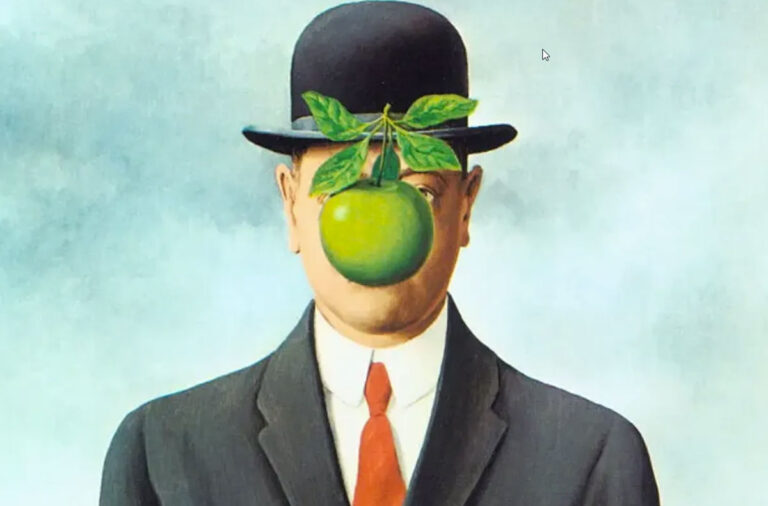
He questioned reality and representation through visual paradoxes. Common elements include men in bowler hats, clouds, birds, pipes, and curtains, often arranged to challenge viewers’ perception of the ordinary.
Influences & Training
Initially influenced by Cubism and Futurism, Magritte discovered Giorgio de Chirico’s metaphysical paintings which inspired his shift toward conceptual surrealism focused on philosophical puzzles rather than dreams.
Notable Works
- The Treachery of Images (This is Not a Pipe) (1929) – Los Angeles County Museum of Art
- The Empire of Light series (1950s) – Various museums
- The Son of Man (1964) – Private collection
Role in Art History
Magritte developed conceptual surrealism that questioned the relationship between images, objects, and language. His thought-provoking visual paradoxes influenced later movements including conceptual art and pop.
Max Ernst (1891-1976)
Nationality: German, later French and American
Art Movement(s): Dadaism, Surrealism
Mediums: Oil, collage, frottage, sculpture
Artistic Signature
Ernst pioneered innovative techniques like frottage (rubbing surfaces to create patterns) and decalcomania (pressing paint between surfaces). These methods created rich textures and organic forms with unusual rhythm.
Recurring Themes & Motifs
Mysterious forests, hybrid bird-men, and strange mechanical constructions populate his works. He often explored themes of alienation, transformation, and the relationship between humans and nature.
Influences & Training
Self-taught in painting, Ernst studied philosophy at Bonn University. His wartime experiences in WWI profoundly shaped his worldview, while Freudian concepts informed his approach to the unconscious and automatic techniques.
Notable Works
- Europe After the Rain II (1940-42) – Wadsworth Atheneum, Hartford
- The Elephant Celebes (1921) – Tate Modern, London
- Two Children Are Threatened by a Nightingale (1924) – Museum of Modern Art, New York
Role in Art History
Ernst was instrumental in developing techniques that bypassed conscious creation, revealing subconscious imagery. His experimental methods and dreamlike imagery helped define surrealism’s visual vocabulary and influenced abstract expressionism.
Frida Kahlo (1907-1954)

Nationality: Mexican
Art Movement(s): Surrealism, Mexican folk art
Mediums: Oil on canvas, self-portraiture
Artistic Signature
Kahlo’s distinctive style blends realism with symbolic elements and flattened composition. Her vivid palette draws from Mexican folk traditions, while her unflinching gaze creates intensely personal images.
Recurring Themes & Motifs
Her work centered on identity, gender, class, and postcolonialism. Medical imagery, Mexican symbols, animals, and natural elements frequently appear in her paintings, reflecting her physical suffering and cultural heritage.
Influences & Training
Self-taught after a devastating bus accident confined her to bed. Her approach was shaped by Mexican retablo painting, pre-Columbian art, and European traditions she studied through art books during recovery.
Notable Works
- The Two Fridas (1939) – Museo de Arte Moderno, Mexico City
- The Broken Column (1944) – Museo Dolores Olmedo, Mexico City
- Self-Portrait with Thorn Necklace and Hummingbird (1940) – University of Texas, Austin
Role in Art History
Initially classified with surrealists (though she rejected the label), Kahlo pioneered autobiographical art that merged personal and political themes. Her unflinching self-portraits expanded representation of female experience in art.
Joan Miró (1893-1983)

Nationality: Spanish (Catalan)
Art Movement(s): Surrealism, Dada
Mediums: Oil, watercolor painting, sculpture, ceramics, printmaking
Artistic Signature
Miró developed a visual language of simplified forms and bold colors. His whimsical, organic shapes and meandering lines float against flat backgrounds, creating playful space and balance.
Recurring Themes & Motifs
Cosmic imagery, stars, and biomorphic forms appear frequently. His pictorial vocabulary includes birds, women, and celestial elements, often reduced to their simplest forms while maintaining symbolic resonance.
Influences & Training
Formally trained at Barcelona’s School of Fine Arts and Francesc Galí’s art academy. Early influences included Fauvism and Cubism before his distinct style emerged through exposure to Dadaist ideas and surrealist automatic techniques.
Notable Works
- The Farm (1921-22) – National Gallery of Art, Washington D.C.
- Harlequin’s Carnival (1924-25) – Albright-Knox Art Gallery, Buffalo
- Blue II (1961) – Centre Pompidou, Paris
Role in Art History
Miró bridged surrealism and abstraction, developing a distinctive visual language that influenced abstract expressionism and later generations of abstract painters. His playful approach to serious art expanded creative possibilities.
Man Ray (1890-1976)

Nationality: American, active in France
Art Movement(s): Dada, Surrealism
Mediums: Photography, film, painting, sculpture, objects
Artistic Signature
Man Ray revolutionized photography through techniques like solarization and rayographs (camera-less photographs). His work across multiple painting mediums displayed a consistent interest in transforming ordinary objects.
Recurring Themes & Motifs
His work often explored the relationship between art, objects, and the body. Everyday items removed from their context, female figures, and mathematical references recur throughout his diverse output.
Influences & Training
Largely self-taught, Man Ray absorbed modernist ideas at Alfred Stieglitz’s gallery and became part of New York’s avant-garde before moving to Paris, where collaboration with Marcel Duchamp shaped his conceptual approach.
Notable Works
- Le Violon d’Ingres (1924) – Photograph
- Object to Be Destroyed/Indestructible Object (1923, remade multiple times) – Metronome with eye
- A l’Heure de l’Observatoire: Les Amoureux (1934) – Painting
Role in Art History
Man Ray expanded surrealism beyond painting into photography and film. His experimental techniques and conceptual approach to images influenced advertising, fashion photography, and later conceptual art movements.
Leonora Carrington (1917-2011)

Nationality: British-Mexican
Art Movement(s): Surrealism
Mediums: Oil painting, sculpture, writing
Artistic Signature
Carrington created densely populated, narrative scenes filled with hybrid creatures. Her meticulous technique employed thin glazes of paint to achieve jewel-like color harmony and luminosity.
Recurring Themes & Motifs
Her imagery drew from Celtic mythology, alchemy, Kabbalah, and indigenous Mexican traditions. Recurring elements include horses, eggs, cauldrons, and transformative female figures engaged in ritual activities.
Influences & Training
Educated at London’s Chelsea School of Art and influenced by Max Ernst, with whom she had a relationship. Her style developed further after fleeing to Mexico, where she absorbed local folklore and pre-Columbian symbolism.
Notable Works
- Self-Portrait (Inn of the Dawn Horse) (1937-38) – Metropolitan Museum of Art, New York
- The Giantess (The Guardian of the Egg) (1947) – Private collection
- The House Opposite (1945) – Art Institute of Chicago
Role in Art History
Carrington expanded surrealism’s scope by incorporating feminist perspectives and diverse mythological traditions. Her exploration of female experience and cosmic consciousness enriched the movement’s visual and conceptual vocabulary.
Giorgio de Chirico (1888-1978)

Nationality: Italian, born in Greece
Art Movement(s): Metaphysical art, early influence on Surrealism
Mediums: Oil on canvas
Artistic Signature
De Chirico created eerily empty urban scenes with sharp, elongated shadows and flattened perspective. His dream-like architectural vistas combine classical elements with modern unease.
Recurring Themes & Motifs
Deserted Italian piazzas, classical statues, mannequins, trains, and long shadows recur throughout his metaphysical period. These elements create a sense of mystery, melancholy, and suspended time.
Influences & Training
Studied at the Athens Polytechnic and Munich Academy of Fine Arts. Friedrich Nietzsche’s philosophical writings and Arnold Böcklin’s symbolist paintings profoundly influenced his enigmatic approach to pictorial space.
Notable Works
- The Enigma of an Autumn Afternoon (1910) – Private collection
- The Nostalgia of the Infinite (1911) – Museum of Modern Art, New York
- Mystery and Melancholy of a Street (1914) – Private collection
Role in Art History
Though he predated official surrealism, de Chirico’s dreamlike architectural scenes and theory of metaphysical art provided essential foundations for surrealist imagery. His influence extends to René Magritte and magical realism.
Remedios Varo (1908-1963)

Nationality: Spanish-Mexican
Art Movement(s): Surrealism
Mediums: Oil on masonite, mixed media
Artistic Signature
Varo developed a meticulous technique using thin glazes to create luminous surfaces. Her precisely rendered architectural spaces and machinery contain fluid, organic elements with delicate color psychology enhancing their dream quality.
Recurring Themes & Motifs
Mystical journeys, transformation, and scientific-magical hybrid activities fill her works. Recurring elements include winged beings, wheeled vehicles, cats, owls, and androgynous figures engaged in alchemical or astronomical pursuits.
Influences & Training
Trained at Madrid’s San Fernando Academy of Fine Arts. European surrealism shaped her early work, while exile in Mexico exposed her to mystical traditions. Her scientific knowledge (her father was a hydraulic engineer) informed her intricate mechanisms.
Notable Works
- Creation of the Birds (1957) – Museo de Arte Moderno, Mexico City
- The Juggler (The Magician) (1956) – Private collection
- Celestial Pablum (1958) – Private collection
Role in Art History
Varo expanded surrealism to include women’s experience and esoteric knowledge. Her scientific-magical worldview created unique imagery that bridged rationalism and mysticism, influencing later magical realist and feminist artists.
Yves Tanguy (1900-1955)

Nationality: French-American
Art Movement(s): Surrealism
Mediums: Oil on canvas
Artistic Signature
Tanguy created vast, barren landscapes populated by ambiguous biomorphic forms. His smooth technique and precise shadows give three-dimensional weight to impossible objects rendered with asymmetrical balance.
Recurring Themes & Motifs
Desolate horizons, mysterious structures, and stone-like organic forms create alien yet familiar environments. His works suggest geological or underwater formations in a timeless, uninhabited world.
Influences & Training
Self-taught as a painter, Tanguy was inspired to become an artist after seeing a painting by Giorgio de Chirico. André Breton’s surrealist circle provided his artistic education through discussion and collaborative techniques.
Notable Works
- Indefinite Divisibility (1942) – Albright-Knox Art Gallery, Buffalo
- Mama, Papa is Wounded! (1927) – Museum of Modern Art, New York
- The Ribbon of Extremes (1932) – Metropolitan Museum of Art, New York
Role in Art History
Tanguy’s distinctive landscapes influenced science fiction imagery and abstract surrealists. His ability to render imaginary forms with geological precision created a bridge between biomorphic abstraction and dream imagery.
Dorothea Tanning (1910-2012)

Nationality: American
Art Movement(s): Surrealism, later Abstract Expressionism
Mediums: Oil painting, soft sculpture, printmaking
Artistic Signature
Tanning’s early work featured hyper-realistic rendering of impossible scenes, often with Gothic undertones. Later, her style evolved toward more fluid painting styles with fragmented forms and prismatic light effects.
Recurring Themes & Motifs
Domestic spaces transformed into sites of mysterious encounters, often featuring young girls at the threshold of transformation. Doors, sunflowers, chess motifs, and fabric elements recur throughout her work.
Influences & Training
Self-taught as a painter after studying art briefly in Chicago. Her approach was shaped by Renaissance masters, Surrealist principles, and later by her own soft sculpture explorations that informed her painterly emphasis.
Notable Works
- Birthday (1942) – Philadelphia Museum of Art
- Eine Kleine Nachtmusik (1943) – Tate Modern, London
- Hôtel du Pavot, Chambre 202 (1970-73) – Installation, Centre Pompidou, Paris
Role in Art History
Tanning expanded surrealism’s exploration of female experience and domestic space. Her seven-decade career bridged surrealism’s dreamscapes and later abstraction, consistently examining transformation and liminal states.
André Breton (1896-1966)

Nationality: French
Art Movement(s): Dadaism, Surrealism
Mediums: Writing, collage, objects
Artistic Signature
Though primarily a writer, Breton created visual art featuring unexpected juxtapositions of found objects and text. His collages and assemblages embodied surrealist principles of disorientation and surprising connections.
Recurring Themes & Motifs
His visual works, like his writing, explored chance operations, unconscious association, and cultural critique. References to occult traditions, primitive art, and revolutionary politics appeared throughout his creative output.
Influences & Training
Trained in medicine and psychiatry, Breton worked in neurological wards during WWI. This experience with traumatized soldiers and Freudian theory profoundly shaped his approach to art and the unconscious mind.
Notable Works
- Surrealist Manifesto (1924) – Text
- Poem-Objects (various dates) – Mixed media assemblages
- Exquisite Corpse drawings (collaborative works)
Role in Art History
As surrealism’s founder and chief theorist, Breton defined the movement’s principles and practices.
His emphasis on automatic creation techniques and merging of revolutionary politics with psychological liberation influenced all surrealist artists.
Meret Oppenheim (1913-1985)

Nationality: German-Swiss
Art Movement(s): Surrealism
Mediums: Sculpture, objects, painting, poetry
Artistic Signature
Oppenheim transformed familiar objects by combining them with unexpected materials. Her work often features tactile elements that create visceral responses through textural contrasts and material variety.
Recurring Themes & Motifs
Her art frequently explored femininity, consumption, and the body through disturbing or humorous transformations of everyday items. Natural elements like fur, feathers, and bones appear in unexpected contexts.
Influences & Training
Studied briefly at schools in Basel and Paris, but largely developed her approach through involvement with surrealist circles. Man Ray’s photography and Marcel Duchamp’s readymades influenced her object-based conceptual approach.
Notable Works
- Object (Breakfast in Fur) (1936) – Museum of Modern Art, New York
- My Nurse (1936) – Moderna Museet, Stockholm
- Table with Bird’s Legs (1939) – Various versions
Role in Art History
Oppenheim created some of surrealism’s most iconic objects, challenging functional design through uncanny transformations. Her feminist approach to surrealist objects opened new possibilities for conceptual sculpture and installation art.
Paul Delvaux (1897-1994)

Nationality: Belgian
Art Movement(s): Surrealism
Mediums: Oil painting, watercolor, drawing
Artistic Signature
Delvaux painted dreamlike scenes with academic precision. His tableaux combine classical architecture with nude figures in impossible scenarios, rendered with careful attention to light and shadow.
Recurring Themes & Motifs
Train stations, classical ruins, and sleepwalking nude women populate his mysterious nocturnal scenes. Skeletons, mirrors, and men in bowler hats create unsettling juxtapositions within seemingly orderly compositions.
Influences & Training
Trained at Brussels’ Académie Royale des Beaux-Arts in a traditional academic style. His early work showed influences of expressionism and symbolism before discovering Giorgio de Chirico and René Magritte.
Notable Works
- The Sleeping Venus (1944) – Tate Gallery, London
- Phases of the Moon (1939) – Museum of Modern Art, New York
- The Echo (1943) – Royal Museums of Fine Arts, Belgium
Role in Art History
Delvaux created a distinctive form of surrealism that combined classical technique with dream narrative. His theatrical scenes explored unconscious desire while maintaining conscious technical control, influencing magical realism and neoclassicism.
Alberto Giacometti (1901-1966)

Nationality: Swiss
Art Movement(s): Surrealism, later Existentialism
Mediums: Sculpture, painting, drawing
Artistic Signature
During his surrealist period, Giacometti created symbolic objects and abstract forms exploring psychological space. His work employed spatial ambiguity with precise attention to scale and isolation.
Recurring Themes & Motifs
His surrealist works explored violence, desire, and game structures. Cage-like constructions, primitive-inspired forms, and horizontal structures suggesting psychological landscapes characterized his surrealist period.
Influences & Training
Studied at Geneva School of Fine Arts and in Paris under Antoine Bourdelle. Early influences included Cubism and African sculpture, while his father’s post-impressionist painting provided his foundation in artistic traditions.
Notable Works
- Suspended Ball (1930-31) – Various versions
- Woman with Her Throat Cut (1932) – Museum of Modern Art, New York
- The Palace at 4 a.m. (1932) – Museum of Modern Art, New York
Role in Art History
Giacometti’s surrealist sculptures explored psychological space through abstract symbols and disturbing juxtapositions. His work bridged surrealism’s psychological concerns with later existentialist art examining human isolation.
FAQ on Surrealism Artists
Who are the most famous Surrealism artists?
The most recognized surrealism artists include Salvador Dalí, René Magritte, Max Ernst, and Frida Kahlo.
Other notable figures are Joan Miró, Man Ray, Leonora Carrington, and Giorgio de Chirico. Each developed unique visual languages exploring dream imagery and the unconscious mind.
What techniques did Surrealism artists use?
Surrealists employed automatic drawing to bypass conscious control, frottage (rubbing surfaces to create textures), decalcomania (pressing paint between surfaces), collage, and photomontage.
Many combined precise realistic rendering with impossible juxtapositions, while others created more abstract dreamscapes with biomorphic forms.
How did Surrealism begin?
Surrealism emerged from Dadaism after World War I, officially launching with André Breton’s Surrealist Manifesto in Paris, 1924.
Influenced by Freudian psychology, the movement sought to resolve contradictions between dreams and reality through artistic expression that freed the unconscious from rational control.
What are common themes in Surrealist art?
Surrealist works often explore psychological tension, sexuality, desire, and the unconscious mind. Recurring motifs include bizarre juxtapositions, metamorphosis, dreamscapes, and symbolic objects.
Many artists incorporated elements of fantasy while challenging conventional perception through irrational scenes and visual paradoxes.
Did women play an important role in Surrealism?
Women were vital to surrealism despite initial marginalization. Artists like Leonora Carrington, Remedios Varo, Dorothea Tanning, and Frida Kahlo created distinctive works exploring female experience, mythology, and identity.
Many incorporated mysticism, personal symbolism, and critiques of gender relations in their fantastical imagery.
How did Salvador Dalí contribute to Surrealism?
Salvador Dalí developed the “paranoiac-critical method” to access hallucinatory forms. His technical brilliance created hyper-realistic dreamscapes with melting clocks, elongated figures, and precise rendering of impossible scenarios.
His eccentric personality and commercial ventures brought surrealist concepts to mainstream audiences worldwide.
What makes René Magritte’s Surrealism unique?
René Magritte created conceptual surrealism focused on philosophical puzzles rather than dreams.
Using clean, illustrative technique with flat color theory applications, he placed ordinary objects in impossible contexts to question the relationship between images, words, and reality.
How did Surrealism influence later art movements?
Surrealism profoundly impacted abstract expressionism, pop art, and conceptual art. Its exploration of unconscious creativity influenced modern advertising, fashion photography, film, and digital art.
Surrealist ideas about accessing deeper consciousness continue to inspire contemporary artists exploring psychological and dreamlike imagery.
What painting mediums did Surrealists prefer?
Most surrealists used traditional oil painting for its precision and rich color possibilities. Some, like Joan Miró, employed watercolor painting for spontaneous effects.
Many expanded beyond conventional painting mediums to explore photography, film, collage, found objects, and sculpture.
How can I identify Surrealist artwork?
Surrealist art typically features dreamlike qualities, impossible scenarios, and psychological depth. Look for unexpected juxtapositions of ordinary objects, distorted figures, biomorphic shapes, or precise rendering of impossible scenes.
Symbolic elements, reference to unconscious states, and a sense of mystery or disorientation are hallmarks of the movement.
Conclusion
Surrealism artists transformed 20th-century visual culture by liberating creativity from rational constraints.
Their exploration of automatic drawing, dream imagery, and the subconscious mind created a revolutionary visual language that continues to resonate across contemporary art forms.
The movement’s legacy extends far beyond museums into film, design, advertising, and digital media.
The exquisite corpse games and chance operations pioneered by these visionaries opened pathways to creativity that artists still travel today.
Their investigation of psychological states through symbolic objects and fantastical creatures expanded art’s capacity to express the inexpressible.
Women surrealists particularly enriched the movement through their unique perspective on mythology, identity, and the marvelous.
What binds these diverse creators-from Miró’s cosmic abstractions to Magritte’s conceptual puzzles-is their shared commitment to accessing deeper truths through composition that transcends ordinary perception.
Their visual paradoxes and irrational scenes continue to challenge us, proving the unconscious mind remains the most radical frontier in artistic exploration.