Most people don’t run out of motivation to paint. They run out of ideas.
Whether you’re a complete beginner staring at a blank canvas or someone looking to push past the same subjects you always reach for, having a solid list of acrylic painting ideas changes everything about how a session starts.
Acrylics are forgiving, fast-drying, and work on almost any surface, which makes them the most accessible painting medium for hobbyists and working artists alike.
This guide covers painting ideas organized by skill level, subject, style, and surface, so you can find something that fits where you are right now and where you want to go next.
What Are Acrylic Painting Ideas

Acrylic painting ideas are subject prompts, techniques, or themes that guide what you paint and how you approach the canvas. They range from a single object on a white background to a full landscape composition with layered color fields.
The term covers a lot of ground. It can mean choosing a subject (flowers, mountains, abstract shapes), picking a style (abstract, realism, folk art), or deciding on a technique like pouring or palette knife work. All of it counts.
Acrylic painting works on canvas, wood panels, watercolor paper, rocks, glass, and even fabric. That surface flexibility is a big part of why acrylics attract so many different painters. You’re not locked into one approach.
The global artist-grade acrylic paint market was valued at USD 0.47 billion in 2024, projected to grow to USD 0.73 billion by 2033 (Business Research Insights). That’s a lot of people buying paint and needing something to do with it.
Why Acrylics Work for So Many Ideas
Fast drying time is the biggest practical advantage. Oil painters wait days between layers. With acrylics, you can glaze over a dried layer within an hour.
Other reasons acrylics suit a wide range of painting ideas:
- Water-soluble when wet, water-resistant when dry
- Compatible with gels, pastes, and acrylic mediums for texture and finish variations
- Work on almost any primed surface
- Easy to correct mistakes by painting over them once dry
That last point matters more than people admit. The forgiving nature of acrylics is why so many beginners start here and why experienced painters keep coming back.
Painting Ideas vs. Painting Techniques

| Concept | What it means | Example |
|---|---|---|
| Painting idea | The subject or theme you paint | A sunset over mountains |
| Painting technique | The method used to apply paint | Dry brushing for texture |
| Painting style | The visual language or movement | Impressionist brushwork |
Most good paintings combine all three. Knowing the difference helps you plan before you start rather than figuring it out mid-canvas.
Easy Acrylic Painting Ideas for Beginners
The best beginner painting ideas share one thing: they rely on basic shapes and limited color mixing. You’re not learning everything at once.
Roughly a quarter of U.S. adults listed DIY and arts and crafts among their personal hobbies in 2024 (Statista). Most of them start with the simplest possible subject. That’s the right call.
Simple Landscape Ideas

Sunsets are the most forgiving landscape subject for beginners. You’re working with a gradient from warm to cool, the shapes are simple (horizon line, maybe a silhouette), and blending errors actually look fine.
Good starting subjects for landscapes:
- Sunset with a flat horizon and two or three color bands
- Mountain silhouettes against a gradient sky
- Rolling hills with a simple foreground
- Night sky using a dark base with stippled stars
The approach that actually works: paint background first, let it dry, add mid-ground, then foreground. This respects layering in acrylic painting and keeps the composition clean.
Single-Object Still Life Ideas
A single apple. One ceramic mug. A lit candle against a dark background.
Single-object still life painting removes the complexity of composition entirely. You have one thing to look at, one shape to build, one set of highlights and shadows to figure out.
What makes this work for beginners is the focus on value, not color. If you can paint light and dark correctly, the color becomes secondary. That’s a lesson most people learn backwards.
Artists like Bob Ross built entire careers teaching people to simplify subjects into manageable shapes. The principle holds.
| Subject | Why it works for beginners | Key challenge |
|---|---|---|
| Single fruit/vegetable | Round forms, clear highlights | Blending the shadow edge |
| Ceramic mug | Cylinder shape, simple rim | Keeping the ellipse consistent |
| Candle with flame | High contrast, clear focal point | Painting the glow effect |
| Single flower head | Petal shapes are forgiving | Color variation between petals |
Abstract Acrylic Painting Ideas

Abstract art gives you permission to not represent anything recognizable. That sounds freeing, and it is, but it also removes the safety net of “does it look like the thing.”
The non-commercial acrylic paint market in the U.S. stood at USD 299.3 million in 2024, with Pinterest, Instagram, and TikTok reels cited as major drivers of demand (Future Market Insights). Abstract pouring videos are a big part of that.
Acrylic Pour Painting Ideas
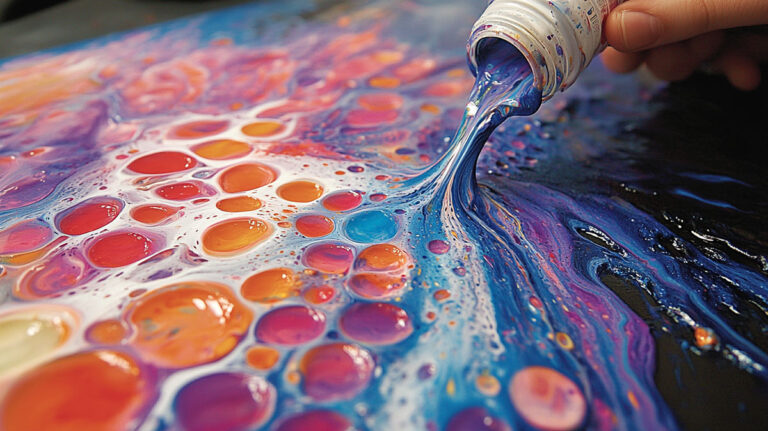
Acrylic pouring involves thinning paint with a pouring medium and letting it flow across the canvas. No brushes required for the main layer, just tilting and gravity.
Common pouring techniques worth trying:
- Dirty pour: Layer colors in one cup, pour all at once
- Flip cup: Pour onto canvas, flip a loaded cup over it
- Swipe technique: Add a contrasting color and drag a palette knife or card through it
- Tree ring pour: Pour in concentric circles without mixing
Adding silicone oil to your paint mix creates cells, those circular shapes that show up in most viral pour paintings. A few drops per color is enough. More than that and the paint won’t cure properly.
For more on what this technique involves structurally, the detail behind acrylic pouring art is worth reading before you buy supplies.
Palette Knife Abstract Ideas
Palette knife painting skips brushes entirely. You’re applying thick paint directly with a metal blade, which creates texture, ridges, and edges that brushwork can’t replicate.
Mark Rothko and Helen Frankenthaler are the most referenced names in color field abstraction. Neither used palette knives heavily, but their approach to large areas of flat or layered color translates well to knife work.
A straightforward abstract knife exercise:
- Choose three colors maximum
- Apply thick blocks with a flat knife, overlapping at edges
- Use the knife tip to drag through wet paint for linear marks
The palette knife painting technique in acrylics creates impasto texture that catches light differently depending on viewing angle. That visual quality is hard to get any other way.
Nature and Landscape Acrylic Painting Ideas

Landscapes are the most painted subject across most skill levels. There’s a reason for that: nature has no copyright, reference photos are everywhere, and the subject is forgiving of minor inaccuracies.
Landscape painting techniques in acrylics work well because the medium allows you to build from light to dark or dark to light, depending on your approach.
Sky and Weather Painting Ideas
The sky is usually 60-70% of a landscape painting. Getting it right matters more than the ground.
Weather-based sky ideas that look impressive without advanced skills:
- Overcast grey sky with a single light source breaking through
- Stormy sky using wet-on-wet blending for soft cloud edges
- Golden hour gradient from deep orange through pink into blue
Atmospheric perspective applies here. Objects in the distance, including clouds near the horizon, should be lighter and less saturated than those up close. That depth cue alone makes a painting read correctly. For the theory behind it, the concept of atmospheric perspective explains the color and value shifts involved.
Jackson Pollock famously worked flat on the floor, letting gravity do compositional work. The same logic applies to painting skies: sometimes tilting the canvas slightly and letting wet paint shift creates soft gradients faster than any brush technique.
Water and Ocean Painting Ideas
Water looks hard but breaks down into a few repeating elements: reflections, movement, and the horizon line.
Ocean wave painting: Start with a dark base, add a mid-value green-blue for the body of the wave, then use titanium white with a flat brush to create foam and spray at the crest.
Calm water ideas that work well in acrylics:
- Still lake reflecting inverted trees and sky
- River with wet rocks, using broken color for the water surface
- Seascape at low tide with wet sand reflections
The blending technique in acrylic painting is especially relevant for water because smooth transitions between colors read as depth and reflection. Keep a wet brush and work quickly before the paint sets.
Acrylic Painting Ideas on Canvas
Canvas is the default surface for acrylic painting ideas, but it’s worth understanding what type suits your subject before you stretch or buy one.
The global online art courses market was valued at USD 2.34 billion in 2024 and is projected to reach USD 6.23 billion by 2033 at an 11.2% CAGR (Business Research Insights). Most of those courses involve canvas work. It’s still the primary painting surface across all skill levels.
Stretched Canvas vs. Canvas Board for Different Ideas
Stretched canvas has a slight give under the brush, which feels different from the firmness of canvas board. For loose, gestural painting, stretched canvas works better. For detailed work where you’re pressing harder, a board won’t flex.
| Surface | Best for | Watch out for |
|---|---|---|
| Stretched canvas | Large paintings, gestural work | Can warp if paint is too wet |
| Canvas board | Detail work, small paintings | Edges can be sharp on cheaper boards |
| Canvas roll (cut to size) | Large-scale murals or custom sizes | Needs stretching or mounting |
The differences in canvas textures also affect how paint behaves. A fine-tooth canvas gives smoother results. A coarser texture adds grit to every brushstroke, which reads well in impasto or rough landscape work.
Texture Techniques Specific to Canvas
Modeling paste and gesso let you build physical texture before painting. You can create ridges, grooves, or rough terrain that paint then settles into.
Canvas-specific texture ideas:
- Apply gesso with a palette knife for directional texture, then paint over once dry
- Press plastic wrap into wet gesso, peel it away for crackled surface effects
- Use a comb or fork through thick wet paint for linear patterns
For detailed prep steps, prepping the canvas for acrylic paint covers the full process from bare surface to paint-ready ground.
Acrylic Painting Ideas on Different Surfaces
Canvas gets most of the attention, but acrylics stick to almost anything that’s been properly primed. That opens up a different set of painting ideas entirely.
The U.S. non-commercial acrylic paint market is expanding at a 4.5% CAGR through 2034, driven partly by DIY culture on social platforms (Future Market Insights). A significant portion of that demand comes from surface-diverse painting, rocks, wood, tiles, and furniture.
Painting on Wood Panels and Boards
Wood panels give you a rigid, stable surface with no flex. The paint sits differently than on canvas, sharper edges, less absorbency once sealed, and fine detail is easier to control.
Good acrylic painting ideas for wood:
- Geometric designs where clean edges matter
- Floral compositions with carved-look detail using a fine liner brush
- Portrait work where you want a smooth base
- Decorative signs or quote art for home decor
Seal the wood with two coats of gesso first. Raw wood absorbs paint unevenly and the grain bleeds through. More on the full process for painting on wood panel if you’re using this surface seriously.
Painting on Rocks and Small Surfaces
Rock painting became a documented grassroots movement through the “Kindness Rocks Project,” which spread internationally and pushed demand for small-surface painting supplies.
Smooth river rocks are the best surface for detailed miniature painting. The shape is already interesting and the natural variation in stone adds to the finished piece.
Popular rock painting ideas:
- Miniature landscapes using the rock shape as the ground plane
- Mandala patterns in concentric rings from the center outward
- Realistic animal portraits on a flat oval surface
Use fluid acrylics or thin your paint to a fluid consistency for rocks. Heavy body paint sits too thick on a curved surface and chips more easily once dry.
Glass, Tiles, and Other Surfaces

Glass and tiles need a different type of prep. Regular acrylic won’t bond well without a glass primer or a medium designed for non-porous surfaces.
Enamel acrylics or multi-surface acrylics are the better choice here. They flex slightly when dry and bond more reliably to smooth surfaces.
What works on glass and tile:
- Abstract color block patterns on ceramic tiles for backsplash decoration
- Pressed flower designs on glass jars using thin washes of color
- Repeating geometric patterns that work with the tile grid
The range of surfaces available is one of the reasons acrylic painting materials lists look so different from oil or watercolor supply lists. You’re not just buying paint for canvas. You’re buying for whatever surface the idea calls for.
Seasonal and Holiday Acrylic Painting Ideas
Seasonal painting ideas are among the most searched subjects year-round, not just during the holidays. Pinterest Christmas searches start as early as July, according to trend data from the platform.
The appeal is practical. Seasonal paintings make good gifts, they tie naturally to home decor rotations, and the subject matter is familiar enough that even beginners can approach them confidently.
Christmas and Winter Painting Ideas
Snow scenes and cabin interiors are the most consistently popular Christmas painting subjects. The high contrast between warm light inside a dark window and cold blue-white snow outside is genuinely satisfying to paint.
Christmas painting ideas that work well in acrylics:
- Snowy cabin with warm candlelight visible through a single window
- Christmas tree silhouette against a dark, starlit background
- Wreath with holly, pine cones, and a bow as a standalone still life
- Ornaments in a loose cluster, focusing on reflections and metallic surfaces
The ornament still life is a good intermediate challenge. Painting reflective curved surfaces pushes you to observe light carefully without requiring portrait-level skill.
Halloween and Autumn Painting Ideas

According to the Americans for the Arts 2023 survey, 76% of Americans view arts and culture as personally important to their wellbeing. Seasonal creative work is one of the most accessible entry points into that engagement.
Autumn color palette: cadmium orange, burnt sienna, yellow ochre, and a touch of raw umber.
Three autumn subjects worth trying:
- Pumpkin patch with varied sizes and muted background
- Bare autumn trees with a warm sky, using a fan brush for fine branches
- Haunted house silhouette against a full orange moon
Spring and Summer Painting Ideas

Spring and summer bring the widest variety of natural subjects: wildflowers, beach scenes, garden compositions, and outdoor light.
Sunflower fields and cherry blossom branches consistently rank among the most-saved painting tutorials on platforms like Pinterest and Skillshare.
The key with spring subjects is color temperature. Warm yellows and pinks sit against cool greens and blues. Getting that contrast right is what makes a spring painting feel fresh rather than flat.
Beach scene tip: paint the sand with a warm base, the water in multiple blue-green layers, and leave hard white edges for foam. The washing technique in acrylic painting works well for the transparent, shallow water zone near the shore.
Acrylic Painting Ideas by Skill Level
Most painters get stuck because they choose subjects that are either too easy to hold their interest or too hard to finish without frustration. Matching idea to skill level matters more than people think.
The APA’s 2023 Healthy Minds Poll found that 46% of Americans use creative activities to manage stress and anxiety. Painting that’s calibrated to your level keeps it enjoyable, not punishing.
Intermediate Painting Ideas
Intermediate painters have the basics down: they can mix colors, build layers, and paint simple shapes accurately. The next step is subjects with more variables.
Pet portraits are the classic intermediate challenge. You’re dealing with fur texture, eye reflections, and a subject your client (the owner) knows intimately. Getting it wrong is very obvious.
Good intermediate subjects:
- Glass objects in a still life (transparent surfaces require careful value observation)
- Portrait from a photo reference, focusing on proportions before rendering
- Cityscape with architectural detail and atmospheric depth
The jump from beginner to intermediate is mostly about value in painting. Once you can see and paint the light-to-dark relationships in a subject, most intermediate challenges become manageable.
Advanced Painting Ideas

Hyperrealism takes time. Most painters underestimate how many layers are involved: usually 10 to 20 thin applications over a carefully rendered underpainting.
Advanced painters tend to work from their own photo references rather than stock images. The intimacy with the subject shows.
| Skill Level | Suitable Subject | Core Challenge |
|---|---|---|
| Beginner | Single fruit, sunset gradient | Basic color mixing, wet blending |
| Intermediate | Pet portrait, glass still life | Value accuracy, surface rendering |
| Advanced | Hyperrealistic figure, complex cityscape | Layered glazing, fine detail control |
One approach advanced painters use: underpainting in acrylic painting in a neutral grey or raw umber, solving all value and composition problems before adding color. It’s slower upfront but saves significant rework.
Acrylic Painting Ideas Inspired by Popular Styles

Choosing a style to work in gives your painting ideas direction. Without one, you’re making decisions about brushwork, color, and detail level from scratch every time.
Abstract art made significant gains in the secondary market in 2023, with large-scale works particularly in demand, according to follow.art’s market trend analysis. Meanwhile, impressionist and semi-abstract landscapes remain strong sellers in the US and UK markets through 2024-2025, per Prominent Painting’s data-driven market review.
Impressionist-Style Acrylic Ideas
Impressionism in acrylics is about visible brushwork, broken color, and capturing light over form. You’re not blending smooth. You’re building color through adjacent strokes that optically mix from a distance.
Try this approach:
- Block in loose shapes with a flat brush, no outlines
- Use pure or near-pure colors side by side rather than pre-mixed flat tones
- Work quickly while paint is wet to keep edges soft
- Step back often, impressionist work reads from distance, not up close
Claude Monet’s approach to water lilies and light-on-water subjects translates well to acrylics. His impressionism painting techniques focused on short, directional strokes that describe movement and light simultaneously.
Realism and Hyperrealism Ideas
Photo-realistic acrylic painting is having a resurgence, driven partly by social media where hyperrealistic process videos perform exceptionally well.
Key difference between realism and hyperrealism: realism aims for accurate representation of a scene, hyperrealism aims to surpass photographic detail. Both require working from reference.
Realism subjects that suit acrylics well:
- Food still life with ceramic and fabric backgrounds
- Portrait from direct photo reference with controlled studio lighting
- Animals with textured fur or feathers
For the technical side of this work, glazing in acrylic painting is how most realists build depth and luminosity. Thin, transparent layers over a dry base let light pass through and reflect back, creating a depth that opaque paint alone can’t achieve.
Alyssa Monks, who creates hyperrealistic paintings of figures seen through wet glass and fabric, uses acrylics alongside oils. Her process demonstrates how layering technique determines the final surface quality more than any other single factor.
Folk Art and Contemporary Style Ideas
Folk art and naive style painting strips away technical complexity deliberately. Flat color, simplified forms, bold outlines.
Why it works: the style’s constraints make decisions easier, not harder. You’re not chasing realism, so every choice is about color, shape, and pattern instead.
Contemporary styles trending on Instagram and Etsy in 2024-2025 include:
- Maximalist floral compositions with saturated color and flat backgrounds
- Loose portrait work with exaggerated features and expressive brushwork
- Geometric abstraction using hard-edge masking tape techniques
The range of painting styles available is genuinely wide. Most painters settle into one or two that match their instincts, then build from there.
How to Find Your Own Acrylic Painting Ideas
Lists of painting ideas are useful up to a point. At some stage, the ideas that hold your attention longest are the ones you generate yourself.
According to Americans for the Arts’ 2023 national survey of over 3,000 adults, 60% of Americans said the arts helped them cope during times of mental or emotional distress. Painting regularly, with subjects you actually care about, is a different experience from working through someone else’s prompt list.
Using Photo References and Observation
Your own photos are better reference material than anything on a stock site. You were there when the light was right. That context shows in how you paint it.
Free photo reference sources worth bookmarking:
- Unsplash (broad range, high quality, free commercial use)
- Pexels (similar to Unsplash, strong for nature and urban scenes)
- Paint My Photo (specifically for artists, curated reference photos)
Painting from life is harder but faster for building observational skill. Set up a simple still life at home with objects you already have. The challenge of working from something in front of you rather than a flat image changes how you see.
Building an Idea System
Keeping a sketchbook or idea journal removes the “what should I paint” friction. You’re not starting from zero every time you sit down.
How most working artists generate ideas:
- Collect reference photos into themed folders on phone or desktop
- Sketch rough composition thumbnails, even stick figures, to test an idea fast
- Note color combinations or lighting conditions that catch your eye day to day
Communities like r/painting on Reddit and the broader Skillshare and YouTube ecosystem are good for seeing what other painters are working on. Not to copy, but to stay curious about what subjects and approaches are out there.
The APA’s 2023 poll found that adults who report very good or excellent mental health engage in creative activities more frequently than those with lower self-rated health. Painting regularly, even informally, matters more than any single painting idea you choose.
Connecting Ideas to Technique

The best painting ideas are the ones you have a reason to work through technically. Painting a glass bottle because you want to understand reflections. Painting a forest because you want to figure out how to mix greens convincingly.
Subject and skill development work best together. When you pick an idea that challenges something specific, the painting becomes a learning session, not just a finished product.
For the technical side, acrylic painting techniques covers the full range of application methods from dry brushing through wet blending and impasto work. Knowing what’s available means you can choose an approach that fits the subject, rather than defaulting to the same brushwork every time.
Took me a while to realize that the most productive painting sessions aren’t the ones where I had the best idea. They’re the ones where the idea connected to something I was genuinely trying to figure out technically. Your mileage may vary.
FAQ on Acrylic Painting Ideas
What are good acrylic painting ideas for beginners?
Start with simple subjects: sunsets, single flowers, mountains, or abstract color blocks.
These rely on basic shapes and limited color mixing, so you’re not overwhelmed. A flat brush, round brush, and a small palette are all you need to get going.
What can I paint with acrylics besides canvas?
Acrylics work on wood panels, rocks, ceramic tiles, glass, fabric, and watercolor paper.
Each surface needs different prep. Wood needs gesso. Glass needs a multi-surface or enamel acrylic. Canvas remains the default, but the options are wide.
How do I find my own painting ideas?
Keep a folder of reference photos on your phone. Sketch rough thumbnails before committing to canvas.
Platforms like Pinterest, Unsplash, and Pexels are good starting points. Your own photos are better.
What abstract acrylic painting ideas are easiest to try?
Acrylic pouring is the lowest barrier entry point. Mix paint with pouring medium, layer colors in a cup, and pour directly onto canvas.
Palette knife work is the next step. No brush required. Thick paint, bold marks, fast results.
What are popular seasonal painting ideas in acrylics?
Winter: snowy cabins, ornament still lifes, bare trees. Autumn: pumpkins, warm foliage, moody skies.
Spring and summer open up florals, beach scenes, and garden subjects. Seasonal paintings also double as gifts.
What painting style should I choose for acrylic painting?
Try impressionist-style work if you prefer loose, expressive brushwork. Try realism if you like working from photo references with careful observation.
Folk art and abstract styles remove technical pressure entirely. Most painters settle into one naturally over time.
How do I paint a landscape with acrylics?
Work background to foreground. Paint the sky first, let it dry, then add mid-ground elements, then foreground detail.
Use atmospheric perspective: distant objects should be lighter and less saturated than close ones. That single rule makes landscapes read correctly.
What acrylic painting ideas work for intermediate painters?
Pet portraits, glass still lifes, and cityscapes all push intermediate skills without requiring advanced technique.
The jump from beginner to intermediate is mostly about reading value accurately. Get light and dark right before worrying about color.
Can I paint on rocks with acrylics?
Yes. Smooth river rocks work best. Use fluid acrylics or thin your paint to a fluid consistency.
Heavy body paint sits too thick on curved surfaces and chips faster once dry. Seal finished rocks with a clear varnish.
What are easy acrylic painting ideas for a quick session?
Mini paintings on small canvases or canvas boards. A single object, one strong light source, two or three colors.
Abstract color block paintings take under an hour. So do basic sunset gradients. Constraints make quick sessions productive, not limiting.
Conclusion
There’s no shortage of acrylic painting ideas once you know where to look and how to match a subject to your current skill level.
From simple still life compositions and seasonal subjects to abstract techniques like pouring and palette knife work, acrylics give you more creative range than almost any other painting medium.
The painting surface, style, and color palette all feed into each other.
Pick one idea that genuinely interests you, not the easiest one, and build from there. Consistent practice with subjects you care about develops observational skill faster than working through prompts you feel nothing for.
Keep a reference photo folder. Sketch before you paint. Let the subject drive the technique.