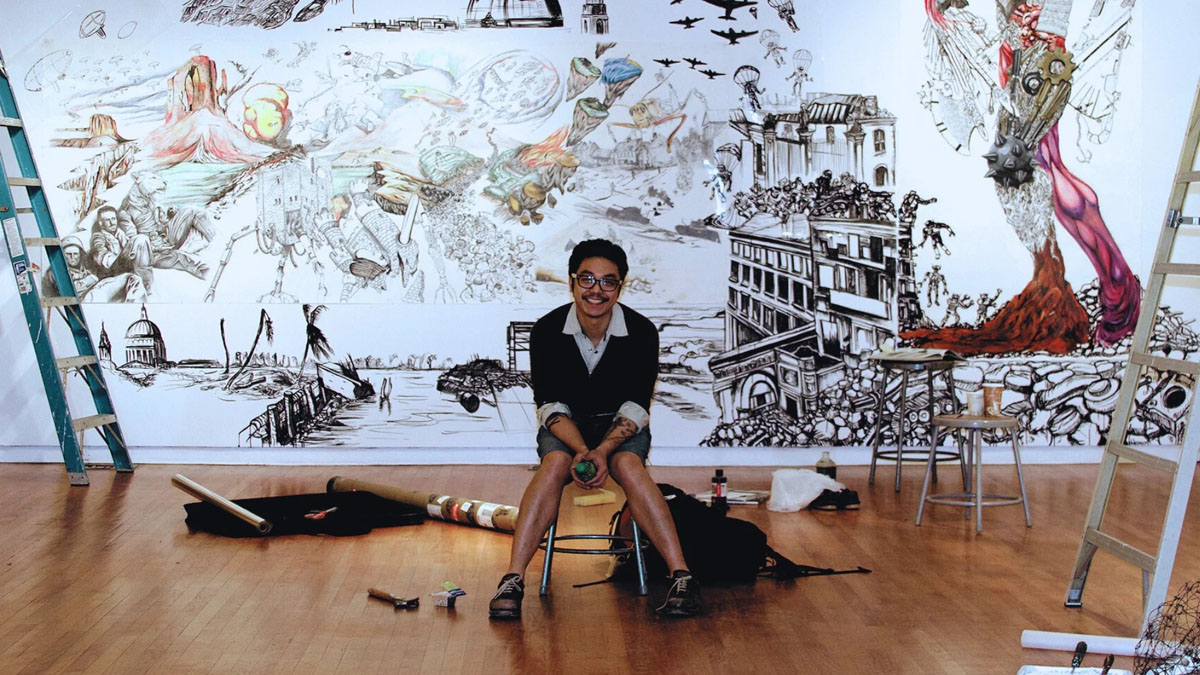

Ernest Concepcion is a Filipino contemporary painter known for merging classical landscape motifs with cartoon-like caricatures of warfare. Born in 1977 in Manila, Philippines, he works between Brooklyn, New York and his hometown.
His paintings sit at an unusual crossroads. They borrow the pastoral calm of traditional landscape art, then shatter it with imagery of conflict, invasion, and pop culture chaos.
Concepcion received his Bachelor of Fine Arts from the University of the Philippines in 1999. He has produced work across painting, sculpture, and installation since the early 2000s. The Cultural Center of the Philippines recognized him with the prestigious 13 Artists Award in 2015.
Identity Snapshot
- Full Name: Ernest Concepcion
- Born: 1977, Manila, Philippines
- Primary Roles: Painter, Installation Artist, Printmaker
- Nationality: Filipino
- Movement: Contemporary Filipino Art, Postwar Visual Culture
- Mediums: Oil on canvas, enamel on steel, acrylic, ink, gypsum, mixed media
- Signature Traits: Layered paint surfaces, thick impasto, battlefield imagery over tranquil landscapes
- Iconography: Soldiers, monsters, pop culture figures, explosions, invasion scenes
- Geographic Anchors: Manila, Brooklyn, Beijing (residency)
- Mentors/Patrons: University of the Philippines faculty, LMCC, Joan Mitchell Foundation (nominee)
- Key Collections: UP Vargas Museum, Lopez Memorial Museum, private collections in US and Philippines
- Market Signals: Works sold at Leon Gallery; pieces typically range from small 12×12 in. canvases to epic 96×96 in. works
What Sets Ernest Concepcion Apart
The trick is contrast. Where most painters choose either chaos or calm, Concepcion forces them into the same frame.
He paints landscapes that look peaceful at first glance. Then you notice the armies. The monsters. The weird pop culture references crawling across the surface like graffiti on a museum piece.
His brushwork runs from loose, dripping enamel pours to tight ink contours. The texture is aggressive. Gypsum, fur, fabric, and thick paint create surfaces you want to touch.
Unlike artists who work in clean, minimal styles, Concepcion piles on visual information. Every inch of canvas holds something. There is a maximalist quality that separates him from peers who prefer restraint.
His work channels the visual overload of Manila street culture. The jeepney stickers. The garish billboards. The sensory assault of urban life translated into fine art.

Origins and Formation
Early Training
Concepcion studied at the University of the Philippines, Diliman, graduating with a BFA in Studio Arts in 1999.
The UP program exposed him to classical techniques while encouraging experimentation. This tension between tradition and disruption shows up throughout his career.
First Stylistic Inflections
His early work focused on ink drawings. Small, obsessive panels filled with warring objects and creatures.
The palette was limited. Black and white dominated. The line work was dense, almost claustrophobic.
Pivotal Travels
In 2002, Concepcion moved to Brooklyn. The relocation changed everything.
New York’s aggressive energy fueled his interest in conflict imagery. He participated in multiple residencies:
- LMCC Workspace Program (2005-2006)
- Bronx Museum AIM Program (2004)
- Lower East Side Printshop Keyholder Residency (2007)
- Governors Island Swing Space Program (2010)
- NY Arts Beijing residency (2010)
Each residency pushed his practice in new directions. The Beijing experience introduced Asian contemporary art influences. Governors Island gave him room to work at larger scales.
First Major Exhibition
The Line Wars Deluxe at Kentler International Drawing Space in 2008 marked a turning point.
He covered the gallery walls floor to ceiling with caricatures layered over landscape imagery. The installation approach became a signature.
Movement and Context
Position Within Filipino Art

Concepcion belongs to a generation of Filipino artists who straddle diaspora and homecoming. He spent over a decade in New York before reconnecting with Manila’s gallery scene in 2012.
His work reflects postwar Filipino visual culture. The chaos of socio-political conflict. The collision of American, Japanese, and indigenous influences.
Comparative Analysis
Compared to Rodel Tapaya, another major Filipino painter, Concepcion leans harder into pop culture and street art aesthetics. Tapaya draws from folklore and mythology with a more classical finish. Concepcion’s surfaces are rougher, more punk.
Against Jean-Michel Basquiat, there are obvious parallels in the graffiti-influenced mark-making and layered compositions. But Concepcion’s palette skews brighter, more synthetic. The enamel paints give his work a glossy, almost commercial quality that Basquiat avoided.
His battlefield scenes share DNA with the war paintings of historical masters, but filtered through cartoons and video games. Think Francisco Goya‘s disaster imagery remixed by a kid raised on anime and Starcraft.
Materials, Techniques, and Process
Supports
Concepcion works primarily on stretched canvas. For his enamel series, he uses plated steel panels.
Canvas sizes range dramatically. Small 9×12 inch studies. Medium works around 36×48 inches. Epic pieces reaching 96×96 inches or larger.
Mediums and Grounds
His painting mediums include:
- Oil paint for layered, traditional passages
- Enamel for glossy, vinyl-like surfaces
- Acrylic for fast-drying layers
- Gypsum for heavy texture
- Ink for contour drawing
He often combines materials within single works. Oil and enamel. Acrylic and gypsum. The combinations create unpredictable surface effects.
Brushwork Taxonomy
Two distinct approaches dominate.
First: poured enamel. He lays canvases flat and “herds” the paint without brushes, letting drips and spills become part of the composition.
Second: fast, intuitive brushwork. Automatic strokes laid down quickly. He prioritizes energy over precision.
The contrast between controlled pouring and wild brushwork creates visual tension.
Palette Archetype
Bright, synthetic colors dominate. Neon pigments. Saccharine pinks and electric blues borrowed from jeepney sticker aesthetics.
His black and white series strips away color entirely, focusing on stark tonal contrast.
Temperature varies by series. The enamel paintings run warm. The battlefield landscapes mix cool grays with earth tones.
Studio Practice
Concepcion describes his process as “terraforming a planet before sending out the rivers.”
He builds textured grounds first. Then adds imagery on top. The layering creates depth and archaeological quality, like discovering images beneath the surface.
Themes, Subjects, and Iconography
Recurring Motifs
- Warfare: Soldiers, tanks, explosions, invasions
- Pop Culture: Comic book characters, video game references, toys
- Religious Imagery: Saints, crosses, sacred hearts (filtered through Filipino Catholic kitsch)
- Monsters: Hybrid creatures, aliens, demonic figures
- Landscapes: Pastoral scenes transformed into battlefields
Compositional Schemes
His compositions favor density over negative space. Every area holds information.
He often uses horizon lines as anchor points, then overwhelms them with competing imagery. The effect is deliberate chaos.
Symbol Sets
The sacred heart appears frequently, borrowed from Filipino religious iconography.
Mushroom clouds reference atomic warfare and postwar anxiety.
Cartoon characters operate as stand-ins for cultural forces. The “Line Wars” series literally depicted objects in combat: chairs versus tables, pasta versus rice.
Socio-Historical Triggers
His work responds to Filipino socio-political turmoil. Inequality. Unrest. The discord that seeps into popular culture.
The immigrant experience also drives imagery. Moving to New York in 2002, he felt the need to create “an entirely new reality” through art.
Notable Works
The Line Wars (2004-2007)
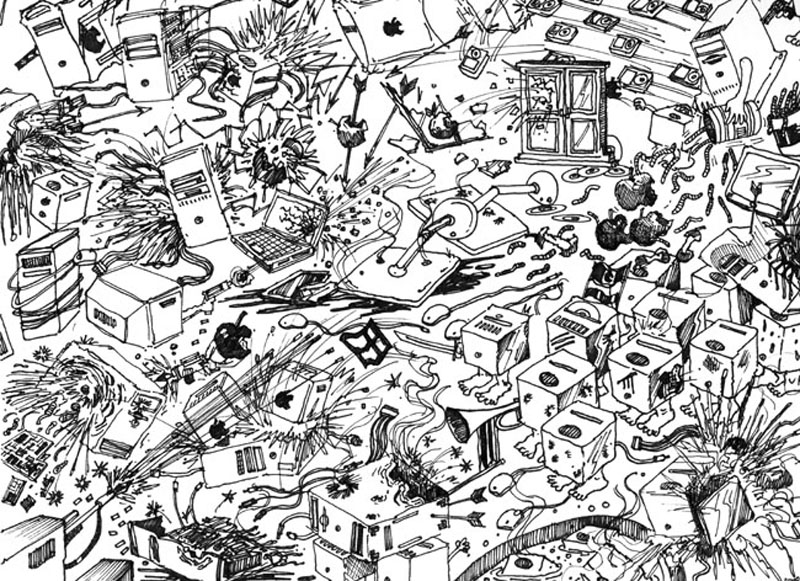
Medium: Ink on paper, 9 x 12 inches each (100+ panels)
Current Location: Various private collections
Visual Signature: Dense black and white linework; cartoon-like conflicts between inanimate objects
Significance: The series that established his visual language. Objects depicted in absurd battles: chairs flying at each other, eggs smothering armies of Saint Benedicts.
The Line Wars Deluxe (2008)
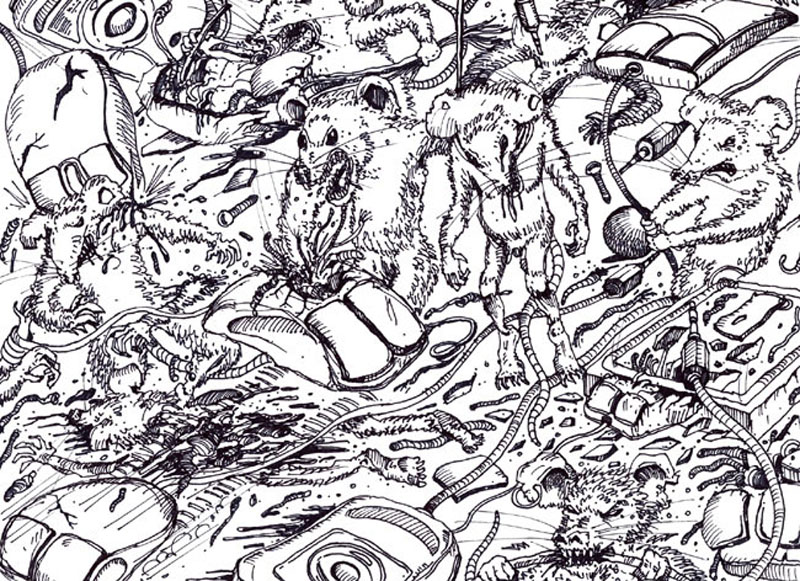
Medium: Mixed media installation
Location: Kentler International Drawing Space, Brooklyn (site-specific)
Visual Signature: Floor-to-ceiling caricatures over landscape imagery
Significance: First major institutional recognition. Marked shift toward large-scale installation work.
Explosion Paintings (2009)
Medium: Enamel on steel
Visual Signature: Layered mushroom clouds built from poured enamel; colors become physical strata
Significance: Departure from figurative work into more abstracted conflict imagery.
Birth of a Dynasty (2014)
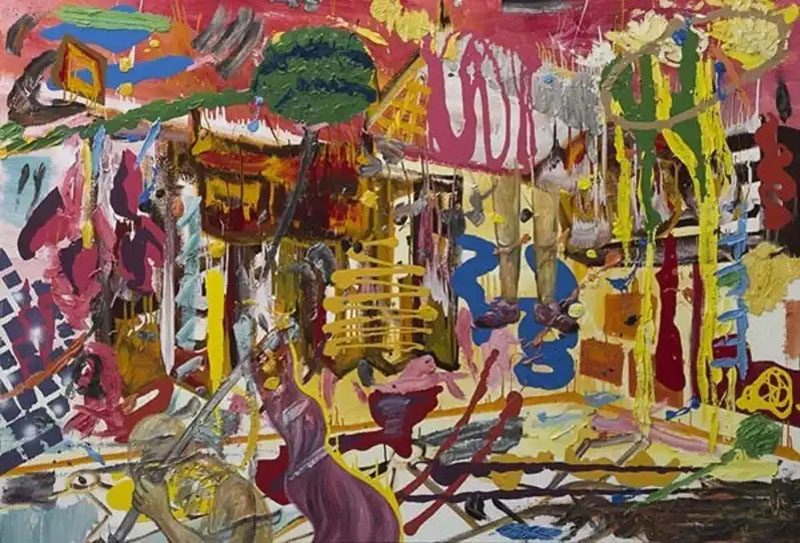
Medium: Oil, enamel, plaster, glue on canvas, 60 x 84 inches
Location: Light and Space Contemporary
Visual Signature: Epic scale, dense impasto, battlefield narrative
Significance: Representative of his mature large-scale approach.
The Crux of Things (2014)
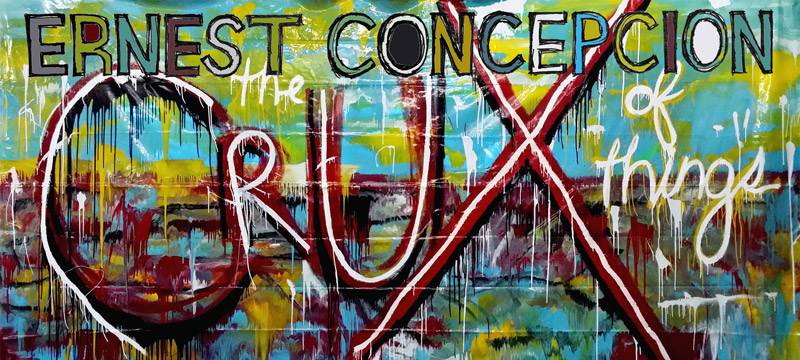
Medium: Mixed media paintings and installations
Location: UP Vargas Museum, Manila
Visual Signature: Epic-scale works combining his New York and Manila influences
Significance: First solo museum exhibition. Marked his return to the Philippines art scene.
Exhibitions, Collections, and Provenance
Major Solo Exhibitions
- The Line Wars Deluxe (2008) – Kentler International Drawing Space, Brooklyn
- L.A. Guerra (2011) – Untitled Art Projects, Los Angeles
- Puso + Daga (2012) – West Gallery, Manila
- All Quiet on the Eastern Front (2012) – Blanc Gallery, Manila
- The Awkward Inevitable (2013) – Gallery 13, Minneapolis
- The Crux of Things (2014) – UP Vargas Museum, Manila
- Re-Evolve in Purgatory (2015) – 1335Mabini, Manila
- Just A Hint of Mayhem (2016) – 1335Mabini, Manila
- Unprecedented Views (2016) – Ysobel Art Gallery, Philippines
Notable Group Shows
- La Bienal 2013 – El Museo del Barrio, New York
- BEAT (2012) – Lopez Memorial Museum, Manila
- 13 Artists Awards Exhibition (2015) – Cultural Center of the Philippines
- Art Stage Singapore (2015) – Light & Space Contemporary booth
Museums with Holdings
- UP Vargas Museum, Manila
- Lopez Memorial Museum, Manila
- USC Fisher Museum of Art (featured exhibitions)
Gallery Representation
Mabini Gallery in Manila has been a primary representative since 2015. Light and Space Contemporary handled international placements. West Gallery, Blanc Gallery, Art Informal, and Secret Fresh have also shown his work.
Market and Reception
Auction Performance
His work has appeared at Leon Gallery in Makati. A 2023 sale of “I Tried And It’s True” (acrylic on canvas, 48 x 36 inches) realized $940 USD.
Prices remain accessible compared to established international names. Primary market works through Manila galleries typically range based on size and complexity.
Critical Reception
The 13 Artists Award from the Cultural Center of the Philippines (2015) represented official recognition within his home country.
His New York years brought nominations for the Joan Mitchell Foundation Painters and Sculptors Grant (2011) and NYFA fellowship finalist status in Drawing (2011).
Publications including ART+ Magazine, Manila Bulletin, and Metro Home have featured his work extensively.
Authentication Notes
Works are typically signed at lower right or left corners. The dense, layered surfaces and specific material combinations (enamel/gypsum/oil) serve as stylistic fingerprints.
Influence and Legacy
Upstream Influences
Concepcion cites comic books, video games, science fiction, and music as primary sources.
Art historically, his battlefield landscapes nod to classical war painting. His color sense borrows from Filipino street culture and religious folk art.
The expressionistic brushwork connects to Abstract Expressionist traditions, while his dense imagery recalls surrealist accumulation.
Downstream Impact
He represents a model for Filipino artists navigating between diaspora experience and homeland reconnection.
His collaborative work with Mike Estabrook as The Shining Mantis influenced performance-drawing practices in the Brooklyn art scene.
Younger Manila artists have absorbed his maximalist approach and willingness to mix high and low culture references.
Cross-Domain Echoes
The Kangarok chalk drawing events anticipated live-drawing performance trends.
His visual vocabulary parallels indie video game aesthetics, a connection he openly acknowledges.
How to Recognize an Ernest Concepcion at a Glance
- Surface texture: Heavy impasto, gypsum buildup, visible drips and pours
- Color palette: Neon-bright synthetic colors OR stark black-and-white contrast
- Layering: Figurative imagery over landscape grounds; graffiti-like additions
- Subject matter: Warfare, monsters, pop culture mashups on pastoral backgrounds
- Canvas sizes: Often large scale (48+ inches), though smaller studies exist
- Medium mix: Enamel combined with oil or acrylic; gypsum for texture
- Edge quality: Mix of hard ink contours and soft paint bleeds
- Density: Little empty space; crowded compositions
- Signature placement: Typically lower right corner
- Cultural markers: Filipino religious iconography (sacred hearts, saints) mixed with American pop culture
FAQ on Ernest Concepcion
Who is Ernest Concepcion?
Ernest Concepcion is a Filipino contemporary painter born in 1977 in Manila. He combines classical landscape motifs with warfare imagery and pop culture caricatures. He works between Brooklyn and Manila, holding a BFA from the University of the Philippines.
What is Ernest Concepcion known for?
He is known for battlefield landscape paintings that merge tranquil scenery with cartoon-like conflict imagery. His signature series, The Line Wars, depicts absurd battles between inanimate objects. Dense layering and heavy impasto define his visual style.
What art style does Ernest Concepcion use?
Concepcion works in a narrative painting style blending pop art influences with expressionistic brushwork. His approach mixes classical landscape traditions with street art aesthetics. The result sits between figuration and controlled chaos.
What materials does Ernest Concepcion use in his paintings?
He uses oil, enamel, acrylic, ink, and gypsum. Many works combine multiple mediums on canvas or steel panels. The enamel creates glossy, vinyl-like surfaces. Gypsum adds dimensional form and heavy texture to his compositions.
What awards has Ernest Concepcion received?
The Cultural Center of the Philippines awarded him the prestigious 13 Artists Award in 2015. He was a NYFA finalist in Drawing (2011) and a Joan Mitchell Foundation Painters and Sculptors Grant nominee the same year.
Where has Ernest Concepcion exhibited his work?
Major exhibitions include UP Vargas Museum, Kentler International Drawing Space, and El Museo del Barrio’s La Bienal 2013. Manila galleries like 1335Mabini, West Gallery, and Blanc Gallery regularly show his work. He has exhibited across the US and Asia.
What is The Line Wars series?
The Line Wars (2004-2007) consists of over 100 ink drawings on 9×12 inch panels. Each depicts absurd conflicts between objects: chairs versus tables, pasta versus rice. The series established his visual hierarchy of layered conflict imagery.
What themes appear in Ernest Concepcion’s artwork?
Warfare, invasion, and socio-political conflict dominate. Pop culture references from comics, video games, and Filipino religious iconography appear throughout. His work reflects the discord of Filipino socio-political life filtered through childhood nostalgia and immigrant experience.
How much do Ernest Concepcion paintings cost?
Prices vary by size and complexity. A 2023 Leon Gallery auction sold “I Tried And It’s True” (48×36 inches) for $940 USD. Primary market works through Manila galleries range based on value factors like scale and medium.
What is The Shining Mantis?
The Shining Mantis is Concepcion’s collaborative project with artist Mike Estabrook. The Brooklyn-based duo creates large-scale chalk drawings called Kangarok during live performances. They have toured New York, Montreal, Miami, and Beijing since 2006.
Conclusion
Ernest Concepcion stands as a significant voice in contemporary Southeast Asian art. His epic-scale paintings bridge Manila and Brooklyn, channeling the socio-political tensions of Filipino culture through conflict-based imagery.
The Line Wars series launched a career built on visual storytelling and layered paint techniques. His 13 Artists Award from the Cultural Center of the Philippines confirmed what galleries already knew.
Whether working in enamel on steel or mixed media on canvas, Concepcion transforms battlefield landscapes into statements about postwar existence. His rhythm of chaos and calm keeps collectors watching.