Animals have dominated canvas and gallery walls for centuries, from cave paintings to contemporary masterpieces.
Famous animal paintings reveal how artists across different eras captured the spirit, power, and beauty of creatures that share our world.
These works demonstrate technical mastery while exploring deeper themes of freedom, domesticity, and humanity’s relationship with nature.
This collection examines ten iconic animal portraits and wildlife scenes that changed art history. You’ll discover the stories behind each painting, the artists who created them, and why these particular works continue to captivate viewers today.
From Stubbs’s life-sized horses to Rousseau’s imagined jungles, each piece offers insight into both artistic technique and cultural significance.
Famous Animal Paintings
Whistlejacket
Artist and Historical Context
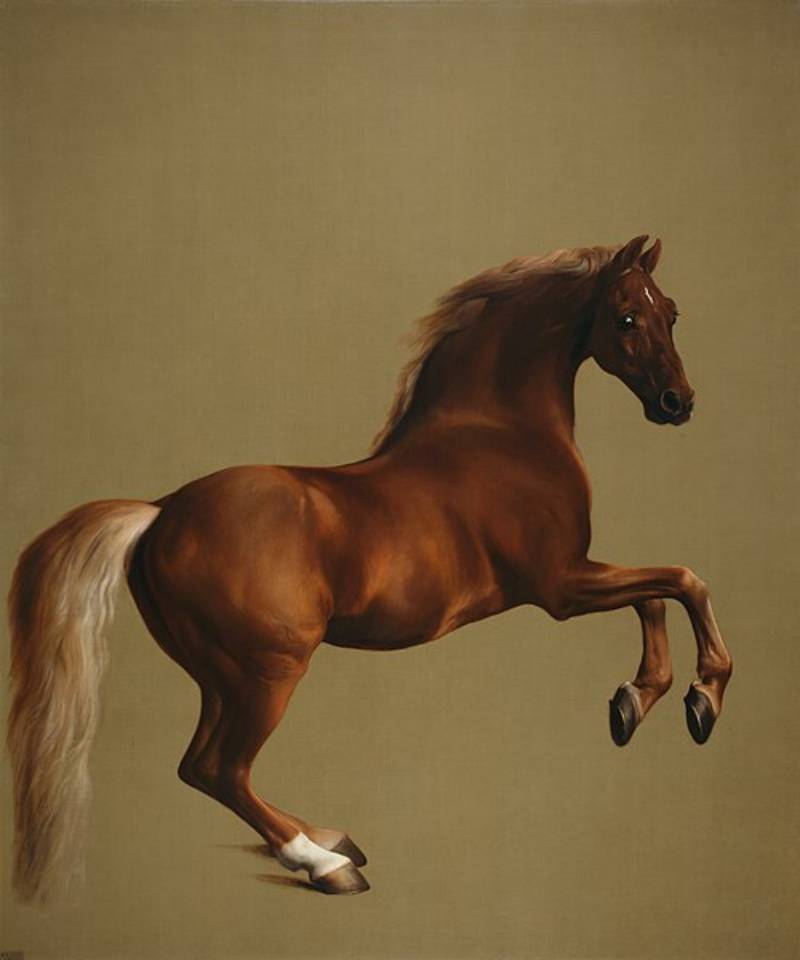
George Stubbs created this masterpiece around 1762 for Charles Watson-Wentworth, the 2nd Marquess of Rockingham.
The British artist was commissioned during several months spent at Wentworth Woodhouse in Yorkshire. Rockingham was among the wealthiest men in England and later served twice as Prime Minister.
Stubbs had built his reputation through meticulous anatomical studies of horses, which gave him unmatched accuracy in realism.
Visual Description and Composition
The life-sized portrait measures 292 x 246.4 cm and shows the Arabian chestnut stallion rearing in a levade position against a plain honey-beige background.
Whistlejacket appears without rider, saddle, or bridle. His white socks on the back legs and small white star on his forehead identify him clearly.
The painting uses loose, feathery brushstrokes for the tail while depicting muscles and veins with anatomical precision. Every sinew shows the strain of the pose.
This plain background was unprecedented in equine art and led contemporaries to believe the work was unfinished.
Artistic Significance
The painting represents a breakthrough in animal portraiture by eliminating landscape elements entirely.
Stubbs likely drew inspiration from classical sculpture in Rockingham’s collection, creating what resembles a Roman relief. The horizontal composition echoes the Parthenon friezes.
This approach prefigured Romanticism‘s celebration of untamed nature and animal energy.
The work showcases Stubbs’s mastery of chiaroscuro through subtle shadowing beneath the hooves.
Current Location and Provenance
The National Gallery in London acquired Whistlejacket in 1997 for £11 million with Heritage Lottery Fund support.
The Fitzwilliam family retained the painting for over two centuries after Rockingham’s death. A special 40-foot room was built at Wentworth to display it.
Cultural Impact
Whistlejacket became one of the most recognizable horse paintings in art history.
According to legend, when the real Whistlejacket saw the nearly finished canvas, he reacted violently and tried to attack it as a rival stallion.
The painting influenced how artists approached animal subjects, proving that wildlife art could command the same grand scale as historical paintings.
The Horse Fair
Artist and Historical Context
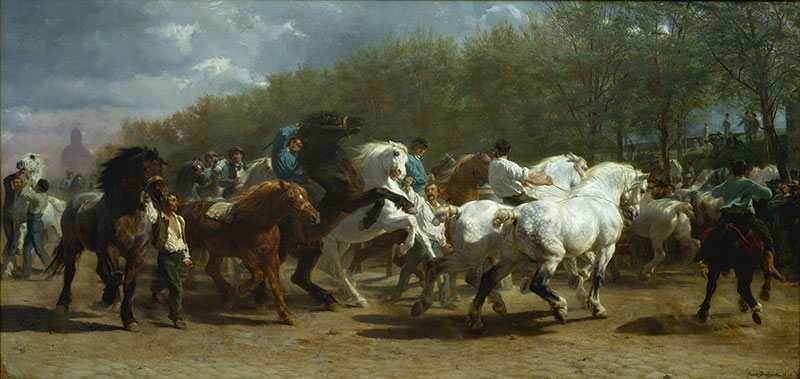
Rosa Bonheur painted this monumental work between 1852 and 1855, with finishing touches added in the final year.
She was only 31 when it debuted at the Paris Salon of 1853. At that time, women artists faced severe discrimination from critics and collectors.
Bonheur spent 18 months visiting the horse market on Boulevard de l’Hôpital twice weekly to sketch Percheron draft horses.
She obtained police permission to wear male clothing during these visits, which helped her avoid unwanted attention and move freely in this masculine space.
Visual Description and Composition
The massive canvas measures 244.5 x 506.7 cm (96.25 x 199.5 inches), making it one of the largest animal oil paintings ever created.
Approximately 15 horses rear, plunge, and gallop from left to right across the middle of the painting. Their handlers struggle to control them while showcasing the animals to prospective buyers.
Dappled white Percherons dominate the scene alongside brown and black horses. The Salpêtrière Hospital appears in the left background.
Bonheur captured individual texture in each horse’s coat, with muscles coiling and manes flying through wind and movement.
Artistic Significance
Bonheur called it her own “Parthenon frieze,” drawing inspiration from ancient Greek sculpture.
The work combines the color harmony and emotional intensity of Romantic painters like Théodore Géricault and Eugène Delacroix with strict anatomical accuracy.
Her deep understanding of animal anatomy came from visits to slaughterhouses, giving the horses lifelike musculature and barely-contained energy.
Critics at the 1853 Salon praised its “masculine” power, with one writing he felt compelled to jump out of the horses’ way.
Current Location and Provenance
The Metropolitan Museum of Art in New York has displayed the original since 1887.
Cornelius Vanderbilt II purchased it for $53,000 at an estate auction and immediately donated it to the museum. A smaller version resides at the National Gallery in London.
British art dealer Ernest Gambart bought it in 1854 for 40,000 francs and toured it throughout Britain from 1855 to 1857.
Queen Victoria requested a private viewing at Buckingham Palace, though she didn’t purchase the work.
Cultural Impact
The Horse Fair brought Bonheur international fame and established her as one of the leading Animalier painters.
Thomas Landseer’s engraving made the image widely accessible through print reproductions during the British tour.
The painting proved women could create monumental works rivaling male artists in both scale and technical mastery.
The Goldfinch

Artist and Historical Context
Carel Fabritius completed this small masterpiece in 1654, shortly before dying in the Delft gunpowder explosion that same year.
The Dutch Golden Age painter studied under Rembrandt van Rijn and became one of the period’s most skilled artists.
The work was painted on a wooden panel and depicts a chained goldfinch, which was a popular pet bird in 17th-century Netherlands.
Visual Description and Composition
The painting measures only 33.5 x 22.8 cm, making it intimate and jewel-like compared to grand historical works.
A goldfinch perches on its wooden feeder box attached to a white wall. The bird’s chain tethers it to the perch.
Fabritius used subtle blending to create various shades of golden-yellow in the bird’s plumage. The value shifts across the feathers demonstrate his technical skill.
The plain background and minimal setting focus attention entirely on the small bird and its delicate features.
Artistic Significance
The painting represents Dutch still life tradition but with unusual simplicity for the era.
Fabritius’s mastery of light and tone creates remarkable three-dimensionality in such a small work.
Many interpret the chained bird as a symbol of captivity versus freedom, or the soul’s imprisonment in the body.
The work influenced later Dutch painters and demonstrated how small-scale paintings could achieve monumental impact.
Current Location and Provenance
The Mauritshuis museum in The Hague, Netherlands, houses the painting.
It was lost for over two centuries before resurfacing in Brussels. Restoration work in 2003 revealed details about its creation and condition.
Conservation experts discovered tiny dents in the surface made while pigment was still wet.
Cultural Impact
Donna Tartt’s 2013 novel “The Goldfinch” brought renewed attention to the painting, followed by a 2019 film adaptation.
The work became one of the most beloved bird paintings in art history despite its small size.
It demonstrates how Dutch Golden Age artists elevated everyday subjects into profound artistic statements.
Tiger in a Tropical Storm
Artist and Historical Context
Henri Matisse created this work in 1891 as his first jungle painting.
The post-impressionist painter was known for inventing the portrait landscape genre and working with naive painting styles.
Rousseau never traveled to tropical locations but painted from imagination, botanical gardens, and illustrated books.
Visual Description and Composition
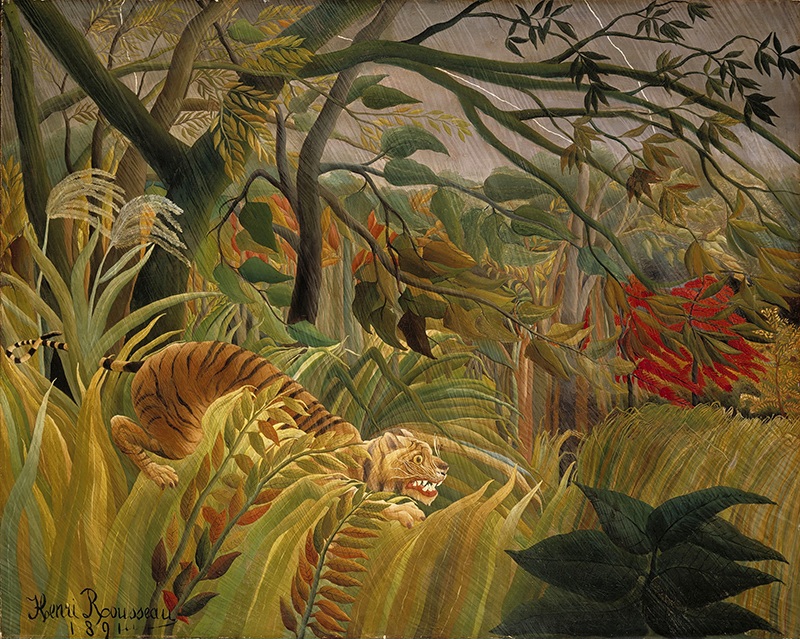
The painting shows a tiger illuminated by lightning, crouching in dense jungle foliage during a violent storm.
Wind bends the plants at sharp angles while rain streaks across the canvas diagonally. The tiger’s color palette blends seamlessly with jungle vegetation.
Rousseau used bold, flat areas of green with simplified form characteristic of his primitive style.
The tiger appears both predatory and vulnerable, caught in nature’s raw power.
Artistic Significance
This work established Rousseau’s distinctive approach to exotic subjects without direct observation.
The painting connects primal animal instincts with human psychology through symbolic representation.
Critics initially dismissed his amateur technique, but later recognized his unique vision as precursor to Surrealism.
The dramatic contrast between chaos and the tiger’s focused presence creates psychological tension.
Current Location and Provenance
The National Gallery in London acquired the painting and displays it in their permanent collection.
It passed through several private collections before entering the museum’s holdings.
Cultural Impact
The painting influenced modern artists’ approaches to depicting wild animals and untamed nature.
It demonstrated how imagination could substitute for direct observation in creating powerful wildlife art.
Rousseau’s jungle scenes inspired later Expressionism and fantasy art movements.
Head of a Stag
Artist and Historical Context
Diego Velázquez painted this work during his Madrid period between 1631 and 1648.
The Spanish Baroque painter served as court artist to King Philip IV and was renowned for royal family portraits.
The painting likely commemorates the king’s hunting adventures from the late 1620s.
Visual Description and Composition
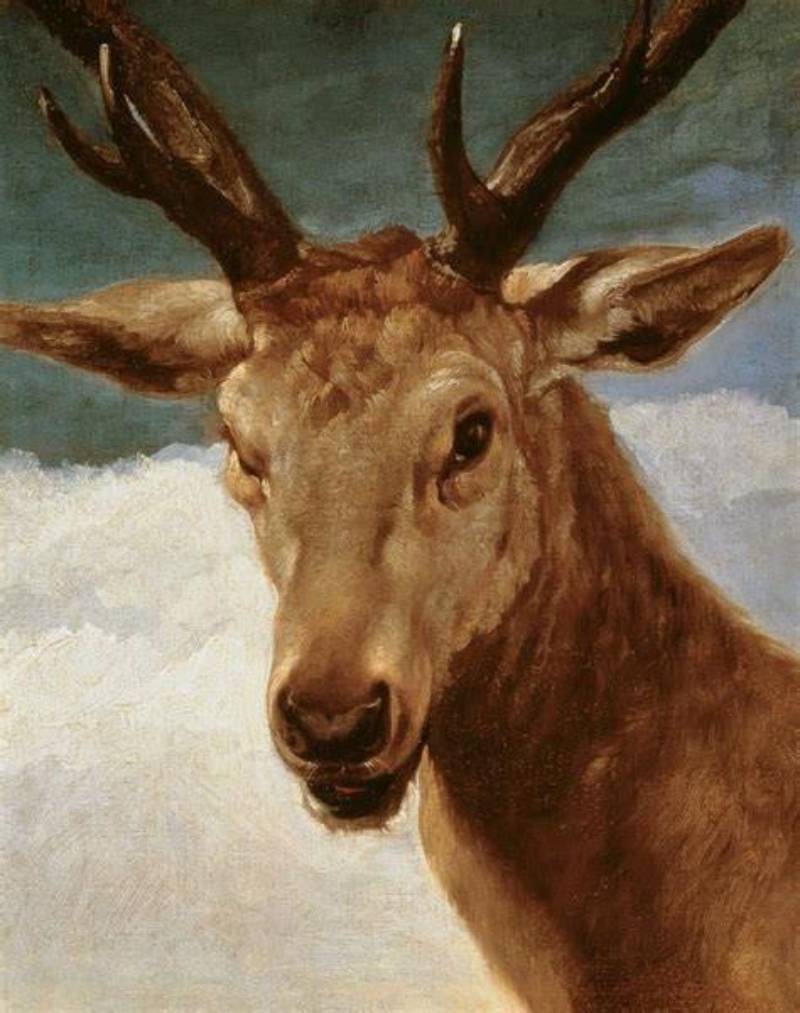
The work presents a close-up portrait of a stag’s head against a dark background.
Velázquez deployed naturalistic expression to emphasize wild animal power and nobility. The stag’s eyes show alertness and vitality.
The painting uses limited complementary colors, focusing on browns and earth tones that highlight the animal’s features.
Antlers frame the composition, creating natural directional lines that draw the eye.
Artistic Significance
The work demonstrates Velázquez’s ability to bring psychological depth to animal subjects.
His distinctive naturalistic style marked a breakthrough in portraiture that influenced future generations.
The painting treats the stag with the same dignity and technical skill as human subjects.
Current Location and Provenance
The Museo del Prado in Madrid, Spain houses the painting in its collection.
Art historians had difficulty dating it precisely due to lack of visible cultural references in the composition.
Cultural Impact
The work influenced how European painters approached hunting scenes and animal portraits.
It elevated wildlife subjects to the same artistic status as royal portraiture.
The Rhinoceros
Artist and Historical Context
Albrecht Dürer created this woodcut print in 1515 after a rhinoceros arrived in Lisbon as tribute to the Pope.
The German Renaissance artist never saw the animal personally but worked from written descriptions and sketches sent to Nuremberg.
The rhino died when its transport ship sank en route to Rome, making it the first of its species seen in Europe since Roman times.
Visual Description and Composition
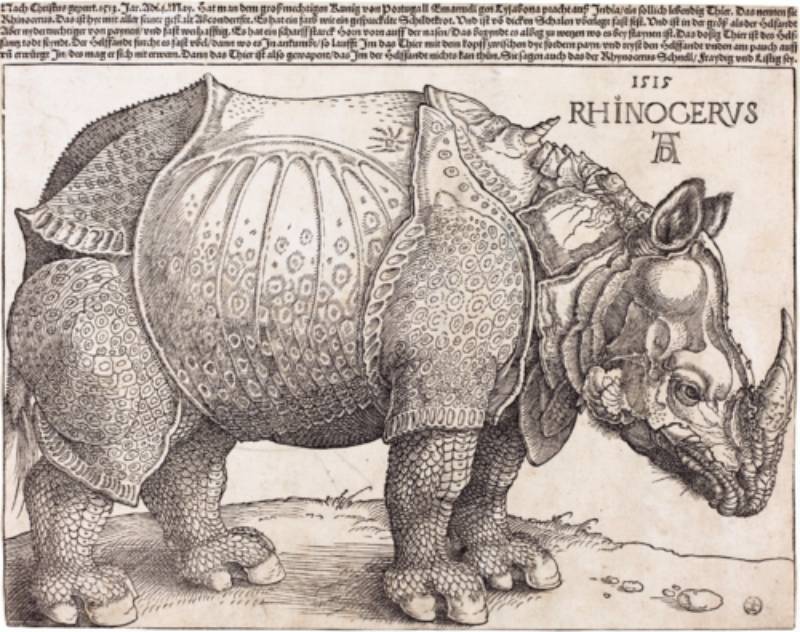
The woodcut shows the rhinoceros in profile with elaborate armor-like skin rendered in intricate detail.
Dürer added decorative elements and textures that don’t exist on real rhinos, including a small horn on the animal’s back.
His preliminary drawing at the British Museum includes handwritten descriptions of the creature.
The print demonstrates masterful use of line work and cross-hatching to create volume and texture.
Artistic Significance
Despite anatomical inaccuracies, the image became the definitive rhinoceros representation for centuries.
It shows how artists interpreted exotic animals through imagination when direct observation was impossible.
The work influenced zoological illustrations and European understanding of wildlife for over 300 years.
Current Location and Provenance
Multiple impressions exist in museums worldwide, including the British Museum and National Gallery of Art.
The original woodblock allowed numerous prints to circulate throughout Europe.
Cultural Impact
The image appeared in scientific texts and natural history books well into the 18th century.
It shaped European imagination about exotic animals and demonstrated art’s role in disseminating knowledge.
Dogs Playing Poker
Artist and Historical Context
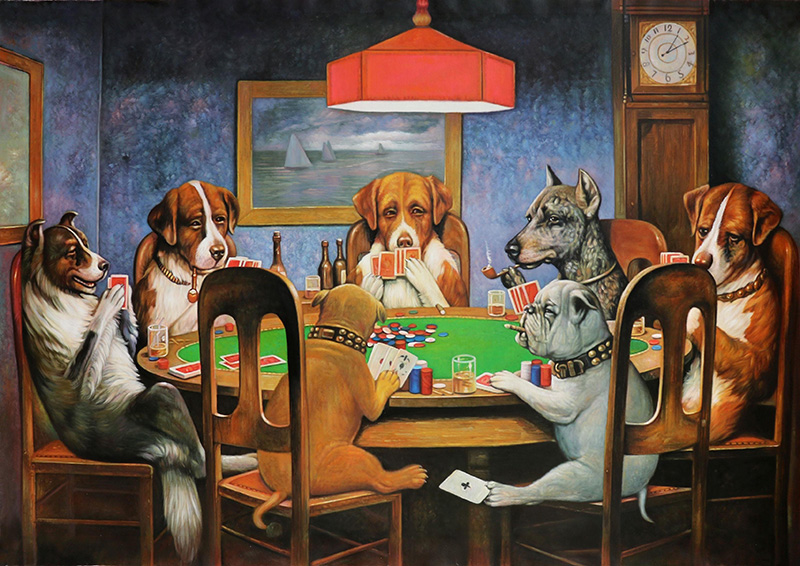
Cassius Marcellus Coolidge created this series of 18 paintings between 1894 and 1910 for cigar company advertisements.
The American artist specialized in anthropomorphic animal paintings, particularly dogs engaged in human activities.
The most famous painting, “A Friend in Need,” shows one dog secretly passing an ace to another under the table.
Visual Description and Composition
The paintings typically show dogs seated around a poker table in a smoke-filled room.
Each dog displays distinct expressions and postures that mimic human gamblers. Some appear confident while others look nervous.
Coolidge used warm lighting and rich browns to create intimate tavern atmospheres.
The works employ emphasis through strategic placement of key characters and actions.
Artistic Significance
The series represents American popular culture and middle-class leisure activities of the era.
Coolidge’s humorous approach made fine art accessible to ordinary people through commercial reproduction.
The paintings use pattern and repetition across the series while varying specific scenarios.
Current Location and Provenance
Various museums and private collections hold individual paintings from the series.
Two paintings sold at auction in 2015 for $658,000, far exceeding estimates.
Cultural Impact
The images became iconic in American popular culture, reproduced on countless posters and prints.
They influenced later artists working with humorous animal subjects and commercial art.
The series demonstrated how Pop Art concepts existed before the formal movement began.
FAQ on Famous Animal Paintings
What makes a painting of an animal famous?
Technical mastery, historical significance, and cultural impact determine fame. Works by renowned artists like George Stubbs or Rosa Bonheur gain recognition through exceptional composition, anatomical accuracy, and exhibition in major museums. Unique artistic approaches and symbolic meanings also contribute to lasting recognition.
Who are the most famous animal painters in history?
George Stubbs revolutionized equine art with anatomical precision. Rosa Bonheur became the leading female Animalier painter. Albrecht Dürer created influential wildlife prints. Henri Rousseau pioneered naive jungle scenes. Edwin Landseer captured British sporting traditions through his detailed wildlife portraits and animal studies.
Why did artists paint animals throughout history?
Animals symbolized power, nobility, and humanity’s relationship with nature. Wealthy patrons commissioned horse portraits to display status. Scientific illustration required accurate depictions. Hunting scenes celebrated aristocratic leisure. Religious and mythological narratives incorporated symbolic creatures across different painting styles.
What is the most expensive animal painting ever sold?
Whistlejacket by George Stubbs was acquired by the National Gallery London for £11 million in 1997. The Horse Fair sold for $53,000 in 1887, equivalent to millions today. Private sales of major animal oil paintings by Pablo Picasso and Franz Marc have reached higher values.
How did Rosa Bonheur create The Horse Fair?
Bonheur visited the Paris horse market twice weekly for 18 months, sketching Percheron draft horses. She obtained police permission to wear male clothing for safety and freedom of movement. Her anatomical studies at slaughterhouses informed the muscular detail and dynamic movement throughout the composition.
Where can I see famous animal paintings?
The National Gallery London displays Whistlejacket and The Goldfinch. The Metropolitan Museum houses The Horse Fair. The Louvre and Prado Museum hold important animal portraits. Museum collections worldwide include works by Dutch Golden Age painters and Baroque animal specialists.
What painting techniques work best for animal subjects?
Oil painting allows detailed fur and feather rendering through layering. Watercolor painting captures quick wildlife sketches. Artists study anatomy, observe live subjects, and use chiaroscuro for volume. Understanding animal movement and behavior improves accuracy in wildlife art creation.
Are cave paintings considered famous animal art?
Lascaux cave paintings from 17,000 years ago rank among history’s most significant wildlife scenes. The Hall of Bulls displays masterful animal depictions. Pech Merle shows woolly mammoths and aurochs. These prehistoric works influenced modern understanding of early human artistic expression and symbolic representation.
Why did George Stubbs paint horses without backgrounds?
The plain background in Whistlejacket was likely inspired by classical sculpture in the Marquess of Rockingham’s collection. This approach focused attention entirely on anatomical detail and the horse’s natural energy. The technique prefigured Romanticism‘s celebration of unbridled animal power and freedom.
What role did animals play in Renaissance art?
Renaissance artists used animals symbolically in religious narratives. Dürer’s rhinoceros introduced exotic species to European audiences. Flemish painters created detailed menageries for wealthy collectors. Animals demonstrated artistic skill through challenging texture, anatomy, and naturalistic color work across various painting mediums.
Conclusion
These famous animal paintings demonstrate how artists transformed wildlife subjects into timeless masterpieces across multiple centuries.
From George Stubbs’s anatomical precision to Rosa Bonheur’s dynamic horse markets, each work reflects deep understanding of animal anatomy and behavior.
The paintings showcase diverse painting mediums and techniques, from oil painting on massive canvases to delicate woodcut prints.
Museum collections worldwide preserve these wildlife art treasures for future generations. The National Gallery, Metropolitan Museum, and other institutions ensure public access to these cultural landmarks.
Whether depicting domestic pets or exotic jungle creatures, these artists elevated animal subjects to the same artistic status as historical and religious paintings.
Their legacy continues influencing contemporary artists exploring humanity’s complex relationship with the natural world through visual expression and creative interpretation.