Love has inspired artists for centuries, but some paintings capture passion so powerfully they transcend time.
Famous romantic paintings showcase intimate embraces, tender kisses, and emotional connections that still resonate with viewers today. From shimmering gold-leaf masterpieces to haunting surrealist scenes, these works reveal different facets of human affection.
This guide explores the most iconic love scenes in art history. You’ll discover the stories behind passionate embraces, learn what makes each painting unforgettable, and understand how artists from Gustav Klimt to Marc Chagall transformed personal devotion into visual poetry.
Whether you’re drawn to Romanticism, Impressionism, or Surrealism, these masterpieces demonstrate why romantic artwork continues captivating audiences across generations.
Famous Romantic Paintings
The Kiss by Gustav Klimt

What Makes It Romantic
The painting captures a couple locked in a passionate embrace, wrapped in shimmering gold robes. Their bodies intertwine on a flower-covered meadow at the edge of an abyss.
The man bends to kiss the woman’s cheek while she melts into his arms with closed eyes. The golden cocoon around them creates an intimate world separate from reality.
Artist & Year Created
Gustav Klimt painted this masterpiece between 1907 and 1908 during his Golden Period. The Austrian Symbolist artist incorporated gold leaf, silver, and platinum into the oil painting.
His father worked as a gold engraver, but Klimt found inspiration for using gold after visiting Ravenna’s Byzantine mosaics in 1903.
Where to See It
The painting hangs in the Belvedere Museum (Osterreichische Galerie Belvedere) in Vienna’s Upper Belvedere Palace. The museum purchased it directly from Klimt in 1908 for 25,000 crowns while the work was still unfinished.
That price was five times higher than any painting previously sold in Vienna.
Visual Elements
The canvas measures 180 x 180 cm (approximately 6 x 6 feet), creating a perfect square composition. Klimt used elaborate geometric patterns on the man’s robe while adorning the woman’s dress with circular, floral designs.
The couple kneels on a patch of wildflowers rendered in vibrant colors against a flat gold background. Art historians note the use of contrast between masculine rectangles and feminine circles.
The woman wears a crown of flowers while the man’s head is decorated with vines.
Historical Context
Klimt created this work after his controversial Vienna Ceiling series that critics labeled pornographic. The Kiss received enthusiastic reception when exhibited at the 1908 Kunstschau celebrating Emperor Francis Joseph I’s 60th anniversary.
Post-Victorian society initially perceived the painting as scandalous despite both figures being fully clothed. Many believe Klimt and his companion Emilie Floge modeled for the work, though no evidence confirms this.
Cultural Impact
The Kiss became Klimt’s most popular work and one of the most reproduced paintings worldwide. In 2003, Austria issued a 100-Euro gold coin featuring Klimt’s portrait on one side and The Kiss on the other.
The painting appears on everything from posters to commercial products. Its influence on Art Nouveau and Vienna Secession movements shaped modern art.
Critics compare it favorably to other famous works, with some noting it surpasses expectations unlike the small Mona Lisa.
The Kiss by Francesco Hayez

What Makes It Romantic
Two medieval lovers embrace in a passionate kiss on stone steps. The woman leans backward while the man bends his left leg to support her, with one foot already resting on the step below.
A hidden dagger in the man’s cloak and shadowy figures lurking in the corner suggest conspiracy and danger. The tight grasp between them hints at an imminent, painful farewell.
Artist & Year Created
Francesco Hayez painted the original version in 1859, commissioned by Count Alfonso Maria Visconti di Saliceto. The Italian artist created three additional versions between 1861 and 1867.
Hayez drew from his Venetian training and knowledge of historical garments to create authentic medieval costumes.
Where to See It
The original hangs in Room XXXVII of the Pinacoteca di Brera in Milan, Italy. The Count donated it to the museum in 1886, a year before his death.
A second version sold at Sotheby’s in 2008 for 780,450 pounds. The third watercolor version resides at the Pinacoteca Ambrosiana in Milan.
Visual Elements
The painting measures 110 x 88 cm in the original version. Hayez used linear perspective with converging diagonals along the staircase steps to direct the viewer’s eye.
The woman’s flowing blue silk dress showcases Venetian painting techniques reminiscent of Titian. The man wears a green cloak with red tights, while the woman’s dress reflects Venetian celebration of “colorito.”
Hayez employed asymmetrical balance through the man’s advanced foot on the lower step.
Historical Context
The painting appeared months after Victor Emanuel II and Napoleon III entered Milan following the Second Italian War of Independence. Hayez created it during the Romanticism movement and Italian unification (Risorgimento).
The chromatic symbolism carries political meaning. The blue dress and red tights represent the French flag, honoring the Franco-Italian alliance against Austrian rule after the 1859 Battle of Solferino.
Later versions shifted to red, white, and green (the Italian tricolor) after the Kingdom of Italy’s proclamation in 1861.
Cultural Impact
The Kiss became the most widely reproduced Italian painting of the 19th century. It symbolizes both romantic passion and patriotic devotion to the Italian homeland.
Director Luchino Visconti referenced the painting in his 1954 film Senso. Perugina chocolate manufacturer adopted the imagery for their “Baci” chocolates marketed as symbols of love.
Scholars frequently compare it to Gustav Klimt’s The Kiss, noting Hayez’s precedence by nearly five decades in fusing intimate eroticism with ideological depth.
The Birthday by Marc Chagall

What Makes It Romantic
The artist floats through the air in an impossible twist, his body suspended and neck bent backward to kiss his beloved. Bella stands on the ground holding a bouquet of flowers, lifting off as if defying gravity.
The couple appears drunk with joy in their simple red-carpeted apartment. This levitating embrace captures pure ecstasy and emotional transcendence.
Artist & Year Created
Marc Chagall painted The Birthday on July 7, 1915, his 28th birthday. He created it just weeks before marrying Bella Rosenfeld despite her wealthy parents’ opposition.
The Russian-born French artist used oil on cardboard, a modest material choice given wartime conditions.
Where to See It
The painting resides in the permanent collection of the Museum of Modern Art (MoMA) in New York. MoMA acquired it in 1949 through the Lillie P. Bliss Bequest.
The work measures 80.5 x 99.5 cm (approximately 31.5 x 39 inches).
Visual Elements
A vivid red carpet dominates the lower portion while ivory, beige, and tan tones balance the upper section. The small room features modest furnishings, a corner of a wall clock, and a window showing the street outside.
Chagall employed color segmentation rather than body decomposition, using black dress and pants against warm red textiles. The artist’s distorted neck and suspended body evoke Hasidic ritual influences from his Jewish heritage.
Simple details like the table and couch emphasize that love transforms ordinary space into something magical.
Historical Context
Chagall painted this during World War I when he returned to Vitebsk, Belarus from Paris. He got stranded there when the war broke out in 1914.
The work came after the success of his Vitebsk series exhibited in Moscow in 1915. This success finally convinced the Rosenfeld family to accept their marriage.
Bella was Chagall’s muse throughout his career until her death in 1944.
Cultural Impact
The Birthday established Chagall’s signature style of floating lovers that appeared in multiple works throughout his career. The painting demonstrates how love literally lifts people above earthly concerns.
This work influenced later movements by showing that emotional truth matters more than realistic depiction. Art historians consider it a key piece reflecting Chagall’s artistic worldview combining primitivism and surrealism.
The levitation motif became synonymous with Chagall’s visual language about romantic devotion.
The Lovers by Rene Magritte

What Makes It Romantic
Two figures attempt to kiss with their faces completely covered by white cloth. The barrier transforms an act of passion into one of frustration and mystery.
The shrouded heads prevent the lovers from truly seeing or touching each other. This creates a haunting portrayal of love’s hidden barriers and emotional distance.
Artist & Year Created
Rene Magritte created four variations of The Lovers in Paris in 1928. The Belgian Surrealist was 30 years old and exploring themes of identity, mystery, and psychological reality.
He painted these works shortly after settling in Paris, where he became absorbed with Fantomas thriller novels and films featuring a villain whose face remained wrapped in cloth.
Where to See It
The Lovers II (the most famous version) hangs in the Museum of Modern Art in New York as part of the Richard S. Zeisler collection. The Lovers I resides in the National Gallery of Australia.
The third and fourth variations remain in private collections.
Visual Elements
The composition uses cinematic close-up framing influenced by Magritte’s passion for films. The couple occupies the entire canvas in the foreground like a romantic movie scene.
In The Lovers I, green verdure of the Normandy coast and sea appear in the background, creating an Instagram-like holiday snapshot ruined by the draped cloth. The Lovers II features a more abstract background with hints of blue and black.
The woman wears a red dress while the man wears a black suit, with genders only discernible through attire. White or grayish veils form curls over their shoulders like ropes.
Historical Context
Magritte painted these during his early Surrealist period when artists explored masks, disguises, and what lies beneath surfaces. Some art historians link the imagery to his mother’s suicide in 1912 when he was 13.
Her body was found in the river Sambre with her nightdress supposedly wrapped around her head. Magritte himself disliked biographical explanations, preferring the mystery to remain unexplained.
He stated, “Mystery means nothing either, it is unknowable.”
Cultural Impact
The Lovers became one of the most influential surrealist artworks. Fashion designer David Delfin created a controversial collection featuring models with covered heads inspired by this painting.
Pedro Almodovar paid homage in his film Broken Embraces, recreating the scene under bedsheets. The work challenges traditional romantic imagery by showing love’s impossibility and alienation rather than fulfillment.
It represents the phrase “love is blind” while depicting how couples remain mysteries to each other despite intimacy.
In Bed: The Kiss by Henri de Toulouse-Lautrec

What Makes It Romantic
Two women lie in bed kissing each other passionately in an intimate embrace. The scene captures a quiet, tender moment between lovers lost in their own world.
Unlike grand romantic gestures, this painting shows love in simple, everyday moments. The women cuddle as they embrace each other’s presence, seeking escape from reality through their kiss.
Artist & Year Created
Henri de Toulouse-Lautrec created this work in 1892 as part of his series depicting life in French brothels. He was a key Post-Impressionist figure in 19th-century France.
The artist frequently visited brothels in Paris, observing the private lives of the women who worked there.
Where to See It
The painting belongs to a series of sixteen works featuring scenes from a brothel on rue d’Ambroise. Toulouse-Lautrec created these intimate portrayals during his regular visits to French brothels in the 1890s.
The work measures approximately 21 1/4 x 27 3/4 inches, painted using oil on cardboard.
Visual Elements
Soft brushstrokes and a warm color palette create feelings of comfort and intimacy. Shadows and lines effectively convey the physical connection between the figures.
The artist used loose, expressive painting techniques typical of Post-Impressionism. The cozy nest of blankets and covers emphasizes the private nature of the moment.
Historical Context
The painting came during a period when depicting lesbian relationships in art was highly controversial. It broke taboos by presenting same-sex affection without judgment.
Toulouse-Lautrec showed genuine respect for his subjects, treating them as people rather than objects. This approach differed from how society typically viewed sex workers.
After this work appeared, more artists began exploring themes of lesbian love in their paintings.
Cultural Impact
The painting challenged Victorian-era morality by depicting erotic content between women. Some viewed it merely as sensual portraiture while others recognized its artistic merit.
Critics eventually acclaimed it as an important work despite initial controversy. The piece belongs to the canon of famous romantic paintings for its honest, non-exploitative portrayal of intimacy.
Toulouse-Lautrec’s empathetic approach influenced how later artists depicted marginalized subjects.
Romeo and Juliet by Frank Dicksee

What Makes It Romantic
The painting captures Shakespeare’s tragic lovers during their famous balcony scene. Romeo and Juliet share a passionate farewell embrace bathed in soft, romantic lighting.
The scene embodies both the beauty and heartbreak of doomed young love. Rich colors and tender positioning convey intense emotion between the star-crossed lovers.
Artist & Year Created
Frank Dicksee painted this work in 1884, drawing inspiration from Shakespeare’s timeless tragedy. The British artist specialized in dramatic historical and literary scenes.
He was known for his romantic, detailed style that appealed to Victorian sensibilities. Dicksee later became President of the Royal Academy.
Where to See It
The painting demonstrates Dicksee’s mastery of capturing emotional moments from literature. It represents the Victorian era’s fascination with Shakespearean themes.
The work shows Romeo on the balcony with Juliet in a tender, intimate pose that emphasizes their forbidden connection.
Visual Elements
Soft lighting creates a dreamlike atmosphere around the lovers. The moonlit setting adds to the secretive, romantic nature of their meeting.
Dicksee used careful chiaroscuro to highlight the figures against the darker background. The rich, warm tones emphasize the passion and tragedy of their love.
Attention to period costumes and architectural details creates historical authenticity.
Historical Context
Victorian England saw renewed interest in Shakespeare’s works. Artists frequently depicted scenes from his plays, especially tragic love stories.
The painting reflects 19th-century Romanticism‘s emphasis on emotion over reason. It appeared during a period when literary subjects dominated academic art.
Cultural Impact
The work became one of the most recognized visual interpretations of Romeo and Juliet. It shaped how generations imagined Shakespeare’s balcony scene.
The painting reinforced the cultural icon status of literature’s most famous young lovers. Its influence extends to modern theatrical and film productions.
Paolo and Francesca by Dante Gabriel Rossetti

What Makes It Romantic
The painting depicts the tragic lovers from Dante’s Inferno in their final embrace. Caught in an adulterous affair, they’re doomed to eternal punishment in the second circle of hell.
Rossetti captures their last moment of earthly tenderness and longing. The scene is both beautiful and heartbreaking, showing love’s power despite its tragic consequences.
Artist & Year Created
Dante Gabriel Rossetti painted this work in 1867. The British artist was a founding member of the Pre-Raphaelite Brotherhood.
He frequently drew inspiration from Dante Alighieri’s Divine Comedy and medieval literature. Rossetti explored themes of forbidden love and tragic romance throughout his career.
Where to See It
The painting represents Rossetti’s fascination with doomed lovers from classical literature. Paolo and Francesca’s story captivated Victorian audiences interested in medieval romance.
Multiple versions exist as Rossetti revisited the theme several times during his career.
Visual Elements
Rich colors and detailed medieval costumes characterize the Pre-Raphaelite style. The lovers appear lost in each other despite the swirling winds of hell around them.
Rossetti used symbolism to represent their eternal punishment while maintaining the tenderness of their connection. The composition emphasizes their intimate embrace against a turbulent background.
Historical Context
The Pre-Raphaelite Brotherhood rejected academic painting conventions, instead looking to medieval and early Renaissance art for inspiration. They valued emotional authenticity and detailed naturalism.
Victorian fascination with medieval romance and tragic love stories made this subject particularly popular. The painting reflects the era’s complex attitudes toward passion and morality.
Cultural Impact
The work became one of the most moving depictions of forbidden love in art history. It influenced how artists portrayed tragic romance and literary subjects.
Rossetti’s interpretation shaped Victorian understanding of Dante’s Inferno. The painting remains an important example of Pre-Raphaelite artistic principles and their focus on emotional intensity.
A Dance in the Country by Pierre-Auguste Renoir

What Makes It Romantic
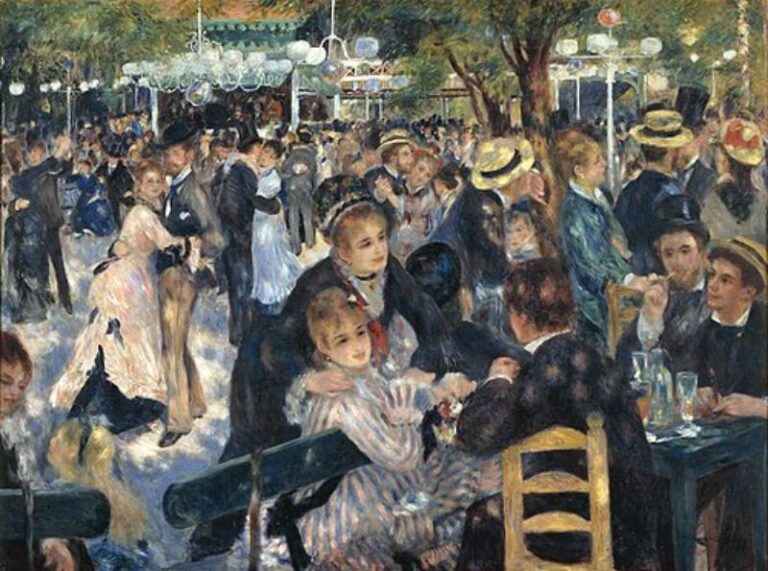
A couple dances spontaneously in the countryside, the woman beaming with genuine joy. The discarded hat and nearby table suggest an impromptu moment of celebration.
The man holds Renoir’s future wife as she displays a rare, radiant smile. Their dance captures the frivolity and happiness common among middle-class entertainment in late 1800s France.
Artist & Year Created
Pierre-Auguste Renoir created this work as the first in a series of three dance paintings. The Impressionist pioneer painted his future wife and muse, Aline Charigot, a seamstress.
Renoir captured the cheerful spirit of popular entertainment during the French Belle Epoque period.
Where to See It
The painting represents a marked change from the somber colors dominating European art. It celebrates the joy and lightness of everyday romance.
The work shows Renoir’s mature Impressionist style with loose brushwork and vibrant colors.
Visual Elements
Vibrant colors capture sunlight filtering through trees in the countryside. Renoir used quick, visible brushstrokes characteristic of Impressionism.
The woman’s flowing dress and the man’s casual attire create a sense of movement. Color saturation emphasizes the warmth and happiness of the scene.
The composition conveys spontaneity through the scattered objects and informal positioning.
Historical Context
The painting reflects late 19th-century French middle-class leisure activities. Dancing became popular public entertainment during this period.
Renoir departed from traditional academic painting by showing ordinary people enjoying simple pleasures. This democratization of subject matter was revolutionary for its time.
Cultural Impact
The work became an iconic representation of joyful romance in Impressionist art. It shows love through shared happiness rather than dramatic gestures.
Renoir’s portrayal of his future wife influenced how artists depicted personal relationships. The painting celebrates everyday moments of connection rather than grand theatrical scenes.
Diego on my Mind by Frida Kahlo

What Makes It Romantic
Frida painted Diego Rivera’s portrait on her forehead, showing how completely he occupied her thoughts. The self-portrait reveals complex emotions about their tumultuous relationship.
Unlike other famous romantic paintings, this came after a painful separation. Frida’s penetrating gaze and Diego’s image create an unsettling intimacy.
Artist & Year Created
Frida Kahlo painted this self-portrait in 1943, also titled “Thinking of Diego.” The Mexican artist created it during a difficult period in her marriage to muralist Diego Rivera.
Kahlo’s life lacked warmth and stability, leading her to paint herself repeatedly as a form of self-examination.
Where to See It
The painting belongs to The Jacques and Natasha Gelman Collection of 20th Century Mexican Art. It’s part of the Vergel Foundation collection.
The work demonstrates Kahlo’s unique approach to self-portraiture and personal narrative in art.
Visual Elements
Kahlo painted Diego’s portrait as a third eye on her forehead, surrounded by veins connecting to her own features. The composition shows sophisticated psychological depth.
Her signature unibrow and direct stare confront the viewer while Diego’s image floats above. The painting uses symbolism to represent obsessive thoughts and emotional dependence.
Tear tracks and emotional intensity mark the canvas.
Historical Context
Kahlo and Rivera had a passionate, volatile relationship marked by mutual infidelities and deep artistic respect. They divorced in 1939 but remarried in 1940.
This painting reflects the complexity of their connection during another troubled period. Mexican art was experiencing a renaissance celebrating indigenous culture and personal narrative.
Cultural Impact
The work stands as one of art history’s most honest portrayals of romantic obsession. It influenced how artists depicted psychological states and emotional truth.
Kahlo’s unflinching self-examination inspired generations of artists to explore personal pain through art. The painting shows that romantic love involves struggle, not just joy.
The Arnolfini Portrait by Jan Van Eyck

What Makes It Romantic
A merchant and his wife stand in their chamber holding hands in a solemn gesture. The formal positioning and joined hands suggest a marriage contract or sacred vow.
Every detail carries symbolic weight about fidelity, domesticity, and partnership. The painting portrays marriage as a serious commitment rather than passionate romance.
Artist & Year Created
Jan Van Eyck completed this work in 1434, making it the oldest painting on many romantic art lists. The Flemish master was a pioneer in oil painting technique.
Van Eyck worked for Philip the Good, Duke of Burgundy, creating both portraits and religious works.
Where to See It
The painting hangs in the National Gallery London. It measures approximately 82 x 60 cm.
Art historians debate whether it depicts Italian merchant Giovanni di Nicolao Arnolfini and his wife or another couple entirely.
Visual Elements
Meticulous detail showcases Van Eyck’s mastery of oil painting technique. The convex mirror in the background reflects the entire room including two additional figures.
Rich fabrics, a small dog, oranges, and a chandelier carry symbolic meanings about wealth, fidelity, and domesticity. The single candle may represent God’s presence at their union.
Van Eyck’s signature appears on the wall: “Jan van Eyck was here 1434.”
Historical Context
Painted during the Northern Renaissance, the work showcases early mastery of oil painting techniques. It may have served as a marriage contract or commemorative portrait.
The detailed realism reflects the Flemish tradition of precise observation. Every object carries multiple layers of religious and social meaning.
Cultural Impact
The Arnolfini Portrait influenced portrait painting for centuries. Its use of symbolism and mirror reflections became iconic.
Art historians still debate its exact meaning and whether it depicts a wedding ceremony. The painting demonstrates how marriage was portrayed as a sacred, legal bond in medieval society.
FAQ on Famous Romantic Paintings
What is the most famous romantic painting ever created?
Gustav Klimt’s The Kiss (1907-1908) is widely considered the most famous romantic painting. The golden masterpiece depicts two lovers in an intimate embrace and hangs in Vienna’s Belvedere Museum. Its shimmering patterns and emotional depth make it an enduring symbol of passionate love.
Which artists are known for painting romantic scenes?
Gustav Klimt, Marc Chagall, Francesco Hayez, and Pierre-Auguste Renoir created iconic romantic artwork. Rene Magritte and Henri de Toulouse-Lautrec explored love’s complexities. Each artist brought unique perspectives to depicting intimate moments and emotional connections between lovers.
Where can I see the most famous romantic paintings?
The Belvedere Museum in Vienna houses Klimt’s The Kiss. MoMA in New York displays Chagall’s The Birthday and Magritte’s The Lovers II. The Pinacoteca di Brera in Milan exhibits Hayez’s The Kiss. Major museums worldwide feature romantic masterpieces in their permanent collections.
What makes a painting romantic versus Romanticism art?
Romantic paintings depict love, passion, and intimate relationships between people. Romanticism was an 18th-19th century art movement emphasizing emotion, nature, and individualism. While some Romanticism paintings show romantic love, the movement focused broadly on emotional intensity and sublime experiences beyond just couple portraits.
How did artists depict love differently across art movements?
Renaissance artists portrayed idealized beauty and mythological love. Baroque painters added dramatic emotion and chiaroscuro. Impressionists captured spontaneous moments. Surrealists explored love’s psychological complexities. Each movement brought fresh perspectives to depicting human connection and affection.
Why do artists use gold leaf in romantic paintings?
Gold leaf creates luminous, ethereal effects that symbolize divine or transcendent love. Klimt used gold extensively after visiting Ravenna’s Byzantine mosaics. The precious material elevates romantic subjects beyond everyday reality, suggesting love’s sacred and eternal nature through shimmering, otherworldly beauty.
What painting techniques create romantic atmosphere?
Artists use soft lighting, warm color harmony, and intimate composition to evoke romance. Sfumato creates dreamy transitions. Tender gestures and close positioning emphasize connection. Atmospheric perspective and flowing brushwork add emotional depth to scenes of love and devotion.
Are there famous romantic paintings featuring same-sex couples?
Henri de Toulouse-Lautrec’s In Bed: The Kiss (1892) depicts two women in an intimate embrace. This groundbreaking work challenged Victorian morality and opened doors for artists exploring diverse expressions of love. The painting hangs as a critically acclaimed example of honest, non-exploitative romantic portraiture.
How do I identify symbolism in romantic paintings?
Look for color symbolism (red for passion, white for purity), flowers representing devotion, and hand gestures showing connection. Clothing colors often carry political or emotional meanings. Background elements like storms or sunsets reflect relationship dynamics. Symbolism adds layers beyond surface romance.
What role does cultural context play in romantic paintings?
Cultural context shapes how love appears on canvas. Hayez’s The Kiss symbolized Italian unification through romantic imagery. Victorian-era works reflected strict social codes. Modern pieces challenge traditional representations. Understanding historical periods helps viewers grasp deeper meanings beyond the obvious depiction of affection and intimacy.
Conclusion
Famous romantic paintings reveal how artists across centuries transformed intimate moments into timeless masterpieces. From Baroque drama to Symbolist mystery, each era brought fresh perspectives to depicting passion and devotion.
These works demonstrate the power of color psychology, composition, and symbolic imagery. Artists like Sandro Botticelli, Peter Paul Rubens, and Frida Kahlo captured love’s complexity through their unique visions.
Whether you prefer the golden embrace in Klimt’s masterpiece or the haunting veils in Magritte’s surrealist scene, these paintings continue inspiring viewers today. They remind us that love transcends time, culture, and artistic movement.
Understanding the stories behind tender kisses, passionate embraces, and emotional connections enriches our appreciation of art history’s most powerful theme.