Rita Ackermann is a Hungarian-American contemporary painter known for abstract figurative works that explore femininity, adolescence, and the tension between creation and destruction. Born in Budapest in 1968, she became a defining figure of New York’s 1990s downtown art scene after immigrating in 1992.
Her paintings merge expressionism with gestural abstraction. She uses erasure as a primary technique, building and removing layers until figures seem to float between visibility and disappearance.
Ackermann’s career spans more than three decades. She has produced several major series, exhibited internationally, and her works are held in collections including MoMA, SFMOMA, and the Ludwig Museum in Budapest.
Identity Snapshot
- Full Name: Rita Ackermann (born Rita Bakos)
- Lifespan: 1968 – present
- Primary Roles: Painter, Collagist, Mixed Media Artist
- Nationality: Hungarian-American
- Movements: Neo-Expressionism, Abstract Expressionism, Figurative Abstraction
- Mediums: Oil on canvas, acrylic, spray paint, chalk, ballpoint ink, china marker, pastel, raw pigment
- Signature Traits: Gestural mark-making, erasure technique, semi-transparent figures, bold contour lines, impasto fields
- Iconography: Nymph-like women, adolescent figures, fairy tale allusions, doe-eyed girls
- Geographic Anchors: Budapest (birthplace), New York City (primary studio)
- Mentor: Karoly Klimo at Academy of Fine Arts Budapest
- Spouse: Daniel Turner (artist)
- Representation: Hauser & Wirth (current), Andrea Rosen Gallery (former)
- Collections: MoMA New York, San Francisco Museum of Modern Art, Dallas Museum of Art, Ludwig Museum Budapest, Museum of Contemporary Art Miami, Museum of Contemporary Art Los Angeles
- Market Signals: Auction record $400,000 for “Red Dots” (2022) at Hauser & Wirth charity sale; prior record $115,500 for “Water Lilies in Chalk V” at Phillips (2018)
What Sets Rita Ackermann Apart
She paints like she’s dancing. That’s how she describes it.
The brushstrokes move with her body. Sometimes they disappear entirely into what she calls “a well-conducted chaos of stains.”
Unlike many painters who work toward completion, Ackermann works toward dissolution. Her figures emerge and vanish in the same gesture.
The technique sits somewhere between Jackson Pollock‘s action painting and Willem de Kooning‘s figurative abstraction. But where those artists built up, she strips away.
Her adolescent female figures carry a particular emotional charge. They’re not idealized. They’re languid, disinterested, caught in states of vulnerability that feel both staged and private.
The work refuses to settle into either pure abstraction or clear figuration. It holds both at once, which creates this persistent visual tension that most painters avoid.

Origins and Formation
Early Training
Ackermann studied at the Academy of Fine Arts Budapest from 1989 to 1992.
Her primary teacher was Karoly Klimo, a Hungarian painter. The academic training gave her strong figurative drawing skills that still show through her most abstract work.
New York Arrival
In 1992, she moved to New York City through the Hanes Family Foundation.
She enrolled at the New York Studio School of Drawing, Painting and Sculpture. She found the teaching too conservative for her interests.
Upon arriving, she changed her name from Rita Bakos to Rita Ackermann, taking her grandmother’s maiden name.
Downtown Scene Immersion
New York in the early 1990s was a particular moment. Rave culture, zine culture, underground music scenes.
She connected with musicians and filmmakers. These collaborations would shape her practice for decades.
The Whitney Independent Study Program further exposed her to the city’s underground art world.
First Recognition
Her first solo exhibition came in 1994 at Andrea Rosen Gallery in New York.
The show was titled “After Dinner I’m Gonna Shoot You But Before I’ll Take a Shower.” It received critical attention, including a review in Artforum by Keith Seward.
That same year, The New Museum commissioned her to create a faux stained-glass window titled “Who Are We? What Are We? Where Did We Come From?” The piece referenced Paul Gauguin’s famous horizontal composition from 1897.
Movement and Context
Position Within Neo-Expressionism
Ackermann emerged after the first wave of Neo-Expressionism had already established itself in the 1980s.
She took the movement’s emphasis on gestural intensity but added something different. Her figures carry emotional weight without the bombast that characterized some earlier Neo-Expressionist work.
Comparative Positioning
Against Tracey Emin: Both artists explore female subjectivity with raw emotional content. Ackermann’s approach is more formally experimental, less confessional. Her figures dissolve where Emin’s confront directly.
Against Cecily Brown: Both merge figuration with gestural abstraction. Ackermann uses erasure as a primary tool where Brown builds up density. Ackermann’s palette runs cooler, her edges softer.
Against George Condo: Both distort the figure for psychological effect. Ackermann’s distortions come through process (erasure, layering) rather than deliberate grotesquerie. Her figures slip away where Condo’s figures confront.
Influences Absorbed

The films of Jean-Luc Godard shaped her understanding of perception as fragmentation.
Paul Virilio’s theories on speed and image informed her approach to visual phenomena.
The German film “We Children from Bahnhof Zoo” about heroin subculture directly inspired her early figure paintings.
Materials, Techniques, and Process
Supports and Grounds
She works primarily on canvas and raw linen.
Some works use Masonite board. Her Chalkboard Paintings series uses canvas primed with chalkboard paint.
Unstretched canvas appears in larger works like “Fire by Days XVII” (2011), measuring over 13 feet.
Painting Mediums
The range of painting mediums she uses is unusual. Oil paint and acrylic form the base.
On top: spray paint, ballpoint ink, china markers, pastel, raw pigment, chalk.
Unconventional materials include Vaseline, sand, latex, glass, motor oil, and rabbit skin glue applied as a final layer rather than a primer.
Brushwork and Mark-Making
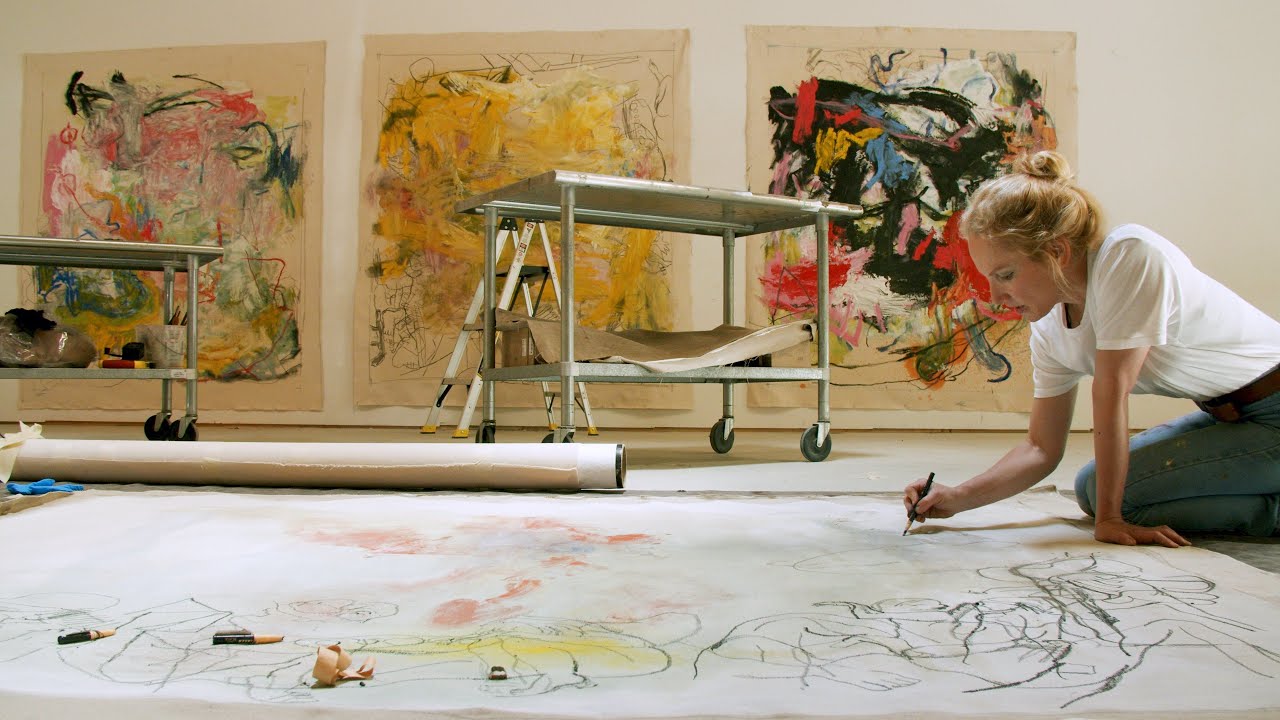
She describes her process as dancing. The body moves with the brush.
Gestural strokes range from sweeping washes to tight contour lines. Impasto fields of imbricated color sit against areas of thin, stained canvas.
Gesture drawing underlies much of the work. Figures begin as drawings that get partially buried under paint.
The Erasure Technique
This is her signature method. She builds up figurative elements, then removes them through washing, scraping, or overpainting.
The result: ghost-like traces. Figures that seem to hover between presence and absence.
In the Chalkboard Paintings, she applies chalk and pigment, then erases repeatedly. The residual marks create a sense of accumulated memory.
Studio Practice
Works develop through “rescue operations” as she calls them. Intended accidents that require assimilation.
The process is additive and subtractive simultaneously. Multiple layers build up while others get stripped away.
Themes, Subjects, and Iconography
The Adolescent Female Figure
Doe-eyed, almond-eyed girls populate her work from the earliest paintings.
They appear languid, disinterested, caught in states of undress or vulnerability. This is adolescent ennui rendered visible.
The figures are not idealized. They carry psychological weight through their very passivity.
Fairy Tale and Literary Allusions
Hints of fairy tales run through the work. Nymph-like women inhabit ambiguous narrative spaces.
Literary influences include references visible in sketchbook projects like “A Midsummer Night’s Dream.”
Violence and Fragility
These two forces exist in constant tension. Figures engage in self-destructive or hazardous activities in early works.
The “Fire by Days” series explores this paradox through form itself. Bodies seem simultaneously burning and dissolving.
Compositional Approaches
Many works use horizontal formats that reference Gauguin’s “Where Do We Come From?” composition.
The composition often divides into stacked bands. Parallel horizontal striations create a sense of cinematic framing.
Figures occupy central bands while gestural abstraction fills upper and lower thirds.
Feminist Dimensions
Her work explores femininity without didacticism. The female figures are subjects, not objects, even in their passivity.
She brings together extremes of female imagery. The prostitute and the Virgin. The ingenue and the knowing.
Notable Works
Who Are We? What Are We? Where Did We Come From? (1994)
Medium: Faux stained-glass window
Location: The New Museum, New York (commissioned)
Visual Signature: Direct reference to Gauguin’s 1897 composition. Adolescent figures in a horizontal format.
Significance: First major institutional commission. Established her engagement with art historical sources.
Fire by Days Series (2010-2012)

Medium: Oil, spray paint, acrylic on canvas (often unstretched)
Scale: Large format, up to 421.6 x 345.4 cm
Visual Signature: Fragmented bodies beneath gestural strokes. Figures dissolve into smears of oil, acrylic, and chalk. Red heat with blue tracing halos.
Significance: Marked a shift toward greater abstraction. The interplay between visible and hidden became central.
Chalkboard Paintings (2013-2015)

Medium: Acrylic, spray paint, chalk on canvas primed with chalkboard paint
Scale: Typically 198.1 x 111.8 cm
Visual Signature: Green and blue pigments over white chalk washes. Classroom chalkboard aesthetic with intentional erasures.
Related Works: “Water Lilies in Chalk V” (auction record $115,500, Phillips 2018)
Significance: Pushed erasure technique to its logical extreme. Figures become pure memory traces.
Mama Series (2019-present)

Medium: Oil, acrylic, pigment, pastel, china marker on canvas
Visual Signature: Figures dissolving into volatile abstract fields. Tension between control and surrender.
Significance: Deepened exploration of instability. Among her most emotionally resonant work.
War Drawings (2022)

Medium: Oil, grease pencil, acrylic on rough linen canvas
Visual Signature: Heavily worked surfaces. Lines scraped away to reveal fragmented compositions.
Significance: Recent direction showing continued experimentation with erasure and texture.
Exhibitions, Collections, and Provenance
Key Solo Exhibitions

- “After Dinner I’m Gonna Shoot You…” Andrea Rosen Gallery, New York (1994)
- “Snowfall in August” Museum Het Domein, Netherlands (2002)
- “BAKOS” Ludwig Museum of Contemporary Art, Budapest (2011)
- “Fire by Days” Hauser & Wirth London (2012)
- “Meditation on Violence” Sammlung Friedrichshof, Austria (2014)
- “The Aesthetic of Disappearance” Malmo Konsthall, Sweden (2016)
- “Movements as Monuments” La Triennale di Milano (2018)
- “Mama ’19” Hauser & Wirth New York (2020)
- “Hidden” MASI Lugano, Switzerland (2023)
- “Vertical Vanish” Hauser & Wirth Los Angeles (2023)
- “Splits” Hauser & Wirth New York (2024)
- “Doubles” Hauser & Wirth Paris (2025)
Major Group Exhibitions
Whitney Biennial (2008). Women Painting Women, Modern Art Museum of Fort Worth (2022). Michael Jackson: On the Wall, National Portrait Gallery, London (2018).
Museum Collections
Museum of Modern Art, New York. San Francisco Museum of Modern Art. Dallas Museum of Art. Ludwig Museum, Budapest. Museum of Contemporary Art, Miami. Museum of Contemporary Art, Los Angeles.
Notable Collectors
Tracey Emin and John Currin reportedly hold works in their private collections.
Market and Reception
Auction Performance
Prices range from $572 to $400,000 at auction.
Most works sell between $10,000 and $25,000.
Record: $400,000 for “Red Dots” (2022) at Hauser & Wirth’s charitable auction, surpassing the previous record of $115,500 set at Phillips in 2018.
Gallery Representation
Hauser & Wirth represents her globally. Previous representation through Andrea Rosen Gallery in New York.
Commercial Collaborations
Supreme fashion house collaboration (2019). Chloe collaboration (2020). Her imagery inspired collection designs.
Filmmaker Harmony Korine collaborated on “Shadow Fux” (2010-2011), exhibited at the Swiss Institute.
Critical Reception
Artforum, ARTnews, The Financial Times, and ArtReview have covered her work extensively.
Critics note the tension between fragility and violence. The use of erasure as conceptual method receives particular attention.
Influence and Legacy
Upstream Influences
Paul Gauguin’s compositions and his depictions of languid female figures.
Abstract Expressionism, particularly the gestural approaches of Pollock and de Kooning.
European cinema, especially Jean-Luc Godard’s fragmented narratives.
Paul Virilio’s theories on perception and speed.
Downstream Impact
Her approach to erasure as a generative technique has influenced younger painters working between figuration and abstraction.
The emotional charge of her adolescent figures opened space for other artists to explore similar psychological territory without sentimentality.
Cross-Domain Connections
Fashion: Direct collaborations with Supreme and Chloe brought her visual language to commercial design.
Film: The collaboration with Harmony Korine on “Shadow Fux” extended her practice into moving image.
Music: Ongoing collaborations with musicians including Sonic Youth. Her connection to punk and no wave scenes shaped her aesthetic from the beginning.
How to Recognize a Rita Ackermann at a Glance
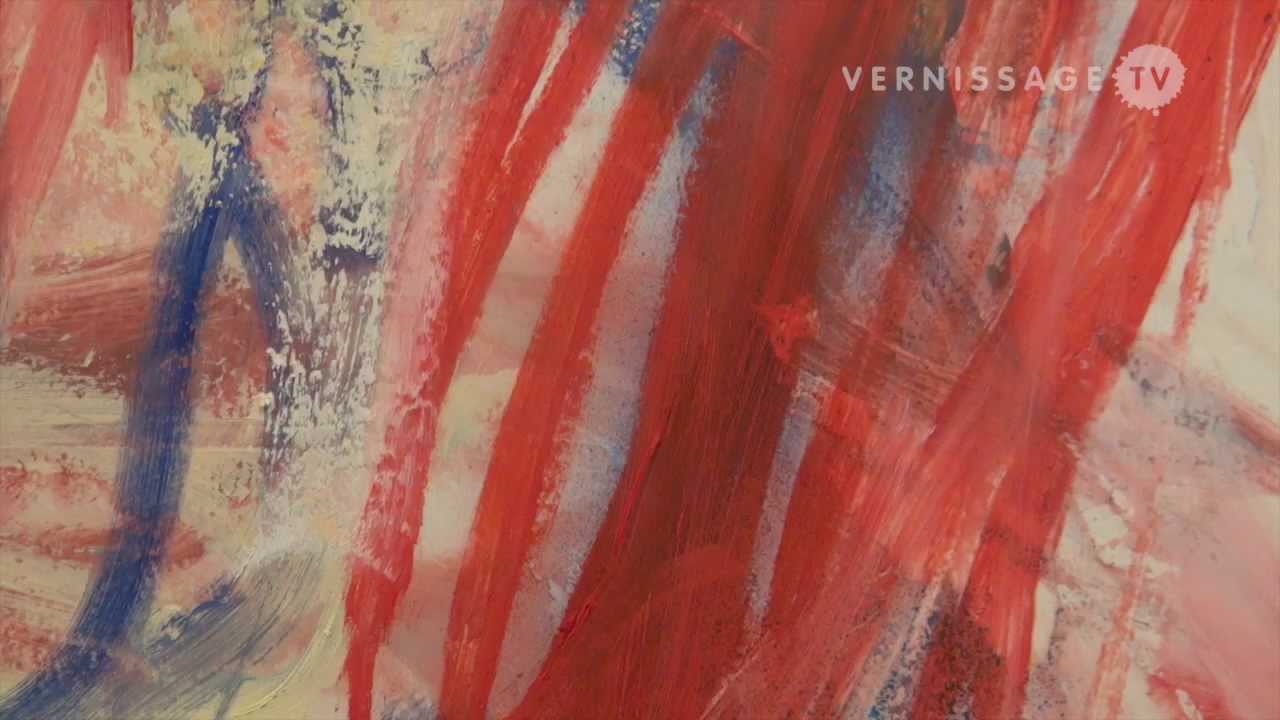
- Ghostly figures that seem to emerge from and dissolve into the paint surface simultaneously
- Doe-eyed or almond-eyed female figures with elongated features and languid poses
- Evidence of erasure: chalky residue, scraped areas, traces of removed imagery
- Mixed media layering: spray paint over oil, ballpoint marks, china marker lines visible
- Large scale: major works often exceed 6 feet in at least one dimension
- Horizontal banding: compositions frequently divide into stacked zones
- Cool-to-warm temperature shifts: blues and greens against ochres and reds
- Impasto passages next to thinly stained areas creating strong contrast
- Semi-transparent bodies: figures rendered with washes that let underlayers show through
- Signature placement: typically on reverse, often with title and date
FAQ on Rita Ackermann
Who is Rita Ackermann?
Rita Ackermann is a Hungarian-American contemporary painter born in Budapest in 1968. She moved to New York City in 1992 and became known for abstract figurative paintings featuring nymph-like female figures. Hauser & Wirth represents her work globally.
What style of painting does Rita Ackermann create?
She works between figuration and abstraction, combining painting styles from Neo-Expressionism and gestural abstraction. Her signature approach uses erasure techniques. Figures emerge and dissolve through layered paint applications and deliberate removal.
What materials does Rita Ackermann use in her artwork?
Ackermann uses oil, acrylic, spray paint, chalk, ballpoint ink, china markers, and pastel on canvas or raw linen. Unconventional materials include Vaseline, sand, and motor oil. She often works on large-scale unstretched canvas.
What is Rita Ackermann’s Chalkboard Paintings series?
The Chalkboard Paintings (2013-2015) feature canvas primed with chalkboard paint. She applies chalk and pigment, then repeatedly erases to create ghost-like traces. The technique produces imagery reminiscent of classroom chalkboards with accumulated memory marks.
Where can I see Rita Ackermann’s work in museums?
Her paintings are held in major collections including MoMA New York, San Francisco Museum of Modern Art, Dallas Museum of Art, Ludwig Museum Budapest, and Museum of Contemporary Art in both Miami and Los Angeles.
What themes does Rita Ackermann explore in her paintings?
She explores femininity, adolescent ennui, and the tension between fragility and violence. Fairy tale allusions appear throughout. Her work examines the paradox between creation and destruction through both subject matter and form.
How much do Rita Ackermann paintings sell for?
Auction prices range from $572 to $400,000. Most works sell between $10,000 and $25,000. Her record was set in 2022 when “Red Dots” sold for $400,000 at a Hauser & Wirth charity auction.
Who influenced Rita Ackermann’s artistic development?
Paul Gauguin’s compositions and languid figures shaped her approach. Abstract Expressionists informed her gestural methods. Jean-Luc Godard’s films and Paul Virilio’s theories on perception also influenced her fragmented visual language.
Has Rita Ackermann collaborated with other artists or brands?
Yes. She collaborated with filmmaker Harmony Korine on “Shadow Fux” (2010). Fashion collaborations include Supreme (2019) and Chloe (2020). She has also worked with musicians including Sonic Youth on multimedia projects.
What is Rita Ackermann’s painting process like?
She describes painting as dancing. Her body moves with the brush. The process involves building figurative elements then removing them through washing or scraping. She calls unexpected problems “rescue operations” that get assimilated into the work.
Conclusion
Rita Ackermann has spent three decades pushing the boundaries between figurative and abstract painting. Her erasure technique remains distinctive in contemporary art.
From her early New York gallery exhibitions to major museum retrospectives, she built a visual language that captures adolescence, femininity, and psychological tension.
The Chalkboard Paintings and Mama series show an artist still experimenting. Her large-scale canvases continue to appear in prestigious collections worldwide.
Whether you’re a collector tracking the art market or a painter studying gestural approaches, her work offers lessons in how destruction can become creation.