Some paintings change the way you look at a field, a sky, or a body of water. Famous nature paintings have done exactly that for centuries, from Van Gogh’s swirling night skies to Monet’s quiet water gardens.
These are not just pretty landscape art masterpieces hanging in museums. They shaped entire art movements, sold for record-breaking prices, and still influence how artists and photographers see the natural world today.
This article covers 10 of the most iconic nature paintings ever created. For each one, you will find the story behind it, the techniques used, where to see it in person, and details that most people miss.
Famous Nature Paintings
The Starry Night (1889) by Vincent van Gogh

Why This Painting Matters
Vincent van Gogh painted The Starry Night during one of the darkest periods of his life. He was living at the Saint-Paul-de-Mausole asylum in Saint-Remy-de-Provence, France, recovering from a severe mental breakdown.
The result? Probably the most recognized nature painting in Western art history. Its swirling sky and glowing stars have become shorthand for artistic genius itself.
Subject and Scene
The scene shows the view from van Gogh’s east-facing bedroom window, just before sunrise. But he didn’t paint it exactly as he saw it.
He added an imaginary village with a church spire that looks more Dutch than French. The brightest star to the right of the cypress tree is actually Venus, which astronomers confirmed was visible at dawn in Provence during the spring of 1889.
The sky takes up nearly three-quarters of the canvas. Cypress trees push up from the foreground like dark flames, and those famous spiraling clouds pull everything into motion.
Technique and Medium
This is an oil painting on canvas, measuring 73.7 x 92.1 cm. Van Gogh applied paint directly from the tube in thick impasto strokes, building up intense texture across the entire surface.
The color palette is dominated by deep blues, bright yellows, and greens. His brushwork creates a sense of movement that feels almost alive, a style that pointed directly toward expressionism.
Where to See It
The Museum of Modern Art (MoMA) in New York City. It has been part of their permanent collection since 1941. MoMA rarely loans it out.
Fun Fact
Van Gogh himself called it a failure. In letters to his brother Theo, he expressed deep dissatisfaction with the painting. Theo agreed that it favored style over substance. Funny how that works out.
Water Lilies (1906) by Claude Monet

Why This Painting Matters
Claude Monet spent the last 31 years of his life painting approximately 250 oil paintings of water lilies. The 1906 version is one of the finest individual works from this massive series.
It represents the peak of impressionism and a bridge toward abstract art. Monet was 66 years old when he painted it, with over four decades of experience behind him.
Subject and Scene
The painting shows Monet’s own water garden at his home in Giverny, France. Lily pads and blooms float on the pond’s surface, with reflections of sky and trees shimmering beneath.
What makes this piece stand out is what Monet left out. No horizon line. No surrounding banks or trees. Just water, lilies, and light. It is as if he cropped a single detail from a much larger scene and made it the entire world.
Technique and Medium
Oil on canvas, measuring 89.9 x 94.1 cm (nearly square). Monet worked en plein air directly in his garden, applying loose, textured brushstrokes without preliminary sketches.
X-ray analysis shows up to nine distinct paint layers in some areas. He built the surface over multiple sessions, reworking wet paint into wet paint. The color harmony of blues, greens, purples, and pinks creates a dreamlike atmosphere that still holds up today.
Where to See It
The Art Institute of Chicago. Other paintings from the Water Lilies series are spread across major museums worldwide, including the Musee de l’Orangerie in Paris, the Metropolitan Museum of Art, and the Musee d’Orsay.
Fun Fact
Monet had a pond dug and planted with lilies in 1893 specifically to paint them. He literally built his own subject matter. Many of the later Water Lilies paintings were created while he suffered from cataracts, which affected his color perception.
The Great Wave off Kanagawa (1831) by Katsushika Hokusai

Why This Painting Matters
Technically, this is not a painting. It is a woodblock print, and possibly the most reproduced image in all of art history. Hokusai created it when he was around 70 years old, and it became the defining image of Japanese art worldwide.
It directly influenced famous impressionist paintings and Western artists from van Gogh to Debussy.
Subject and Scene
Three fishing boats are caught in a storm-tossed sea near Kanagawa. A massive cresting wave dominates the foreground, its clawed foam reaching down toward the boats. Mount Fuji sits tiny and still in the background, dwarfed by the ocean.
That size contrast is the whole point. Hokusai used perspective tricks learned partly from Dutch trade prints to make Japan’s grandest mountain look like a small triangular mound inside the hollow of the wave.
Technique and Medium
Polychrome woodblock print, ink and color on paper. It measures just 25.7 x 37.9 cm. The print is part of the series Thirty-six Views of Mount Fuji and was one of the first Japanese prints to use Prussian blue, a synthetic pigment imported from Europe.
Around 8,000 copies were eventually printed from the original woodblocks. As of 2022, only 113 original first-edition impressions are known to survive, with 35 of them in American museums.
Where to See It
Copies exist in many major museums. The Metropolitan Museum of Art in New York, the British Museum in London, and the Art Institute of Chicago all hold early impressions. Because the prints are sensitive to light, they rotate in and out of display.
Fun Fact
When it was first sold in the 1830s, the price of one print was roughly the same as two servings of noodles. Van Gogh himself wrote about the power of Hokusai’s wave imagery, saying he “did not know that one could be so terrifying with blue and green.”
The Oxbow (1836) by Thomas Cole
Why This Painting Matters
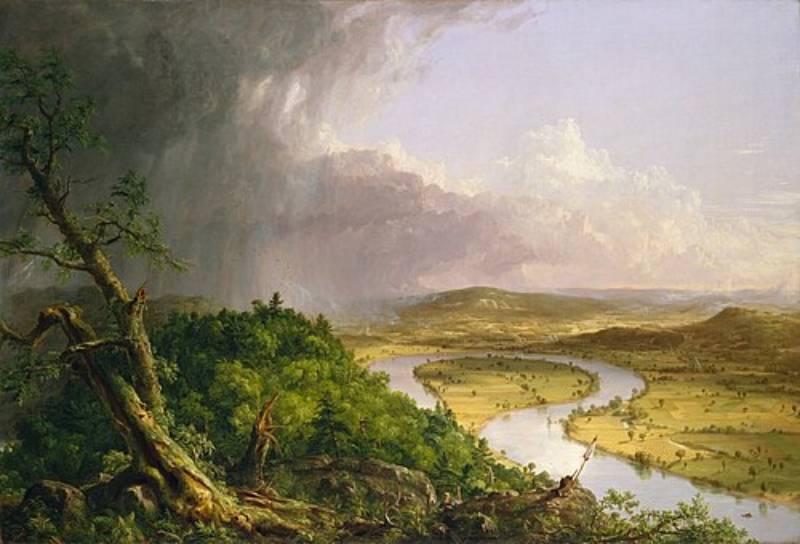
Thomas Cole founded the Hudson River School, the first major American art movement. The Oxbow is its most famous landscape painting, and it defined how Americans saw their own wilderness for generations.
Cole painted it during a break from his ambitious series The Course of Empire. His patron Luman Reed encouraged him to paint something he actually enjoyed, and this was the result.
Subject and Scene
The view is from Mount Holyoke in Massachusetts, looking down at the U-shaped bend of the Connecticut River. A thunderstorm rolls across the left side, where wild, untamed forest dominates. The right side opens into sunlit, settled farmland.
That split is intentional. Cole set wilderness and civilization side by side, letting viewers decide which future they preferred for America. He even painted himself into the middle distance, sitting on a rocky ledge with an easel.
Look closely at the hillside in the background. Logging scars in the trees spell out Hebrew letters, reading “Noah” (or “Shaddai,” meaning “The Almighty,” when viewed upside down).
Technique and Medium
Oil on canvas, 130.8 x 193 cm. Cole stitched together two separate viewpoints from Mount Holyoke to capture the panoramic breadth, which extended beyond typical landscape formats of the time.
The composition uses a strong diagonal from lower right to upper left, dividing the canvas into a dark, sublime left half and a bright, pastoral right half. The contrast between these two sections carries the painting’s entire argument.
Where to See It
The Metropolitan Museum of Art in New York City. It was donated in 1908 by philanthropist Olivia Sage.
Fun Fact
Cole sold the painting for $500 at the 1836 National Academy of Design exhibition. He was surprised it sold at all, since the reviews were mixed.
Wanderer Above the Sea of Fog (c. 1818) by Caspar David Friedrich

Why This Painting Matters
This painting is basically the logo for romanticism. It shows up on book covers, philosophy textbooks, and internet memes at roughly equal rates. Friedrich created one of the most recognizable images of a human confronting nature.
The painting was not immediately famous. Friedrich’s reputation faded after his death and only revived in the 1970s, when this specific work became wildly popular.
Subject and Scene
A man in a dark green overcoat stands on a rocky cliff, his back turned to us. Below him, thick fog rolls across a mountainous landscape. Ridges and forests poke through the mist, and faded peaks rise in the far distance.
Friedrich used a technique called Ruckenfigur (rear-facing figure), placing the viewer behind the subject so we see what he sees. The landscape itself is a composite. Friedrich sketched locations across the Elbe Sandstone Mountains in Saxony and rearranged them in his studio.
Technique and Medium
Oil on canvas, 94.8 x 74.8 cm. Friedrich did not start painting in oils until after age 30, but his handling of the medium here is confident. Dark, layered colors create depth in the fog, and the figure’s silhouette is crisp against the hazy background.
The value shifts between the sharp foreground and soft, dissolving background give the painting its sense of vastness and mystery.
Where to See It
The Hamburger Kunsthalle in Hamburg, Germany. The museum acquired it in 1970 and it has been on display there since.
Fun Fact
Friedrich wrote: “When a region cloaks itself in mist, it appears larger and more sublime, elevating the imagination, and rousing the expectations like a veiled girl.” The man’s identity remains debated. Some scholars believe it is a portrait of a Prussian military officer killed fighting Napoleon.
The Hay Wain (1821) by John Constable

Why This Painting Matters
The Hay Wain is widely considered the greatest English landscape painting ever made. It was voted the second most popular painting in any British gallery in a 2005 BBC poll, beaten only by Turner’s Fighting Temeraire.
When it first appeared at the Royal Academy in 1821, nobody bought it. It was not until it reached Paris in 1824 that it caused a sensation, earning a gold medal from King Charles X of France.
Subject and Scene
The scene shows a hay wagon (a “wain”) crossing the shallow River Stour at Flatford, on the border of Suffolk and Essex. On the left stands Willy Lott’s Cottage, a building that still exists today practically unchanged.
Constable’s father owned Flatford Mill, which sits just out of view to the right. The painting captures a warm summer noon in a place the artist knew since childhood. Haymakers dot the distant meadows as white clouds drift overhead.
Technique and Medium
Oil on canvas, 130.2 x 185.4 cm. Constable created a full-size oil sketch beforehand to work out the composition. The final painting was executed in his London studio based on years of outdoor sketches.
His brushwork captures light hitting water, cloud shadows moving across fields, and the subtle gradation of greens from foreground to background. Eugene Delacroix saw the painting in Paris and reportedly reworked parts of his own Massacre at Chios after studying Constable’s technique.
Where to See It
The National Gallery in London. Collector Henry Vaughan donated it in 1886.
Fun Fact
Constable never called it “The Hay Wain.” The original title was “Landscape: Noon.” His friend Archdeacon Fisher gave it the nickname that stuck.
Wheatfield with Crows (1890) by Vincent van Gogh
Why This Painting Matters
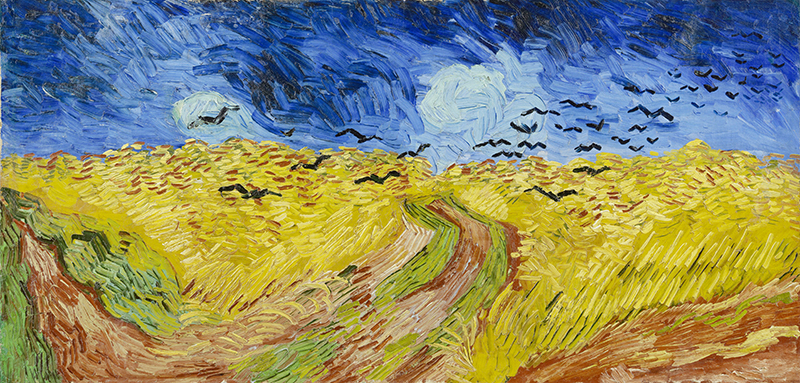
This is one of van Gogh’s most famous paintings, widely (but incorrectly) believed to be his final work. It was painted in July 1890, during the last weeks of his life at Auvers-sur-Oise, near Paris.
Van Gogh described it as expressing “sadness, extreme loneliness,” but also what he saw as “healthy and fortifying about the countryside.” That tension is what makes the painting hit so hard.
Subject and Scene
A golden wheat field fills the lower half, painted with thick, agitated brushstrokes. Above it, a dark blue sky churns with black crows. Three paths cut through the wheat, but none of them lead anywhere clear. The central path just stops.
The whole thing feels claustrophobic. The crows advance toward the viewer, the sky presses down, and there is no visible horizon to offer relief.
Technique and Medium
Oil on canvas, 50.5 x 103 cm. Van Gogh used an elongated double-square format that he favored exclusively in his final weeks. The paint application is rapid and heavy, with short, choppy strokes building up dense layers of color contrast.
Blue sky against yellow wheat. Red path intensified by green grass. The complementary colors create a visual tension that mirrors the emotional content.
Where to See It
The Van Gogh Museum in Amsterdam, Netherlands.
Fun Fact
The painting was stolen in 1991 along with 19 other Van Gogh works. It was recovered quickly but suffered severe damage during the theft. His actual last painting was likely Tree Roots, not this one. The myth of Wheatfield with Crows being the final work was popularized by the 1956 biopic “Lust for Life.”
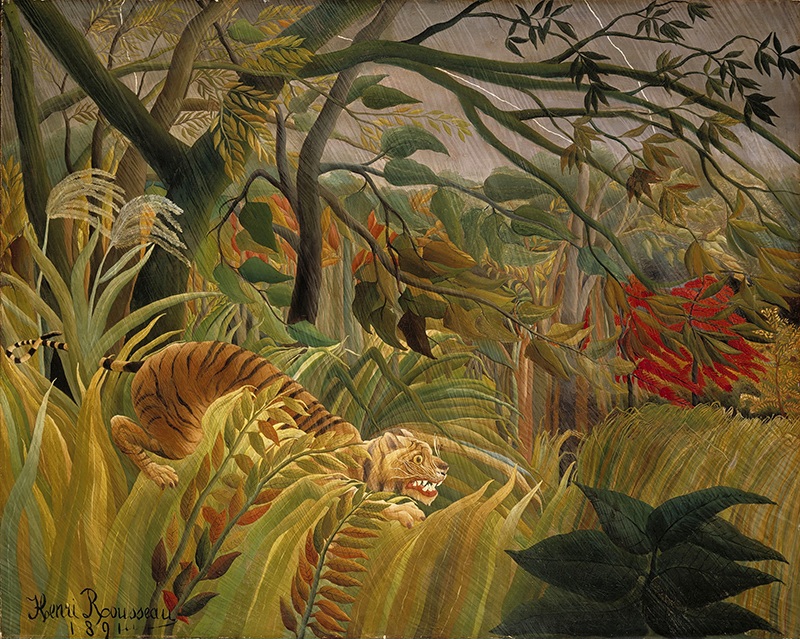
Tiger in a Tropical Storm (1891) by Henri Rousseau
Why This Painting Matters
Henri Rousseau was entirely self-taught. He worked as a toll collector in Paris and painted in his spare time. When Tiger in a Tropical Storm debuted at the Salon des Independants in 1891, critics dismissed it as childish.
They were wrong. Rousseau’s jungle paintings became some of the most beloved nature paintings in art history, and this was where it all started.
Subject and Scene
A tiger crouches low in dense tropical foliage, ready to pounce during a violent storm. Rain slashes diagonally across the canvas while lightning flashes in the background. The plants are painted in dozens of different shades of green, layered one over another to create an almost overwhelming sense of depth.
Rousseau never visited a jungle. He studied plants at the Jardin des Plantes botanical garden in Paris and drew from illustrated magazines for his animal references.
Technique and Medium
Oil on canvas, 129.8 x 161.9 cm. Rousseau built his compositions layer by layer, starting with the background sky and working forward through multiple planes of vegetation. His flat, precise style was closer to folk art than the academic tradition.
He reportedly used over 50 shades of green in this single painting. The lack of traditional atmospheric perspective gives the jungle an almost dreamlike flatness that later attracted surrealist artists like Salvador Dali.
Where to See It
The National Gallery in London.
Fun Fact
After the harsh critical reception, Rousseau did not attempt another jungle painting for nearly a decade. When he returned to the subject, he produced masterpieces like The Dream (1910), which finally earned him serious recognition.
Irises (1889) by Vincent van Gogh

Why This Painting Matters
Van Gogh painted Irises within the first week of arriving at the Saint-Paul-de-Mausole asylum. The irises grew right outside the building. For an artist in crisis, this painting radiates something surprisingly close to calm.
It sold for $53.9 million at auction in 1987, setting a record at the time for the most expensive painting ever sold.
Subject and Scene
A bed of irises fills the canvas, painted from a low angle as if van Gogh was kneeling in the garden beside them. The flowers are mostly deep violet-blue (originally purple, but the red pigment has faded over time), with one white iris standing apart on the left.
Marigolds form an orange-yellow backdrop, and the soil is visible as a rich reddish-brown. There is no sky, no distance. Just the flowers, very close, very present.
Technique and Medium
Oil on canvas, 71 x 93 cm. Van Gogh outlined the iris petals with strong dark contour lines, a technique influenced by Japanese woodblock prints he admired. The paint is applied thickly, with visible directional strokes that give each leaf and petal its own sense of energy.
The analogous color scheme of blues and violets against warm oranges and yellows creates a striking but harmonious effect.
Where to See It
The J. Paul Getty Museum in Los Angeles, California.
Fun Fact
Van Gogh called it “the lightning conductor for my illness.” He believed that working kept him sane. His brother Theo submitted Irises to the Salon des Independants in Paris in 1889, where it was noticed by other artists, even though Van Gogh himself did not attend.
Hunters in the Snow (1565) by Pieter Bruegel the Elder

Why This Painting Matters
Pieter Bruegel the Elder painted Hunters in the Snow as part of a series depicting the months or seasons of the year. It is the most recognized work from famous Dutch paintings of the Northern Renaissance and one of the most influential winter paintings ever created.
Bruegel captured a specific moment of seasonal life with a precision that feels almost photographic, centuries before photography existed.
Subject and Scene
Three hunters and their dogs return home through deep snow, descending a hill toward a Flemish village in the valley below. Skaters play on frozen ponds. Snow-covered rooftops line the streets. Jagged Alpine-like peaks rise in the distance.
On the left, villagers tend a fire outside an inn. A sign with a stag hangs from the building. Birds perch on bare branches overhead. Every detail adds to a complete picture of winter rural life in 16th-century northern Europe.
Technique and Medium
Oil on wood panel, 117 x 162 cm. Bruegel arranged the pictorial space in carefully layered planes, using aerial perspective to push the valley and mountains into the far distance. The dark tree trunks in the foreground frame the scene and guide the eye downhill into the landscape.
His color palette is muted and cold. Whites, grays, greens, and earth tones dominate, with only small touches of warm color from the fire and building details.
Where to See It
The Kunsthistorisches Museum in Vienna, Austria.
Fun Fact
Director Andrei Tarkovsky featured Hunters in the Snow in his 1972 film Solaris, lingering on the painting in a long, meditative shot. The painting’s mountains are unusual for Flanders, which is flat. Bruegel likely drew on memories from crossing the Alps during a trip to Italy earlier in his career.
FAQ on Famous Nature Paintings
What is the most famous nature painting in the world?
The Starry Night (1889) by Vincent van Gogh is widely considered the most famous nature painting. Its swirling night sky and glowing stars make it one of the most recognized artworks in Western art history. It hangs at MoMA in New York.
What art movement produced the most nature paintings?
Impressionism produced the largest volume of nature-focused artwork. Artists like Claude Monet, Pierre-Auguste Renoir, and Paul Cezanne painted outdoors to capture light, weather, and seasonal changes directly from the landscape.
Why did artists paint nature so often?
Nature offered endless variety in light, color, and mood. For many painters, landscape art was also a way to express spiritual ideas, national identity, or personal emotion. The Hudson River School, for example, tied American wilderness to patriotic pride.
What is the most expensive nature painting ever sold?
Paul Cezanne’s Mont Sainte-Victoire and Monet’s Meules (Haystacks) have both sold for over $100 million at auction. Prices for famous impressionist paintings of nature scenes continue to climb at major auction houses.
What is the difference between a landscape painting and a nature painting?
Landscape paintings focus on wide outdoor views with sky, terrain, and distance. Nature paintings can also include close-up subjects like flowers, trees, or animals. All landscapes are nature paintings, but not all nature paintings are landscapes.
Who are the most famous nature artists in history?
Claude Monet, Vincent van Gogh, J.M.W. Turner, John Constable, Thomas Cole, and Caspar David Friedrich are among the most recognized. Each shaped how entire generations understood and depicted the natural world through paint.
What techniques are commonly used in nature paintings?
Common approaches include en plein air painting, atmospheric perspective for depth, and impasto for texture. Oil on canvas is the most popular medium, though watercolor and woodblock printing have also produced iconic nature artworks.
Are nature paintings still popular today?
Yes. Contemporary landscape art remains one of the strongest categories at galleries and auctions worldwide. Digital tools have added new options, but traditional oil and watercolor painting of natural scenes still attract both collectors and new artists.
What makes a nature painting valuable?
Artist reputation, historical significance, condition, and provenance drive value. Paintings tied to major art movements like romanticism or impressionism tend to fetch higher prices. Rarity matters too. A one-of-a-kind Monet will always outprice a common print.
Where can I see famous nature paintings in person?
Major museums hold the best collections. The Metropolitan Museum of Art, Musee d’Orsay, National Gallery London, Art Institute of Chicago, and Van Gogh Museum in Amsterdam all display iconic nature paintings year-round.
Conclusion
These famous nature paintings span centuries, continents, and wildly different artistic approaches. From Hokusai’s woodblock prints to Bruegel’s frozen Flemish valleys, each one captures something specific about how humans respond to the world around them.
What connects them is not style or period. It is the impulse to stop and record what nature looks like at a particular moment, in a particular light.
Some of these works launched entire movements like the Hudson River School or Post-Impressionism. Others, like Rousseau’s jungle scenes, were mocked before they were loved.
If any of these paintings caught your attention, go see the originals. No screen or print comes close to standing in front of a Constable or a Monet and seeing the actual brushwork up close. That is still the best way to understand what made these nature artists great.