The turbulent early 19th century gave birth to a revolutionary artistic movement that rejected rational order for emotional intensity.
Romanticism artists broke from classical restraint, embracing imagination, nature, and personal expression during an era of political upheaval.
These visionary painters captured sublime landscapes, historical drama, and psychological states through dynamic compositions and powerful color contrasts.
Their work often featured exotic settings, spiritual symbolism, and Gothic elements that evoked emotional responses rather than intellectual analysis.
From Friedrich’s solitary figures contemplating misty mountains to Delacroix’s passionate historical scenes, Romanticism represented a profound shift in Western art.
The movement emerged differently across Europe and America, with German artists exploring spiritual connections to nature, British painters revolutionizing landscape techniques, and French masters dramatizing contemporary events.
This guide explores the signature styles and contributions of fifteen influential Romanticism artists whose work transformed painting through emotional intensity, atmospheric effects, and imaginative vision.
Romanticism Artists
Caspar David Friedrich (1774-1840)

Nationality: German
Art Movement(s): Romanticism
Mediums: Oil painting
Artistic Signature
Friedrich’s work features solitary figures facing away from viewers, contemplating vast, atmospheric landscapes with dramatic lighting and symbolic elements that emphasize human smallness against nature’s grandeur.
Recurring Themes & Motifs
His paintings frequently explore spiritual connections between humanity and nature through misty mountains, ruined Gothic churches, and moonlit scenes that evoke feelings of the sublime and divine presence.
Influences & Training
Trained at the Copenhagen Academy, Friedrich developed his distinctive style through Dresden’s artistic community and German philosophical ideas about nature’s spiritual dimension, especially during the Napoleonic era.
Notable Works
- Wanderer Above the Sea of Fog (1818) – Oil on canvas, Kunsthalle Hamburg
- Monk by the Sea (1810) – Oil on canvas, Alte Nationalgalerie, Berlin
- The Abbey in the Oakwood (1810) – Oil on canvas, Alte Nationalgalerie, Berlin
Role in Art History
Friedrich revolutionized landscape painting by infusing nature with profound spiritual and emotional significance, creating scenes that embodied German Romantic ideals of contemplation and the sublime.
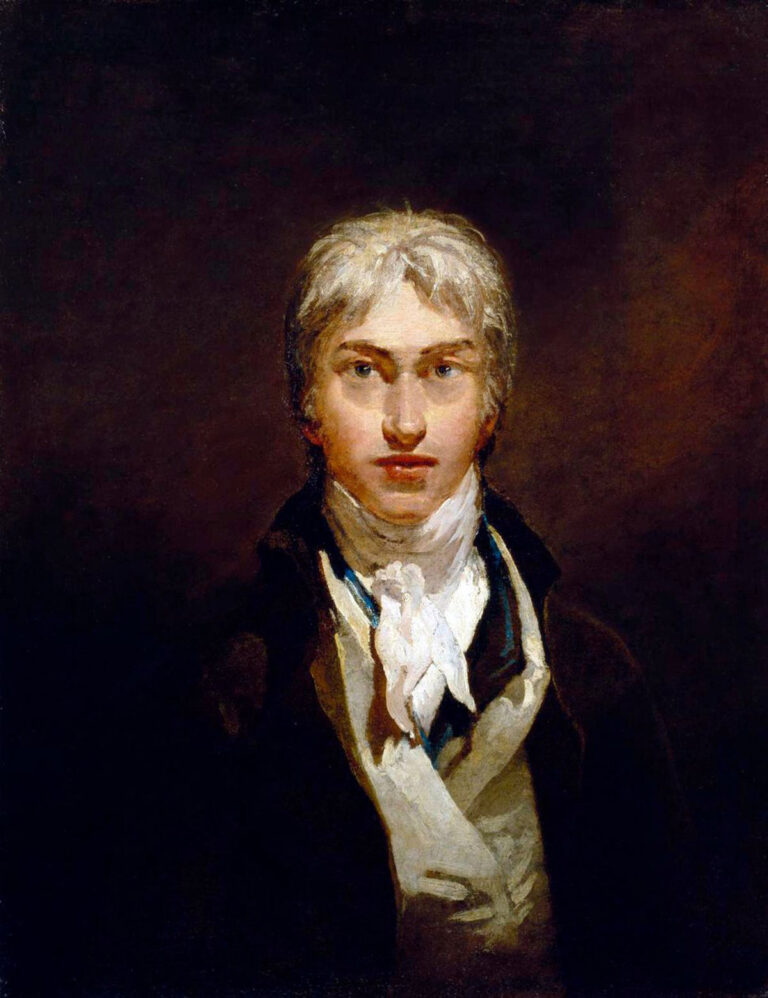
J.M.W. Turner (1775-1851)

Nationality: British
Art Movement(s): Romanticism
Mediums: Oil and watercolor
Artistic Signature
Turner’s mature style features atmospheric light effects and swirling, luminous color masses that dissolve solid forms into radiant mists and dramatic weather conditions with expressive brushwork.
Recurring Themes & Motifs
His works often depict powerful natural forces like storms, fires, and floods alongside human vulnerability, frequently incorporating maritime subjects, industrial development, and mythological or historical narratives.
Influences & Training
Educated at the Royal Academy of Arts, Turner studied Old Masters while traveling extensively through Europe, absorbing classical traditions that he progressively transformed through personal experimentation.
Notable Works
- The Fighting Temeraire (1839) – Oil on canvas, National Gallery, London
- Rain, Steam and Speed (1844) – Oil on canvas, National Gallery, London
- Snow Storm: Steam-Boat off a Harbour’s Mouth (1842) – Oil on canvas, Tate Britain, London
Role in Art History
Turner transformed landscape painting through his revolutionary approach to light, color theory, and atmospheric effects, anticipating both Impressionism and abstract painting of the 20th century.
Eugène Delacroix (1798-1863)

Nationality: French
Art Movement(s): Romanticism
Mediums: Oil paintings, lithography, murals
Artistic Signature
Delacroix employed dynamic composition, vibrant color contrast, and energetic brushwork to create emotionally charged scenes with swirling movement that broke from neoclassicism‘s restraint.
Recurring Themes & Motifs
His works often feature exotic North African settings, literary subjects from Shakespeare and Dante, violent historical events, wild animals, and impassioned mythological scenes expressing human drama.
Influences & Training
Formally trained under Pierre-Auguste Renoir‘s teacher Pierre-Narcisse Guérin, Delacroix was deeply influenced by Rubens, Venetian painters, and his travels to Morocco.
Notable Works
- Liberty Leading the People (1830) – Oil on canvas, Louvre, Paris
- The Death of Sardanapalus (1827) – Oil on canvas, Louvre, Paris
- Women of Algiers in their Apartment (1834) – Oil on canvas, Louvre, Paris
Role in Art History
As Romanticism’s leading French painter, Delacroix championed emotional intensity, exotic subjects, and expressive color over classical restraint, directly influencing later movements from Impressionism to Expressionism.
Francisco Goya (1746-1828)

Nationality: Spanish
Art Movement(s): Romanticism, Early Modern Art
Mediums: Oil paintings, etchings, frescoes
Artistic Signature
Goya’s mature work features bold brushwork, stark contrasts between light and shadow, psychological intensity, and an unflinching portrayal of human cruelty and irrationality with haunting directness.
Recurring Themes & Motifs
His works explore war atrocities, social critique, superstition, madness, and nightmare visions, often contrasting with his earlier court portraits and reflecting Spain’s turbulent political climate during his lifetime.
Influences & Training
Initially trained in Baroque traditions under José Luzán and later influenced by Velázquez, Goya developed his distinctive vision through firsthand witnessing of war and personal illness.
Notable Works
- The Third of May 1808 (1814) – Oil on canvas, Prado Museum, Madrid
- Saturn Devouring His Son (1819-1823) – Oil mural transferred to canvas, Prado Museum, Madrid
- The Sleep of Reason Produces Monsters (1797-1799) – Etching, various collections
Role in Art History
Goya bridged 18th-century traditions and modern sensibilities, pioneering psychological depth and social criticism that influenced later movements from Expressionism to Surrealism.
John Constable (1776-1837)

Nationality: British
Art Movement(s): Romanticism
Mediums: Oil paintings, watercolors, sketches
Artistic Signature
Constable developed a distinctive approach to landscape featuring natural light effects, accurate atmospheric conditions, and vibrant green color psychology with expressive brushwork and precise observation.
Recurring Themes & Motifs
His works celebrate the English countryside of his native Suffolk, often depicting everyday rural scenes with working people, agricultural activities, and meteorological phenomena like changing skies and weather.
Influences & Training
Formally educated at the Royal Academy, Constable studied Old Masters like Claude Lorrain and Jacob van Ruisdael while developing his revolutionary approach through direct outdoor observation.
Notable Works
- The Hay Wain (1821) – Oil on canvas, National Gallery, London
- Stratford Mill (1820) – Oil on canvas, National Gallery, London
- Salisbury Cathedral from the Meadows (1831) – Oil on canvas, Tate Britain, London
Role in Art History
Constable revolutionized landscape painting through his naturalistic approach, scientific observation of weather conditions, and celebration of ordinary rural scenes that influenced French painters and outdoor practice.
William Blake (1757-1827)

Nationality: British
Art Movement(s): Romanticism, Symbolism
Mediums: Relief etching, watercolor, engraving
Artistic Signature
Blake created visionary works combining text and image with linear precision, symbolic figures, and bold outlines filled with luminous watercolor washes to express mystical and prophetic content.
Recurring Themes & Motifs
His art explores spiritual visions, biblical narratives, mythology, and personal symbolic systems depicting cosmic forces, divine figures, and human conditions through powerful symbolic imagery.
Influences & Training
Trained as an engraver under James Basire and briefly at the Royal Academy, Blake developed his unique visual language through religious visionary experiences and Renaissance masters like Michelangelo.
Notable Works
- The Ancient of Days (1794) – Relief etching with watercolor, various collections
- The Great Red Dragon and the Woman Clothed with the Sun (c.1805) – Watercolor, Brooklyn Museum
- Newton (1795-c.1805) – Color print finished in ink and watercolor, Tate Britain, London
Role in Art History
Blake created a unique fusion of poetry, printmaking, and painting that embodied Romantic ideals of imagination and spiritual vision, influencing later Symbolism and visionary art.
Théodore Géricault (1791-1824)

Nationality: French
Art Movement(s): Romanticism
Mediums: Oil paintings, lithography
Artistic Signature
Géricault created dramatically composed scenes with powerful diagonal structures, muscular figures, theatrical lighting, and emotional intensity through dark color harmony and vigorous brushwork.
Recurring Themes & Motifs
His works often explore human suffering, political scandals, mental illness, violent action, and powerful horses, frequently addressing contemporary events with psychological depth and social critique.
Influences & Training
Studied with Carle Vernet and Pierre-Narcisse Guérin while absorbing Rubens‘ dynamism, Michelangelo’s figures, and contemporary political turbulence in post-Napoleonic France.
Notable Works
- The Raft of the Medusa (1818-1819) – Oil on canvas, Louvre, Paris
- Mounted Officer of the Imperial Guard (1812) – Oil on canvas, Louvre, Paris
- The Madwoman (1822-1823) – Oil on canvas, Musée des Beaux-Arts, Lyon
Role in Art History
Géricault pioneered Romantic themes of disaster, social injustice, and psychological exploration through monumental contemporary history paintings that broke from neoclassical traditions.
Thomas Cole (1801-1848)

Nationality: American (born in England)
Art Movement(s): Romanticism, Hudson River School
Mediums: Oil paintings
Artistic Signature
Cole created dramatic American landscapes with idealized natural grandeur, theatrical lighting effects, and classical compositional structures that balanced detailed observation with sublime emotional impact.
Recurring Themes & Motifs
His works frequently depict untamed American wilderness as spiritually significant, often including ruined structures, allegorical sequences of civilization’s rise and fall, and contrasts between nature and human development.
Influences & Training
Largely self-taught before studying briefly at the Pennsylvania Academy, Cole absorbed European Romantic landscape traditions while developing a distinctly American vision through direct observation of the wilderness.
Notable Works
- The Oxbow (View from Mount Holyoke) (1836) – Oil on canvas, Metropolitan Museum of Art, New York
- The Course of Empire series (1833-1836) – Five oil paintings, New-York Historical Society
- The Voyage of Life series (1842) – Four oil paintings, National Gallery of Art, Washington D.C.
Role in Art History
Cole founded the Hudson River School, America’s first major art movement, establishing landscape painting as a vehicle for national identity and spiritual meaning in the young republic.
Henry Fuseli (1741-1825)

Nationality: Swiss-British
Art Movement(s): Romanticism, Gothic
Mediums: Oil paintings, drawings
Artistic Signature
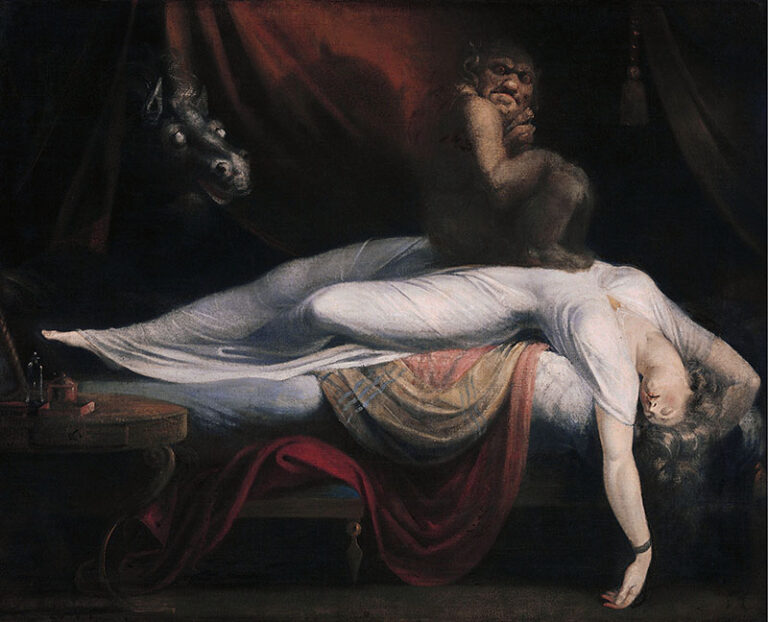
Fuseli created dramatically lit scenes with elongated, sometimes contorted figures, theatrical compositions, and sharp contrasts between light and shadow to convey supernatural and psychological content.
Recurring Themes & Motifs
His works often explore dreams, nightmares, erotic obsession, supernatural creatures, literary scenes from Shakespeare and Milton, and the darker aspects of the human subconscious.
Influences & Training
Initially trained as a theologian before studying in Rome, Fuseli absorbed Michelangelo‘s anatomical expressiveness and Mannerist distortion while developing his unique visionary approach.
Notable Works
- The Nightmare (1781) – Oil on canvas, Detroit Institute of Arts
- The Three Witches (1783) – Oil on canvas, Royal Shakespeare Company Collection
- Thor Battering the Midgard Serpent (1790) – Oil on canvas, Royal Academy of Arts, London
Role in Art History
Fuseli pioneered psychological and supernatural themes in Romantic art, anticipating later Symbolism and Surrealism through his exploration of dreams and the irrational.
Albert Bierstadt (1830-1902)

Nationality: American (born in Germany)
Art Movement(s): Romanticism, Hudson River School
Mediums: Oil paintings
Artistic Signature
Bierstadt created monumental landscapes featuring dramatic lighting effects, panoramic scale, luminous atmospheres, and meticulous detail to capture the awe-inspiring grandeur of the American West.
Recurring Themes & Motifs
His works celebrate the untamed wilderness of the American frontier, particularly the Rocky Mountains and Yosemite Valley, often depicting dramatic weather, pristine lakes, Native Americans, and wildlife.
Influences & Training
Formally trained at the Düsseldorf Academy in Germany, Bierstadt combined European Romantic traditions with firsthand observation during multiple expeditions across the American West.
Notable Works
- Among the Sierra Nevada, California (1868) – Oil on canvas, Smithsonian American Art Museum
- The Rocky Mountains, Lander’s Peak (1863) – Oil on canvas, Metropolitan Museum of Art
- Yosemite Valley (1868) – Oil on canvas, Oakland Museum of California
Role in Art History
Bierstadt’s dramatic Western landscapes shaped America’s vision of its frontier wilderness, popularizing the notion of the West as an unspoiled Eden and influencing conservation movements.
Philipp Otto Runge (1777-1810)

Nationality: German
Art Movement(s): Romanticism
Mediums: Oil paintings, drawings, paper cuts
Artistic Signature
Runge created works with intricate symbolic systems, clear outlines, flat decorative patterns, and allegorical elements that combine observation with mystical symbolism and mathematical order.
Recurring Themes & Motifs
His art explores cyclical time, natural symbolism through plants and children, cosmic harmony, and spiritual rebirth, often using daybreak and children as metaphors for spiritual awakening.
Influences & Training
Initially trained in Hamburg before studying at the Copenhagen Academy, Runge developed his distinctive approach through conversations with German Romantic poets and his study of color wheel theory.
Notable Works
- The Morning (1808) – Oil on canvas, Kunsthalle Hamburg
- The Hülsenbeck Children (1805-1806) – Oil on canvas, Kunsthalle Hamburg
- Color Sphere (1810) – Color theory diagrams, various collections
Role in Art History
Though short-lived, Runge pioneered symbolic approaches to color theory and developed early color psychology ideas that influenced later artists and theorists from Goethe to the Bauhaus.
Antoine-Jean Gros (1771-1835)

Nationality: French
Art Movement(s): Romanticism, Neoclassicism
Mediums: Oil paintings
Artistic Signature
Gros created dynamic battle scenes and official portraits with theatrical lighting, emotional intensity, vibrant colors, and heroic figures that bridged neoclassicism‘s structure with Romantic passion.
Recurring Themes & Motifs
His paintings frequently glorify Napoleon Bonaparte’s military campaigns, depicting moments of compassion amid battle, exotic Middle Eastern settings, and heroic sacrifice with dramatic pathos.
Influences & Training
Trained under Jacques-Louis David, Gros traveled with Napoleon’s army in Italy, absorbing both neoclassical discipline and the coloristic traditions of Venetian masters like Titian.
Notable Works
- Napoleon on the Battlefield of Eylau (1808) – Oil on canvas, Louvre, Paris
- Bonaparte Visiting the Plague Victims at Jaffa (1804) – Oil on canvas, Louvre, Paris
- Battle of Abukir (1806) – Oil on canvas, Versailles Palace
Role in Art History
Gros served as a crucial bridge between Neoclassical formality and Romantic emotion, pioneering the dramatic historical painting style that influenced Géricault and Delacroix.
Joseph Anton Koch (1768-1839)

Nationality: Austrian
Art Movement(s): Romanticism, Neoclassicism
Mediums: Oil paintings, etchings
Artistic Signature
Koch created heroic landscapes with classical structures, precise linear detail, and dramatic lighting that combine observed natural elements with idealized compositional frameworks and epic scope.
Recurring Themes & Motifs
His works often depict Alpine landscapes, biblical and mythological scenes set in nature, and Italian countryside views that express spiritual and heroic qualities through natural formations.
Influences & Training
Initially self-taught before studying in Stuttgart and Rome, Koch absorbed classical landscape traditions from Nicolas Poussin and Claude Lorrain while developing his distinctive Alpine imagery.
Notable Works
- Heroic Landscape with Rainbow (1805) – Oil on canvas, Neue Pinakothek, Munich
- The Schmadribach Falls (1821-1822) – Oil on canvas, Neue Pinakothek, Munich
- Landscape with Noah’s Thank Offering (1803) – Oil on canvas, Museum der bildenden Künste, Leipzig
Role in Art History
Koch established an influential idealized landscape style that combined classical structure with direct Alpine observation, helping shape German Romantic landscape traditions.
Karl Friedrich Schinkel (1781-1841)

Nationality: German
Art Movement(s): Romanticism, Neoclassicism
Mediums: Oil paintings, architecture drawings, stage designs
Artistic Signature
Schinkel’s paintings feature architectural precision, dramatic perspective, theatrical lighting effects, and visionary structures that blend Gothic and classical elements within sublime natural settings.
Recurring Themes & Motifs
His works often depict idealized Gothic cathedrals, ancient ruins amid nature, panoramic cityscapes, and dramatic mountainous landscapes that express spiritual and national aspirations.
Influences & Training
Trained as an architect and largely self-taught as a painter, Schinkel absorbed classical traditions during Italian travels while developing his distinctive synthesis of architecture and landscape.
Notable Works
- Cathedral Towering over a Town (1813) – Oil on canvas, Alte Nationalgalerie, Berlin
- Medieval City on a River (1815) – Oil on canvas, Alte Nationalgalerie, Berlin
- View of Flower Garden Terrace (1820) – Oil on canvas, Schloss Charlottenburg, Berlin
Role in Art History
Though primarily recognized as an architect, Schinkel’s paintings embodied Germanic Romantic ideals of spiritual architecture within nature, influencing both landscape painting and architectural vision.
Thomas Gainsborough (1727-1788)

Nationality: British
Art Movement(s): Romanticism (early), Rococo
Mediums: Oil paintings
Artistic Signature
Gainsborough developed a fluid, feathery brushwork style with delicate complementary colors, graceful lines, and soft atmospheric effects that captured both elegant portraiture and moody landscapes.
Recurring Themes & Motifs
His works often depict fashionable aristocratic portraits in natural settings, rural laborers, woodland scenes, and rustic cottages that express his preference for naturalism over formal conventions.
Influences & Training
Initially trained in London under Hubert Gravelot, Gainsborough studied Dutch landscape masters while developing his distinctive approach through direct observation and society portraiture.
Notable Works
- The Blue Boy (c.1770) – Oil on canvas, Huntington Library, California
- Mr and Mrs Andrews (c.1750) – Oil on canvas, National Gallery, London
- The Morning Walk (1785) – Oil on canvas, National Gallery, London
Role in Art History
Gainsborough helped establish landscape as a prestigious genre in British art while developing a painterly approach to portraiture that anticipated later Romantic attitudes toward nature and individuality.
FAQ on Romanticism Artists
Who were the most influential Romanticism artists?
The most influential Romanticism artists include J.M.W. Turner, Caspar David Friedrich, Eugène Delacroix, and Francisco Goya.
They revolutionized painting through emotional intensity, sublime landscapes, and dramatic composition.
Their work rejected neoclassical restraint, instead embracing imagination, nature worship, and individual expression.
What defined the Romantic style in painting?
Romantic style featured atmospheric effects, emotional expression, and dramatic lighting that evoked sublime feelings.
Artists used dynamic asymmetrical balance, vibrant color contrast, and expressive brushwork to create paintings with spiritual symbolism and emotional turbulence.
Intuitive approaches replaced classical formality, often depicting solitary figures in vast landscapes.
When did Romanticism flourish in art?
Romanticism flourished primarily between 1800 and 1850, emerging as a reaction against Enlightenment rationality and industrial revolution.
The movement gained momentum following the French Revolution and Napoleonic Wars, with different timelines across Europe.
German Romanticism developed earliest (1790s), while French and British traditions peaked in the 1820s-1830s.
How did Romanticism differ across countries?
German Romanticism emphasized spiritual connection to nature through misty landscapes and Gothic elements.
British artists like Constable and Turner revolutionized landscape painting mediums with atmospheric effects and naturalistic scenes.
French Romanticism under Delacroix featured exotic settings, literary influences, and political themes, while American Hudson River School celebrated wilderness as national identity.
What themes did Romanticism artists explore?
Romantic artists explored emotional intensity, sublime nature, medieval revival, and individual imagination.
Their work featured nationalist themes, exotic settings, historical drama, literary influences, and spiritual symbolism.
Many depicted primitivism, folkloric subjects, and dream imagery, often contrasting human fragility against powerful natural forces like storms and rugged wilderness.
How did Romanticism influence later art movements?
Romanticism directly influenced Impressionism, Symbolism, and Expressionism through its emphasis on personal vision, emotional content, and atmospheric effects.
Turner’s light experiments anticipated abstract techniques, while Goya’s psychological darkness influenced Surrealism.
The movement’s focus on individual expression and rejection of academic rules shaped the foundation for modern art.
What techniques did Romanticist painters use?
Romanticist painters employed spontaneous brushwork, dramatic chiaroscuro, and vibrant color schemes to evoke emotional responses.
Many worked with oil painting techniques that allowed atmospheric effects, glazing for luminosity, and impasto for texture.
They prioritized harmony of mood over precise detail, using rhythm and variety to create dynamic compositions.
How did the political climate influence Romantic art?
Revolutionary politics profoundly shaped Romantic art, with many artists responding to upheavals like the French Revolution and Napoleonic Wars.
Delacroix’s “Liberty Leading the People” directly addressed political revolution, while Goya’s war scenes critiqued violence.
German artists expressed nationalist yearnings during French occupation, creating paintings that captured philosophical idealism and historical nostalgia.
What role did nature play in Romanticism?
Nature became a spiritual and emotional mirror for Romantic artists, who depicted landscapes as sublime expressions of divine power rather than mere scenery.
Friedrich’s contemplative figures faced vast natural vistas symbolizing spiritual transcendence.
Constable’s atmospheric English countryside and Turner’s dramatic weather scenes elevated landscape from background to primary subject, emphasizing nature worship and emotional connections.
How can you identify a Romantic painting?
Romantic paintings typically feature emotional intensity, dramatic lighting, and atmospheric effects over precise classical form.
Look for sublime landscapes, solitary figures, and Gothic elements that evoke mood rather than reason.
Expressive brushwork, vibrant color psychology, historical or mythological narratives, and scenes of nature’s power are hallmarks. The work often creates a sense of awe, melancholy, or passionate feeling.
Conclusion
Romanticism artists transformed Western painting through their rejection of classical restraint and embraced emotional self-expression during an era of radical change.
Their artistic individuality created a revolutionary approach that celebrated imagination over reason, intuitive creation over academic rules.
These visionary painters left lasting legacies that continue to resonate today:
- Their emphasis on personal expression paved the way for modern artistic freedom
- Their innovative use of space and balance broke from rigid compositional formulas
- Their exploration of emphasis through dramatic lighting influenced countless later movements
- Their integration of unity of mood and atmospheric effects created powerful emotional experiences
From Friedrich’s sublime landscapes to Delacroix’s passionate historical scenes, these painters captured the philosophical idealism and sentimental themes of their time while creating painting styles that would inspire generations of artists across expressionism, symbolism, and beyond.