The ocean has been scaring and inspiring painters for centuries. From Hokusai’s towering wave to Turner’s dissolving storms, famous ocean paintings capture something that photographs still struggle to match: the raw, unpredictable feel of the sea.
These are not just pretty seascapes. They changed art movements, sparked political scandals, and redefined what paint on canvas could do.
This guide covers 10 of the most important marine paintings ever created. For each one, you will find the artist’s background, the techniques used, the color choices that make it work, and the historical context behind it.
Whether you are drawn to Romantic oil paintings of stormy seas or Impressionist coastal scenes bathed in morning light, there is something here worth your time.
Famous Ocean Paintings
The Great Wave off Kanagawa (1831)

Artist and Origin
Katsushika Hokusai, a Japanese painter and printmaker, created this piece during the Edo period. He was over 70 years old at the time.
The work belongs to his series Thirty-six Views of Mount Fuji, a collection of prints showing Japan’s sacred mountain from different vantage points. This one just happened to become the most recognized piece of Japanese art ever made.
The Scene
Three fishing boats cut through violent waters off the coast of Kanagawa Prefecture. A massive rogue wave curls overhead with claw-like foam, ready to crash down.
Mount Fuji sits small and calm in the background. That size difference is the whole point. The mountain looks tiny compared to the wave, flipping the expected scale of the scene.
Artistic Technique and Medium
This is not a painting in the traditional sense. It is a polychrome woodblock print, made using the ukiyo-e method. Separate carved blocks were used for each color, with the final image pressed onto mulberry paper.
At least seven colors went into the print. The standout was Prussian blue, a synthetic pigment recently imported from Europe. Hokusai used it in two concentrations, layering one over the other to give the wave a striking three-dimensional quality.
Art Movement and Style
Ukiyo-e, meaning “pictures of the floating world,” was a popular Japanese printmaking tradition. But Hokusai blended it with European graphical perspective techniques, creating something that felt both familiar and completely new.
Color Palette and Light
Deep Prussian blue dominates the water. White foam contrasts sharply against it. The sky holds soft yellows and grays, with Mount Fuji rendered in a muted indigo.
There is no visible sun. The light feels diffused, almost overcast, which makes the wave’s energy even more intense.
Composition and Perspective
Hokusai used a diagonal composition that pulls the eye from the lower left boats up toward the cresting wave. The spiral of the wave frames Mount Fuji perfectly in the negative space beneath it.
The boats sit low. The wave towers high. The entire layout creates a sense of movement that feels almost cinematic.
Symbolism and Meaning
The fishermen represent human fragility against nature’s overwhelming force. Mount Fuji, a spiritual symbol in Japanese culture, sits unbothered in the distance. Some scholars read it as a meditation on impermanence and the smallness of human life.
Historical Context
Japan was under strict isolationist policies during the Edo period. Yet Hokusai’s use of imported pigments and Western perspective shows that cultural exchange was still happening, even quietly. The print later influenced Western artists like Claude Monet and Vincent van Gogh.
Where to See It
Copies exist in several major institutions. The Metropolitan Museum of Art in New York, the British Museum in London, and the National Museum in Tokyo all hold impressions. Fewer than 200 original prints are believed to survive.
Why It Matters
It is probably the most reproduced image in art history. The wave motif appears on everything from banknotes to phone cases. In 2024, Japan placed it on the new 1,000 yen note. Took me a while to realize this isn’t technically a painting, but honestly, that makes it even more impressive.
The Ninth Wave (1850)
Artist and Origin
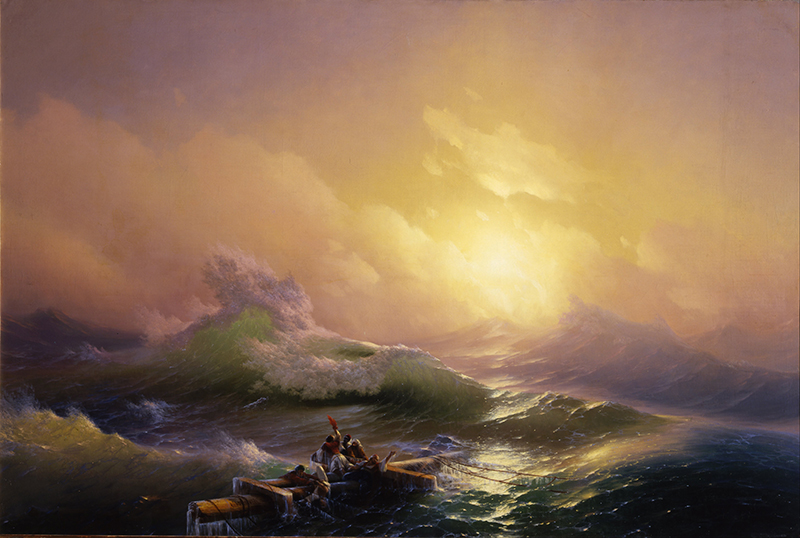
Ivan Aivazovsky, a Russian-Armenian Romantic painter, created this at the peak of his career. He specialized in marine art and completed over 6,000 paintings in his lifetime. Most were seascapes.
The Scene
Survivors cling to the wreckage of a destroyed ship after a brutal night storm. The “ninth wave,” a legendary final and most destructive wave in a storm cycle, is about to crash over them.
But dawn is breaking. There is light coming through.
Artistic Technique and Medium
Oil on canvas, measuring a massive 221 x 332 cm. Aivazovsky’s signature technique involved transparent glazes layered over one another. This gave the ocean an almost luminous quality, as if the waves were glowing from inside.
His brushwork ranges from fine detail in the wave crests to broader strokes in the turbulent water. The combination creates real energy on the canvas.
Art Movement and Style
Pure Romanticism. The painting hits every note of the movement: raw emotion, the power of nature, human struggle, and spiritual undertones. Aivazovsky lived on the Black Sea coast and experienced violent storms firsthand, which shows in his work.
Color Palette and Light
Warm amber and rose tones in the sky push against deep greens, blues, and purples in the water. The sunrise creates an ethereal glow that softens the danger. Aivazovsky used a varied palette of sea shades, from blue to purple to aquamarine, all within the same canvas.
The contrast between the warm sky and cool water is what gives this painting its emotional pull.
Composition and Perspective
The horizon line sits low, making the wave appear enormous. A diagonal composition draws the viewer’s eye from the desperate survivors up to the towering water. The cross-shaped debris in the foreground is likely intentional, a Christian symbol of salvation.
Symbolism and Meaning
The painting balances destruction and hope. The warm tones suggest survival is possible. Across generations, it has been read as a statement about human resilience and faith. The ninth wave represents the ultimate test before either death or deliverance.
Historical Context
Created during the height of European Romanticism, the painting was originally acquired for the Imperial Hermitage by Emperor Alexander III. Russian painters of this era were deeply invested in themes of nature’s power and spiritual meaning.
Where to See It
State Russian Museum, Saint Petersburg. It has been there since 1897 and has never been sold.
Why It Matters
Often called “the most beautiful painting in Russia.” It set the standard for dramatic ocean art and influenced marine painters for over 170 years. Aivazovsky’s ability to make water look translucent using oil glazes remains hard to match.
The Fighting Temeraire (1839)

Artist and Origin
J.M.W. Turner, the English Romantic painter often called “the painter of light,” created this at the height of his 40-year career. He was in his early 60s when he painted it.
The Scene
The HMS Temeraire, a 98-gun warship famous for its role in the Battle of Trafalgar, gets towed up the River Thames by a small steam-powered tugboat. Destination: the scrapyard at Rotherhithe.
A blazing sunset fills the right side of the canvas. A crescent moon rises on the left. One era ending, another beginning.
Artistic Technique and Medium
Oil on canvas, 91 x 122 cm. Turner used loose brushwork and thick impasto in the sky, contrasted with more detailed work on the ship. The sky is layered with yellow, orange, red, and mauve, creating a vaporous, almost dreamlike atmosphere.
He took significant artistic liberties. The real ship had already been stripped of its masts before being towed. Turner added them back for dramatic effect.
Art Movement and Style
This is Romantic painting at its most effective. Turner’s late style was pushing toward abstraction, with color and light taking priority over precise detail. Some critics see this as a bridge between Romanticism and early modern art.
Color Palette and Light
The right side burns with hot oranges and reds. The left side stays cool with blues and silvery grays. The Temeraire itself is rendered in ghostly whites and golds, almost transparent against the fiery sky.
The tugboat is dark, utilitarian, belching smoke. The color contrast between old and new could not be more deliberate.
Composition and Perspective
The ghostly warship dominates the center, forming a triangle with the patches of blue sky above. The small tugboat pulls it forward, its chimney placed in front (Turner moved it on purpose) so the smoke drifts back through the Temeraire’s masts.
Everything about the layout reinforces the theme: progress pulling the past to its end.
Symbolism and Meaning
The painting is a meditation on the end of the age of sail. Steam power replacing wind. Industry overtaking tradition. The sunset doubles as a farewell. Turner reportedly called this painting “my darling” and refused to sell it during his lifetime.
Historical Context
Britain’s naval dominance defined the 19th century. The Temeraire was a hero ship from Trafalgar. Its scrapping was widely covered in newspapers. Turner turned a factual event into something much bigger, a comment on time, change, and loss.
Where to See It
National Gallery, London. Part of the Turner Bequest since 1856. It was voted Britain’s favorite painting in a 2005 BBC poll and appears on the new 20-pound banknote.
Why It Matters
It is one of England’s greatest paintings, full stop. Turner’s handling of light here influenced generations of artists, from the Impressionists onward. The emotional weight of the piece, quiet sadness mixed with admiration for progress, still hits hard almost 200 years later.
Impression, Sunrise (1872)

Artist and Origin
Claude Monet painted this from a hotel window overlooking the port of Le Havre, his hometown in Normandy, France. He created it in a single sitting on a November morning in 1872.
The Scene
The harbor at dawn. Mist hangs over the water. Small rowboats sit in the foreground. Industrial smokestacks and cranes line the background. A bright orange sun hovers above the horizon, its reflection cutting across the gray-blue water in quick, choppy strokes.
Artistic Technique and Medium
Oil on canvas, 48 x 63 cm. The technique here is deliberately sketchy. Monet used thin washes rather than thick paint, leaving the canvas visible in places. The only impasto appears in the sun’s reflection on the water.
Critics at the time thought it looked unfinished. Monet himself considered it incomplete, which is exactly why he titled it “Impression” rather than giving it a more formal name.
Art Movement and Style
This is the painting that gave Impressionism its name. Critic Louis Leroy meant it as an insult when he coined the term in 1874. The group of artists, including Edgar Degas and Pierre-Auguste Renoir, adopted it anyway.
Color Palette and Light
Muted blues and grays dominate. The only warmth comes from the orange sun and its reflections. The hues blend together so completely that sky and water become almost indistinguishable.
Here is the tricky part: when measured with a photometer, the sun is actually the same brightness as the surrounding sky. It just appears brighter because of the warm-cool contrast. Clever stuff.
Composition and Perspective
The sun sits slightly off-center, acting as the clear focal point. Three dark boats create a diagonal line that guides the eye into the misty middle ground. The background dissolves into shapes barely distinguishable from the fog.
Symbolism and Meaning
Art historians see political meaning here. France had just lost the Franco-Prussian War. Le Havre’s busy port represented national recovery and industrial renewal. Monet captured not just a sunrise but a country waking back up.
Historical Context
The painting debuted at the first independent exhibition of the group that would become the Impressionists in April 1874. It was originally purchased for just 800 francs. That price tells you how little people thought of it at the time.
In 1985, it was stolen from the Musee Marmottan Monet. Recovered five years later.
Where to See It
Musee Marmottan Monet, Paris. It was donated to the museum in 1940 but largely ignored until the 1950s, when art historians recognized its founding role in the Impressionist movement.
Why It Matters
Without this painting, the word “Impressionism” might not exist. It changed how artists thought about light, time, and the act of painting itself. Your mileage may vary on whether you find it beautiful, but its place in art history is locked in.
The Monk by the Sea (1810)

Artist and Origin
Caspar David Friedrich, a German Romantic painter, worked on this for two years in his Dresden studio. He started it around 1808 and exhibited it at the Berlin Academy in 1810.
The Scene
A solitary monk stands on a low, grassy dune. Before him stretches a dark, narrow band of sea. Above that, an enormous sky fills nearly three-quarters of the canvas. That is it. No ships, no drama, no narrative.
Just a person, the ocean, and infinite sky.
Artistic Technique and Medium
Oil on canvas, 110 x 171.5 cm. Friedrich initially painted two small sailing ships on the horizon but later removed them. He kept stripping the scene down to its essentials, which is what makes it so unsettling.
The paint is applied in subtle layers. The sky shifts from dark gray at the top to lighter tones near the horizon, with touches of blue added late in the process.
Art Movement and Style
German Romanticism, but pushed to a radical extreme. Most Romantic landscape paintings include dramatic action or narrative elements. Friedrich removed all of that. Some critics have called this “perhaps the first abstract painting in a very modern sense.”
Color Palette and Light
Dark, muted, almost somber. The sea is nearly black. The sky moves through grays, muted blues, and occasional hints of lighter cloud. There is no visible sun. The value range is narrow, which flattens the space and makes the monk feel even more alone.
Composition and Perspective
The painting deliberately avoids a repoussoir, the typical framing device that draws the viewer’s eye into the scene. Friedrich rejected it entirely. The foreground is empty. The horizon sits low. There is no entry point, which creates a strange, unbridgeable distance between the viewer and the monk.
Symbolism and Meaning
The monk is likely a self-portrait. Friedrich was deeply spiritual and saw nature as a direct expression of the divine. The vast sky suggests God’s incomprehensible greatness. The tiny human figure represents our limited ability to grasp it.
Historical Context
King Frederick Wilhelm III bought the painting after the 1810 exhibition. It was initially polarizing. Some visitors loved it. Others, including the wife of a fellow painter, found it too lonely and disturbing. The German Romantic author Clemens Brentano wrote a critique, though it was substantially revised by Heinrich von Kleist into a sympathetic review.
Where to See It
Alte Nationalgalerie, Berlin. It hangs alongside Friedrich’s companion piece, The Abbey in the Oakwood.
Why It Matters
It anticipated abstraction by over a century. The decision to compress space, remove narrative, and focus on raw emotional atmosphere was unheard of in 1810. Most people walk past it quickly, but if you sit with it for a few minutes, it does something to you.
The Raft of the Medusa (1819)

Artist and Origin
Theodore Gericault, a French painter, completed this when he was just 27 years old. He died five years later from tuberculosis and injuries from a riding accident. Short career, but this one painting cemented his legacy.
The Scene
Survivors of the French naval frigate Medusa crowd a makeshift raft in the open Atlantic. They have been stranded for 13 days. Some are dead. Some are dying. A few at the top of a human pyramid desperately wave toward a tiny ship on the horizon, the Argus, which initially passed them by.
Artistic Technique and Medium
Oil on canvas, an enormous 4.91 x 7.16 meters (roughly 16 x 23 feet). Canvases this large were traditionally reserved for heroic or religious subjects. Gericault used the scale for a scene of sheer human suffering instead.
He researched obsessively. Interviewed survivors. Studied corpses from morgues. Built a scale model of the raft in his studio. The result is disturbingly realistic.
Art Movement and Style
Bridges Neoclassicism and Romanticism. The triangular composition and muscular figures come from classical tradition. The raw emotion, dark palette, and contemporary subject matter push it firmly into Romantic territory.
Color Palette and Light
Dark, brooding tones. Browns, ochres, and grays dominate. The sky offers barely a sliver of hope. Chiaroscuro effects highlight the bodies in the foreground, pulling them out of the murky background.
Composition and Perspective
Two opposing diagonals create the structure. One rises from the dead bodies in the lower left toward the waving figures in the upper right. The other pulls downward with the crashing waves. This crossing generates intense tension.
Gericault placed the rescue ship as a tiny speck on the far horizon, making the viewer feel the impossible distance between hope and reality.
Symbolism and Meaning
The Medusa sank because of an incompetent captain appointed through political connections. Gericault’s painting was a direct indictment of the French government. Placing a Black man at the pyramid’s peak was a deliberate anti-slavery statement, radical for 1819.
Historical Context
The actual shipwreck happened in 1816 off the coast of Senegal. Survivors resorted to cannibalism. The scandal rocked France. Gericault turned a political disaster into one of France’s most important paintings.
Where to See It
The Louvre, Paris. It is one of the museum’s most visited works.
Why It Matters
It broke the rules of history painting by depicting ordinary people instead of heroes, and offering no redemption or divine presence. No god watches over the raft. The influence on later maritime art, from Turner to Winslow Homer, is unmistakable.
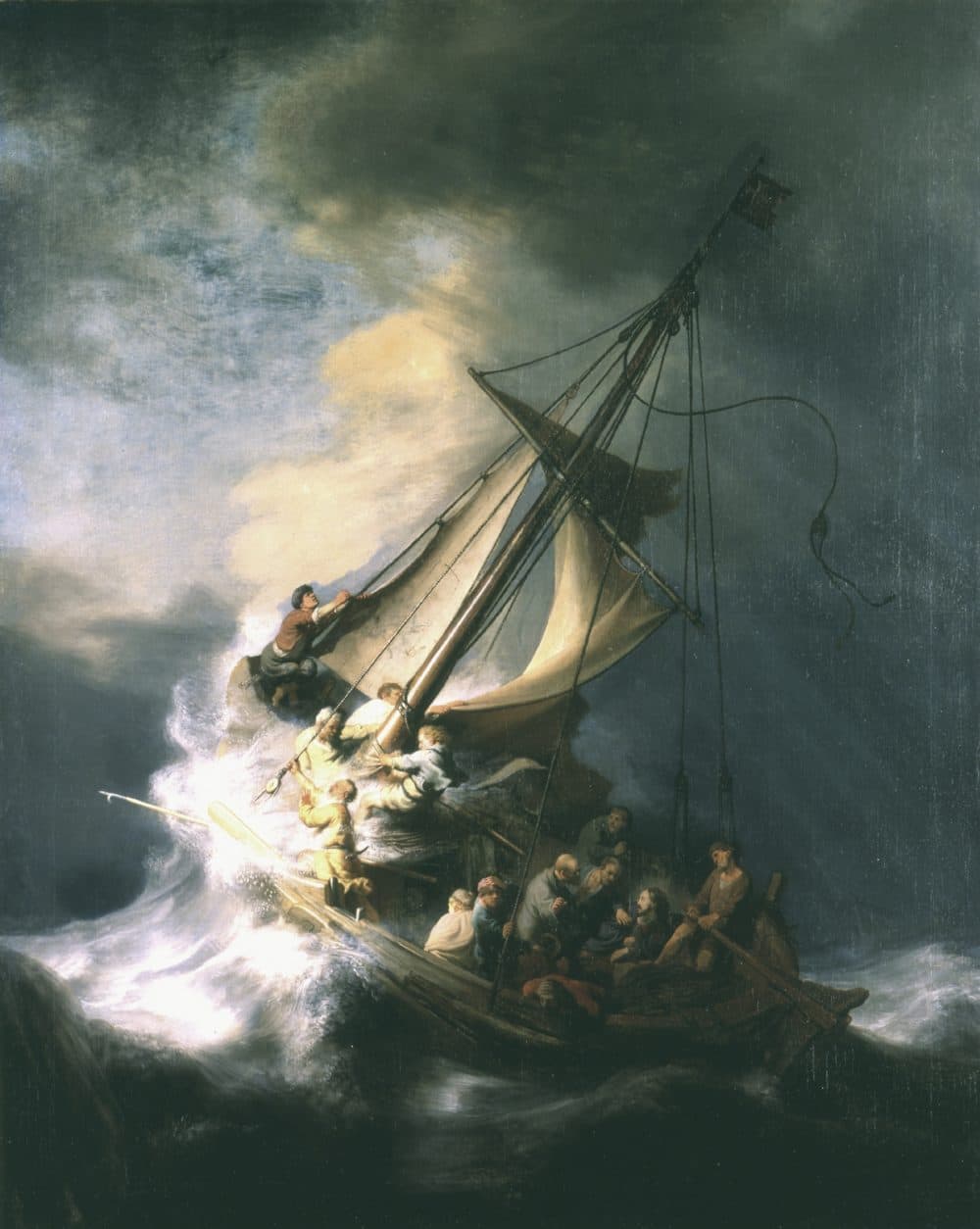
Christ in the Storm on the Sea of Galilee (1633)
Artist and Origin
Rembrandt van Rijn, the Dutch Golden Age master, painted this early in his Amsterdam career. It is his only known seascape. That alone makes it remarkable.
The Scene
The biblical story from the Gospel of Mark. Disciples struggle to control their fishing boat during a violent storm. Christ sits calmly on the right side of the vessel. A massive wave crashes against the bow, shredding the sail.
One disciple vomits over the side. Another stares directly at the viewer. That second figure is Rembrandt himself, a self-portrait inserted into the drama.
Artistic Technique and Medium
Oil on canvas, approximately 160 x 128 cm. Rembrandt applied his masterful use of tenebrism, creating extreme contrasts between light and shadow. Light breaks through the storm clouds from the upper left, illuminating a patch of blue sky and Christ’s figure.
Art Movement and Style
Baroque painting at its most dramatic. The tight framing, dynamic diagonals, and theatrical lighting are all hallmarks of the period. Unlike secular Dutch marine paintings of the same era, this one is a biblical narrative first and a seascape second.
Color Palette and Light
Dramatic darks dominate. The stormy sky is heavy with grays and blacks. Warm light hits the figures and the sail selectively, creating pockets of brightness against overwhelming darkness. The contrast gives the scene a visceral, almost theatrical quality.
Composition and Perspective
The boat tilts forward at a sharp angle, pulling the viewer into the chaos. The lowered perspective makes the sky feel massive and oppressive. Every face is painted with individual emotion, from terror to faith to physical sickness.
Symbolism and Meaning
The calm Christ versus the panicking disciples represents faith overcoming fear. Rembrandt’s self-portrait among the disciples suggests personal identification with the story. The stormy sea is a test of belief.
Historical Context
Painted during Rembrandt’s early Amsterdam period, when he was building his reputation under the influence of teacher Pieter Lastman. The same year, he sketched Christ Walking on the Waves, showing a continued fascination with biblical maritime themes.
Where to See It
You cannot. It was stolen from the Isabella Stewart Gardner Museum in Boston on March 18, 1990, along with 12 other works in what became the largest art heist in U.S. history. Total value: over $500 million. The FBI identified suspects in 2013 but made no arrests. The painting’s whereabouts remain unknown. An empty frame still hangs in the museum’s Dutch Room.
Why It Matters
It is Rembrandt’s only seascape, which makes it irreplaceable. The stolen status only adds to its mystique. As a religious painting, it demonstrates how ocean art can carry deeply personal spiritual meaning beyond just depicting waves and weather.
The Gulf Stream (1899)

Artist and Origin
Winslow Homer, a self-taught American painter, created this after multiple trips to the Bahamas and Caribbean. He relocated to the Maine coast in the 1890s and spent his final years focused almost entirely on the ocean.
The Scene
A lone Black sailor sits in a rudderless, dismasted boat drifting on the Gulf Stream current. Sharks circle the vessel. A waterspout churns in the distance. There is no land in sight.
Before exhibiting the painting, Homer added a faint ship on the far horizon. A slim suggestion that rescue might be possible.
Artistic Technique and Medium
Oil on canvas, 71.5 x 124.8 cm. Homer’s brushwork is confident and direct. The ocean is rendered with visible strokes that suggest churning movement. The sharks are painted with an almost casual precision. You can practically feel the spray.
Art Movement and Style
Sits between Realism and late Romanticism. Homer was not interested in idealized beauty. He painted what the sea actually looked like, rough, indifferent, and dangerous. His later marine works dropped human figures entirely and focused purely on waves and rocks.
Color Palette and Light
Rich blues and greens in the water contrast with the warm skin tones of the sailor and the reddish-brown of the boat. The sky is heavy with storm clouds. Patches of turquoise and aquamarine break through the darker ocean tones, giving the water a shifting, restless feel.
Composition and Perspective
The boat sits at a diagonal across the canvas. The sailor’s gaze directs the viewer away from the sharks and toward the distant horizon. The waterspout and the ship create two competing focal points: danger and hope.
Symbolism and Meaning
Art historians have debated this for over a century. Some read it as a commentary on the post-Civil War experience of Black Americans, adrift and surrounded by threats. Others see it as a more universal statement about isolation and survival. Homer himself refused to explain it, which probably tells you something.
Historical Context
Homer traveled extensively through the Caribbean in the 1880s and 1890s, crossing the Gulf Stream multiple times by boat. The painting draws on those direct experiences. He is widely considered the greatest American marine painter.
Where to See It
Metropolitan Museum of Art, New York.
Why It Matters
It combines technical brilliance with genuine emotional complexity. Homer does not tell you what to feel. He just shows you a man, a broken boat, sharks, and open water, and lets you sit with it. The painting influenced how Americans thought about ocean art and raised marine painting to a level of serious commentary rather than pure scenery.
Snow Storm: Steam-Boat off a Harbour’s Mouth (1842)

Artist and Origin
J.M.W. Turner again. He was 67 years old when he painted this. The full title claims the scene is based on a real storm he experienced aboard the steamship Ariel, though some historians doubt the ship even existed.
The Scene
A steamboat fights against a violent snowstorm. The vessel is barely visible, swallowed by swirling wind, waves, snow, and smoke. There is almost no horizon. Sea, sky, and storm all merge into a single vortex of energy.
Artistic Technique and Medium
Oil on canvas, 91.4 x 121.9 cm. Turner reportedly asked to be lashed to the ship’s mast during the storm so he could observe it firsthand (this story may be exaggerated, or entirely made up). Regardless, the painting feels experienced rather than imagined.
The brushwork is aggressive and loose. Colors swirl in concentric patterns. Some areas look almost abstract.
Art Movement and Style
Late Romanticism pushing hard toward abstraction. Critics at the time were not kind. One reviewer called it “soapsuds and whitewash.” Turner was furious. He felt deeply misunderstood.
Color Palette and Light
Whites, grays, blacks, and muddy yellows dominate. The palette is deliberately limited, mimicking the visual conditions of a real blizzard at sea. Somewhere in the chaos, a faint warm glow suggests the steamboat’s furnace.
Composition and Perspective
The entire painting spirals inward, like a vortex of directional lines. There is no stable ground, no clear horizon, no fixed point for the eye to rest. Turner designed it to make you feel disoriented. It works.
Symbolism and Meaning
Humanity versus nature, but without any guarantee of survival. The steam-boat represents industrial progress, yet the storm reduces it to almost nothing. Turner seems to be saying that technology does not protect us from the elements.
Historical Context
By the 1840s, Turner was moving into his most experimental phase. Many contemporaries found these late works confusing or ugly. Today, they are considered ahead of their time by decades.
Where to See It
Tate Britain, London.
Why It Matters
It is one of the most radical ocean paintings ever made. The near-total dissolution of form influenced later movements from Impressionism to Abstract Expressionism. At least in my experience, once you understand what Turner was doing here, you never look at seascape art the same way.
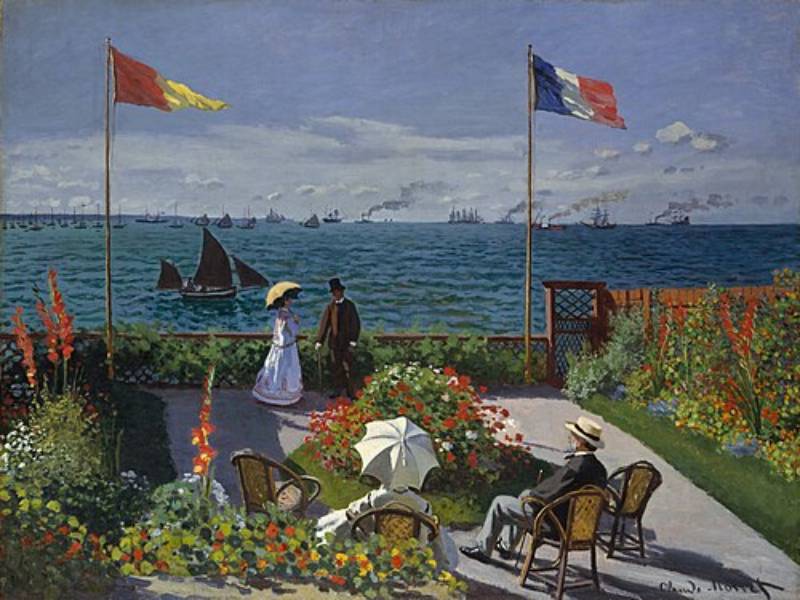
La Terrasse de Sainte-Adresse (1867)
Artist and Origin
Claude Monet painted this at his family’s seaside property near Le Havre, France. He was 27 years old and still years away from the Impressionist breakthrough.
The Scene
A sun-drenched garden terrace overlooking the English Channel. Two figures sit in chairs near a railing. Two more stand near a flagpole. Sailing ships and steamships dot the bright blue water. The sky is filled with white cumulus clouds.
It feels like summer. Like warmth and salt air.
Artistic Technique and Medium
Oil on canvas, 98.1 x 129.9 cm. The technique is crisper and more structured than Monet’s later work. The garden flowers are rendered in bright, distinct colors. The water sparkles with individual brushstrokes of white and blue. It was likely painted en plein air, directly from the scene.
Art Movement and Style
Pre-Impressionist, sitting at the crossroads between Realism and the looser style Monet would develop later. The structured composition shows the influence of Japanese woodblock prints, which Monet admired. The flat, layered arrangement of garden, sea, and sky echoes ukiyo-e design principles.
Color Palette and Light
Bright and warm. Rich greens in the garden, deep blue ocean, white-capped waves, red and yellow flowers. The light is full and direct, typical of a clear summer day on the Normandy coast. The color saturation is high compared to Monet’s later, mistier work.
Composition and Perspective
Three clear horizontal bands: garden, sea, sky. The flagpoles create strong vertical lines that divide the image. The seated and standing figures add human balance to the geometric layout. It reads almost like a stage set.
Symbolism and Meaning
The mix of sailing vessels and modern steamships on the water mirrors France’s transition into industrialization. The relaxed garden scene suggests leisure and prosperity. Monet painted his father and aunt among the figures, grounding the work in personal experience.
Historical Context
Created just five years before Impression, Sunrise, this painting shows Monet already experimenting with light and outdoor subjects. The influence of Japanese prints on his composition became a recurring theme throughout his career.
Where to See It
Metropolitan Museum of Art, New York.
Why It Matters
It is one of the most accessible and beloved ocean paintings in any collection. The combination of garden beauty and shimmering sea light shows Monet’s talent for making the ocean feel inviting rather than threatening. Not every great seascape needs a storm.
FAQ on Famous Ocean Paintings
What is the most famous ocean painting in the world?
The Great Wave off Kanagawa by Katsushika Hokusai is widely considered the most recognized ocean artwork ever made. Created in 1831 as a woodblock print, it depicts a massive wave dwarfing Mount Fuji and has become a global cultural icon.
Who is the best known ocean painter?
Ivan Aivazovsky holds that title. The Russian-Armenian Romantic artist completed over 6,000 paintings, most of them seascapes. His ability to render translucent waves using oil glazes remains unmatched in marine art history.
What painting gave Impressionism its name?
Impression, Sunrise by Claude Monet, painted in 1872. Critic Louis Leroy used the title mockingly in an 1874 review. The group of artists, including Degas and Renoir, adopted the term anyway. It stuck.
Are there famous ocean paintings that have been stolen?
Yes. Rembrandt’s Christ in the Storm on the Sea of Galilee was stolen from the Isabella Stewart Gardner Museum in Boston in 1990. It has never been recovered. An empty frame still hangs in its place.
What techniques do artists use to paint the ocean?
Oil painting with layered glazes is the most common method for realistic seascapes. Artists also use impasto for wave crests, thin washes for misty atmospheres, and careful color mixing to capture how light moves through water.
Why did so many Romantic painters focus on the sea?
Romanticism valued emotion, nature’s power, and the sublime. The ocean was a perfect subject because it represented forces beyond human control. Painters like Turner and Friedrich used stormy seas to express spiritual and existential themes.
What is the largest famous ocean painting?
Theodore Gericault’s The Raft of the Medusa measures roughly 4.9 x 7.2 meters. That is about 16 by 23 feet. It hangs in the Louvre and remains one of the biggest narrative canvases in any major museum.
Where can I see famous ocean paintings in person?
Major collections include the Metropolitan Museum of Art in New York, the National Gallery in London, the Louvre in Paris, and the State Russian Museum in Saint Petersburg. Each holds several significant marine artworks.
What makes a great ocean painting different from a regular seascape?
The best ocean paintings go beyond scenery. They use composition, color, and light to communicate something deeper, whether that is human vulnerability, political commentary, or spiritual meaning. Technical skill alone is not enough.
Did Japanese art influence Western ocean paintings?
Absolutely. Hokusai’s prints reached Europe in the mid-1800s and directly influenced Impressionist painters like Monet and Van Gogh. The flat compositions and bold outlines of ukiyo-e changed how Western artists approached marine subjects.
Conclusion
These famous ocean paintings are more than beautiful seascapes hung in gallery halls. Each one pushed art forward, whether through Hokusai’s fusion of ukiyo-e and Western perspective, Gericault’s rejection of classical heroism, or Turner’s early steps toward abstraction.
The sea gave these artists something no other subject could. Constant change. Danger. Light that never behaves the same way twice.
From Aivazovsky’s luminous oil glazes to Monet’s sketchy harbor dawn, the techniques vary wildly. But the intent stays consistent: capture something that refuses to hold still.
If one of these maritime masterpieces caught your attention, go see it in person. Reproductions do not come close. Standing in front of a canvas that size, with that much paint and history on it, is a different experience entirely.