Sweden produced some of the most talented painters in European art history, yet many of them remain surprisingly unknown outside Scandinavia.
From Anders Zorn’s luminous portraits to Hilma af Klint’s groundbreaking abstract compositions, famous Swedish painters shaped movements that rippled far beyond Stockholm and the Nordic art scene.
Some, like Carl Larsson, defined an entire country’s visual identity. Others, like Ernst Josephson, pushed against conservative institutions and changed how Swedish art was taught and practiced.
This guide covers the most important Swedish artists across centuries of art history. You’ll find their key works, techniques, where to see their paintings today, and what makes each one worth knowing. Whether you’re studying Scandinavian art or just curious about who belongs on the list, this is the place to start.
Famous Swedish Painters
Anders Zorn
Early Life and Training
Born in 1860 in Mora, Dalarna, Anders Zorn grew up on his grandparents’ farm. He never met his father.
At just 15, he entered the Royal Swedish Academy of Arts in Stockholm. His teachers noticed his talent fast. But Zorn later admitted the Academy didn’t teach him much. He was already ahead of most students.
His early work focused on watercolor painting, which was unusual for the time. A watercolor called In Mourning shown at a student exhibition in 1880 launched his career almost overnight.
Artistic Style and Movement
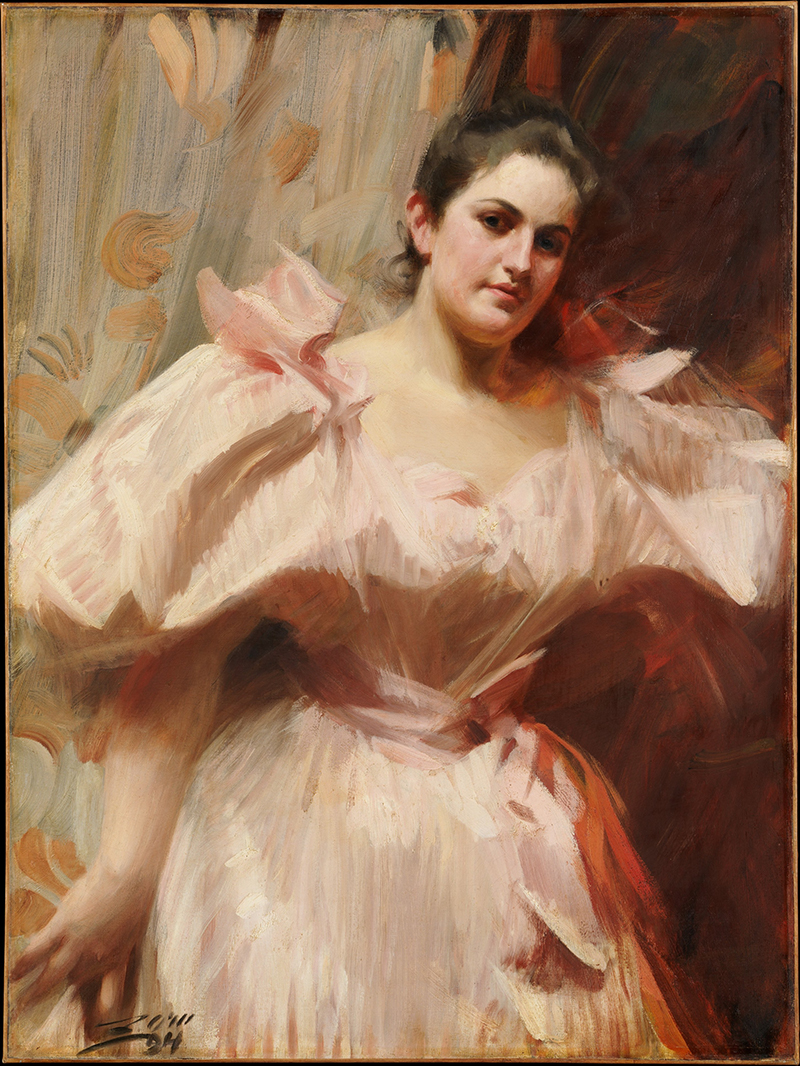
Zorn is often called the “Swedish Impressionist,” though that label only tells part of the story. He combined loose, confident brushwork with sharp realism. His paintings look effortless up close, almost rough. Step back and they become photographic.
During the 1880s and 1890s, he lived in London and Paris. He rubbed shoulders with Claude Monet, John Singer Sargent, and Auguste Rodin. The influence of impressionism shows in his attention to light and atmosphere, but Zorn always kept one foot in traditional realism.
Most Famous Paintings
Midsummer Dance (1897) is probably his best-known work, and the one Zorn himself valued most. It shows dancers bathed in golden evening light during a rural Midsummer’s Eve celebration in Dalarna.
Other standout works include:
- In Mourning (1880) – the watercolor that started everything
- A Fisherman in St Ives (1888) – his breakthrough oil painting, purchased by the French state
- Self-Portrait in Red (1915)
- Portraits of three U.S. Presidents: Grover Cleveland, William Taft, and Theodore Roosevelt
Techniques and Mediums
The “Zorn palette” is legendary among painters. Just four colors: lead white, yellow ochre, vermilion, and ivory black. That’s it.
Well, sort of. Recent research by art historian Emma Jansson has shown that Zorn actually used more colors than the myth suggests. But the idea behind the limited palette holds. He got an incredible range from very few pigments. Understanding color theory at that level takes years.
He started in watercolors, switched to oils around 1887, and also produced 289 etchings throughout his career. Took me a while to realize that his etchings are almost as celebrated as his paintings.
Themes and Subject Matter
Portraits made Zorn rich and famous. Kings, presidents, industrialists, society figures. He had this ability to capture personality, not just likeness.
But his heart was in Dalarna. After returning to Mora in 1896, he painted Swedish folk life, countryside scenes, and his well-known nude studies. The full-figured women in his paintings became so associated with the region that locals coined the term Zornkulla to describe them.
Legacy and Influence
At the turn of the 20th century, Zorn was one of the most celebrated artists alive. He won the French Legion of Honour at 29. He painted for the Uffizi Gallery’s self-portrait collection in Florence.
He and his wife Emma donated their entire art collection to the Swedish state. He also established the Bellman Prize in 1920, still awarded annually by the Swedish Academy for outstanding Swedish poetry.
Where to See Their Work
The Zorn Museum in Mora houses the largest collection. The Nationalmuseum in Stockholm holds Midsummer Dance and other major pieces. Internationally, you’ll find his work at the Musee d’Orsay in Paris, the Metropolitan Museum of Art in New York, and the Museum of Fine Arts in Boston.
Zorngarden, his combined farmstead and residence in Mora, is open to tourists from May through October.
Carl Larsson
Early Life and Training
Carl Larsson was born in 1853 in Gamla Stan, Stockholm’s old town. His childhood was rough. The family was poor and conditions were bleak.
At thirteen, a teacher urged him to apply to the Royal Swedish Academy of Arts. He got in. Those first years were hard socially. He felt out of place, confused. But by sixteen, he’d been promoted to the “antique school” and had become a central figure among students.
He earned money on the side as a caricaturist for humor papers and as an illustrator for newspapers. It kept his family afloat.
Artistic Style and Movement
Larsson is closely tied to the Arts and Crafts movement. His work evolved dramatically over the years.
He moved to Paris in 1877 and spent several frustrating years there without success. The turning point came when he joined a Scandinavian artists’ colony in Grez-sur-Loing in 1882. That’s where he shifted from oils to watercolors and found his voice.
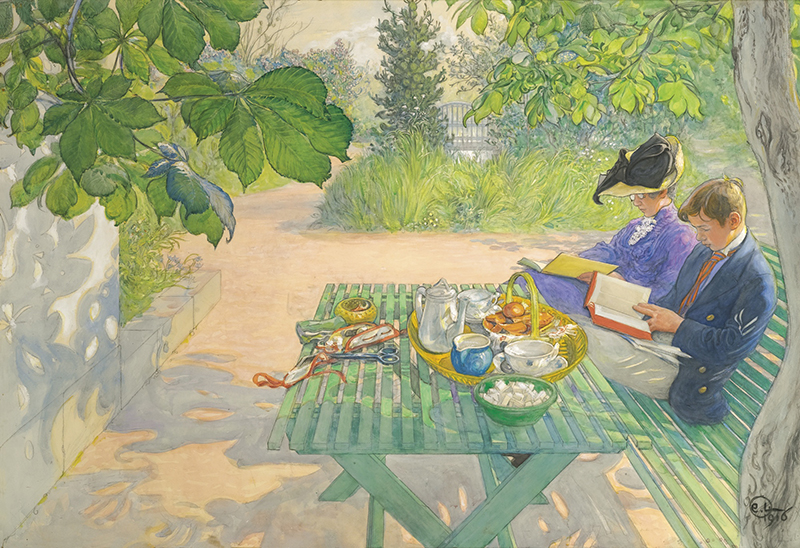
His mature style is light, decorative, intimate. The line work is precise but never stiff. Colors are bright and cheerful. If you look at the way he handles domestic scenes, there’s a warmth that still feels modern.
Most Famous Paintings
His depictions of family life at Sundborn made him a household name across Sweden and beyond.
- Midvinterblot (Midwinter Sacrifice, 1915) – his most ambitious and controversial work, now at the Nationalmuseum
- The Ett Hem (A Home) watercolor series – scenes of daily life at Sundborn
- Crayfishing – one of many beloved domestic scenes
- The Kitchen (c. 1898)
Techniques and Mediums
Larsson worked across painting mediums. Oils, watercolors, and frescoes. But watercolor was his signature.
His watercolor technique was bold for the time. Fluid washes combined with careful line drawing. The transparency of the medium suited his sun-filled interiors perfectly. He also worked extensively as an illustrator, and that graphic sensibility shows in every painting.
Themes and Subject Matter
Family life. That’s the short answer.
Larsson married artist Karin Bergoo in 1882, and together they raised eight children at their home, Lilla Hyttnas, in Sundborn. Their house became the most painted home in Sweden. Every room, every child, every meal was a potential painting.
Through his books and paintings, Lilla Hyttnas shaped Swedish interior design for generations. The bright, airy aesthetic that many associate with Scandinavian style traces back to what Carl and Karin created at Sundborn.
Legacy and Influence
Larsson essentially defined the visual identity of Swedish domestic life. His influence on Scandinavian design is hard to overstate. IKEA catalogs, Swedish home culture, the whole “cozy light-filled interior” idea – it connects back to him.
The Midvinterblot painting had a wild history. Rejected by the Nationalmuseum, sold to a Japanese collector, eventually bought back in 1997 after public demand. It now hangs in the exact spot Larsson intended.
Where to See Their Work
Carl Larsson-garden in Sundborn, just outside Falun, is open every summer. The family still owns it. The Nationalmuseum in Stockholm holds major works including Midvinterblot. The Gothenburg Museum of Art also has significant pieces in its Scandinavian art collection.
Hilma af Klint
Early Life and Training
Hilma af Klint was born in 1862 in Solna, Sweden, into a naval family. Her father was a mathematician with an extensive library, and she had access to scientific knowledge from a young age.
She studied at the Royal Academy of Fine Arts in Stockholm from 1882 to 1887. After graduating, she maintained a studio in central Stockholm and painted conventional portraits and landscapes in a naturalist style for years. Nothing about her early career suggested what was coming.
Artistic Style and Movement
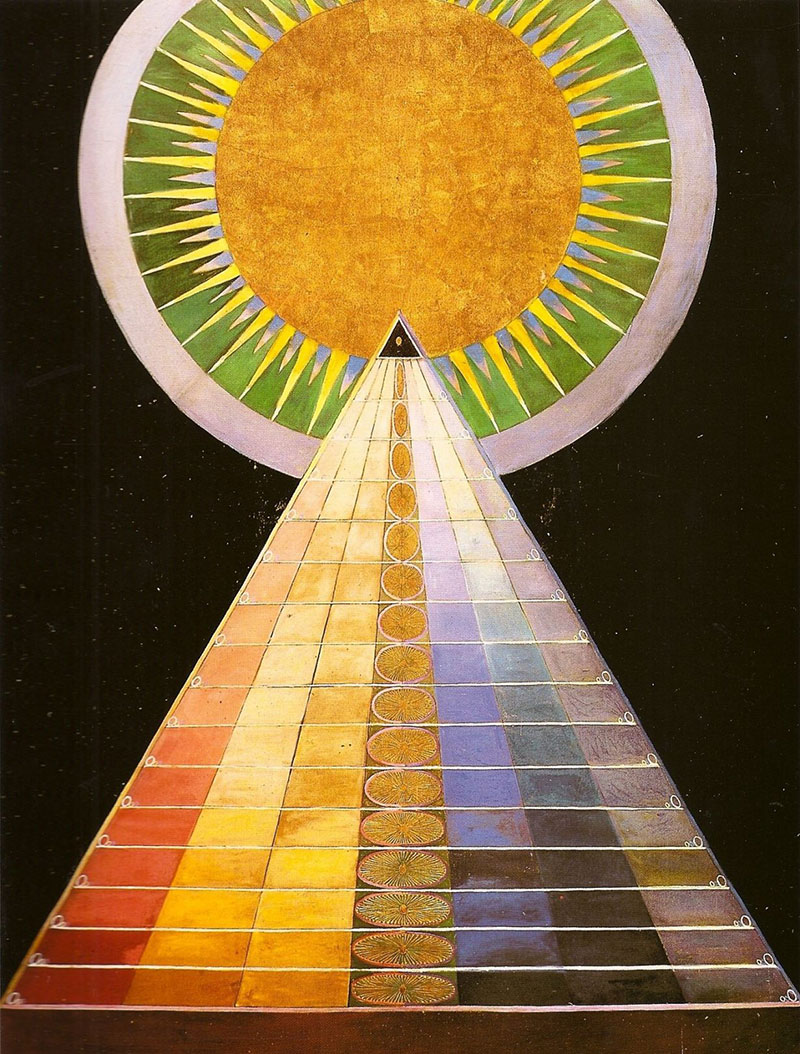
Here’s the thing. Af Klint was producing fully abstract paintings by 1906. That’s five years before Wassily Kandinsky claimed to have invented abstraction, and years before Piet Mondrian or Kazimir Malevich got there.
Her work sits at the intersection of spirituality, science, and art. She belonged to a group called “The Five,” a circle of women who practiced seances, meditation, and automatic drawing. During these sessions, af Klint believed spiritual beings called “High Masters” guided her hand.
The result was paintings that look like intricate diagrams of invisible forces. Geometric shapes, spirals, organic forms, bold color. Nothing else looked like this in 1906.
Most Famous Paintings
- The Ten Largest (1907) – a series of abstract compositions depicting life stages from childhood to old age, each over 10 feet tall
- Paintings for the Temple (1906-1915) – 193 works created under spiritual guidance, her most significant body of work
- The Swan series (1914-1915) – exploring duality through black and white swans
- Altarpieces (1915) – the concluding works of the Temple series
Techniques and Mediums
Af Klint worked in oils, watercolors, and mixed media. Her canvases ranged from small studies to monumental formats. The Ten Largest paintings are enormous for abstract work of that era.
She used color saturation with specific meaning. Blue represented femininity or spirituality. Yellow stood for masculinity or intellect. Every geometric shape carried symbolic weight. Spirals meant evolution. Circles meant wholeness.
Her approach was systematic and intentional, rooted in both scientific training and spiritual practice.
Themes and Subject Matter
Duality runs through everything. Male and female. Spirit and matter. The visible and the invisible.
She was deeply influenced by Theosophy and later Anthroposophy. When Rudolf Steiner visited her studio in 1908, he appreciated the symbolism but was wary of the mediumistic process. That feedback affected her, and she paused painting for several years before returning with a more independent approach.
Af Klint also maintained a serious interest in botany and natural sciences. Her studies of shells, flowers, and organic growth found their way into her abstract compositions.
Legacy and Influence
Af Klint specified in her will that her abstract works should not be shown publicly until at least 20 years after her death. She didn’t think the world was ready.
She was right that it would take time. When the works were first offered to the Moderna Museet in Stockholm in 1970, they were rejected. It wasn’t until a 1986 exhibition at the Los Angeles County Museum of Art that the public first saw her paintings.
The 2018-2019 retrospective at the Guggenheim Museum in New York shattered attendance records and cemented her status. She left behind over 1,200 paintings, 100 texts, and 26,000 pages of notes.
Where to See Their Work
The Hilma af Klint Foundation in Stockholm manages her entire estate. The Moderna Museet in Stockholm regularly exhibits her work. Internationally, pieces rotate through major museums including the Solomon R. Guggenheim Foundation in New York and the Museum of Modern Art. A 2025 show at MoMA continued the growing recognition of her contributions.
Bruno Liljefors
Early Life and Training
Bruno Liljefors was born in 1860 in Uppsala. He was a sickly child who spent a lot of time indoors, where a tutor introduced him to painting at age six. As he grew stronger, he took up hunting and outdoor exploration. Those two interests, painting and wildlife, never separated.
He studied at the Royal Swedish Academy of Fine Arts from 1879 to 1882. Then he traveled to Dusseldorf, Italy, and Paris between 1882 and 1883, where he encountered impressionist paintings and Japanese woodcuts that shaped his approach.
Artistic Style and Movement
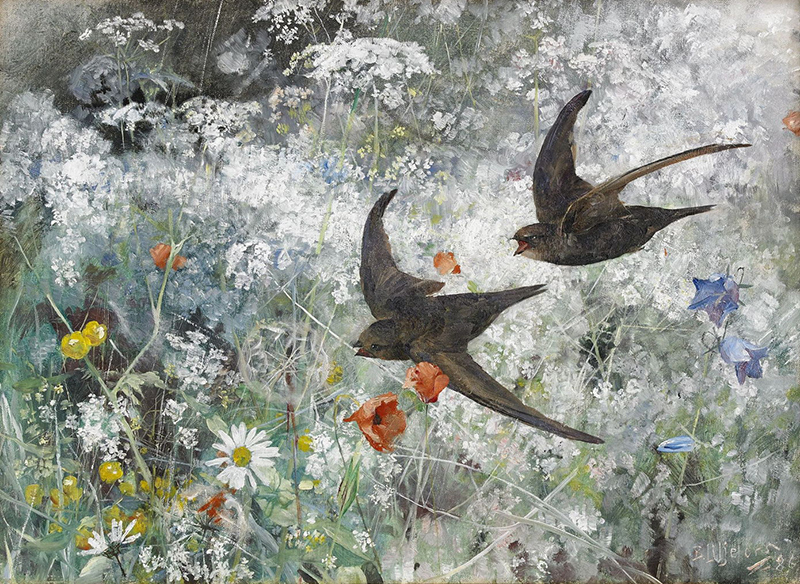
Liljefors is widely considered the most important Swedish wildlife painter of the 19th and early 20th centuries. Actually, probably one of the most important wildlife painters period.
His style combines careful observation with impressionistic brushwork. The animals in his paintings aren’t stiff scientific illustrations. They move. They breathe. They exist within their environments rather than being placed on top of them. He painted en plein air whenever possible, sometimes positioning dead specimens outdoors to capture the right setting.
He joined the “Opponents” (Opponenterna), a group of 84 Swedish artists led by Ernst Josephson who rebelled against the conservative Royal Academy. This put him firmly in the progressive camp of Swedish art history.
Most Famous Paintings
- Hawk and Black Grouse (1884) – a dramatic winter predator-prey scene
- A Fox Family (1886) – foxes in their natural habitat at the Nationalmuseum
- Eiders on a Rock – capturing seabird pairs on a spring morning
- Eagle and Hare (1902) – a golden eagle in mid-hunt
- Mallards, Evening (1901) – sunlight on water resembling leopard skin, earning the Swedish nickname Panterfallen
Techniques and Mediums
Primarily an oil painter, Liljefors was obsessive about getting animals right. He kept live foxes, badgers, hares, squirrels, and an eagle at his home as models. When live models weren’t available, he used specimens he’d hunted himself.
His understanding of camouflage patterns in nature was ahead of its time. He was fascinated by how animals blend into their surroundings, and this interest in natural pattern gave his paintings a scientific depth that pure landscape artists lacked.
He also painted the panoramic backdrops for the Biologiska Museet (Biological Museum) in Stockholm in 1893, one of the world’s first museums to use dioramas with painted settings.
Themes and Subject Matter
Predator and prey. That’s the core tension in most of his work.
Fox and hare. Sea eagle and eider. Goshawk and black grouse. He painted these encounters without sentimentality. The predator isn’t villainous. The prey isn’t pathetic. It’s just nature doing what nature does. As a lifelong hunter, he understood these dynamics firsthand.
He also painted Scandinavian landscapes, seascapes, and the occasional human portrait, but wildlife was always his primary focus.
Legacy and Influence
Liljefors basically invented modern wildlife art as we know it. Before him, bird paintings and animal art were largely scientific illustration or taxidermy-adjacent. He brought fine art sensibility to animals in their natural habitats.
American wildlife artist Michael Coleman and others have specifically cited Liljefors as a major influence. His approach to showing animals within environments rather than isolated from them changed the entire genre.
Where to See Their Work
The Nationalmuseum in Stockholm holds major works. The Thiel Gallery in Stockholm has a strong collection. The Zorn Museum in Mora also displays some of his pieces, as Zorn collected Liljefors’ work. The Biological Museum in Stockholm featured his panoramic backdrops, though the museum has been closed since 2017.
Ernst Josephson
Early Life and Training
Ernst Josephson was born in 1851 in Stockholm to a middle-class family of Jewish merchants. He started pursuing art professionally at sixteen, enrolling at the Royal Swedish Academy of Fine Arts.
After receiving a Royal Medal for painting in 1876, he traveled through Italy, Germany, and the Netherlands to study the Old Masters. His uncle was a dramatist, another uncle a composer. Creativity ran in the family.
Artistic Style and Movement
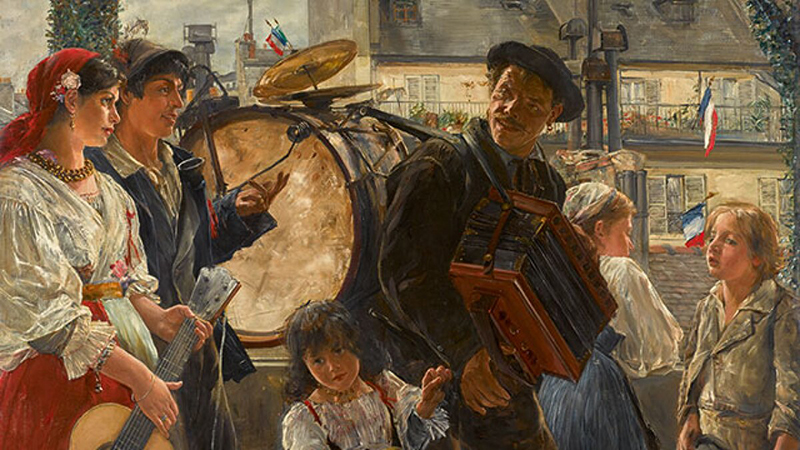
Josephson’s career splits into two distinct periods. Before 1888, he was a skilled painter of portraits and genre scenes influenced by the Old Masters, particularly Rembrandt.
Then everything changed. In the summer of 1888, while living on an island in Brittany, he suffered a severe mental breakdown, experiencing delusions and hallucinations. After that, his work became visionary, hallucinatory, raw. He painted in altered states and signed some works with the names of dead artists.
He was also a leader. In 1885, he became a driving force behind the “Opponenterna,” a group of 84 artists who protested the outdated methods at the Royal Academy. This rebellion led to the founding of the Konstnarsförbundet (Artists’ Association), which pushed Swedish art forward.
Most Famous Paintings
- Strömkarlen (The Water Sprite, 1884) – a naked figure playing violin by a waterfall, his most recognized work
- Spanish Blacksmiths (1882)
- Visionary drawings and paintings from his post-1888 period, which anticipated expressionism
Techniques and Mediums
In his earlier career, Josephson worked in oils with traditional painting techniques. His value control and draftsmanship were excellent.
After his breakdown, his approach loosened dramatically. The later works are more spontaneous, with distorted forms and intense emotional energy. Many art historians see these later pieces as proto-expressionist, decades ahead of their time.
Themes and Subject Matter
Before illness: portraits, Nordic mythology, scenes of people, and Scandinavian folk life.
After illness: spiritual visions, mythological figures, and intensely personal imagery drawn from his hallucinations. His patron Pontus Furstenberg, a wealthy Gothenburg merchant and art collector, supported him through both phases.
Legacy and Influence
Josephson’s dual legacy is unique in Swedish art. He’s remembered both as the organizer who modernized the Swedish art scene and as a visionary painter whose illness-period work predicted artistic movements that wouldn’t fully emerge for decades.
His paintings hang in the Nationalmuseum alongside Zorn, Larsson, and Hill as one of the defining figures of 19th-century Swedish art.
Where to See Their Work
The Nationalmuseum in Stockholm has the most significant collection. The Gothenburg Museum of Art holds important pieces as well, thanks to the Furstenberg collection. His prints and drawings are housed in the Nationalmuseum’s extensive graphic arts collection.
Alexander Roslin
Early Life and Training
Alexander Roslin was born in 1718 in Malmö, Sweden. His father was a naval physician. He showed talent early and trained as a naval draughtsman before apprenticing with court painter Georg Engelhard Schröder in Stockholm from age sixteen.
By 1745, he left Sweden for Bayreuth, then Italy, and finally settled in Paris in 1752 at age 34. He’d stay in France for the rest of his life.
Artistic Style and Movement
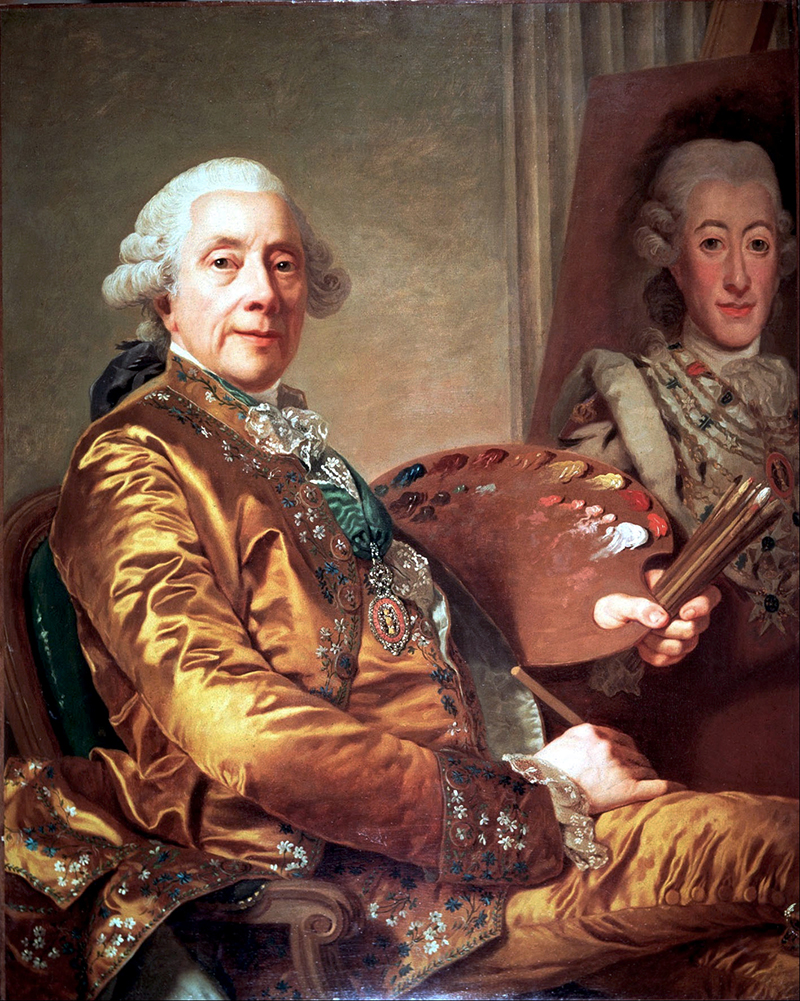
Roslin worked in the rococo style with classicist tendencies. His paintings have that characteristic lustre, the shimmering, elegant quality that defined 18th-century French court art.
What set him apart was his almost supernatural ability to paint fabrics. Silk, lace, pearls, gold filaments. Critics and clients were mesmerized by the way he rendered textures. His texture work in portraiture was arguably the finest of his generation.
Most Famous Paintings
- The Lady with the Veil (1768) – a portrait of his wife Marie-Suzanne Giroust dressed in Bolognese fashion, which philosopher Denis Diderot called “tres piquante”
- The Roslin Family Portrait (1767) – a double portrait showing Roslin and his wife at work
- Portraits of Empress Catherine II of Russia (1775-1777)
- Portraits of the Swedish royal family painted during his 1774-75 visit
Techniques and Mediums
Roslin was an oil painter who specialized in portrait paintings. His ability to capture both personality and material splendor made him one of the most sought-after portraitists in Europe.
He married pastel painter Marie-Suzanne Giroust in 1759, and the couple formed a creative partnership. His understanding of contrast between skin tones and rich fabrics remains studied by portrait painters today.
Themes and Subject Matter
Aristocratic portraiture. Almost exclusively. Kings, queens, empress, nobility, wealthy merchants. He painted the Swedish royal family, Catherine the Great of Russia (who tried to keep him at court permanently), and the upper echelons of Parisian society.
He flattered his subjects according to the rococo ideal while still managing to capture something genuine about their personalities. That balance kept clients coming back.
Legacy and Influence
Roslin was elected a member of the Royal Swedish Academy of Arts (as a foreign honorary member, oddly enough, since he’d been living abroad so long). His art made him wealthy, and he survived the French Revolution, outliving many of his patrons.
In 2013, the Nationalmuseum purchased his family portrait for 19.5 million SEK, calling it an important piece of Swedish cultural heritage.
Where to See Their Work
The Nationalmuseum in Stockholm holds major works. The Gothenburg Museum of Art has the Grill Family Portrait. Internationally, pieces are at the Metropolitan Museum of Art in New York. The Minneapolis Institute of Art purchased his portrait of the Countess of Egmont Pignatelli for $3 million in 2006.
Carl Fredrik Hill
Early Life and Training
Carl Fredrik Hill was born in 1849 in Lund, Sweden. He studied at the Royal Swedish Academy of Arts in Stockholm before moving to France in the 1870s to pursue landscape painting.
In Paris, he worked obsessively. “Ambition drives me to overexert myself and I give myself no peace,” he said. Despite the effort, the Paris Salon rejected his submissions.
Artistic Style and Movement
Hill’s career breaks into two radically different phases.
The first phase (roughly 1873-1878) produced atmospheric French landscapes with a quality that anticipated later movements. His landscapes have a brooding intensity, somewhere between romanticism and early modernism. They’re moody, alive, full of shifting light.
Then in January 1878, at just 28, Hill suffered a severe psychotic attack. He was hospitalized and diagnosed with hallucinations and paranoia. His career as a landscape painter was over.
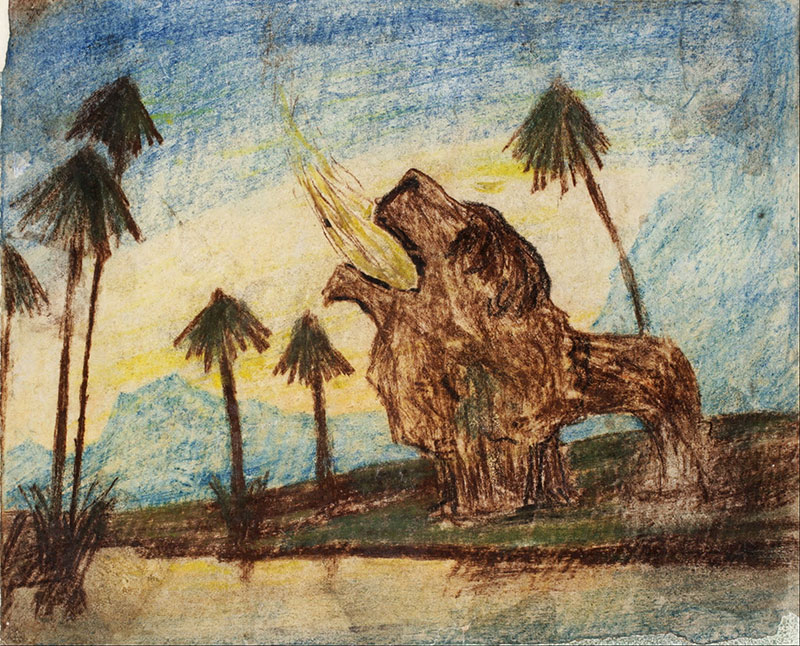
The second phase lasted 28 years. Cared for by his mother and sister at home in Lund, he produced thousands of drawings. Wild, fantastical, visionary. Art historian Ragnar Josephson called this “the second great period of his life as a painter.”
Most Famous Paintings
- His French landscape paintings from the 1870s, held at the Nationalmuseum
- The visionary drawings from 1878-1911, which number in the thousands
- Various nature paintings that show his mastery of atmospheric perspective
Techniques and Mediums
During his landscape period, Hill worked primarily in oils. His paint handling was sensitive, especially in how he captured Swedish and French skies.
The later drawings used pencil, charcoal, and crayon. They’re completely different from the landscapes. Frenetic, imaginative, sometimes disturbing. They were discovered and admired mainly by other artists first.
Themes and Subject Matter
Landscapes dominated the early period. French countryside, trees, water, sky. Simple subjects treated with unusual emotional depth.
The later drawings are fantastical. Mythological creatures, imagined landscapes, surreal compositions that look like they could have been made by someone who’d seen surrealism, decades before the movement existed.
Legacy and Influence
Thanks to Swedish collector Rolf de Mare, Hill’s work became known to the French avant-garde of the 1920s and 1930s. A traveling exhibition in 1949 showed in London, Lucerne, Basel, Geneva, and Hamburg to great success.
Hill is now considered one of Sweden’s most important landscape painters, and his illness-period drawings have earned him recognition internationally.
Where to See Their Work
The Nationalmuseum in Stockholm has the most comprehensive collection of both his landscapes and drawings. The Malmo Art Museum also holds pieces. His prints and drawings form a significant part of the Nationalmuseum’s graphic arts holdings.
Sigrid Hjerten
Early Life and Training
Sigrid Hjerten was born in 1885 in Sundsvall, northern Sweden. Her mother died when she was two. The family moved to Stockholm in 1897 after her father remarried.
She studied at the University College of Arts, Crafts and Design in Stockholm, graduating as a drawing teacher and textile artist. At a studio party in 1909, she met the young painter Isaac Grunewald, who convinced her that her true talent lay in painting, not textiles.
Later that year, she enrolled at Henri Matisse’s academy in Paris. Matisse reportedly considered her his favorite pupil because of her fine sense of color.
Artistic Style and Movement
Hjerten is considered a central figure in Swedish modernism and a pioneer of Swedish expressionism. She was the only female member of the artist group De Atta (“The Eight”).
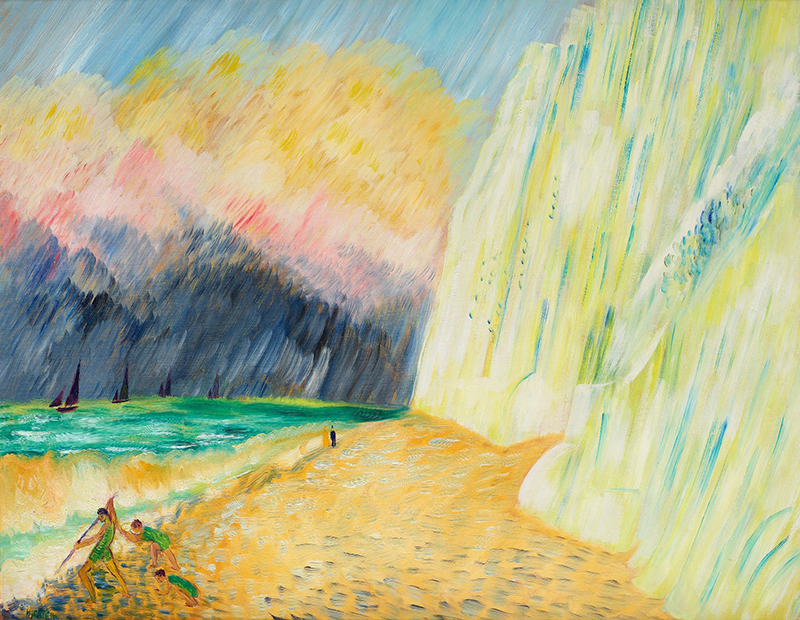
Her style draws from both fauvism and German expressionism. She developed contrasting color fields with simplified contours. Her work is closer to Ernst Ludwig Kirchner than to the more decorative French approach, though Matisse‘s influence stays visible throughout.
Her paintings are intensely personal. Color wasn’t decorative for Hjerten. It was emotional. The darker her mental state, the colder and more intense the palette became.
Most Famous Paintings
- Ateljeinterior (The Studio Interior) – her most celebrated work, a complex group portrait with modernist aesthetics
- Den roda rullgardinen (The Red Blind, 1916) – a radical nude that broke from academic tradition
- Interior scenes from Kornhamnstorg and Katarinavagen in Stockholm
- Portraits of her son Ivan and husband Isaac
Techniques and Mediums
Hjerten worked in oils, watercolors, and various graphic techniques including linocuts, woodcuts, and lithography. She also painted on tiles and ceramics.
Her total production was slightly over 500 paintings plus sketches and drawings. In her most productive period (1932-1934), she created one painting per day, described in the Swedish art magazine Paletten as “the picture-book of her life.”
Themes and Subject Matter
City life, interiors, family, and emotional states.
Her studio scenes, cafe paintings, and theater interiors weren’t just depictions of places. They served as stages for modernist experimentation with composition and color. Children, particularly her son Ivan, appear frequently. She was ahead of her time in how she portrayed childhood, honest and unsentimental.
As her mental health declined in the late 1920s and 1930s, the paintings became darker. Storm clouds, cold tones, diagonal strokes that create tension. Some radiate horror. Others maintain a surprising warmth.
Legacy and Influence
Hjerten fought prejudice throughout her career. Male critics dismissed her work as “idiocy” and “humbug.” They called her “Mrs. Grunewald” despite her consistent use of her own name. She participated in over 100 exhibitions, but full recognition came only in 1936 at a Royal Academy retrospective, and by then, she was already struggling.
Diagnosed with schizophrenia in 1932, she was eventually institutionalized at Beckomberga Psychiatric Hospital. She died in 1948 from complications after a lobotomy. She was 62.
Today she’s recognized as one of the most innovative Swedish painters of the early 20th century.
Where to See Their Work
The Moderna Museet in Stockholm holds significant works. The Gothenburg Museum of Art and Prins Eugens Waldemarsudde in Stockholm have also exhibited her pieces. A major retrospective, Sigrid Hjerten – A Masterly Colourist, was held at Waldemarsudde in 2018.
John Bauer
Early Life and Training
John Bauer was born in 1882 in Jonkoping, Sweden. He studied at the Royal Swedish Academy of Arts in Stockholm, where he began illustrating stories for books and magazines.
Trips to Lapland, Germany, and Italy broadened his artistic vocabulary. The Lappish wilderness, in particular, left a deep impression that shows up again and again in his work.
Artistic Style and Movement
Bauer is best known as an illustrator, blending romantic nationalism with hints of Italian Renaissance composition and Sami cultural elements.
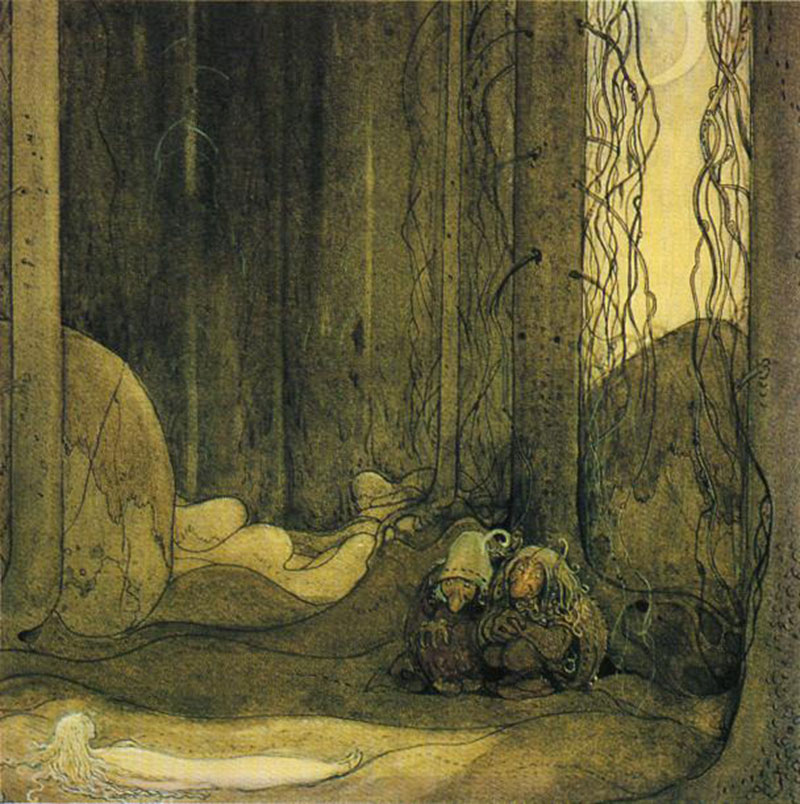
His style is immediately recognizable. Enchanted forests, mossy trolls, delicate princesses, ancient trees. The work sits between fine art and illustration, with line quality that’s both precise and dreamlike.
Most Famous Paintings
- Illustrations for Bland Tomtar och Troll (Among Gnomes and Trolls), an annual Christmas book he illustrated from 1907 to 1915
- Landscape paintings and portrait works
- Various mythological and folklore paintings
Themes and Subject Matter
Scandinavian folklore, mythology, and the Swedish forest. His trolls aren’t menacing. They’re ancient, mossy, part of the landscape itself. The children and princesses who wander through his scenes carry a quiet courage.
His paintings of the Swedish wilderness, particularly the old-growth forests, have an almost sacred quality.
Legacy and Influence
Bauer died tragically in 1918 at just 36, in a steamship sinking on Lake Vattern. His wife Ester and their young son also perished.
Despite his short career, Bauer defined the visual language of Swedish fairy tales. If you’ve seen a moss-covered troll in a dark forest, you’re seeing John Bauer’s influence.
Where to See Their Work
The Jonkopings lans museum in his hometown holds the largest collection of his work. The Nationalmuseum in Stockholm also has pieces. His illustrations remain in print and continue to sell widely across Scandinavia.
Early Life and Training
August Strindberg was born in 1849 in Stockholm. Most people know him as the father of modern Swedish literature. Playwright, novelist, poet, essayist. But he was also a painter.
He had no formal art training. He just painted. Starting in the 1870s and continuing intermittently throughout his life.
Artistic Style and Movement
Strindberg’s paintings are wild. Thick impasto, stormy skies, churning seas. He worked fast and intuitively, sometimes using a palette knife instead of brushes. Knowing how to paint with a palette knife was part of his raw approach.
His style anticipated expressionism by decades. The paintings feel urgent, almost violent. They’re not pretty. They’re powerful.
He also experimented with photography and what he called “celestographs,” images made by exposing photographic plates directly to the night sky without a camera.
Most Famous Paintings
- The Town (1903)
- Wonderland (1894)
- Various seascapes and stormy Swedish landscape paintings
Themes and Subject Matter
Turbulent seascapes, dramatic skies, rocky coastlines. The paintings mirror the emotional intensity of his literary work. When Strindberg was in turmoil (which was often), the paintings got more intense.
He produced roughly 117 paintings total. Not a huge output compared to his literary work, but each one carries real force.
Legacy and Influence
For decades, Strindberg’s paintings were treated as a curious side project. That’s changed. Today his visual art is taken seriously, and art historians see him as one of the earliest proto-expressionists in Scandinavian art.
His paintings hang at the Nationalmuseum in Stockholm and the Nordiska Museet, among other institutions.
Where to See Their Work
The Nationalmuseum and Nordiska Museet in Stockholm hold significant works. The Strindberg Museum (Blå Tornet) in Stockholm offers context on his entire creative output, including his paintings. The Moderna Museet has also exhibited his visual art.
FAQ on Famous Swedish Painters
Who is the most famous Swedish painter?
Anders Zorn is widely considered the most famous Swedish painter. His portraits, nudes, and depictions of Dalarna folk life earned him international acclaim. He painted three U.S. presidents and received the French Legion of Honour at 29.
What Swedish artist invented abstract art?
Hilma af Klint created abstract paintings as early as 1906, years before Kandinsky, Mondrian, or Malevich. Her work remained hidden until the 1980s because she requested it stay private for 20 years after her death.
What is Carl Larsson known for?
Carl Larsson is best known for his watercolor paintings of Swedish family life at his home in Sundborn. His bright, intimate domestic scenes shaped Scandinavian interior design and remain iconic in Swedish culture today.
Are there famous female Swedish painters?
Yes. Hilma af Klint and Sigrid Hjerten are two of the most significant. Hjerten pioneered Swedish expressionism as a student of Matisse in Paris. Both women faced dismissal during their lifetimes but are now celebrated internationally.
What art movement did Swedish painters follow?
Swedish painters worked across many movements. Zorn leaned toward impressionism, Hjerten toward expressionism, af Klint toward abstraction, and Roslin toward rococo portraiture. There was no single dominant movement in Swedish art history.
Where can I see Swedish paintings in Stockholm?
The Nationalmuseum holds the largest collection of Swedish art, including works by Zorn, Larsson, Hill, and Josephson. The Moderna Museet shows Hilma af Klint. Prins Eugens Waldemarsudde and the Thiel Gallery are also worth visiting.
What is the Zorn palette?
The Zorn palette refers to four colors Anders Zorn reportedly used: lead white, yellow ochre, vermilion, and ivory black. Recent research suggests he used more colors than this, but the limited palette concept remains popular among oil painters.
Who was Bruno Liljefors?
Bruno Liljefors was Sweden’s most important wildlife painter. Born in Uppsala in 1860, he combined impressionistic brushwork with precise animal observation. His predator-prey scenes set the standard for modern wildlife art worldwide.
Did any Swedish painters live in Paris?
Many did. Zorn, Larsson, Hjerten, Hill, and Josephson all spent significant time in Paris. The city was the center of the European art world in the 19th century, and most serious Swedish artists trained or exhibited there.
What makes Swedish art different from other Nordic art?
Swedish art developed strong ties to both folk tradition and French academic training. While Norwegian art centered on landscape painters like Edvard Munch, Swedish painters covered a wider range, from Larsson’s domestic scenes to af Klint’s spiritual abstraction.
Conclusion
These famous Swedish painters didn’t just contribute to Nordic visual arts. They reshaped how the world thinks about portraiture, wildlife art, abstraction, and modernist color.
Zorn’s mastery of light still influences portrait painters today. Af Klint’s spiritual abstractions rewrote the origin story of 20th-century art. Larsson’s Sundborn watercolors became the blueprint for Scandinavian design.
What connects them is range. From Roslin’s 18th-century rococo silk to Hjerten’s emotionally charged expressionist canvases, Swedish art history covers far more ground than most people expect.
If you’re planning to visit Stockholm, start at the Nationalmuseum. It holds the strongest collection of Swedish masterworks under one roof. The Moderna Museet and Zorn Museum in Mora round out the picture.
These artists deserve the attention. Go look at the work.