Most ancient Roman paintings should be gone. And yet, thanks to a volcanic disaster in 79 AD, dozens of extraordinary frescoes survived under the ash of Mount Vesuvius.
From the haunting walls of Pompeii to the portrait panels of Roman Egypt, these works reveal how people actually lived, worshipped, and decorated their homes across the empire. They also happen to be some of the only surviving examples of classical painting from antiquity.
This guide covers the most famous Roman paintings still in existence. You’ll find where each one was discovered, what it depicts, the fresco techniques behind it, and why it still matters to art history. Whether you’re studying ancient Roman art or just curious about what hung on the walls two thousand years ago, this is where to start.
Famous Roman Paintings
The Dionysiac Frieze (Villa of the Mysteries)
Origin and Date
Painted around 60-50 BC during the late Roman Republic. Found in a large suburban villa located about 400 meters northwest of Pompeii’s city walls, overlooking the Gulf of Naples.
The villa itself dates to the 2nd century BC. It reached peak splendor during the Augustan age before Mount Vesuvius buried everything in 79 AD.
Location and Discovery
Aurelio Item, a local landowner, first uncovered the villa between 1909 and 1910. A deeper excavation followed in 1929-1930 under archaeologist Amadeo Maiuri.
He renamed it the “Villa of the Mysteries” to highlight the painted room’s significance. The frescoes survived under roughly 20 feet of volcanic ash with surprisingly little damage.
Subject and Scene
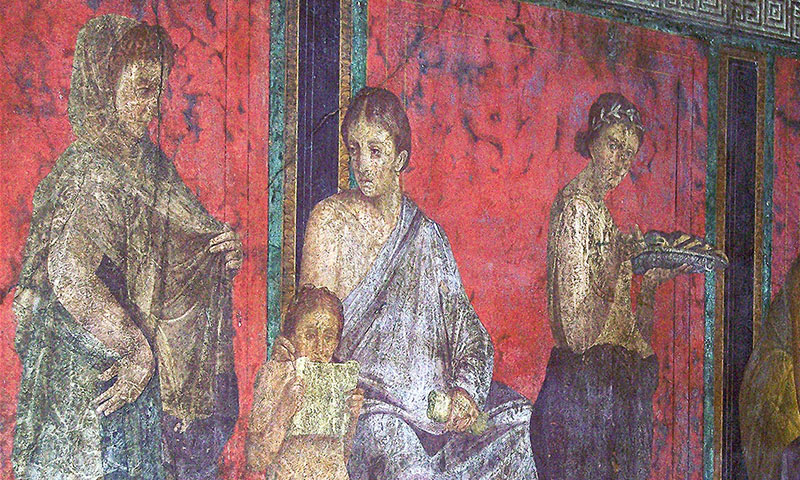
The frieze wraps around all four walls of a 15-by-15-foot room, likely used as a dining space. It shows nearly life-size figures against a striking red background, now called “Pompeii Red.”
The most accepted reading? A young woman being initiated into a mystery cult devoted to Dionysus (Bacchus to the Romans). The narrative moves through several scenes:
- A boy reading from a scroll before a priestess
- Dionysus reclining in the arms of his mother Semele
- A winged figure preparing to strike with a whip
- The initiate kneeling, being flagellated, then dancing
- A seated woman, now veiled, displaying a ring on her finger
But scholars still argue about the exact meaning. Some see a bride preparing for marriage. Others see a theatrical performance. That ambiguity is part of what keeps it fascinating.
Painting Style and Technique
This is a true fresco, meaning pigment was applied directly to wet plaster. The artists used natural mineral pigments, with cinnabar creating that famous red.
The work belongs to the Second Style of Roman wall painting, which focused on creating architectural illusions and depth. The figures feel almost sculptural, modeled with careful chiaroscuro effects that give them weight and presence.
Took me a while to appreciate how advanced the shading is here. These painters understood how light works on form better than most artists would for centuries afterward.
Symbolism and Cultural Meaning
The Dionysiac cult was a mystery religion. Initiates swore secrecy about its rituals, which is exactly why scholars can’t fully decode this painting.
Wine, ecstasy, fertility, transformation. These were Dionysus’s domains. The frieze likely connected the homeowner to these themes, projecting wealth and cultural sophistication to dinner guests.
Some researchers think the villa’s owner may have modeled the women and children in the painting after her own family members.
Current Preservation
Still in its original location inside the Villa of the Mysteries at Pompeii. Major restoration work took place between 2013 and 2015, removing decades of wax buildup that had yellowed the pigments.
The frescoes remain among the best-preserved examples of ancient Roman wall painting anywhere in the world.
Why It Matters
This is arguably the single most studied Roman painting in existence. It bridges Greek mythological painting traditions with distinctly Roman domestic art. And it gives us one of our only visual records of what mystery cult rituals might have actually looked like.
For anyone interested in ancient painting styles, the Dionysiac Frieze is where you start.
The Alexander Mosaic
Origin and Date
Created around 100 BC as a Roman floor mosaic. But here’s the thing. It’s almost certainly a copy of a lost Greek painting from around 315 BC, possibly by Philoxenus of Eretria (though some scholars argue for Apelles).
Found in the House of the Faun in Pompeii, one of the largest and wealthiest private residences in the ancient city, covering an entire city block at roughly 3,000 square meters.
Location and Discovery
Archaeologists discovered it in 1831 during excavations at Pompeii. The mosaic decorated the floor of an exedra, an open room connecting the villa’s two large peristyles.
It was transported to Naples in September 1843. Today it hangs on a wall at the National Archaeological Museum of Naples (MANN), where a major restoration project began in January 2021.
A full-scale replica was installed back in the House of the Faun in 2005. That copy alone took 22 months and about 2 million tessera pieces to complete.
Subject and Scene
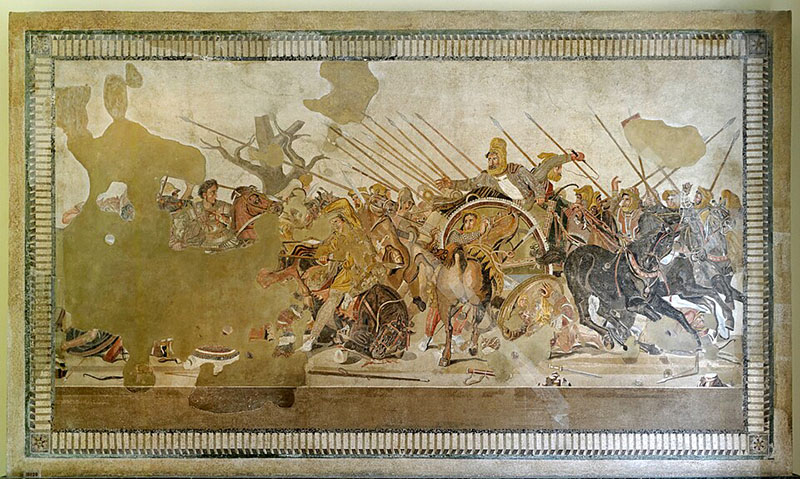
The mosaic captures the decisive turning point of a battle between Alexander the Great and Darius III of Persia. Most scholars identify it as the Battle of Issus (333 BC), though some argue for Gaugamela.
Alexander charges from the left on horseback. Darius, eyes wide with fear, turns his chariot to flee. The moment is pure chaos. Fallen horses, shattered spears, reflections in shields.
What makes it remarkable is the emotional intensity. You can read the panic on Darius’s face and the determination on Alexander’s. This isn’t just a record of battle. It’s a psychological portrait.
Painting Style and Technique
Composed of approximately 2 million tiny tesserae, cut from naturally colored stones and glass. The piece measures roughly 12 by 17 feet (5.82 x 3.13 meters).
The artists used a limited palette (similar to what ancient sources describe for Greek painting): white, yellow, red, and black. Despite that constraint, they achieved convincing foreshortening, cast shadows, and reflections that feel remarkably modern.
The perspective work here is something else. Horses are shown at complex angles, and the spears create powerful directional lines that pull your eye across the scene.
Symbolism and Cultural Meaning
For the wealthy Roman owner, displaying this mosaic sent a clear message. It connected them to Hellenistic culture and Greek military glory, both highly valued in Roman high society.
The mosaic also reflects the Roman habit of collecting and copying Greek art, treating their cultural predecessors with a mix of admiration and appropriation.
Current Preservation
At MANN in Naples, currently undergoing extensive conservation. Researchers have found detached tesserae, cracks, bulges, and surface depressions from centuries of aging and earlier restoration attempts.
Non-invasive analysis in 2015 and 2025 has revealed new details about the original materials and construction methods.
Why It Matters
Probably the most famous mosaic from the ancient world. It’s our best evidence for what Hellenistic Greek painting looked like at its peak. And it proves that Roman artists (or the Greek artists they hired) understood composition, movement, and drama at a level that wouldn’t be matched until the Renaissance.
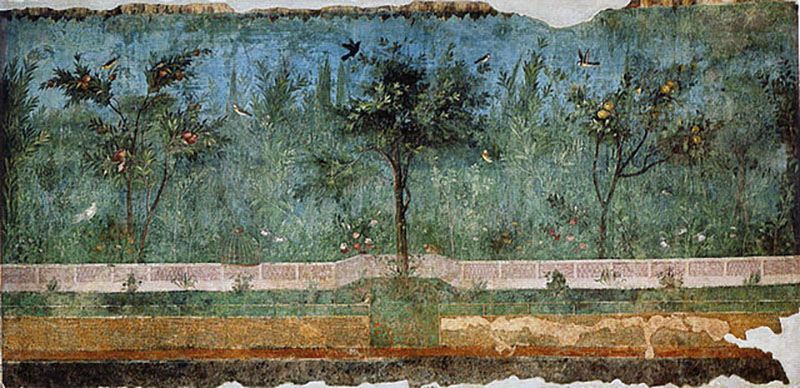
The Painted Garden of Livia
Origin and Date
Painted around 30-20 BC during the reign of Emperor Augustus. It decorated a semi-underground room in the Villa of Livia at Prima Porta, about 12 kilometers north of Rome along the Via Flaminia.
Livia Drusilla was Augustus’s wife. This was her country estate, and the painted room likely served as a summer triclinium (dining room), kept cool by being partially below ground.
Location and Discovery
The villa site was first explored as early as 1596, but wasn’t identified as Livia’s estate until the 19th century. The famous Augustus of Prima Porta statue was found here in 1863.
The frescoes were detached from the walls in 1951 due to water damage. Since 1998, they’ve been reassembled in a purpose-built room at the Museo Nazionale Romano, Palazzo Massimo alle Terme in Rome.
Subject and Scene
Floor-to-ceiling garden landscapes covering all four walls. No architectural framing, no mythological figures. Just nature.
The scene unfolds in layers:
- A low stone fence and grassy walkway in the foreground
- Dense plantings of fruit trees and flowering shrubs
- A deeper forest fading into open sky
- Birds (partridges, doves, goldfinches) flying and perching throughout
Scholars have identified over 20 plant species, including umbrella pine, oak, pomegranate, laurel, cypress, oleander, date palm, iris, poppy, and chamomile. Every plant is in bloom. Every fruit is ripe. Even though they flower at different times of the year.
That botanical impossibility is the point. This is a paradise garden, frozen in eternal abundance.
Painting Style and Technique
True fresco, with remarkable attention to atmospheric perspective. Plants in the foreground are painted with sharp detail. Those in the background become softer and less defined.
The color work is subtle. Greens shift from deep emerald to pale sage. The sky transitions from blue to almost white near the horizon, creating genuine depth on a flat wall.
The room measures roughly 40 by 20 feet. Visitors entered through a dark, five-meter hallway, which forced their eyes to adjust. Stepping into the painted room felt like walking into an actual garden.
Symbolism and Cultural Meaning
The bay laurel appears more than any other plant. According to Pliny the Elder, a white hen once dropped into Livia’s lap holding a laurel branch. She planted it, and it grew into a grove that provided triumphal wreaths for generations of emperors.
The painting broadcasts Augustan ideology. Eternal spring. Boundless prosperity. A golden age under stable rule. The strawberry tree (arbutus) also appears, a plant mentioned in the Aeneid, connecting the garden to Rome’s founding myths.
Current Preservation
Displayed at Palazzo Massimo alle Terme in Rome, in a room built to match the original dimensions. A faithful reproduction has also been installed at the original villa site at Prima Porta.
The frescoes are fragmentary in places but remarkably well-preserved overall for work that’s over 2,000 years old.
Why It Matters
The oldest surviving continuous garden painting. It’s the sole example from antiquity where a nature scene takes up the entirety of a room’s four walls. This fresco became the model for landscape painting in other imperial and private Roman residences.
Perseus and Andromeda (House of the Dioscuri)
Origin and Date
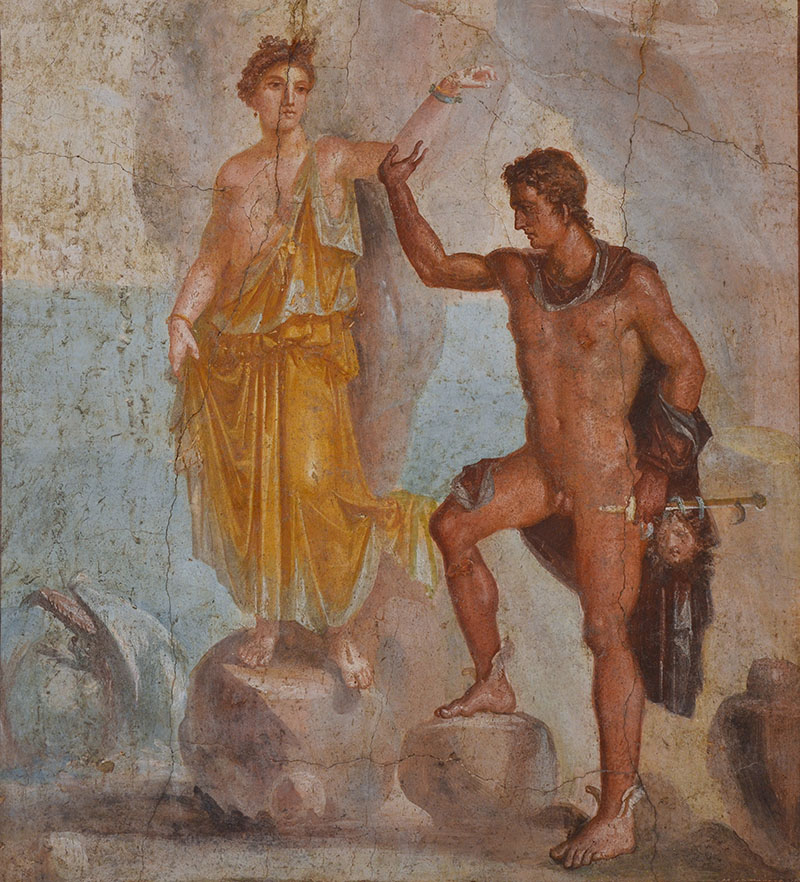
A 1st century AD fresco from the House of the Dioscuri in Pompeii. The painting was made during the Fourth Style period of Roman wall painting, which favored elaborate, busy compositions with multiple framed scenes.
Location and Discovery
Excavated from Pompeii and now housed at the National Archaeological Museum of Naples. Several versions of this same mythological scene were found across Pompeii, but this one from the House of the Dioscuri is the best-known.
Subject and Scene
The Greek myth of Perseus rescuing Andromeda. She’s been chained to a rock as a sacrifice to a sea monster. Perseus, fresh from slaying Medusa, swoops in to save her.
The painting captures the moment just after the rescue. Perseus guides Andromeda down from the rocks, their hands meeting in what reads almost like a romantic gesture. The slain monster is visible in the background.
Painting Style and Technique
Fresco with confident brushwork and strong use of contrast. The figures are rendered with soft, almost impressionistic modeling.
What’s interesting is the tonal range. Perseus’s skin is bronzed and warm, Andromeda’s is pale. That color contrast wasn’t accidental. Roman painters used it to separate figures and create visual hierarchy.
Symbolism and Cultural Meaning
Greek mythology was everywhere in Pompeian homes. Displaying scenes like this showed the homeowner’s cultural sophistication and connection to Hellenistic tradition.
Perseus and Andromeda also carried romantic overtones, making the painting suitable for private chambers and dining rooms where guests would appreciate the narrative.
Current Preservation
Well-preserved at the Naples Archaeological Museum, though some color saturation has faded over the centuries.
Why It Matters
A perfect example of how Roman artists adapted Greek mythological painting for domestic decoration. The composition influenced later depictions of the same myth by artists including Titian and Peter Paul Rubens.
The Aldobrandini Wedding
Origin and Date
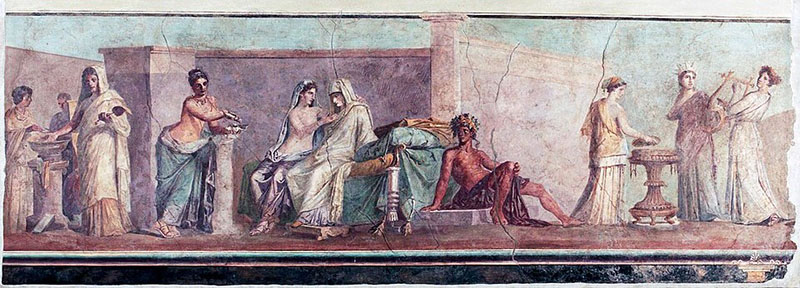
Dated to the second half of the 1st century BC, during the Augustan period. This ancient Roman fresco measures 2.60 meters wide by roughly 1.20 meters high.
For centuries, scholars debated whether it was a copy of a Hellenistic original. Current consensus? It’s an original Roman painting from the age of Augustus.
Location and Discovery
Found around 1601, buried in the masonry of a house near the Arch of Gallienus on Rome’s Esquiline Hill. The discovery was made by professional seekers who routinely scoured Roman ruins for antiquities to sell.
Cardinal Pietro Aldobrandini acquired it (hence the name). The Vatican purchased it in 1818, and it’s been displayed there since 1838 in a room that now bears the painting’s name.
Subject and Scene
Ten figures arranged in three groups across a frieze-like composition. The action moves between indoor and outdoor settings within the same household.
- Center: A bride sits on a bed, looking anxious. Venus (or Aphrodite) sits beside her, offering comfort. The god Hymen appears at the threshold.
- Left: A matron tests the temperature of water in a basin, likely referencing the Roman marriage ritual of “acceptance of water and fire.”
- Right: A sacrifice scene takes place outdoors, with a young woman playing music.
It’s essentially a snapshot of a Roman wedding ceremony, capturing the bride’s pre-wedding anxiety with surprising psychological depth.
Painting Style and Technique
Detached fresco, originally part of an upper wall frieze in a Roman domus. The Third Style of Roman wall painting, characterized by delicate architectural frames and refined line work over light backgrounds.
The drawing is precise and elegant. Figures are modeled with restraint, letting outline and posture carry the emotional weight rather than heavy shading.
Symbolism and Cultural Meaning
The painting documents actual Roman marriage customs, including the flammeum (orange wedding veil), the joining of right hands (dextrarum iunctio), and the wedding torch carried by Hymen.
This makes it one of our best visual records of how Roman weddings actually worked.
Current Preservation
On display at the Vatican Museums in the Room of the Aldobrandini Wedding. Broken at both ends, so we’re seeing an incomplete scene. Multiple restorations over the centuries, most recently in 1962.
Why It Matters
Until Pompeii was excavated in the 18th century, this was the most famous and most studied Roman painting in existence. It directly inspired neoclassical artists and fueled European interest in ancient wall art for over 200 years.
Portrait of Terentius Neo and His Wife
Origin and Date
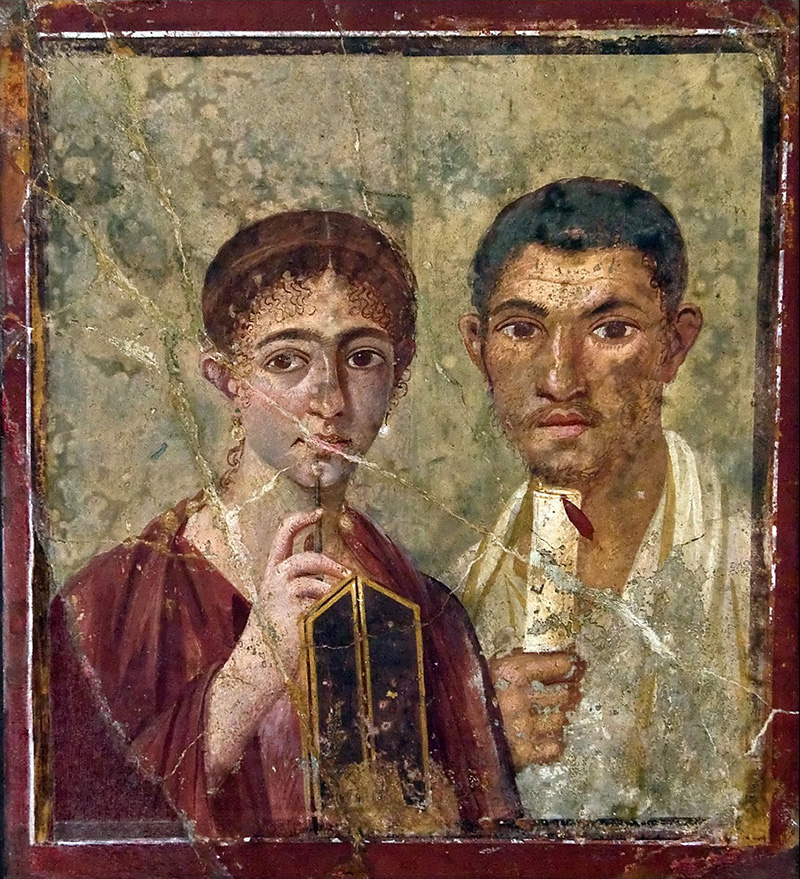
Painted around 55-79 AD, during the Fourth Style period. Found in a modest house in Pompeii, this double portrait gives us a direct look at middle-class Roman life.
Location and Discovery
Discovered during Pompeii excavations and now at the National Archaeological Museum of Naples. The portrait was found on a wall of a house belonging to Terentius Neo, identified as a baker.
Subject and Scene
A husband and wife, shown side by side, looking directly at the viewer. He holds a sealed scroll (a rotulus). She holds a wax writing tablet and a stylus pressed to her lips, as if pausing mid-thought.
These aren’t aristocrats. They’re regular Pompeians who wanted to project literacy and cultural refinement. The writing implements are deliberate props, meant to communicate social ambition.
Painting Style and Technique
Fresco with rounded, naturalistic features. The skin tones are warm and varied. Both faces show individualized features rather than idealized beauty, giving the portrait a documentary quality.
The tonal modeling on the faces is remarkably skilled for what was probably a local workshop production, not a high-end commission.
Symbolism and Cultural Meaning
Literacy was a status symbol in Roman society. By posing with writing tools and scrolls, this couple signaled their education and respectability, even as tradespeople.
The portrait also tells us something about gender roles. The wife is shown as equally literate, holding her own writing implements. That detail matters.
Current Preservation
One of the best-preserved Roman portrait paintings. Colors remain vivid, and facial details are sharp enough that these feel like real people you could recognize on the street.
Why It Matters
One of the earliest surviving examples of realistic portrait painting from the ancient world. It bridges the gap between idealized Greek portraiture and the raw individuality that would later define realism in Western art.
The Sappho Fresco
Origin and Date
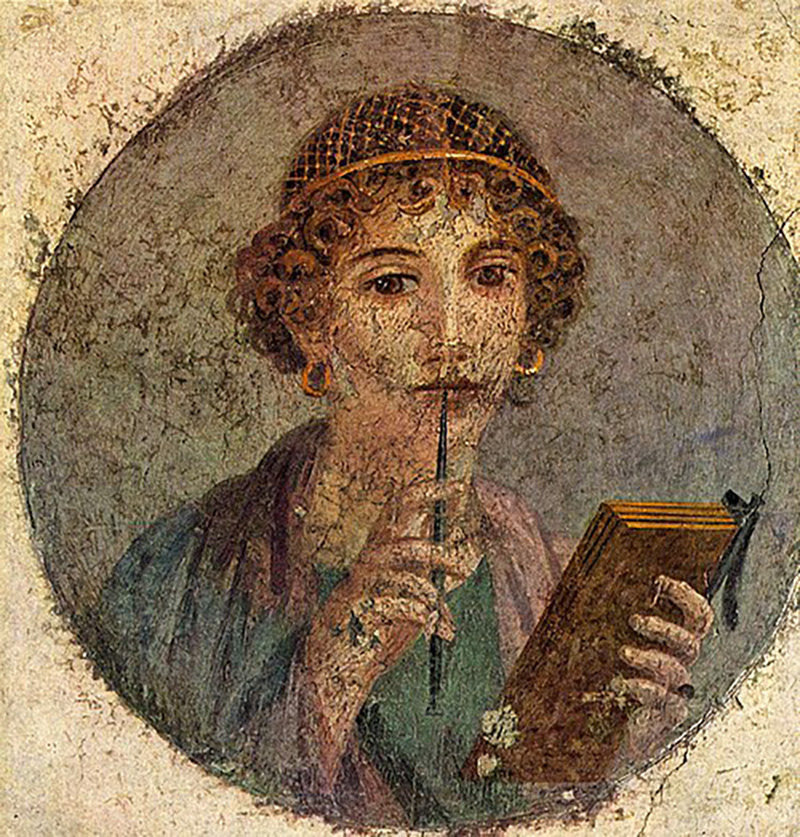
Circa 50 AD, from Pompeii. Despite the nickname, this painting doesn’t actually depict the Greek poet Sappho. That’s a 19th-century label that stuck.
Location and Discovery
Found in Pompeii. Now housed at the Naples National Archaeological Museum. It’s one of the museum’s most reproduced and recognizable pieces.
Subject and Scene
A young woman holds a wax tablet in one hand and a stylus pressed to her lips in the other. She gazes slightly upward and to the side, as if considering what to write next.
Her hair is gathered in a gold-threaded net. She wears large gold earrings. This is clearly a woman of means, someone who could afford both the jewelry and the education the writing tools imply.
Painting Style and Technique
A tondo (circular format) portrait, painted in fresco. The background is a neutral, dark tone that pushes the figure forward. The texture of her hair net and the reflective quality of her earrings show real technical skill.
The focal point is her face, specifically her eyes, which carry an expression that feels genuinely contemplative.
Symbolism and Cultural Meaning
Like the Terentius Neo portrait, this painting emphasizes literacy as a mark of status. The stylus-to-lips gesture appears in multiple Pompeian portraits, always signaling intellectual refinement.
Current Preservation
Well-preserved, with value gradations in the skin tones still clearly readable. Some pigment loss around the edges.
Why It Matters
Probably the most recognized single-figure portrait from ancient Rome. It’s become something of a symbol for women’s education in antiquity, used in countless books and documentaries about Roman daily life.
Priapus Fresco (House of the Vettii)
Origin and Date
Painted after 62 AD (when a major earthquake damaged Pompeii and many homes were redecorated). The House of the Vettii belonged to two freed brothers, former slaves who had bought their way out of servitude.
Location and Discovery
The house was excavated in 1894-1895 in Pompeii. The Priapus fresco sits in the entrance vestibule, the first thing any visitor would see. It remains in situ.
Subject and Scene
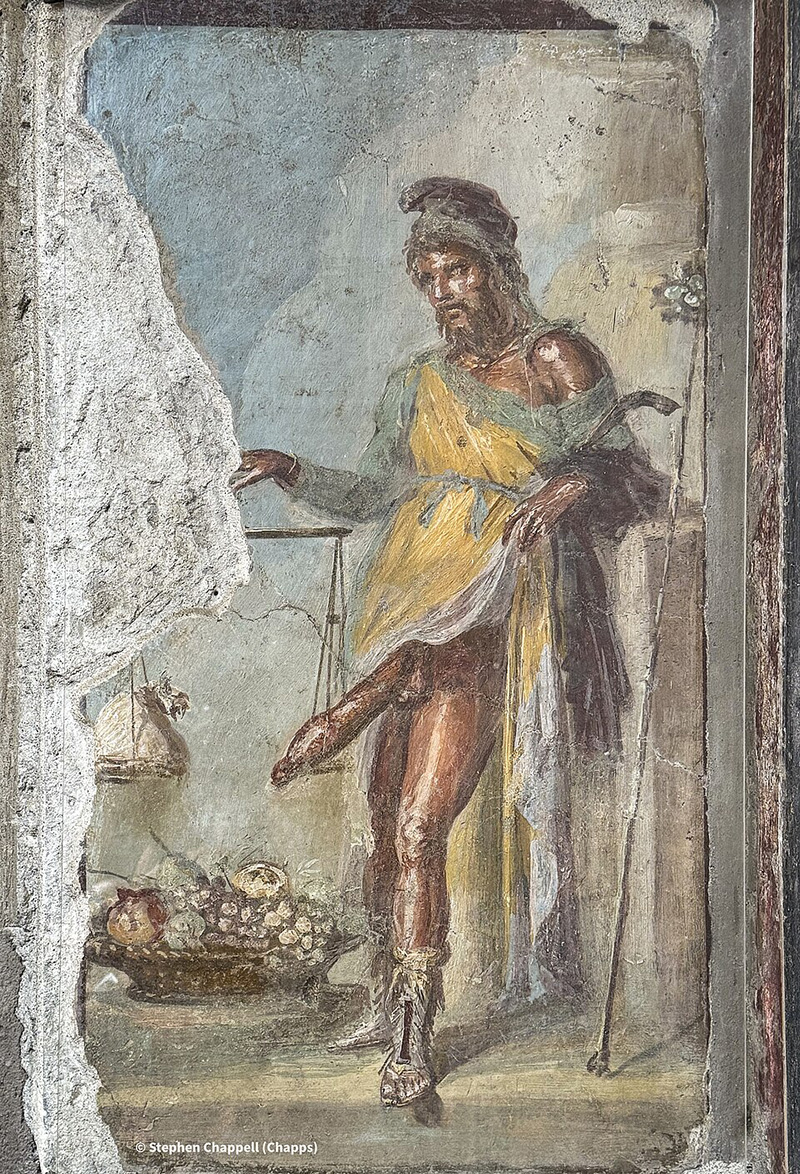
Priapus, the Roman god of fertility, stands weighing his enlarged phallus on a scale against a bag of money. A fruit basket sits at his feet.
Look, I know. It’s blunt. But that’s the point. Roman attitudes toward sexuality were fundamentally different from modern Western ones. This wasn’t pornography. It was a protective charm.
Painting Style and Technique
Fourth Style fresco, painted on a vermillion red background. The figure is bold and flat compared to more refined Pompeian paintings. But the execution is confident, with clear outlines and saturated hues.
Symbolism and Cultural Meaning
Priapus served as a guardian figure. His image was believed to ward off evil spirits and the “evil eye.” The scales weighing fertility against wealth directly connect prosperity with divine blessing.
For two freed men building new lives, placing this image at their front door was a statement. Good fortune lives here. We’ve earned it.
Current Preservation
Still in the House of the Vettii, Pompeii. The entire house is considered one of the finest examples of Fourth Style Roman domestic decoration.
Why It Matters
It’s the most famous example of Roman erotic art and a direct window into ancient Roman beliefs about fertility, protection, and wealth. The House of the Vettii itself gives us one of the most complete pictures of what a decorated Roman home actually looked like.
Polyphemus and Galatea
Origin and Date
A 1st century BC fresco from a villa at the Royal Stables in Portici, near Pompeii. Part of the broader tradition of mythological Roman landscape frescoes that flourished in the Campania region.
Location and Discovery
Excavated from the area surrounding Pompeii and Herculaneum. Now displayed at the Metropolitan Museum of Art in New York.
Subject and Scene
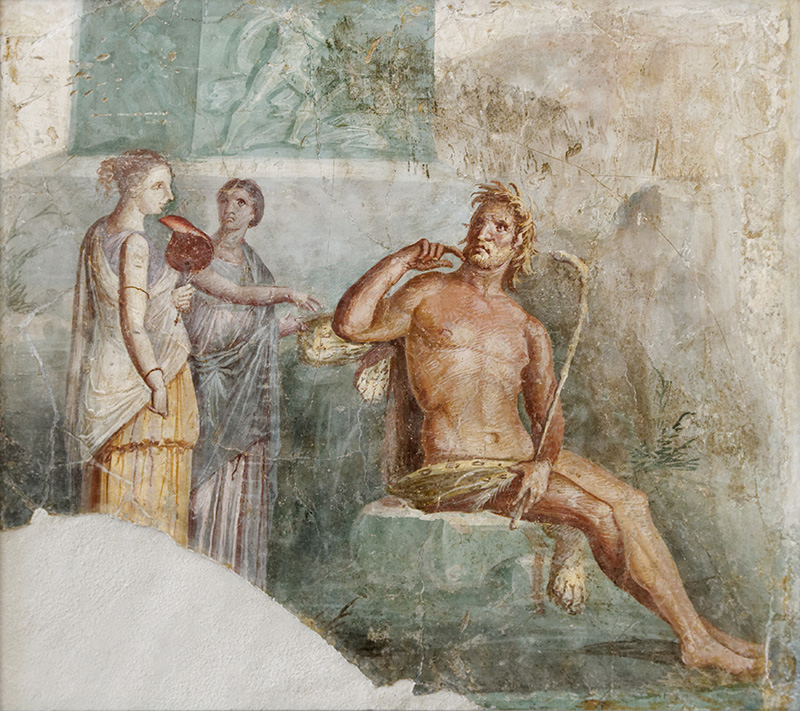
The Cyclops Polyphemus sits on a rocky shore, gazing at the sea nymph Galatea as she rides the waves on a dolphin. It’s a scene from Ovid’s Metamorphoses, one of the most popular literary sources for Roman artists.
The composition blends figure painting with landscape in a way that feels surprisingly natural. Polyphemus is massive but vulnerable, lovesick rather than monstrous.
Painting Style and Technique
Second Style fresco with a strong sense of spatial depth. The landscape recedes convincingly into the background using aerial perspective, with colors becoming cooler and lighter in the distance.
The brushwork on the sea is loose and impressionistic. If you squint, it could almost pass for a 19th-century seascape.
Symbolism and Cultural Meaning
Mythological scenes like this served as conversation starters at Roman dinner parties. A well-educated guest would recognize the Ovidian source and engage in discussion about it.
The landscape element also reflects a growing Roman taste for nature painting, something Pliny the Elder credited to an artist named Studius.
Current Preservation
At the Met in New York, well-preserved with atmospheric effects still readable despite some fading.
Why It Matters
One of the earliest examples of landscape painting being treated as a serious artistic subject. Roman artists were blending mythology with naturalistic scenery centuries before European painters would revisit the idea during the Romanticism period.
The Fayum Mummy Portraits
Origin and Date
Created between the 1st and 3rd centuries AD in Roman Egypt. The name comes from the Faiyum Basin, the region where most were found, though examples exist from across Egypt.
These aren’t a single painting. They’re a collection of roughly 900 surviving portraits, and they represent the only large body of panel painting to survive from the entire Greco-Roman world.
Location and Discovery
British archaeologist W.M. Flinders Petrie discovered a major cache at Hawara in 1887-1889. More were found at other Faiyum sites and at Antinoopolis.
Today, Fayum portraits are scattered across museums worldwide, including the British Museum, the Metropolitan Museum of Art, the Louvre, the Getty Villa, and the Egyptian Museum in Cairo.
Subject and Scene
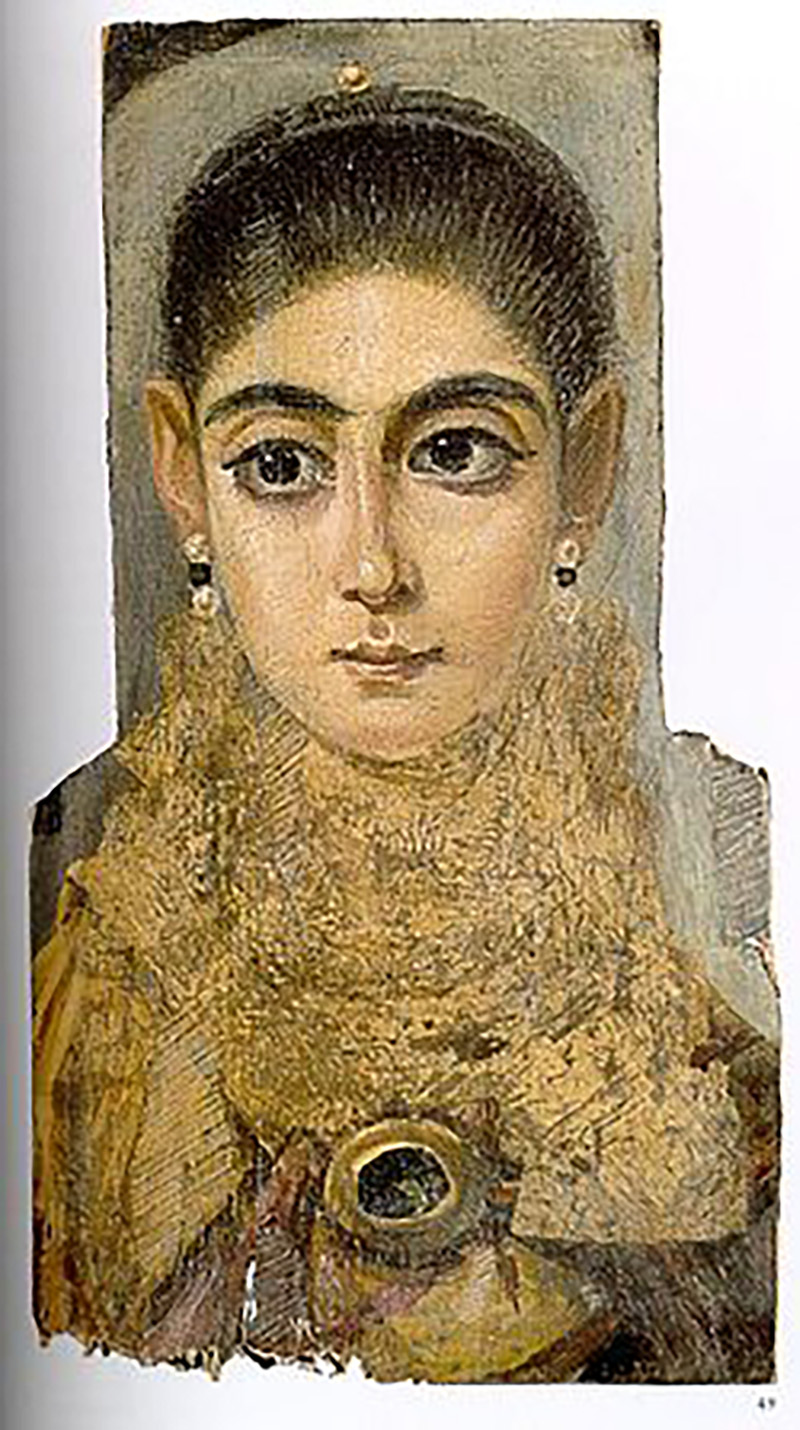
Naturalistic portraits of real individuals, painted to be placed over the face of their mummified body. Most show the subject from the chest up, in three-quarter view, looking directly at the viewer.
The subjects are mostly young. CT scans confirm the age and sex of the portraits match the mummies. Many show elaborate hairstyles, jewelry, and clothing that follow current Roman imperial fashion, which actually helps scholars date them precisely.
Children, teenagers, middle-aged adults. Each face is distinct. These aren’t idealized types. They’re specific people.
Painting Style and Technique
Two main painting mediums were used:
- Encaustic: Pigments mixed with heated beeswax and resin, applied quickly before cooling. Produces rich, translucent colors.
- Tempera: Pigments bound with animal glue or egg. More affordable but less luminous.
Painted on thin wooden panels (oak, lime, cedar, cypress, fig) cut to roughly 17 by 9 inches. Some were painted directly on linen shrouds.
The encaustic portraits especially show remarkable understanding of light and shade. Artists used visible brushstrokes and layered wax to create convincing three-dimensionality. Highlights in the eyes give each subject a startling sense of life.
Symbolism and Cultural Meaning
These portraits represent a fusion of three cultures:
- Egyptian mummification practices and afterlife beliefs
- Greek portrait painting traditions and three-quarter view conventions
- Roman fashion, citizenship symbols, and funerary customs
The subjects were mostly Greco-Egyptian elites who enjoyed privileged status under Roman rule. They dressed in Roman style but were buried in Egyptian fashion. The portraits bridge both worlds.
Gold leaf embellishment appears on many portraits, sometimes on wreaths, jewelry, or clothing. Wealth mattered, even in death.
Current Preservation
Remarkably well-preserved thanks to Egypt’s arid climate, which prevented the organic materials (wood, wax, pigments) from decaying. Many retain vivid colors and sharp details after nearly 2,000 years.
The Getty Museum’s APPEAR Project (Ancient Panel Paintings: Examination, Analysis, Research) coordinates ongoing international study of these portraits across more than 40 collections.
Why It Matters
The Fayum portraits are the closest thing we have to seeing real people from the ancient world face-to-face. They’re also the only significant surviving examples of Greco-Roman panel painting, the art form that ancient writers like Pliny considered the highest form of visual art.
Their influence stretches far. The frontal gaze and concentrated facial features directly anticipate Byzantine icon painting and, further down the line, the entire tradition of Western portraiture from Rembrandt to modern paintings of people.
FAQ on Famous Roman Paintings
What are the most famous Roman paintings?
The Dionysiac Frieze at the Villa of the Mysteries, the Alexander Mosaic, and the Painted Garden of Livia are among the most recognized. Most surviving examples are Pompeii wall paintings preserved under volcanic ash from Mount Vesuvius in 79 AD.
Why did so few ancient Roman paintings survive?
Roman paintings were mostly frescoes on plaster walls or panels on perishable wood. Exposure to weather, fire, and demolition destroyed nearly all of them. Only sites buried by volcanic eruptions or sealed in Egyptian desert tombs preserved significant examples.
What techniques did Roman painters use?
Fresco was the primary method, applying pigment to wet plaster. Romans also used encaustic (heated beeswax mixed with pigments) and tempera. Natural minerals like cinnabar produced the iconic Pompeii Red seen across Campania’s ancient villas.
What are the four styles of Roman wall painting?
Scholars classify them as Incrustation (simulating marble), Architectural (creating depth illusions), Ornamental (decorative panels on flat backgrounds), and Intricate (complex, busy compositions). All four developed before the eruption of Mount Vesuvius in 79 AD.
Where can I see famous Roman paintings today?
The National Archaeological Museum of Naples holds the largest collection. You can also see originals at the Vatican Museums, the Metropolitan Museum of Art in New York, the British Museum, and on-site at Pompeii and Herculaneum.
What subjects did Roman painters depict?
Mythological scenes were the most popular, followed by portraits, landscapes, still life compositions, and daily life. Roman artists also painted garden scenes, erotic imagery, and religious paintings connected to household shrines and mystery cults.
How did Greek art influence Roman painting?
Roman artists heavily copied and adapted Hellenistic Greek originals. Many Pompeii frescoes are believed to reproduce lost Greek panel paintings. The Romans imported Greek artworks, hired Greek painters, and used Greek mythological subjects throughout their homes.
What are the Fayum mummy portraits?
Naturalistic panel portraits from Roman Egypt, painted between the 1st and 3rd centuries AD. They were attached to mummified bodies and represent the only large surviving collection of Greco-Roman panel painting. Around 900 examples exist worldwide.
Did Romans consider painting a high art form?
Yes. Pliny the Elder wrote extensively about famous painters and their techniques. Romans valued Greek painting above almost all other art forms. Wealthy citizens paid large sums for original Greek works and high-quality Roman fresco commissions for their villas.
How did Roman paintings influence later art?
The rediscovery of Pompeii and Herculaneum in the 18th century directly sparked the Neoclassical movement. Roman fresco techniques, compositional approaches, and mythological subjects influenced Renaissance masters and continued shaping European painting for centuries.
Conclusion
These famous Roman paintings are more than archaeological curiosities. They’re direct visual evidence of how an entire civilization thought about beauty, status, religion, and death.
From the Dionysiac mysteries at Pompeii to the encaustic portraits of Roman Egypt, each work carries layers of cultural meaning that still inform how we understand ancient Mediterranean art.
The fresco techniques, the mythological narratives, the domestic wall decorations. All of it fed into later movements, from Neoclassicism through the Renaissance and beyond.
What makes these paintings worth studying isn’t just their age. It’s the skill. Roman artists understood light, depth, and human emotion in ways that wouldn’t be matched for over a thousand years.
If any of these caught your attention, visit the Naples Archaeological Museum or Palazzo Massimo in Rome. Seeing them in person changes everything.