
A Taiwanese-American artist dissolves the boundary between comic book covers and museum walls, transforming ballpoint pen sketches into six-figure paintings that hang alongside Renaissance masters.
James Jean built a reputation winning seven Eisner Awards before age thirty, then walked away from commercial illustration at his peak. That 2008 pivot proved prescient.
His large-scale acrylic paintings now command $96,875 at auction, fusing ukiyo-e waves with Baroque intensity and pop surrealism‘s accessibility. Directors like Guillermo del Toro and Darren Aronofsky commission his poster art. Prada tapped him for four seasons of collaborations.
This profile examines Jean’s technical evolution, his intricate line work signature, and how an immigrant perspective shaped a visual language that speaks simultaneously to fashion runways, comic conventions, and contemporary art collectors across three continents.
Identity Snapshot
James Jean (born 1979)
Primary roles: Painter, illustrator, visual artist, printmaker
Nationality: Taiwanese-American
Active movements: Contemporary pop surrealism, Superflat
Mediums: Acrylic painting, oil painting, watercolor, ink, digital, mixed media
Signature traits: Intricate line work, curvilinear forms, liquid-like layered composition, gestural marks, dream-like figuration
Iconography: Chrysanthemums, tigers, ocean waves, feminine figures, botanical elements, mythological creatures
Geographic anchors: Born in Taipei, Taiwan; raised in New Jersey; based in Los Angeles since 2003
Mentors/influences: School of Visual Arts (2001); Hieronymus Bosch; Hokusai; Yoshitoshi; Baroque traditions; Japanese ukiyo-e
Collections & museums: Lotte Museum of Art (Seoul), Vancouver Art Gallery, Kaikai Kiki Gallery (Tokyo), Jonathan LeVine Gallery, Modern Art Museum Shanghai
Market signals: Record auction $96,875 (Seamstress, 2023); paintings average $30,000; prints $3,500
What Sets The Artist Apart

Jean dissolves boundaries between commercial illustration and fine art through technical precision borrowed from comics, married to painterly softness drawn from Renaissance and Asian scroll traditions.
His work operates in perpetual flux. Figures melt into organic patterns, edges blur between waking and dream states, and cultural symbols from East and West collide without hierarchy.
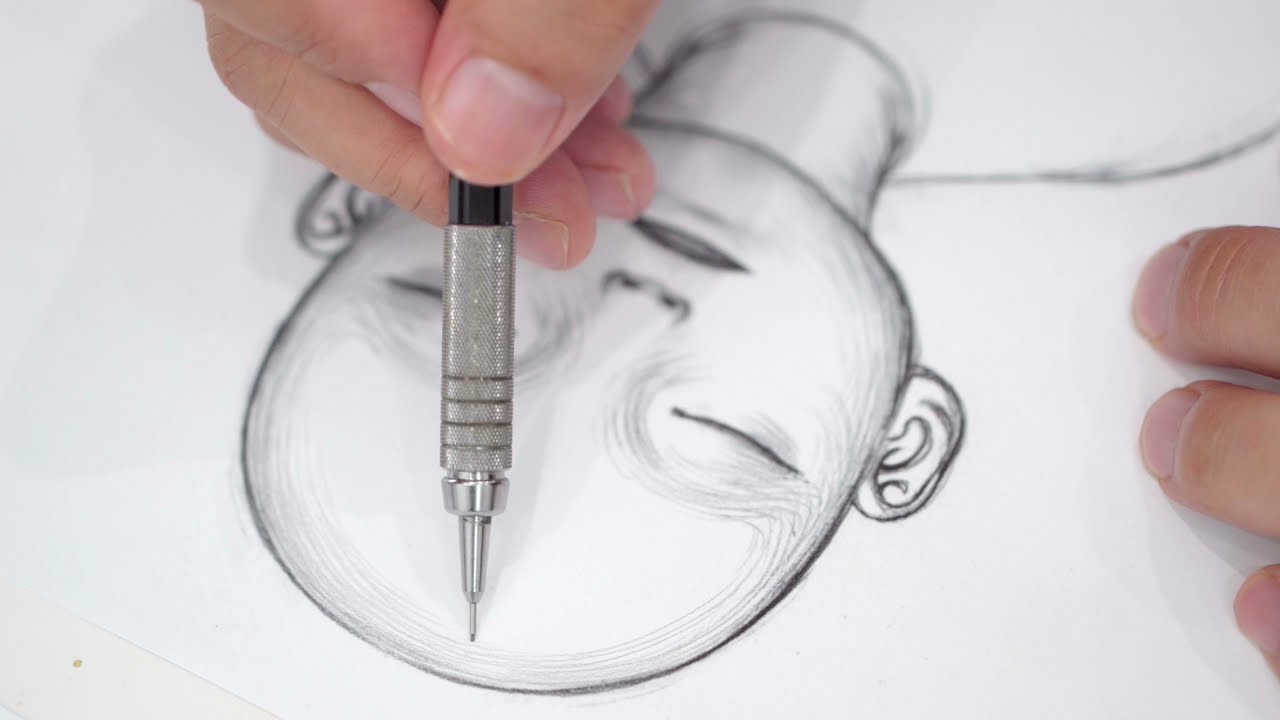
The intricate ballpoint pen drawings that emerged around 2010 became his trademark. Those dense, neurotic lines now anchor paintings where acrylic washes bleed and pool unpredictably, creating aged patinas impossible to reproduce intentionally.
Where Takashi Murakami flattens pop art into candy-coated surfaces, Jean builds atmospheric depth through layered translucency.
Origins & Formation
Early Training
Born in Taipei (1979), emigrated to New Jersey at age three.
Initial focus: piano and trumpet performance through adolescence.
Discovered comics at thirteen. X-Men and Wolverine opened visual narrative possibilities.
School of Visual Arts (1997-2001)
Enrolled for cartooning major but foundation year pushed him toward painting, photography, sculpture.
Switched to illustration program (more competitive, broader art-historical exposure).
Absorbed Dave Cooper, Chris Ware, Dan Clowes, Adrian Tomine alongside traditional painting techniques.
First Professional Break
1 DC Comics cover commission arrived before graduation (2001).
Mark Chiarello saw portfolio, connected Jean with Shelly Bond and Bill Willingham for Fables series.
Immediate recognition: won Eisner Award for Best Cover Artist four consecutive years (2004-2007).
Movement & Context
Jean exists at the intersection of Superflat and contemporary narrative painting, though he refuses easy categorization.
Positioning Within Superflat
Included in “Juxtapoz x Superflat” (Vancouver Art Gallery, 2016), curated by Murakami and Evan Pricco.
But where Superflat artists embrace graphic flatness, Jean builds pictorial space through atmospheric perspective and layered washes.
His painting “Bouquet” served as marquee image for that exhibition, signaling his role as bridge figure between pop illustration and museum-worthy painting.
Comparative Attributes
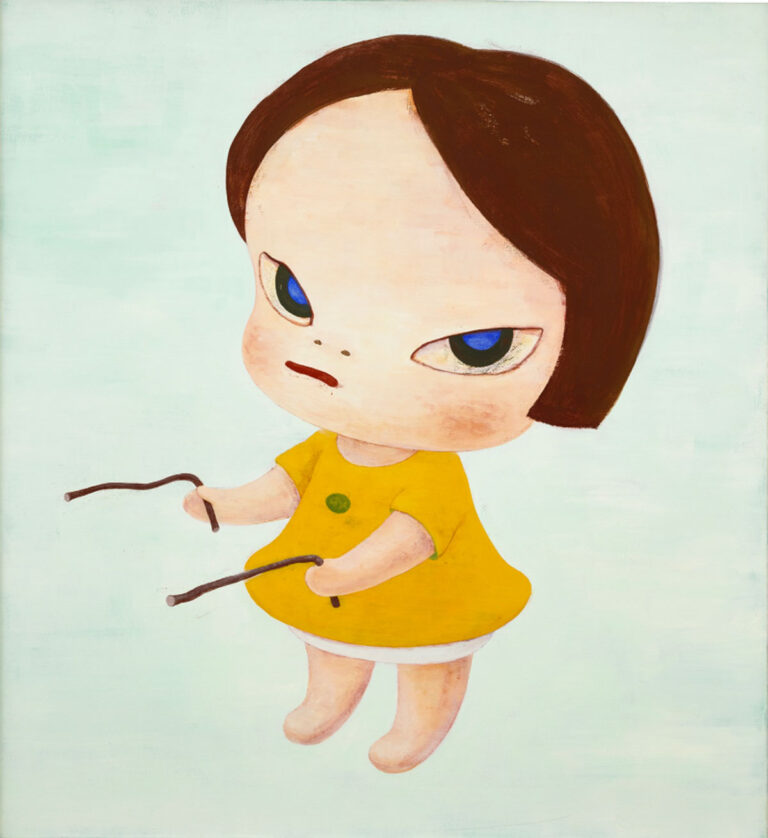
vs. Yoshitomo Nara:
- Nara: hard-edge cartoon simplicity, aggressive innocence
- Jean: soft-edge complexity, intricate detail, multi-layered narratives
vs. Audrey Kawasaki:
- Kawasaki: wood grain integrated, muted earth tones, single figures
- Jean: canvas or panel, vibrant complementary colors, cosmological compositions
vs. KAWS:
- KAWS: clean vector aesthetics, sculptural mass production
- Jean: painterly randomness, each piece unique, embraces medium’s accidents
Jean’s edge control sits between photorealism‘s razor precision and expressionism‘s emotional blur.
Materials, Techniques, and Process
Supports & Grounds
Primary surfaces: stretched cotton canvas, linen canvas, dimensional wood panels
Wood panels for smaller works (16 x 20 inches typical).
Large-scale paintings on canvas (up to 150 x 98 inches for major pieces like “Bear,” 2023).
Uses gesso primer, though sometimes works on raw wood for textural variation.
Paint Application
Dominant medium: acrylic paint as base layer
Applied thinly in washes, building up translucent layers.
Oil glazes applied over dried acrylic for depth and luminosity.
Occasionally pure oil on canvas for works requiring extended blending time.
Ink used for precise line work and detailed passages.
Brushwork Taxonomy
Wet-into-wet technique for soft gradations (especially skin tones).
Dry brush for textural marks in botanical elements.
Gestural sweeps create liquid, flowing forms.
Fine sable brushes for intricate line details.
Occasionally palette knife for thick accents, though rarely impasto.
Palette & Color Strategy
Temperature bias: warm golds, oranges against cool cerulean blues
Creates vibrating color contrast “to create sparks in the eye” (artist statement).
Frequent use of complementary color schemes (blue/orange, red/green).
Limited palette periods: “Zugzwang” series restricted to blue and red dominance.
Signature hues: Naples yellow, cadmium orange, ultramarine, cerulean, titanium white with pearlescent additives
Underdrawing & Planning
Small graphite sketches establish composition before painting.
Ballpoint pen studies (circa 2010 onward) became signature preparatory method.
Sketches figure out structure, but final paintings “always trying to recapture initial energy” with spontaneous additions.
No rigid transfer methods. Keeps loose relationship between sketch and final work.
Studio Practice Evolution
2001-2008: Digital-heavy workflow for comic covers (Photoshop color over line drawings)
2008-present: Shift to traditional painting mediums
Paintings can take months to years (“Bear” required one full year, 2023).
Works across multiple pieces simultaneously, allowing rest periods for problem-solving.
Digital Integration
No hard divide between traditional and digital.
Uses digital tools for texture overlays, color studies.
Some works are hybrid: traditional painting scanned, digital additions, then printed with hand-painted enhancements.
Collaborated with Adachi Institute (Tokyo) for traditional woodblock print reproductions of paintings.
Surface Treatments
Spray paint for backgrounds and atmospheric effects (seen in “Pagoda”).
Lacquer layers for glossy finish on dimensional wood panels.
Holographic and pearlescent enhancements on limited edition prints.
Stained glass work (Judson Studios collaboration) expands practice into light-based media.
Themes, Subjects, and Iconography
Recurring Motifs
Botanical explosion: chrysanthemums, cherry blossoms, parasol mushrooms, vines, foliage overwhelming figures
Feline predators: tigers (often neon-hued), cats in repose, animal-human hybrids
Ocean imagery: ukiyo-e-style waves, water as transitional space between consciousness states
Feminine figures: elongated bodies, androgynous faces, often in states of transformation or suspension
Mythological beings: Gaia (earth goddess), dragons, phoenixes, chimeric creatures
Compositional Schemes
All-over composition: no single focal point, eye travels constantly across surface (influence of Tang dynasty landscapes)
Vertical emphasis: figures ascending/descending, suggesting spiritual journey
Triangular stability: classical Renaissance structure beneath surrealist imagery
Radial expansion: elements spiral outward from central axis (seen in “Bouquet” series)
Symbol Systems & Meanings
Tigers: power, Asian cultural heritage, danger domesticated
Chrysanthemums: mortality, beauty’s impermanence, East Asian philosophical traditions
Water/waves: unconscious mind, transformation, cultural crossing
Geometric patterns: order imposed on organic chaos, digital age intersecting with nature
Nested figures: psychological layers, multiple consciousness states
Socio-Historical Triggers
Immigrant experience: East-West cultural collision as primary subject
Comic book culture: superhero mythology as modern pantheon
Environmental anxiety: nature overwhelming human-made structures
Digital age dislocation: figures adrift in information overload
Parenthood influence: “Azimuth” exhibition (2018) driven by “optimism and innocence” after son’s birth
Notable Works
“Bouquet” (2016)
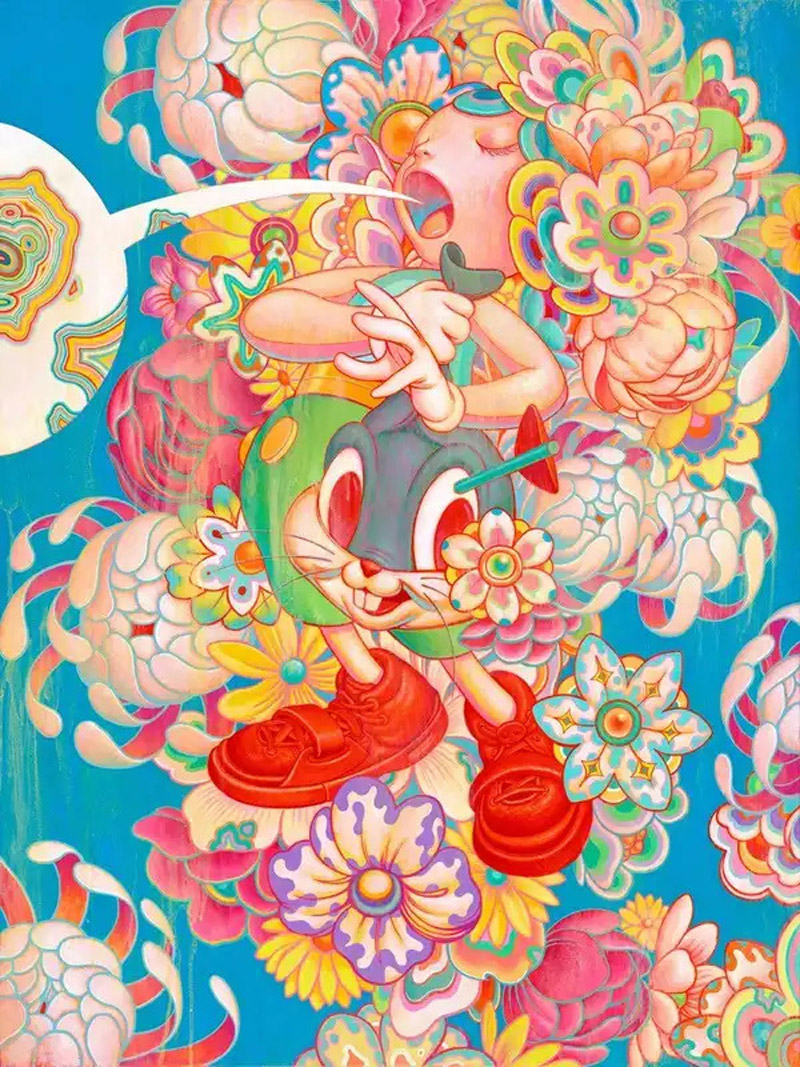
Medium: Acrylic on canvas
Current location: Private collection; served as marquee image for “Juxtapoz x Superflat” exhibition
Visual signature: Dense floral arrangement consuming feminine figure; soft-edge rendering with hard-line accents; warm gold tones against cool greens
Why it matters: Positioned Jean within Murakami’s Superflat movement while demonstrating his departure from flat graphic style
Related works: “Bouquet II” (2022, 182.88 x 228.6 cm), continued exploration with larger scale
“Gaia – Yellow Earth Center” (2019)
Medium: Illuminated stained glass sculpture, water jet cutting, hand and airbrush painting, fused glass
Dimensions: Over 8 feet height
Current location: Created for “Eternal Journey” retrospective at Lotte Museum of Art (Seoul)
Visual signature: Earth goddess Gaia with slinking tiger; all-over composition mixing natural and geometric elements; light emanates from within
Why it matters: First major sculptural expansion of painting vocabulary; collaboration with Judson Studios (oldest U.S. stained-glass maker)
Related works: “Azimuth” series stained glass explorations (2018)
“Bear” (2023)
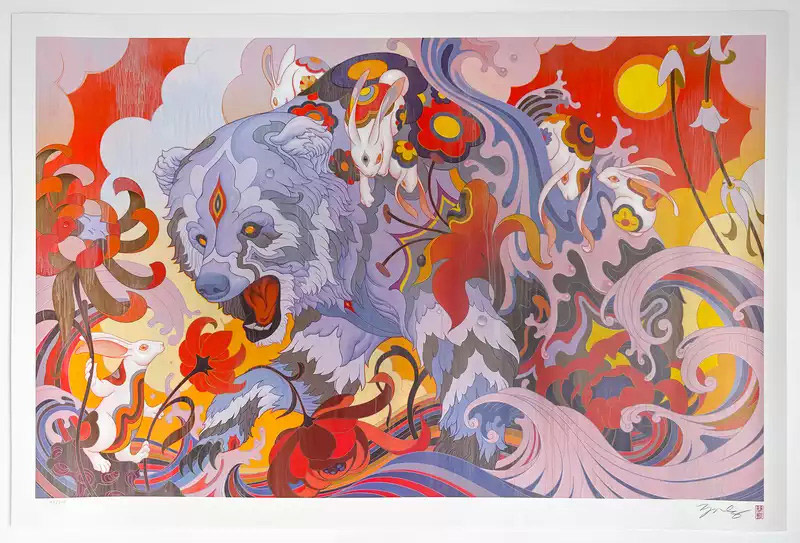
Medium: Acrylic on two canvases
Dimensions: 150 x 98 inches
Production time: One full year
Visual signature: Monumental scale; bear figure surrounded by botanical excess; wet-into-wet blending creates aged patina
Why it matters: Demonstrates commitment to time-intensive traditional process; scale rivals old master altarpieces
Film Poster Trilogy (2017)
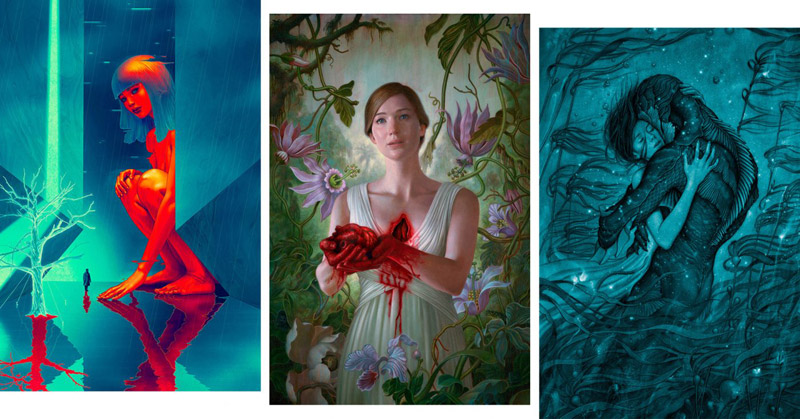
“mother!” (Darren Aronofsky): Hand-painted character portraits (Jennifer Lawrence, Javier Bardem)
“The Shape of Water” (Guillermo del Toro): Charcoal drawing emphasizing del Toro’s “delicate nature and beautiful line work”
“Blade Runner 2049” (Denis Villeneuve): Digital drawing tools
Why it matters: Different medium for each film shows technical range; elevated movie poster to fine art status; close collaboration with auteur directors
Market note: Limited edition prints (e.g., Shape of Water edition of 1,719) regularly appear at auction
“Zugzwang” Series (2018)

Medium: Etching (printmaking) combined with painting
Exhibition: Hidari Zingaro Gallery (Tokyo)
Visual signature: Restricted color palette (blue and red dominance); “cerulean atmosphere” unifies series; illustrative cyanotype aesthetic
Why it matters: Printmaking skills applied to painting; unified palette creates cohesive narrative across multiple works
Fables Comic Covers (2003-2008)
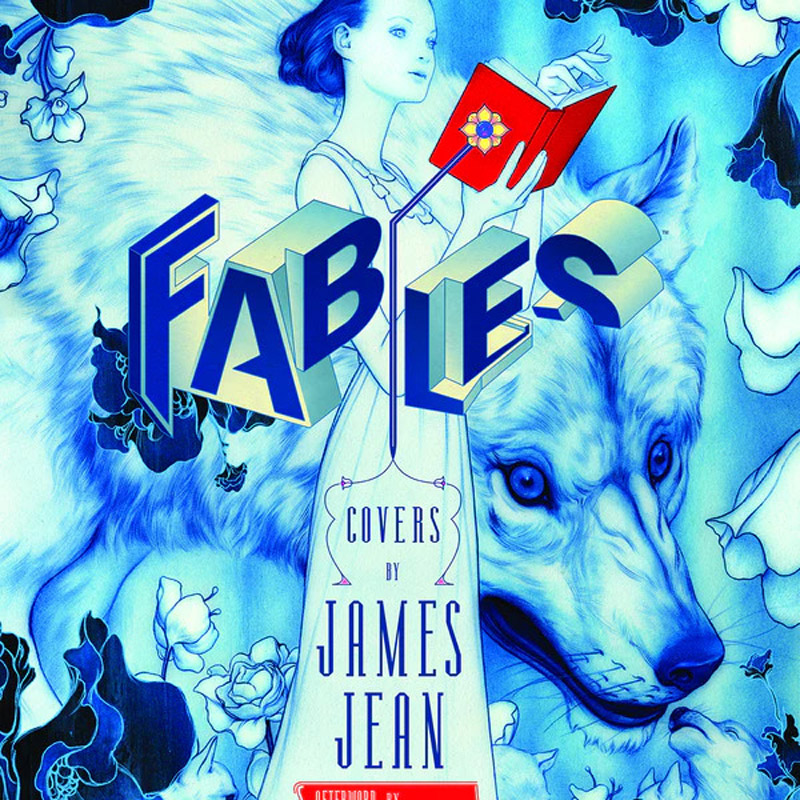
Medium: Digital illustration (Photoshop over line drawing)
Recognition: Six Eisner Awards for Best Cover Artist
Visual signature: Narrative complexity compressed into single image; tight rendering; fantasy elements grounded in emotional realism
Why it matters: Established reputation; provided financial stability to transition into fine art; influenced generation of illustrators
Market note: Original cover art sells $7,200-$33,600 range
Exhibitions, Collections, and Provenance Highlights
Major Solo Exhibitions
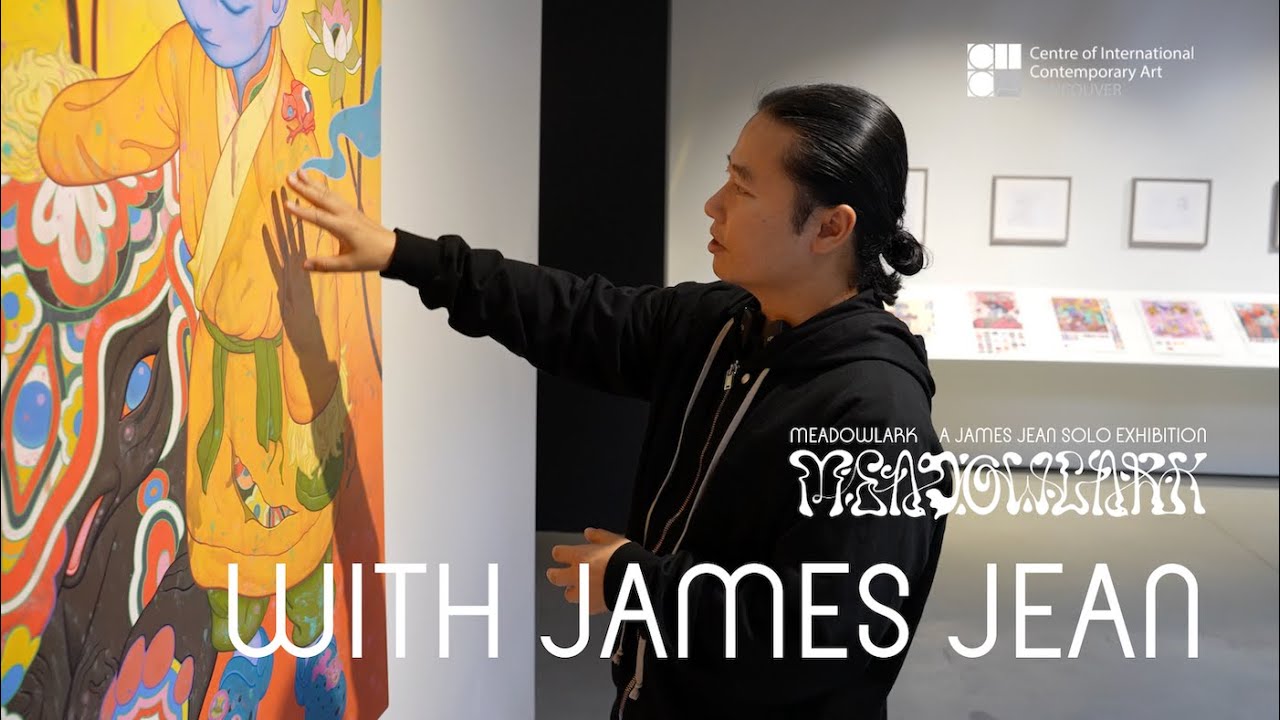
“Kindling” (2009) – Jonathan LeVine Gallery, Chelsea, New York First solo fine art exhibition; paintings sold rapidly.
“Rebus” (2011) – Jonathan LeVine Gallery Consolidated reputation beyond comics world.
“Azimuth” (2018) – Kaikai Kiki Gallery, Tokyo Introduced illuminated stained glass works; collaboration with Judson Studios; centered on color and light radiance.
“Eternal Journey” (2019) – Lotte Museum of Art, Seoul Largest retrospective to date; featured “Gaia – Yellow Earth Center” centerpiece; 200+ works spanning 20-year career; accompanied by scholarly catalogue.
“Eternal Spiral” (2022-2023) – Modern Art Museum Shanghai, Today Art Museum Updated retrospective; 290-page catalogue; large-scale paintings, sculptures, animations, prints, rare sketchbooks; five interactive digital animations.
Group Exhibitions
“Juxtapoz x Superflat” (2016) – Vancouver Art Gallery Curated by Takashi Murakami and Evan Pricco. “Bouquet” as marquee image.
“Seven Phases” (2021) – HYBE INSIGHT, Seoul Collaboration with BTS (South Korean pop group).
Gallery Representation
Kaikai Kiki Gallery (Tokyo) – Murakami’s gallery, solidifies Superflat connection
WOAW Gallery (Hong Kong) – Contemporary market presence
Jonathan LeVine Gallery (New York, now closed) – Early fine art champion
Museums with Depth
Lotte Museum of Art (Seoul) – Major retrospective, permanent collection
Modern Art Museum Shanghai – Solo exhibition, ongoing relationship
Vancouver Art Gallery – Group show participation
Today Art Museum (Beijing) – Featured exhibitions
Provenance Patterns
Early career (2001-2008): Comic art sold through specialty dealers, direct from DC Comics
Transition period (2008-2015): Jonathan LeVine Gallery primary market
Current (2015-present): Kaikai Kiki Gallery for Asian market; WOAW Gallery for international collectors; direct sales through artist website for prints
Notable collectors: Shawn and Andrew Hosner (Thinkspace Projects, Los Angeles) – major holdings
Catalogues Raisonnés & Publications
“Process Recess” (art book)
“Kindling” (2009 exhibition catalogue)
“Rebus” (2011 exhibition catalogue)
“Adrift” (art book)
“Eternal Journey” (2020) – 176 pages, Korean language original, English redesign
“Eternal Spiral” (2023) – 290 pages, expanded edition with lenticular animation, signed bookplates; limited to 2,000 copies at $80
Market & Reception
Auction Records & Price Bands
Record price: $96,875 for “Seamstress” (Heritage Auctions, Dallas, 2023)
Painting average (past 12 months): $30,019
Works on paper average: $3,501
Price range observed: $50 (small prints) to $96,875 (major paintings)
Medium-Specific Pricing
Original paintings: $10,000-$96,000+ depending on scale, period, subject
Original comic cover art: $7,200-$33,600 (Fables covers most valuable)
Limited edition prints: $450-$6,500
- Film posters (Shape of Water, Everything Everywhere All At Once): $1,000-$3,000
- Embellished prints with holographic details: $3,000-$6,500
Sculptures (bronze editions): $3,000-$6,000
- “Slingshot (Aurum)” edition of 50: approx. $5,000
- “Descendent” polystone editions: $3,000-$4,000
Period Value Hierarchy
Most valuable: 2008-2015 transitional paintings (comic aesthetic meeting fine art ambitions)
Strong market: 2017 film posters (cultural cachet from Oscar-winning films)
Accessible entry: 2020s giclee prints with enhancements (edition sizes 300-1,700)
Authentication & Signatures
Jean signs prints in pencil lower margin.
Original paintings typically signed on verso or discreetly integrated into image.
Limited editions include embossed chops (dimensional seals).
Certificates of authenticity for sculptures and major prints.
Forgery risk: Moderate for prints (digital reproductions); low for paintings (technique difficult to replicate)
Market Trajectory
Steady upward climb since 2008 fine art transition.
Film poster collaborations (2017) expanded collector base beyond art world.
Asian market (particularly South Korea, China) shows strongest demand.
Print market remains accessible ($450-$3,000), creating broad collector base supporting painting prices.
Condition Concerns
Acrylic on canvas: Generally stable; watch for UV fading in works with fugitive pigments
Mixed media works: Ink and acrylic combination stable if properly fixed
Stained glass works: Fragile; require specialized handling and insurance
Digital prints: Archival pigment inks on cotton rag paper show good longevity (rated 100+ years)
Influence & Legacy
Upstream Influences
Hieronymus Bosch: Dense, all-over compositions; fantastical creatures; moral narratives
Hokusai & Yoshitoshi: Japanese woodblock print traditions; wave patterns; dramatic staging
Baroque painting: Chiaroscuro, dramatic lighting, spiritual intensity
Renaissance portraiture: Idealized feminine beauty, sfumato softness
Tang dynasty landscapes: Vertical compositions, atmospheric recession, philosophical themes
Dave Cooper, Chris Ware, Dan Clowes: Contemporary graphic novel narrative compression
Downstream Impact
Illustration community: Elevated comic cover art to collectible fine art status
Pop surrealism movement: Demonstrated commercial-to-gallery transition possible without compromising technical excellence
Digital-traditional hybrid artists: Showed seamless integration of media without hierarchy
Asian-American artists: Created visibility for bicultural visual vocabulary in Western art market
Fashion illustration: Prada collaborations (2007-2018) influenced luxury brand partnerships with fine artists
Cross-Domain Echoes
Film: Poster art for auteur directors legitimized artist-director collaborations; influenced A24’s artist poster program
Music: Album art for My Chemical Romance (“The Black Parade,” 2006), Linkin Park expanded visual music culture
Fashion: Four-season Prada collaboration (2007-2018); 60-meter mural at Prada Epicenter New York; animated shorts “Trembled Blossoms”; influenced luxury brand artist residencies
Publishing: Time Magazine, New York Times, Rolling Stone editorial illustration raised commercial work standards
Animation: Digital installations at Lotte Museum showed static paintings could transform into moving image without losing integrity
Stained glass: Judson Studios collaboration revived interest in traditional medium among contemporary artists
Teaching & Mentorship
Limited formal teaching but influential through process documentation.
Sketchbooks published widely, showing developmental thinking.
Process videos on social media educate younger artists.
Critical Reception Evolution
2001-2008: Praised as comic cover innovator; seven Eisner Awards, three Harvey Awards
2008-2015: Skepticism about commercial-to-fine-art transition; gradual critical acceptance
2015-present: Museum exhibitions legitimized; scholarly catalogues position within art historical lineage
Guillermo del Toro’s endorsement (“delicate nature and beautiful line work… realistic and elevated into style of his own”) bridged popular and critical audiences.
How to Recognize a James Jean at a Glance

Intricate line work: Dense, neurotic pen lines (especially post-2010); ballpoint pen aesthetic even in paintings
Liquid forms: Curvilinear shapes flowing like melting wax; figures dissolving into botanical surroundings
Soft-hard edge contrast: Areas of atmospheric blur adjacent to razor-sharp line details
Botanical excess: Chrysanthemums, vines, mushrooms, flowers overwhelming composition
Ukiyo-e waves: Unmistakable Hokusai-inspired ocean patterns; coiling water around figures
Warm-cool vibration: Gold and orange against cerulean blue; complementary colors creating optical buzz
Feminine elongation: Idealized female figures with stretched proportions; androgynous faces
All-over composition: No empty space; eye travels continuously without resting
Aged patina: Acrylic washes bled and pooled to create accidental antiqued surfaces
Signature placement: Discreet integration into image or verso; pencil signature on prints lower margin
Canvas sizes: Small works 16 x 20 inches on wood panel; large paintings 60 x 80 inches up to 150 x 98 inches
Tiger motif: Neon-colored felines; often paired with mythological female figures
Transitional spaces: Figures suspended between states (waking/sleeping, human/animal, Eastern/Western)
Sketchbook genesis: Finished works retain doodle-like energy from preparatory drawings
FAQ on James Jean
What is James Jean known for?
James Jean earned recognition as a cover artist for DC Comics’ Fables series, winning six Eisner Awards. After 2008, he transitioned to fine art, creating large-scale acrylic paintings that blend surrealism, Asian aesthetics, and contemporary narrative techniques.
What art style does James Jean use?
Jean fuses pop surrealism with Baroque painting traditions and Japanese ukiyo-e influences. His signature style features intricate line work, liquid curvilinear forms, botanical excess, and dream-like compositions that dissolve boundaries between Eastern and Western visual languages.
How much are James Jean paintings worth?
Original paintings sell between $10,000 and $96,875, with his auction record set by “Seamstress” at Heritage Auctions in 2023. Limited edition prints range from $450 to $6,500, while original comic cover art commands $7,200 to $33,600.
What medium does James Jean work in?
Jean primarily uses acrylic paint with oil glazes layered over dried acrylic. He incorporates ink for detailed line work, digital tools for textures, and has experimented with stained glass, printmaking, and bronze sculpture in collaborations.
Where can I see James Jean’s work?
Major exhibitions occurred at Lotte Museum of Art (Seoul), Kaikai Kiki Gallery (Tokyo), and Modern Art Museum Shanghai. His work appears in permanent collections across Asia. Limited edition prints sell through his official website and select galleries like WOAW Gallery Hong Kong.
Did James Jean work on any famous movies?
Jean created poster art for three 2017 films: Darren Aronofsky’s “mother!”, Guillermo del Toro’s Oscar-winning “The Shape of Water,” and “Blade Runner 2049.” He later designed the poster for “Everything Everywhere All At Once,” earning a Bronze Lion at Cannes.
What are James Jean’s influences?
Hieronymus Bosch‘s fantastical compositions, Hokusai’s wave patterns, Renaissance portraiture, Tang dynasty landscapes, and comic artists like Chris Ware shaped his aesthetic. His Taiwanese-American background creates constant dialogue between Eastern scroll paintings and Western painting traditions.
How did James Jean start his art career?
Born in Taipei (1979), Jean emigrated to New Jersey at age three. He graduated from School of Visual Arts in 2001 and immediately began creating covers for DC Comics’ Fables series, winning his first Eisner Award in 2004 for Best Cover Artist.
What technique does James Jean use for his intricate lines?
Jean developed his signature detailed line work around 2010 using ballpoint pens in sketchbooks. He creates small graphite studies first, then builds paintings with thin acrylic washes over precise ink lines, allowing random bleeding to create aged patinas.
Has James Jean collaborated with fashion brands?
Jean partnered with Prada across four seasons (2007-2018), creating sketches, a 60-meter mural at Prada Epicenter New York, and animated shorts titled “Trembled Blossoms.” He also designed textiles and installation spaces, elevating luxury brand collaborations into comprehensive artistic projects.
Conclusion
James Jean proves that technical mastery and commercial success need not preclude museum legitimacy. His trajectory from comic book covers to six-figure contemporary art sales charts a path few illustrators navigate successfully.
The intricate line work that defines his painting style emerged from sketchbook doodles, transformed through watercolor washes and oil glazes into cosmological narratives. Takashi Murakami‘s gallery representation and Guillermo del Toro’s endorsements validate his cultural bridge-building.
Whether examining his Fables covers, Prada collaborations, or monumental paintings like “Bear,” the consistent thread remains: an immigrant’s visual vocabulary that refuses to choose between traditions. Jean’s work doesn’t reconcile Eastern and Western aesthetics.
It insists they were never separate.