Most watercolor painters don’t struggle because they lack talent. They struggle because nobody explained how mixing watercolors actually works at a physical level.
Pigment transparency, color temperature, water-to-paint ratios, palette setup – these are the real reasons a mix goes clean or turns muddy.
This guide covers everything that matters: color theory built for watercolor’s unique subtractive mixing behavior, how pigment properties affect every mix you make, palette and on-paper techniques, and specific recommendations for pigments and watercolor painting tools worth using.
By the end, you’ll know exactly why your colors behave the way they do – and how to control them.
What Watercolor Mixing Is

Watercolor mixing is the process of combining pigment-based paints suspended in a water-soluble binder to produce new colors, values, and effects. It is not just a creative decision. It is a physical and chemical process where pigment particles, binder behavior, water ratio, and paper surface all interact at once.
Unlike acrylic painting or oil painting, watercolor has no white pigment to fall back on. The paper is your light source. That single fact changes how mixing works entirely.
Most watercolor painting materials use gum arabic as the binder. It holds pigment particles to the paper surface and controls how much the paint flows when wet. The binder directly affects how two colors behave when they meet, whether they blend smoothly, granulate, or push against each other.
Mixing happens in two places: on the palette before the brush touches paper, and on the paper itself while the paint is still wet. Both produce different results. A controlled palette mix gives you predictability. An on-paper mix gives you texture, movement, and sometimes a happy accident.
The global watercolor paints market was valued at around $1.86 billion in 2024 and is projected to grow at a CAGR of roughly 5.9% through 2035 (Wise Guy Reports), reflecting a sharp rise in interest from both hobbyists and professionals across all skill levels.
How Watercolor Differs From Other Painting Mediums

Transparency is the defining property. Light passes through the paint layer, hits the paper, and reflects back through the pigment again. That two-way light travel is what gives watercolor its characteristic glow.
| Property | Watercolor | Acrylic | Oil |
|---|---|---|---|
| Binder | Gum Arabic: A water-soluble sap that allows for easy re-wetting and transparency. | Acrylic Polymer: A plastic emulsion that dries into a permanent, water-resistant film. | Linseed/Walnut Oil: A drying oil that hardens through oxidation over weeks or months. |
| White Source | The Paper: Light reflects off the white fibers through transparent layers of pigment. | Titanium White: An opaque physical pigment used to build highlights on top of colors. | Lead/Titanium: Heavy, opaque pastes used to create “impasto” (thick) light effects. |
| Mixing Base | Water Only: Purely aqueous; the water-to-pigment ratio dictates the value. | Water + Mediums: Can be thinned with water or thickened with gels to change texture. | Oil Mediums: Requires solvents (turpentine) or oils to adjust viscosity and “fat” content. |
| Correction | Lifting: Subtractive and limited; you must pull pigment out of the fibers. | Overpaint: Additive; simply wait 10 minutes and paint a new layer over the mistake. | Scrape/Overpaint: Can be scraped off while wet or covered once the “tacky” phase passes. |
You cannot simply paint over a mistake. This is what makes understanding mixing so critical before paint hits the paper.
Palette Mixing vs. On-Paper Mixing
Palette mixing gives you full control over the ratio of pigments before committing to the surface. You can test consistency, adjust water content, and match a specific color value with more accuracy.
On-paper mixing (dropping wet color into a wet wash) creates effects that palette mixing cannot reproduce: blooms, granulation patterns, soft edges, and the organic-looking color shifts that most people associate with watercolor painting.
Most finished paintings use both. Palette mixing for your base tones, on-paper mixing for texture and atmosphere.
Color Theory Fundamentals for Watercolor

Watercolor operates on subtractive color mixing. Pigments absorb certain wavelengths of light and reflect others back to the eye. When you mix two pigments, the combined material absorbs more wavelengths than either color alone, shifting the result toward a darker, more neutral tone.
This is why adding more colors to a mix usually makes it worse, not better. Each pigment you introduce subtracts more light from the result.
The Color Wheel in Watercolor Practice
Understanding the color wheel is practical, not just theoretical. It tells you which combinations will produce clean secondary colors and which will produce neutrals or grays.
- Primary colors (red, yellow, blue) cannot be mixed from other colors
- Secondary colors result from mixing two primaries
- Tertiary colors come from combining a primary with an adjacent secondary
- Complementary colors sit opposite each other and neutralize when mixed
Mixing complementary colors together is how you produce grays, browns, and natural-looking darks without reaching for black from the tube.
Color Temperature and Mixing Results
Color temperature is one of the most misunderstood factors in mixing. Every blue is not the same blue. French Ultramarine leans warm (toward red). Phthalo Blue leans cool (toward green). Mix the wrong blue with a red and your purple turns muddy instead of vibrant.
The fix is simple once you understand it. To mix a clean, vibrant purple, use a cool red (like Quinacridone Rose) with a warm blue (like French Ultramarine). Both colors bias toward each other on the color wheel. No third color sneaks into the mix.
This same logic applies across the wheel. Clean secondaries come from pairing colors that share a bias toward each other. Muted, neutral secondaries come from crossing that bias line. Daniel Smith’s split primary palette method is built entirely on this principle, and it works.
Why a Limited Palette Mixes Cleaner
Fewer pigments, cleaner results. It sounds obvious, but most beginners buy more colors than they need and end up with more mud.
A core limited palette typically includes one warm and one cool version of each primary. Six colors total. From those six, you can mix most colors in the visible spectrum without the mixes going gray or flat.
Berlin Drawing Room instructor Juan-Carlos Rosa-Casasola recommends limiting to just 3 to 6 colors when learning. This forces you to understand how each pigment behaves rather than reaching for a pre-mixed convenience color every time.
Pigment Properties That Affect Mixing
Two colors can look perfect together on the color wheel and still produce a disappointing mix on paper. Why? Because the physical properties of each pigment determine how they interact, not just their hue.
This is the part most tutorials skip. Knowing your pigment codes and properties before you mix saves a lot of frustration.
Reading Pigment Codes on Paint Labels
Every professional watercolor lists a pigment code on its label. PB = Pigment Blue, PR = Pigment Red, PY = Pigment Yellow, PV = Pigment Violet, PBr = Pigment Brown, PBk = Pigment Black.
The number after the letter tells you the exact pigment used. PB29 is French Ultramarine. PB15 is Phthalo Blue. Same “blue,” completely different mixing behavior.
Single-pigment paints (one code on the label) produce more predictable, cleaner mixes. Multi-pigment paints (two or more codes) already contain internal mixing, which limits how far you can push them before results turn muddy. Research from Parkablogs found that while single vs. multi-pigment is less critical than color wheel position, single-pigment paints still give beginners better mixing control and more consistent results.
Transparency, Opacity, and How They Change the Mix
Transparent pigments let light pass through fully, making them ideal for glazing and layering. They mix cleanly with each other and with semi-transparent pigments.
Opaque pigments block light and sit on the paper surface. Mixed together, two opaque pigments often produce a dull, chalky result because neither allows light reflection from the paper below.
The rule watercolor artist Louise de Masi follows: if you need to mix with an opaque pigment, always pair it with a transparent one. The transparent pigment keeps the mix from going heavy and lifeless.
Pigment transparency is also affected by dilution. A thick application of Cadmium Yellow behaves opaquely. A very thin wash of it reads as semi-transparent. However, as noted by watercolor.lk, the inherent transparency of a pigment is fixed. Dilution changes appearance, not the pigment’s core behavior.
Staining vs. Non-Staining Pigments
Staining pigments absorb deep into paper fibers and are nearly impossible to lift once dry. They dominate mixes and can overpower more delicate pigments quickly.
| Type | Examples | Mixing Behavior | Best Used For |
|---|---|---|---|
| Staining | Phthalo Blue, Quinacridone Red, Prussian Blue | Aggressive: Particles are so small they dye the paper fibers instantly. They are nearly impossible to lift once dry. | Deep glazing, high-contrast silhouettes, and bold, vibrant washes that won’t “muddy” when overpainted. |
| Non-Staining | French Ultramarine, Burnt Sienna, Aureolin | Gentle: Pigment sits on the surface of the paper rather than inside it. They lift easily with a damp brush. | Soft clouds, subtle skin tones, and areas where you expect to make corrections or “lift” highlights later. |
| Granulating | Ultramarine, Cerulean Blue, Viridian | Textural: Heavy pigment particles settle into the “valleys” of the paper, creating a speckled, 3D effect. | Natural textures like rugged rocks, stormy skies, rusted metal, and old architectural surfaces. |
Granulating pigments deserve their own mention. They physically separate on the paper surface as the wash dries, settling into the texture of the paper and creating a speckled, mineral-like appearance. Mixed with a non-granulating pigment, you get a color that shifts and separates as it dries. Unexpected, but often beautiful.
Mixing Techniques on the Palette
Good palette technique prevents at least half of all muddy-color problems before they start. Most issues trace back to the palette, not the paper.
Water-to-Pigment Ratios
This is where most beginners go wrong. Too much water and the mix becomes too pale to control. Too little and the pigment goes down thick and opaque, losing the transparency that makes watercolor work.
A usable guideline:
- Light washes: mostly water, trace pigment (5-10% pigment)
- Mid-value mixes: roughly equal water and pigment concentration
- Dark, saturated passages: mostly pigment, minimal water
The mix should flow off your brush without dripping uncontrollably. If it drips off the brush tip before you touch paper, you probably have too much water.
One practical test: tilt your palette. A well-loaded mix should move slowly. If it runs like water, add more pigment. If it barely moves, add water.
Tools: Palette Knives vs. Brushes for Mixing
Most watercolorists mix with their brush. It is faster and keeps the workflow moving. But mixing with a brush wears down bristles over time, particularly on ceramic or porcelain palettes.
A palette knife is better for mixing larger quantities of color. It blends pigments without damaging your brushes and gives a more thorough mix for large washes.
For small accent mixes, the brush is fine. For anything covering a significant area of the painting, mix with a knife first, then load the brush from the mixed pool.
Keeping the Palette Clean
A contaminated palette is one of the most common causes of muddy mixes. Leftover paint from a previous session can carry unwanted pigments into a fresh mix without you realizing it.
You do not need a spotless palette every session. But you do need to know what is sitting in each well. The recommendation from watercolor artist Miranda Balogh is straightforward: mixing 9 different pigments together by accident is how you get mud, not creativity. Track what is in your palette wells.
A ceramic or porcelain painting palette is easier to keep clean than plastic. Paint does not stain into the surface and wipes off with less effort.
Wet-on-Wet and Wet-on-Dry Mixing on Paper
These are the two foundational paper-based mixing methods. They produce fundamentally different results, and knowing when to use each is more useful than any color theory lesson.
Wet-on-Wet Technique
Pre-wet the paper with clean water. Then drop pigment into the wet surface. The paint spreads, blooms, and blends on its own. You are not fully in control. That is the point.
What wet-on-wet does well:
- Soft, diffused backgrounds with no visible hard edges
- Sky gradients and atmospheric color shifts
- Organic-looking color variation within a single wash
- Skin tones with natural warmth and coolness in one pass
The wet-on-wet technique requires timing. Too early and color spreads too far. Too late and it creates a hard-edged bloom (a “cauliflower” or backwash effect) where wet paint pushes into a drying wash.
Paper texture matters here. Cold press paper has more tooth, which slows the spread and gives you slightly more control. Hot press paper is smoother, letting paint move faster and further.
Wet-on-Dry Technique
Apply paint onto completely dry paper or a dried wash. The paint stays where you put it, creating crisp, controlled edges.
This is the go-to for glazing in watercolor, which is layering transparent washes over each other to build up depth and color richness. Each layer needs to be bone dry before the next goes on. Work into wet glazes and the layers blend instead of stack.
Cold press vs. hot press watercolor paper becomes especially relevant here. On hot press, glazed layers sit cleanly on top of each other and can be lifted more easily. On cold press, the rougher texture holds pigment more firmly, making glazes richer but harder to correct.
J.M.W. Turner was known for building up complex atmospheric effects through multiple glazed layers, often letting each wash dry completely before adding the next. His handling of light in watercolor still sets the benchmark for how transparent layering can produce luminosity impossible to achieve in a single pass.
Common Mixing Mistakes and How to Fix Them
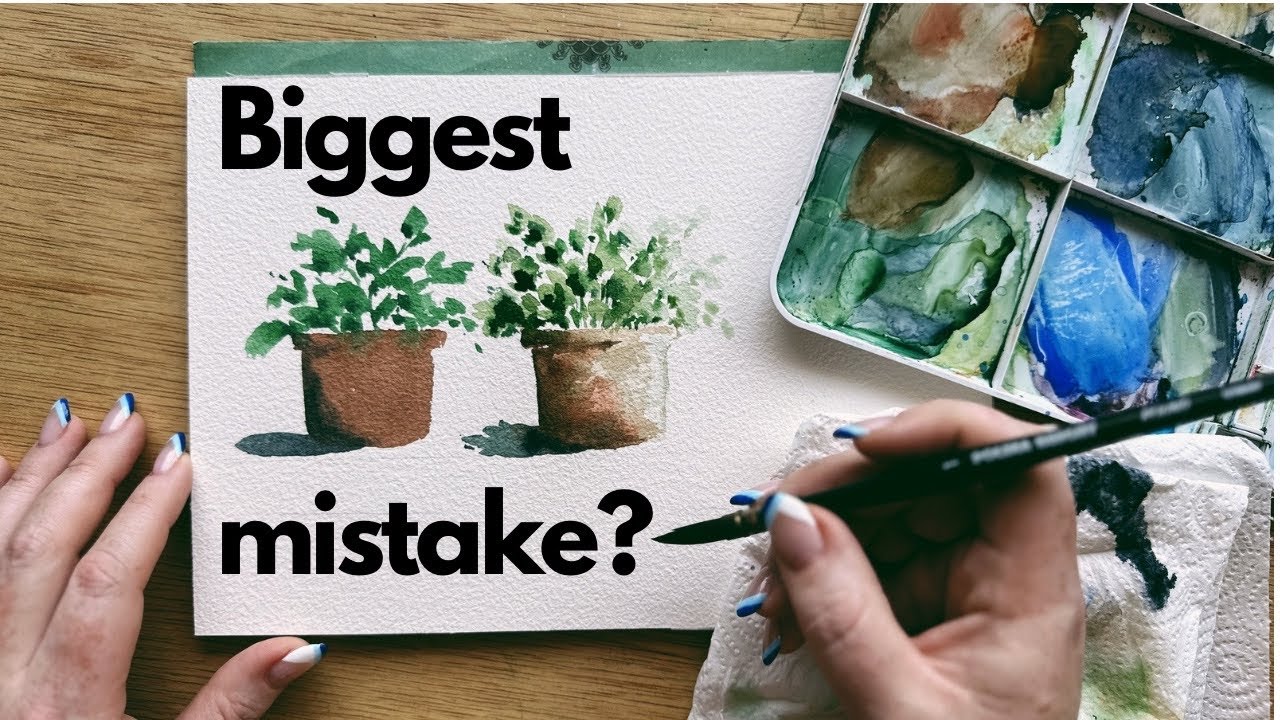
Most watercolor problems trace back to a small number of recurring mistakes. The good news is that each one has a clear cause and a straightforward fix.
Muddy Colors
Mud comes from one or more of these three sources.
Too many pigments in the mix. Every additional pigment adds more light absorption and more color bias. Three pigments is typically the limit before a mix starts losing clarity. Keep it to two where possible.
Wrong color temperature pairing. Mixing a warm blue with a cool red, for example, introduces a tiny amount of the opposite primary color into the secondary. That third-color contamination is what creates gray, lifeless purples and greens.
Mixing complements by accident. If your orange wash bleeds into a blue area before either dries, the overlap produces brown. Understanding color contrast on the page, not just on the palette, prevents this.
Overworking Wet Paint
Going back into a wash that has started to dry is one of the fastest ways to ruin it. The surface tension of the drying wash gets broken, and the pigments spread back out in an uncontrolled bloom.
Put the color down. Walk away. Come back when it is dry.
Took me a long time to actually follow that rule. The instinct to fix a slightly uneven wash by dabbing at it almost always makes it worse.
Incorrect Water Ratios and How to Recover
A mix that is too watery on the palette can be corrected before it hits paper. Dab the excess water from your brush with a cloth or paper towel, then reload from the paint well rather than the water pool.
A mix already on paper that is too wet can be partially corrected. A dry brush (or a brush damp-dried on a cloth) drawn gently across the surface will absorb excess water before the pigment fully sets. This technique also works for softening hard edges that appear while a wash is still slightly damp.
For a mix that went down too dark, lifting while wet is your best option. A damp brush, a piece of tissue, or a dry brush can pull pigment back up from the surface, especially with non-staining colors.
Reactivating Dried Layers
Watercolor is water-soluble even after it dries. Scrubbing over a dried wash with a wet, loaded brush dissolves the layer beneath and mixes it with whatever you are adding on top.
The fix: use a light touch on dried layers. Lay the new wash down in one smooth pass without going back over it. For complex layered work, use staining pigments in early washes (they resist reactivation better) and save liftable, non-staining colors for upper layers where corrections are more likely.
Understanding value and how it shifts when layers reactivate also helps you plan the sequence of your washes more deliberately. Dark, staining layers first. Lighter, liftable layers last.
Mixing Skin Tones, Neutrals, and Grays
These are the color categories that trip up the most people, including experienced painters. Skin tones are not a single formula. Neutrals are not just “brown.” Grays are not just diluted black.
Each requires a different approach, and getting them right depends more on understanding pigment behavior than memorizing recipes.
Skin Tones: The Core Principle
All skin tones, across every complexion, are chromatic neutrals. They are created by mixing the three subtractive primaries (red, yellow, and blue) in different proportions and densities. No single tube color will do the job on its own.
According to Artists Network, the relationship between warm and cool within skin is more important than exact color matching. Light skin areas read warm. Shadow areas go cool. Getting that shift right creates the illusion of form without needing perfect hue accuracy.
Pigment recommendations that hold up in practice:
- Quinacridone Rose or Permanent Alizarin Crimson for the red component
- Yellow Ochre or Raw Sienna for warmth and earth tones
- French Ultramarine for cool shadows and undertones
- Burnt Sienna for mid-value transitions and darker complexions
Avoid mixing more than three colors in a single skin tone passage. Mixing four or more produces the kind of muddy, flat result that no amount of layering will fix.
Mixing Neutrals Without Black

Reaching for black tube paint to mix darks is a shortcut that usually produces flat, dead-looking results. Neutrals built from complements stay optically active. They have a subtle color bias that keeps them alive on the paper.
Burnt Sienna + French Ultramarine: produces a deep, warm neutral that shifts from brown-gray to near-black depending on ratio.
Quinacridone Red + Phthalo Green: makes a rich, cool dark. Both are transparent staining pigments, so the mix stays luminous even at full saturation.
Raw Umber + Ultramarine: a softer, more earth-toned neutral. Good for shadows in landscapes and natural textures.
The ratio controls everything. More blue = cooler, darker neutral. More red or brown = warmer, lighter neutral. Test on a scrap before committing to the painting.
Chromatic Grays vs. Black-Based Grays
A black-based gray (Payne’s Gray diluted, or Ivory Black with water) is consistent but flat. It has no color identity.
A chromatic gray is mixed from two near-complementary colors and carries a subtle temperature. Color theory explains this well: when you mix colors that sit across from each other on the wheel without fully neutralizing them, the result reads as gray but with a lean, either cool (toward blue-violet) or warm (toward orange-brown).
| Mix | Result | Best For |
|---|---|---|
| Ultramarine + Burnt Sienna | Classic Neutral Gray: A versatile “workhorse” mix that can lean warm or cool depending on the ratio. | Natural shadows, skin tones, and building “living” grays that feel more organic than black paint. |
| Ultramarine + Burnt Umber | Cool/Deep Dark: Produces a heavier, more somber gray-black that settles into the paper. | Deepest shadow pockets, masonry, and creating a sense of weight in architectural renders. |
| Cobalt Blue + Raw Sienna | Soft & Airy: A very delicate, transparent gray that mimics the look of light through vapor. | Atmospheric perspective, distant mountains, and the underside of light-filled clouds. |
| Phthalo Blue + Quin. Sienna | Rich “Midnight” Black: High-intensity, staining darks that maintain a vibrant “glow” even at maximum depth. | Crisp foreground accents, high-contrast e-commerce assets, and deep water. |
Painter and illustrator Mario A. Robinson uses a blue-gray block-in (Burnt Umber + French Ultramarine) as the foundation for portrait shadows, then glazes warm skin tones over it. The chromatic gray underneath creates shadow depth that warm pigments alone never produce.
Recommended Pigments and Palettes for Mixing

The types of watercolor paints available now range from student-grade to professional artist quality, and the gap between them matters for mixing. Student-grade paints contain more filler and less pigment. Mixes go muddy faster and dry lighter in unpredictable ways.
According to an Art Materials Survey cited by TechSci Research in 2024, 75% of artists choose watercolor over other painting mediums primarily for ease of use. But that ease depends heavily on paint quality and palette construction.
Core Pigments for Clean Mixing
These are the workhorses. Not every artist uses all of them, but each earns its place based on mixing performance, not just color range.
- Hansa Yellow Medium (PY97): clean, transparent yellow with a slight warm bias. Mixes well with both blues and reds
- Quinacridone Rose (PV19): cool-leaning red, excellent for clean purples and violets
- French Ultramarine (PB29): warm blue, granulates beautifully, essential for neutral mixing
- Phthalo Blue GS (PB15:3): cool, staining, very strong. Use sparingly in mixes
- Burnt Sienna (PBr7): the most useful earth tone for neutralizing and shadow building
- Quinacridone Gold (PO49): warm golden orange-yellow, excellent for earthy secondary mixes
Brand Comparison for Mixing Performance
Schmincke Horadam is the go-to for transparency and smooth layering. Their pigments are finely ground, which makes wet-on-dry glazes exceptionally clean. Best choice if your work relies on subtle color transitions.
Daniel Smith has the widest pigment range of any major brand. Their PrimaTek series uses genuine mineral pigments that granulate in ways no synthetic pigment replicates. If you want texture in your mixes, Daniel Smith delivers it.
Winsor & Newton Professional (not Cotman) is the most predictable across the board. Founded in 1832, the brand has consistent pigment quality across reformulations. Good starting point before committing to specialty brands.
Miwa Gardner’s 2025 comparative tests found that even when using the same pigment code (like PB29 for Ultramarine), mixing behavior differs between brands. Schmincke Ultramarine has finer particles than Daniel Smith’s version, making it smoother for glazing but less textured in granulating washes.
Palette Types and How They Affect Mixing

The surface you mix on changes how paint behaves. Not a minor detail.
Ceramic and porcelain palettes are ideal for watercolor. Paint does not bead or pool unevenly, and the white surface gives an accurate preview of color against paper. Easy to clean.
Plastic palettes cause paint to bead up on the surface, making consistent mixes harder to achieve. Fine for field work, but not ideal for careful color mixing in the studio.
A wooden vs. plastic palette comparison matters less in watercolor than in oils. What matters more is surface color (always white), well depth (deeper wells hold more working mix), and whether the surface allows even paint flow.
Building a Limited Palette for Mixing: Where to Start

The split primary palette is still the most practical starting point. Six colors, one warm and one cool of each primary. Enough to mix the full visible spectrum when applied correctly.
| Primary | Warm Version (Leans toward neighbor) | Cool Version (Leans toward neighbor) |
|---|---|---|
| Yellow | New Gamboge: Leans toward Orange. Rich, golden, and “sunny.” | Lemon Yellow: Leans toward Green. Bright, acidic, and “sharp.” |
| Red | Pyrrol Scarlet: Leans toward Orange. Fire-engine red; very opaque and intense. | Quin. Rose: Leans toward Violet. Vibrant, transparent, and creates pure purples. |
| Blue | French Ultramarine: Leans toward Violet. Deep, granulating, and “royal.” | Phthalo Blue (GS): Leans toward Green. High-staining, “electric” cyan. |
From those six, you add pigments based on what your work actually needs. Portraits might add Raw Sienna and Burnt Sienna. Landscape painters often bring in a reliable green like Phthalo Green to avoid mixing it from scratch every session.
Strathmore’s 2024 guide on limited palettes confirms that a 3 to 6 color palette is sufficient for a full value and color range in watercolor, since water (not white paint) controls lightness. Expanding beyond six colors before you understand your primary six is one of the most common and most expensive mistakes beginners make.
Watercolor painting techniques like glazing, wet-on-wet mixing, and layering all become significantly more controllable once the palette is reduced to colors you fully understand. There is a reason the most accomplished watercolor artists in history worked with fewer colors, not more.
FAQ on Mixing Watercolors
Why do my watercolors look muddy when I mix them?
Mud happens when too many pigments combine, when you mix across color temperature lines, or when you overwork a wet wash. Stick to two pigments per mix where possible. Clean mixes come from understanding color temperature and pigment transparency before touching the brush to paper.
What is the best way to mix watercolors on a palette?
Add water first, then pull pigment into it gradually. Use a ceramic or porcelain palette for accurate color reading. Palette mixing gives you control over water-to-pigment ratio before committing to paper, which reduces the chance of uneven washes and muddy results.
Can I mix watercolors directly on the paper?
Yes. Wet-on-wet mixing on paper produces soft blooms, gradients, and organic color shifts. It requires timing. Drop pigment into a wet wash too late and you get hard-edged backwash blooms. Used intentionally, on-paper blending creates effects impossible to achieve on a palette.
How do I mix watercolors without them drying too fast?
Work in small sections and keep your palette wells loaded with enough pigment. On hot or dry days, mist your palette lightly with water. Gum arabic mixed into your water slightly slows drying time and improves paint flow without changing color behavior.
What are the best watercolor pigments for clean color mixing?
Single-pigment paints mix cleanest. Good starting choices are Hansa Yellow, Quinacridone Rose, French Ultramarine, and Phthalo Blue. Brands like Daniel Smith, Schmincke Horadam, and Winsor & Newton Professional offer consistent pigment quality that makes mixing more predictable.
How do I mix a limited palette to get the most colors?
Use a split primary palette: one warm and one cool version of each primary. Six colors total. Pair colors that share a bias toward each other for clean secondaries. Cross that bias line intentionally when you want muted, neutral tones.
How do I mix skin tones in watercolor?
All skin tones are chromatic neutrals built from the three primaries in varying ratios. Start with Yellow Ochre and Quinacridone Rose, then shift color temperature using French Ultramarine for shadows. Avoid mixing more than three pigments or the result loses clarity. Read more about how to mix skin tones here.
How do I mix gray without using black paint?
Mix complementary colors together without fully neutralizing them. Burnt Sienna and French Ultramarine produce a warm, deep neutral gray. Shift the ratio for warmer or cooler results. Chromatic grays built this way stay optically active on paper in a way tube black never does.
Why does watercolor look different when it dries?
Watercolor always dries lighter than it appears wet. The wet surface reflects light differently than dry pigment. The degree of shift varies by pigment. Some colors barely change; others lighten dramatically. Mix slightly darker than your target color saturation to compensate.
How do I fix a watercolor mix that went wrong on the paper?
If the wash is still wet, use a dry brush or tissue to lift excess pigment. For dried layers, try the lifting technique with a damp brush on non-staining pigments. Staining pigments like Phthalo Blue are nearly impossible to remove once dry, so prevention matters more than correction.
Conclusion
This article on mixing watercolors covers the full picture: from how pigment dispersion and binder behavior shape every wash, to building a split primary palette that actually works.
Color theory, pigment codes, granulation, staining behavior, palette technique – none of it is complicated once you understand what each element does.
Clean secondary colors come from matching color temperature bias. Chromatic grays beat tube black every time. Starting with fewer pigments and understanding them deeply produces better results than buying more paint.
The fundamentals covered here apply whether you paint in the tradition of the great watercolorists or work in a completely personal style.
Mix deliberately. The results follow.