A soft-voiced painter turned a 2-inch brush and “happy little trees” into a cultural phenomenon that still captivates millions decades after his death.
Bob Ross transformed how Americans think about art. His PBS show “The Joy of Painting” ran for 31 seasons, teaching the wet-on-wet oil painting technique to viewers who’d never touched a canvas.
But Ross was more than a television personality. He created an estimated 30,000 landscape paintings using a systematic approach that made painting mediums accessible to everyone.
This article examines Ross’s life, his refined alla prima technique, the limited palette that defined his work, and why his paintings now sell for over $100,000 at auction. You’ll understand what separated his method from traditional painting styles and why his influence extends far beyond the art world.
Identity Snapshot
Robert Norman Ross
Born: October 29, 1942, Daytona Beach, Florida
Died: July 4, 1995, New Smyrna Beach, Florida (lymphoma)
Primary role: Painter, television instructor, art educator
Nationality: American
Movement: Landscape painting, instructional art
Primary medium: Oil painting (wet-on-wet technique)
Signature traits: Rapid alla prima application, soft-edge atmospheric work, limited palette (13 colors), knife-applied impasto for mountains, fan brush foliage
Iconography: Mountains, forests, cabins, lakes, waterfalls, “happy little trees,” wildlife (squirrels), winter scenes, northern lights
Geographic anchors: Daytona Beach (birth), Orlando (childhood), Alaska (Air Force service, artistic awakening), Muncie, Indiana (show production), New Smyrna Beach (death)
Key relationships: Bill Alexander (mentor), Annette and Walt Kowalski (business partners), Steve Ross (son, certified instructor)
Collections: Bob Ross Inc. (majority of works), Smithsonian American History Museum, Bob Ross Experience (Muncie, Indiana), private collectors
Market position: Paintings range $8,000-$114,800 at auction; estimated 30,000 paintings created lifetime; most works retained by Bob Ross Inc.
What Sets Ross Apart

Ross turned painting mediums into mass entertainment.
His wet-on-wet method wasn’t original (dates to 16th century), but his systematization was. He reduced landscape painting to teachable steps anyone could follow in thirty minutes. Where most instructors focused on theory, Ross gave viewers immediate results.
The permed afro became branding by accident. He needed cheap haircuts while building his business. Once it stuck, he couldn’t change it.
His voice did the real work. Soft, unhurried, non-judgmental. He never corrected mistakes, only “happy accidents.” That philosophy separated him from traditional art education, which emphasized perfection. Ross emphasized process over product.
Origins & Formation
Early Years (1942-1961)
Ross grew up working-class Orlando. His father Jack built houses. His mother Ollie waited tables and taught him to care for injured wildlife.
He dropped out in ninth grade. Lost part of his left index finger working carpentry with his father. The injury shaped how he held his palette later (he’d position it to hide the missing fingertip).
Military Service (1961-1981)
Enlisted at eighteen as a medical records technician. Rose to Master Sergeant at Eielson Air Force Base, Alaska.
His role required discipline. Earned the nickname “Bust ‘Em Up Bobby” for his strict management style. He hated it. Promised himself he’d never yell again after leaving the service.
Alaska changed everything. The mountains, the light, the snow. He took his first painting class at a USO club in Anchorage but found the instructor frustrating. “They’d tell you what makes a tree, but they wouldn’t tell you how to paint a tree.”
Started painting Alaskan landscapes on gold-mining pans to sell tourists while bartending. When his art income exceeded his military salary, he knew what came next.
Discovery of Wet-on-Wet (1975-1981)
Discovered Bill Alexander’s PBS show “The Magic of Oil Painting” around 1975.
Alexander used the alla prima technique (Italian for “first attempt”). Paint applied wet over wet layers. No waiting for drying between applications. Complete paintings in one session.
Ross studied Alexander’s method, then refined it. Created custom brushes, painting knives, specific paint formulations. His innovation was making the technique even faster and more accessible than Alexander’s version.
Retired from Air Force in 1981 as Master Sergeant. Studied directly with Alexander in Florida. Joined Alexander Magic Art Supplies Company as traveling instructor.
Business Launch (1982-1983)
Annette Kowalski attended one of Ross’s classes in Clearwater, Florida. She’d been looking for Alexander but found Ross instead.
She saw commercial potential immediately. Convinced Ross to partner with her and her husband Walt. They formed Bob Ross Inc. in 1982.
First classes yielded small audiences. Money was tight. The perm started as a cost-saving measure.
A Falls Church, Virginia PBS station saw a promotional tape. Offered a pilot. “The Joy of Painting” premiered January 11, 1983.
Movement & Context
Ross existed outside traditional art movements. He wasn’t interested in impressionism, realism, or abstract debates.
His lineage traces through instructional painters, not gallery artists.
Comparison: Ross vs. Alexander
Bill Alexander painted with dramatic flair. Thick impasto, bold knife work, theatrical demonstrations. His paintings had harder edges, more defined contrast. He emphasized speed and showmanship.
Bob Ross softened everything. More atmospheric blending, gentler transitions, quieter demeanor. His edges were softer, his atmospheric perspective more developed. He emphasized accessibility and encouragement over entertainment.
Comparison: Ross vs. Thomas Kinkade

Thomas Kinkade sold paintings as collectible commodities. Glowing light sources, suburban idealism, religious undertones. Crisp detail work, photographic composition. Mass-produced prints.
Bob Ross gave paintings away to PBS stations. Wilderness settings, absence of human activity (rare cabins excepted). Loose brushwork, impressionistic foliage. He wasn’t selling paintings but teaching method.
Comparison: Ross vs. Contemporary Plein Air Movement

En plein air painting prioritizes observed light, changing conditions, location authenticity.
Ross painted from imagination and memory. His landscapes were idealized composites, not specific locations. He worked in studio, under controlled lighting, with standardized materials.
The plein air movement valued spontaneity through observation. Ross valued spontaneity through practiced technique.
Materials, Techniques & Process
Supports & Grounds
Ross used pre-stretched canvas, double-primed. Preferred 18×24 inch format for television work (standard 3:4 aspect ratio fit TV screens).
Canvas texture: medium-smooth surface. Too rough absorbed paint badly. Too smooth prevented tooth for blending.
His canvases came primed with gray ground. The gray showed through where Liquid White hadn’t been applied yet.
Oil Paint Formulation
Ross used thicker-bodied oils than standard tube paints. Bob Ross-branded paints were formulated specifically for wet-on-wet work. Stiffer consistency allowed paint to support itself without excessive flowing.
Standard Palette (13 colors):
- Titanium White (mixing and highlights)
- Phthalo Blue (skies, water)
- Prussian Blue (deep water, shadows)
- Midnight Black (darkest darks)
- Van Dyke Brown (tree trunks, earth)
- Dark Sienna (warm earth tones)
- Alizarin Crimson (sunsets, mixing)
- Sap Green (foliage)
- Cadmium Yellow (highlights, mixing)
- Yellow Ochre (earth, highlights)
- Indian Yellow (warm accents)
- Bright Red (occasional accents)
- Permanent Red (mixing)
He worked from a huge palette (much larger than standard) to accommodate large brush loads without mixing mud.
Liquid Mediums
Liquid White (most common base): A thin, translucent white oil that created the “wet” base layer for wet-on-wet application. Applied evenly across canvas before painting began. Created slip for blending.
Liquid Black: For night scenes, dramatic skies.
Liquid Clear: For water effects, transparent applications.
Ross used odorless paint thinner (odorless mineral spirits) for brush cleaning. His famous “beat the devil out of it” brush-cleaning technique involved striking cleaned brushes against a can to remove excess thinner.
Brushes & Tools
2-inch landscape brush (hog bristle): His workhorse. Used for skies, water, mountains, large foliage masses. Natural hog bristle was critical (synthetic didn’t hold enough paint or blend properly).
1-inch landscape brush (hog bristle): Smaller trees, bushes, detail work.
Fan brush (stiff bristles): Foliage, grass, tree branches. Ross used stiffer fans than standard to maintain shape control.
Liner brush (script liner): Fine branches, tree trunks, signature. Used with paint thinned to ink consistency.
Palette knife: Mountains, architectural elements (cabins), texture effects. Ross used a curved knife (not straight edge).
Technique Taxonomy
Base application: Liquid White applied thin and even with 2-inch brush. Complete coverage in under two minutes.
Wet-on-wet blending: New paint applied directly over wet base. Colors mixed on canvas, not palette. Allowed soft transitions without visible brushstrokes.
Mountain technique: Paint loaded heavily on palette knife edge. Applied with single downward stroke. Knife pulled at angle to create snow caps. Shadows added immediately while paint wet.
Tree technique: Fan brush loaded with paint, then tapped vertically on canvas to create foliage. “Just tap. Let the brush do the work.” Varied pressure created depth.
Cloud technique: Titanium White loaded on 2-inch brush, then applied in circular, swirling motions. Edges blended immediately with clean, dry brush using circular strokes.
Water technique: Horizontal strokes with large brush. Reflections painted by pulling paint vertically downward, then blended horizontally. “Thin paint will stick to thick paint” (key principle).
Highlighting: Paint loaded on brush, then applied with light pressure to catch raised texture. Created shimmer effects on water, snow.
Studio Practice
Ross worked standing, canvas at eye level on easel. Completed paintings in 26-28 minutes (allowing commercial breaks in 30-minute show).
Painted three versions of each work:
- Reference painting (painted before show, kept off-camera)
- Demonstration painting (painted on camera)
- Detailed version (painted after show for instructional books)
No preliminary sketching or underdrawing. Worked entirely from imagination and practiced memory. Could visualize complete composition before starting.
His speed came from practiced muscle memory, not shortcuts. He painted the same subjects hundreds of times until technique became automatic.
Themes, Subjects & Iconography
Wilderness Isolation
Ross rarely painted human figures or signs of civilization. Occasional cabin appeared, usually without smoke from chimney (suggesting vacancy or peaceful solitude).
His landscapes existed outside human time. No power lines, roads, fences, or modern intrusions.
Recurring Motifs
Mountains: Appeared in majority of works. Usually background element, snow-capped, painted with palette knife. Represented permanence, majesty.
Water: Lakes, streams, waterfalls. Painted with horizontal strokes, perfect reflections. Represented peace, stillness.
Trees: “Happy little trees” became his catchphrase. Evergreens dominated (Douglas fir, spruce). Painted with fan brush or knife. He personified them constantly (“This tree lives right here. He’s got a little friend.”).
Cabins: Rare but beloved. Simple log structures, usually beside water or in forest clearing. Represented refuge, human-scale harmony with nature.
Wildlife: Squirrels, birds, deer existed verbally more than visually. Ross encouraged viewers to imagine animals living in the scenes. He kept rescued squirrels as pets and featured them occasionally on camera.
Compositional Schemes
Triangular composition: Mountain peak as apex, foreground trees/elements as base. Created stable, balanced feeling.
Focal point placement: Usually off-center (following rule of thirds unconsciously). Cabin, waterfall, or distinctive tree served as visual anchor.
Layered depth: Background mountains, middle-ground trees, foreground elements. Each layer slightly darker and more detailed than previous. Created atmospheric recession.
Horizon placement: Typically upper third or lower third of canvas. Rarely centered (which would create static division).
Seasonal Emphasis
Winter scenes: Most frequent. Snow simplified value structure (whites and darks). Evergreens read clearly against snow. Alaska influence obvious.
Autumn: Second most common. Allowed warm color harmony demonstrations. Golds, oranges, reds against cool water or sky.
Summer: Lush greens, full foliage. Less frequent because harder to create clear visual separation between elements.
Spring: Rarely depicted explicitly. Ross didn’t paint flowers often (required different techniques).
Philosophical Themes
Ross embedded life philosophy into subject matter. “We don’t make mistakes, just happy accidents” applied to painting and existence.
Trees represented resilience (“even old, dead trees have their place”). Mountains represented challenges (“you need the dark to show the light”). Water represented peace.
His landscapes offered escape from stress. No conflict, no struggle. Pure sanctuary.
Notable Works
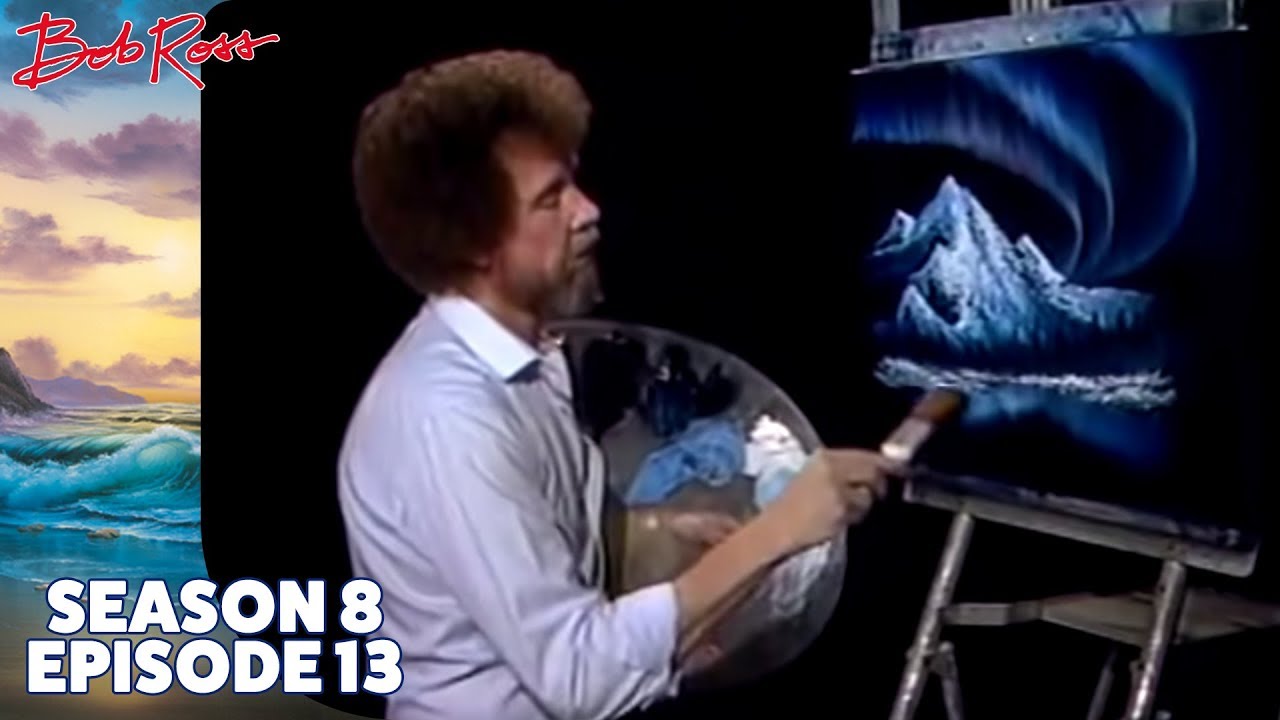
Northern Lights (Season 8, Episode 13, 1986)
Medium: Oil on canvas, approximately 18×24 inches
Current location: Private collection
Visual signature: Dramatic night sky with aurora borealis in green and purple. Mountain silhouette in foreground. Perfect lake reflection. Rare departure from typical warm-lit scenes.
Why it matters: Most requested painting by viewers. Demonstrated Ross’s ability to paint dramatic atmospheric effects. Challenged his usual palette range (required vibrant greens not typically used).
Technique notes: Aurora created with Phthalo Green and Prussian Blue mixed with Liquid White, applied in sweeping vertical strokes, then blended with fan brush. Reflections pulled vertically with perfect mirror precision.
Mountain Retreat (Season 3, Episode 1, 1984)

Medium: Oil on canvas, approximately 18×24 inches
Current location: Bob Ross Inc. collection
Visual signature: Snow-covered cabin beside frozen lake, evergreen forest background, massive mountain peak. Warm light suggesting sunset or sunrise.
Why it matters: Became template for thousands of student recreations. Combined all Ross signature elements (cabin, trees, mountain, water) in single composition. Demonstrated complete wet-on-wet workflow in 26 minutes.
Related works: Ross painted cabin variations throughout series, but this composition became archetypal.
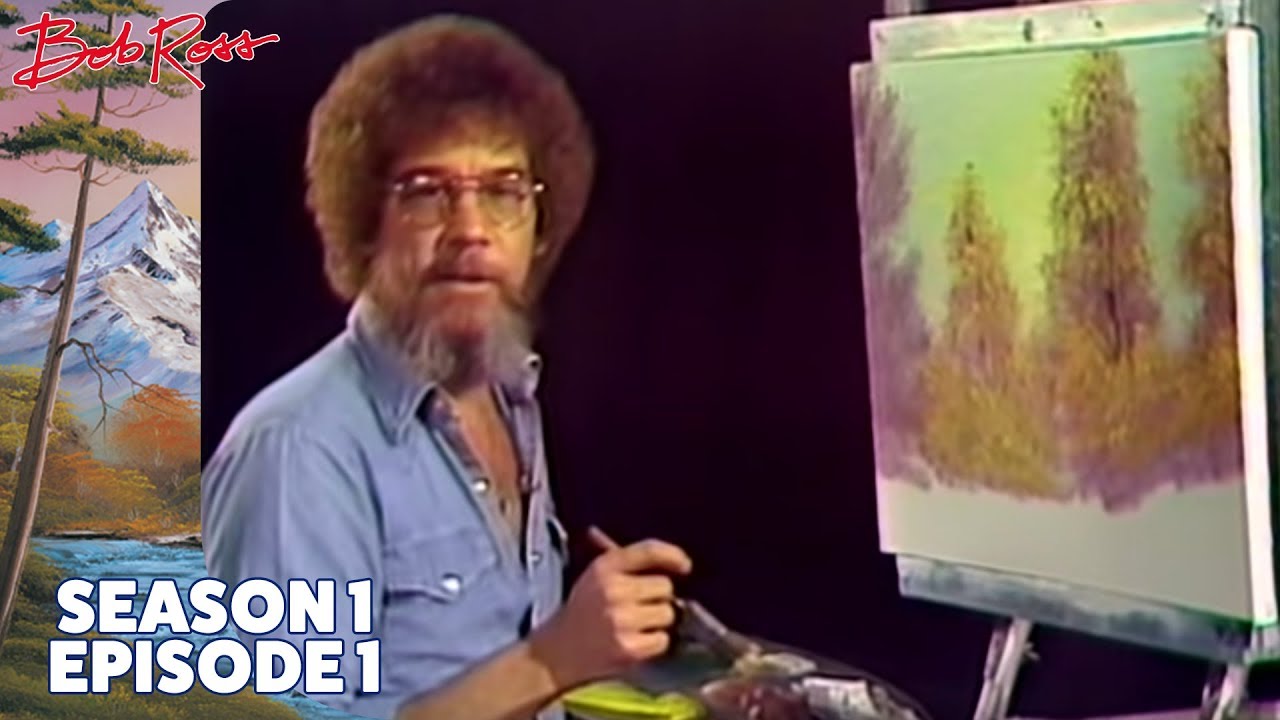
A Walk in the Woods (Season 1, Episode 1, 1983)
Medium: Oil on canvas, approximately 18×24 inches
Current location: Private collection (acquired by art dealer Ryan Nelson)
Visual signature: Forest path leading to distant mountains, dappled light through trees, autumn colors.
Why it matters: First painting demonstrated on “The Joy of Painting.” Established show’s format and Ross’s teaching style. Historical significance as launchpad for his television career.
Market note: Listed for sale at $9,850,000 by current owner (2023), though not yet sold at that price. Represents extreme high end of Ross painting valuations.
Blue Ridge Falls (Season 30, Episode 13, 1994)

Medium: Oil on canvas, approximately 18×24 inches
Current location: Smithsonian American History Museum (acquired 2019)
Visual signature: Waterfall cascading through rocky terrain, lush summer foliage, misty atmosphere. More detailed than typical demonstration paintings.
Why it matters: First Ross painting acquired by major national museum. Book version (more detailed than TV version) selected for permanent collection alongside three versions of “On a Clear Day.”
Technique notes: Waterfall painted with Liquid White pulled vertically with fan brush, creating illusion of flowing water. Rocks built with palette knife, shadows added while wet.
Mystic Mountain (Season 20, Episode 13, 1990)

Medium: Oil on canvas, approximately 18×24 inches
Current location: Bob Ross Inc. collection
Visual signature: Mist-shrouded mountain peak, soft atmospheric perspective, limited color saturation creating ethereal quality.
Why it matters: Demonstrates Ross’s mastery of atmosphere and depth. Minimal detail but strong emotional impact. Often cited as example of his artistic sophistication beyond “simple” label.
Technique notes: Multiple layers of thinned Titanium White created mist effect. Mountain built with very light knife work, barely distinct from sky. Foreground trees provided only solid elements.
Exhibitions, Collections & Provenance
Television Distribution
“The Joy of Painting” aired 403 episodes across 31 seasons (1983-1994). PBS in United States, CBC in Canada. Each episode represented three paintings (reference, demonstration, detailed version).
Total: approximately 1,209 paintings directly associated with television series.
Primary Collection Holder
Bob Ross Inc., Herndon, Virginia: Holds majority of Ross’s paintings (estimated 1,000+). Stored in warehouse, not displayed. Includes all three versions from most episodes. Not for sale.
Museum Holdings
Smithsonian American History Museum (2019): Acquired four paintings plus memorabilia (easel, palette, brushes, fan letters, production notebooks). Not yet regularly displayed.
Bob Ross Experience, Muncie, Indiana (2020): Museum and workshop facility. Displays rotating selection of original paintings. Located where show was filmed.
Auction History
Ross’s paintings rarely reached public market during his lifetime. He donated many to PBS stations for fundraising.
Recent auction results (2023-2025):
- Two early-1990s mountain and lake scenes: $114,800 and $95,750 (Bonhams auction house, more than doubled pre-sale estimates)
- “Row Boat on the Beach”: $95,000 (previous public record)
- Typical range: $8,000-$25,000 for authenticated works
Authentication Challenges
Bob Ross Inc. controls authentication. No official catalogue raisonne exists. Authentication relies on:
- Provenance documentation (PBS donation records, early sales records)
- Technical analysis (paint formulation, canvas type, stretcher marks)
- Signature verification (Ross signed consistently but location varied)
Forgeries exist (market demand high, supply extremely limited). Most authentic paintings remain in Bob Ross Inc. collection or early PBS station donations.
Notable Private Collections
Most private owners acquired works through:
- PBS station auction donations (1980s-1990s)
- Bob Ross Inc. gifts to certified instructors
- Direct purchase from Ross during early career (pre-television)
Private collectors rarely sell (sentimental value exceeds market value for many owners).
Market & Reception
Auction Market Evolution
1990s: Paintings considered television memorabilia more than fine art. Limited collector interest.
2000s-2010s: Nostalgic resurgence as show reached streaming platforms. Prices began rising.
2020s: Significant market maturation. Record prices established. Growing recognition of technical skill and cultural significance.
Price Determinants
Subject matter: Cabins, northern lights, autumn scenes command premiums. Generic mountain/forest scenes less valuable.
Provenance: PBS donation documentation adds value. Early career works (pre-television) also valued.
Condition: Ross’s wet-on-wet paintings relatively stable if stored properly. Craquelure rare (paintings relatively recent). Varnish yellowing occasional issue.
Version type: Book paintings (most detailed) most valuable. Demonstration paintings (painted on TV) next. Reference paintings (least detailed) still valuable but lower tier.
Critical Reception
During lifetime: Dismissed by fine art establishment. Seen as craft instruction, not serious art. No gallery representation. No major museum interest.
Posthumous reassessment: Growing appreciation for accessibility mission, technical consistency, cultural impact. Still not embraced by contemporary art world but recognized as unique American phenomenon.
Academic interest: Limited scholarly attention. More focus on Ross as media personality than painter. Recent studies examine his democratization of art education.
Market Outlook
Scarcity supports values (fewer than 100 paintings likely available for purchase). Continued streaming popularity maintains demand. Young collectors discovering work through YouTube.
Authentication remains bottleneck (Bob Ross Inc. controls process). If more paintings released to market, could impact prices, but company shows no interest in selling.
Influence & Legacy
Upstream Influences

Bill Alexander (1915-1997): Direct mentor. German-born painter who developed quick landscape method for television. Ross studied Alexander’s approach, then refined it.
Alla prima tradition: Historical lineage through Diego Velázquez, Claude Monet, Vincent van Gogh, Willem de Kooning. Ross didn’t reference art history but worked within established wet-on-wet tradition.
Alaskan landscape: Geographic influence stronger than artistic influence. The mountains, light, scale of Alaska shaped his subject matter permanently.
Downstream Impact
Certified instructors: Bob Ross Inc. trained thousands of instructors worldwide. His method continues through workshops, classes, YouTube tutorials by certified teachers.
ASMR culture: Ross’s soft voice, gentle brush sounds, calming demeanor made him unintentional ASMR pioneer. Streaming platforms amplified this audience decades after his death.
DIY art movement: Ross proved art could be accessible without formal training. Influenced growth of adult art classes, paint-and-sip businesses, instructional YouTube channels.
Therapeutic art practice: His emphasis on process over product influenced art therapy approaches. “Happy accidents” philosophy adopted in mental health contexts.
Cross-Domain Influence
Digital culture: Internet memes, GIFs, remix culture. Ross became symbol of wholesome positivity in often-cynical online spaces.
Documentary media: “Bob Ross: Happy Accidents, Betrayal & Greed” (Netflix, 2021) renewed interest, exposed business conflicts with Kowalski family.
Product merchandising: Bob Ross brand expanded to Chia Pets, board games, LEGO figures, energy drinks, toasters. His image commodified far beyond original paintings.
Meditation/mindfulness: His shows used as relaxation tools. The Joy of Painting streams on Twitch drew millions seeking calm, meditative viewing.
Artists Influenced
Direct students: Steve Ross (son), countless certified instructors who continue teaching method.
YouTube painting instructors: Kevin Hill, Paint Coach, Cinnamon Cooney (The Art Sherpa) all cite Ross inspiration, use similar instructional approaches.
Indirect influence: Ross demonstrated that art instruction could be entertainment. Paved way for art content creators across platforms.
Cultural Permanence
Ross’s legacy exceeds his paintings. He changed how Americans think about art (accessible vs. elite). His personality mattered more than his paintings.
The permed afro, soft voice, “happy little trees” catchphrase became cultural shorthand for gentle encouragement and creative possibility.
Twenty-five years after his death, he remains more popular than during his lifetime. Streaming platforms gave him posthumous audience far larger than PBS viewership.
His business empire (Bob Ross Inc.) continues profitably, though Kowalski family control remains controversial among Ross’s heirs.
How to Recognize a Ross at a Glance

Canvas format: Standard 18×24 inch stretched canvas, horizontal orientation (3:4 ratio). Occasionally 16×20 or smaller.
Wet-on-wet surface: Smooth paint application, minimal visible brushwork. Soft edges throughout (except knife-applied mountain peaks). No impasto buildup except on mountains and highlighted areas.
Limited palette: Dominated by earth tones, cool blues, titanium white. Rarely uses pure bright colors. Color harmony stays within narrow range.
Signature elements: Mountains (palette knife), evergreen trees (fan brush), water reflections (horizontal blending), soft clouds (circular swirls). Almost always present in combination.
Horizon placement: Upper third or lower third, rarely centered. Follows rule of thirds instinctively.
Atmospheric depth: Three distinct spatial zones (background, middle, foreground). Each darker and more detailed moving forward. Clear recession into distance.
Absence of detail: No fine botanical accuracy. Trees are generic evergreens. Rocks are textured masses. Grass is suggested, not painted blade by blade.
Compositional balance: Usually asymmetrical but weighted properly. Focal point off-center. Supporting elements distributed for visual stability.
Signature placement: Usually lower corner, small script, sometimes hidden in foliage or rocks. Inconsistent location (not always same corner).
Subject matter: Wilderness landscapes only. Mountains, forests, water. Rare cabin. No urban scenes, no people, no still life, no portraits.
Mood: Peaceful, serene, idealized. No storms (except occasional dramatic skies). No conflict or tension in composition.
Speed evidence: Finished within thirty minutes. Demonstrates practiced efficiency but not carelessness. Economy of brushwork visible in repeated patterns (every tree painted same method, every mountain same knife technique).
FAQ on Bob Ross
What painting technique did Bob Ross use?
Ross mastered the wet-on-wet technique (alla prima), applying fresh oil painting layers directly over wet base coats without waiting for drying. He learned this method from Bill Alexander, then refined it with custom brushes and specific paint formulations. The technique allowed him to complete landscape paintings in under 30 minutes on television.
How many paintings did Bob Ross create?
Ross painted an estimated 30,000 works during his lifetime. For “The Joy of Painting,” he created three versions of each piece: a reference painting, the demonstration painting viewers watched him create, and a detailed version for instructional books. Most paintings remain in Bob Ross Inc.’s Virginia warehouse collection.
What colors did Bob Ross use in his palette?
His standard palette contained 13 colors: Titanium White, Phthalo Blue, Prussian Blue, Midnight Black, Van Dyke Brown, Dark Sienna, Alizarin Crimson, Sap Green, Cadmium Yellow, Yellow Ochre, Indian Yellow, Bright Red, and Permanent Red. Ross kept his color theory approach simple and consistent, allowing beginners to follow easily.
Why did Bob Ross have a perm?
The afro started as a cost-saving measure when Ross was building his business and couldn’t afford regular haircuts. His hair was naturally straight. Once the perm became part of his brand identity and Bob Ross Inc. logo, he couldn’t change it despite disliking the style personally.
What happened to Bob Ross’s paintings?
Bob Ross Inc. owns the majority of his works, stored in a Herndon, Virginia warehouse. The Smithsonian acquired four paintings in 2019. Ross donated many to PBS stations for fundraising. Authentic paintings rarely reach auction but now sell for $8,000 to $114,800 when available.
Did Bob Ross serve in the military?
Ross enlisted in the United States Air Force at age 18 in 1961. He rose to Master Sergeant and served 20 years, stationed primarily at Eielson Air Force Base in Alaska. His strict disciplinarian role earned him the nickname “Bust ‘Em Up Bobby,” which he hated and vowed to change after retirement.
What brushes did Bob Ross use?
Ross used four primary tools: a 2-inch landscape brush (hog bristle), 1-inch landscape brush, fan brush (stiff), and palette knife. He also used a script liner brush for fine details. Natural hog bristle was critical for his technique because synthetic brushes couldn’t hold enough paint or blend properly.
Where can I see original Bob Ross paintings?
The Bob Ross Experience in Muncie, Indiana displays rotating originals and offers workshops. The Smithsonian American History Museum acquired pieces in 2019 but hasn’t regularly displayed them yet. Private collectors rarely sell their paintings. Most works remain in Bob Ross Inc.’s storage facility, not available for public viewing.
How much are Bob Ross paintings worth?
Recent auction sales reached $114,800 for early-1990s mountain scenes at Bonhams. Typical authenticated works sell between $8,000 and $25,000. “Row Boat on the Beach” previously held the record at $95,000. One dealer lists Ross’s first television painting for $9.85 million, though it hasn’t sold at that price.
What was Bob Ross’s cause of death?
Ross died from lymphoma complications on July 4, 1995, in New Smyrna Beach, Florida, at age 52. He’d been diagnosed years earlier. A lifelong cigarette smoker, he had multiple health issues throughout his life. He married his third wife Lynda Brown just two months before his death.
Conclusion
Bob Ross proved that art instruction could become mass entertainment without sacrificing authenticity. His wet-on-wet method democratized landscape painting, making it accessible to millions who’d never considered picking up a brush.
The numbers tell part of the story. Thirty thousand paintings, 403 episodes, decades of continued streaming popularity.
But his real legacy lives in the philosophy. “Happy accidents” changed how people approach creativity and mistakes. His gentle teaching style influenced art education far beyond PBS.
Ross’s paintings now hang in the Smithsonian alongside works by Claude Monet and Vincent van Gogh, artists who also used alla prima techniques. The art establishment finally recognized what his audience knew all along.
He made painting feel possible. That matters more than any individual canvas.