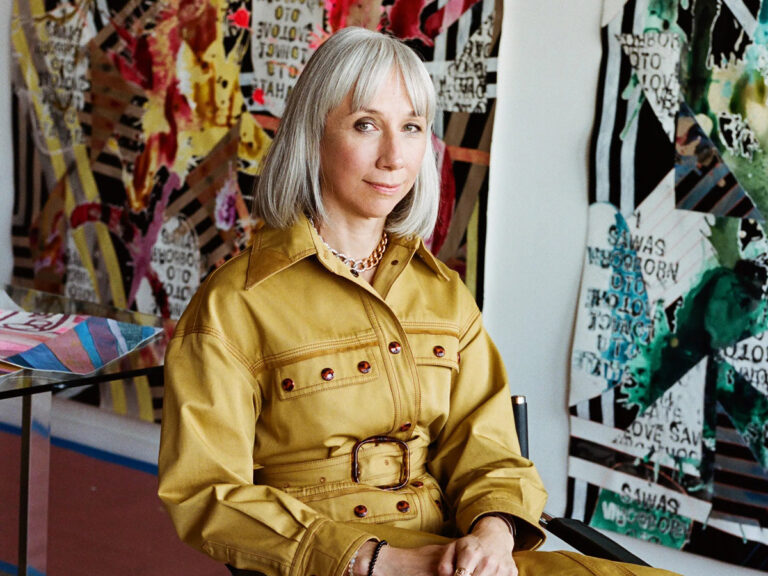
Most painters use brushes. Ayako Rokkaku uses her bare hands.
The self-taught Japanese artist paints exclusively with her fingers, creating vibrant canvases that sell for over a million dollars at auction. Born in Chiba in 1982, she discovered her unconventional technique at twenty while experimenting on cardboard in Tokyo parks.
What started as spontaneous finger-painting has evolved into a globally recognized artistic practice. Her works blend manga-influenced figures with abstract expressionism, featuring oversized eyes and rainbow-like backgrounds that reference childhood imagination.
This article explores how Rokkaku became the sixth best-selling Japanese contemporary artist of all time. You’ll discover her unique acrylic painting technique, the color theory behind her signature palette, and why collectors pay premium prices for work created just months earlier.
From Tokyo parks to major museums, here’s the story behind those finger-painted canvases.
Identity Snapshot
Name: Ayako Rokkaku (六角彩子 / ロッカクアヤコ)
Born: 1982, Chiba, Japan
Primary roles: Painter, Sculptor, Performance Artist
Nationality: Japanese
Movements: Contemporary Japanese Art, Superflat influence, Naive Art, Neo-Expressionism
Mediums: Acrylic painting on canvas, cardboard, Louis Vuitton suitcases; bronze sculpture; Murano glass; limited edition prints
Signature traits: Finger-painted application (no brushes), spontaneous gestural marks, high-chroma palette bias (pinks, yellows, blues, greens), manga-influenced figures with oversized eyes
Iconography / motifs: Female figures, cats, birds, flowers, rainbow-like smears, cloud formations, musical notes
Geographic anchors: Chiba (birthplace), Tokyo, Amsterdam, Berlin, Porto (current studios)
Mentors / influences: Inspired by Jackson Pollock, Cy Twombly, Claude Monet; discovered by Takashi Murakami (2006 Geisai)
Collections & museums: Kunsthal Rotterdam, Danubiana Meulensteen Art Museum (Slovakia), Chiba Prefectural Museum of Art, Long Museum (Shanghai), Hangaram Art Museum (Seoul), Thyssen-Bornemisza Museum (Madrid)
Market signals: Record sale $1.3 million+ (2022, SBI Art Auction Tokyo); typical canvas sizes 100×140 cm; sixth best-selling Japanese artist all-time; primary representation Gallery Delaive (Amsterdam), KONIG GALERIE (Berlin)
What Sets This Artist Apart

Rokkaku obliterates the distance between body and canvas.
She paints exclusively with bare fingers and hands, no brushes. Ever. This isn’t a gimmick. It’s acrylic paint applied with flesh, translating physical impulse directly onto support without mediation. The result? Tactile immediacy that brushwork can’t replicate.
Her figures float between kawaii culture and visceral emotion. Those manga eyes? They stare with anxiety, joy, confusion. Not cute. Complicated.
The color palette screams. Pinks bleed into lime greens. Yellows crash against electric blues. Yet somehow the color harmony holds.
Where abstract expressionism meets children’s drawings meets performance art. She builds paintings as large as seven meters during live sessions. Audiences watch paint get smeared, dragged, dotted. The process becomes spectacle.
Self-taught means no academy rules bound her technique. She discovered finger-painting at twenty while experimenting on cardboard in Tokyo parks. That raw approach stuck.
Origins & Formation
Early Discovery (2002-2003)
Started painting at age twenty. No art school, no formal training.
Found her method during amateur artist event in Tokyo. Tried brushes, pens, crayons. Nothing clicked until she dipped hands directly into acrylic paint and worked on salvaged cardboard.
The squishy, tactile sensation felt right. Primitive impulse met surface.
Breakthrough (2003-2006)
Won Scout Prize at Geisai #4 art fair (2003), organized by Takashi Murakami.
Exhibited finger-painted cardboard works. Bright, spontaneous, unlike anything else at the fair.
Awarded prestigious Akio Goto Prize at Geisai (2006). Nico Delaive of Gallery Delaive met her at Volta Basel same year.
Offered Amsterdam studio space and exclusive representation. Moved between Japan and Netherlands.
Formation Period (2006-2011)
Developed signature large-format canvases. Preferred working on pieces several meters wide.
Started live painting performances at art fairs. Made creation visible, communal.
First major museum solo: “Colours in My Hand” at Kunsthal Rotterdam (2011). Thousands attended.
Expanded to unconventional supports: vintage Louis Vuitton trunks, larger cardboard sheets, wooden panels.
Movement & Context
Superflat Adjacent, Not Contained

Takashi Murakami‘s Superflat movement provided initial platform. But Rokkaku diverged.
Murakami: slick, graphic, production-based. Multiple assistants, digital precision, manufactured aesthetic.
Rokkaku: raw, gestural, solo. Hand-applied paint, visible marks, physical presence.
Where Murakami flattens depth deliberately, Rokkaku builds texture accidentally through layered finger-dragging.
Comparative Positioning
Versus Yoshitomo Nara:
Both work with childlike figures and big eyes. Nara’s characters glare with punk defiance. Sharp edges, controlled application.
Rokkaku’s figures drift, uncertain. Soft boundaries where paint blurs. Less attitude, more vulnerability.
Nara uses brushes and palette knives. Clean delineation. Rokkaku’s finger-smeared edges create atmospheric dissolution.
Versus Yayoi Kusama:
Kusama: obsessive repetition, dots covering everything, controlled application despite conceptual chaos.
Rokkaku: spontaneous composition, unique marks every time, embrace of unpredictability.
Both use high-intensity color saturation. Kusama’s dots remain uniform. Rokkaku’s finger-marks vary with pressure and speed.
Versus American Abstract Expressionists:
Pollock’s drip method eliminated brush contact. Rokkaku’s method maximizes it.
Willem de Kooning used aggressive brushwork and palette knife. Rokkaku achieves similar energy with softer, fleshier tool (fingers).
Both create all-over compositions without single focal point. Rokkaku adds figurative anchors that de Kooning avoided.
Materials, Techniques, and Process
Supports
Canvas: Primarily linen, occasionally cotton. Stretched and primed.
Cardboard: Salvaged or purpose-acquired corrugated sheets. Warm, absorbent surface that accepts paint differently than canvas.
Louis Vuitton trunks: Vintage suitcases transformed into three-dimensional painted objects. Hard surface requires different pressure.
Wood panels: Occasionally for smaller works.
Application Method
No brushes. Ever.
Dips fingers and palms directly into acrylic paint. Applies to surface with:
- Fingertip dots (pointillist-style marks)
- Palm smears (broad gestural sweeps)
- Finger-dragging (creates streaks and blurred edges)
- Multi-finger stippling (creates texture clusters)
Recently started wearing gloves during application (toxin concerns) but maintains same technique.
Palette Profile
Dominant hues: Hot pinks, lime greens, sky blues, sunflower yellows.
Temperature bias: Warm-leaning. Even blues and greens feel warm through neighboring hot pinks.
Value distribution: High-key overall. Rare use of dark values. Occasional deep reds or forest greens create contrast.
Color relationships: Complementary colors placed adjacently (pink/green, yellow/purple) but blended at edges to soften color contrast.
Studio Practice
Approach: Alla prima. Works wet-in-wet, completes paintings in single sessions or consecutive days.
No preliminary sketches. Begins with intuitive marks, builds composition responsively.
Large canvases placed on floor. Crouches, kneels, moves around entire perimeter.
Layering: Thin initial washes establish background. Thicker acrylic paint layers build figures and details.
Finger-dragging creates accidental blending. Wet-in-wet technique where colors mix on surface.
Drying time: Acrylics dry fast. Can add layers within hours. Sometimes works multiple canvases simultaneously.
Performance Painting
Live sessions at art fairs and exhibitions. Works quickly, intuitively.
Audience watches entire creation process. Painting becomes theater.
Sessions last several hours. Final works often go to auction immediately.
Themes, Subjects, and Iconography
Core Motifs
Female figures: Primary subjects. Large eyes (manga influence), elongated limbs, ambiguous expressions.
Faces suggest multiple emotions simultaneously. Joy mixed with uncertainty. Contentment shadowed by anxiety.
Cats and birds: Recurring animal presences. Usually small scale, scattered through compositions.
Flowers: Abstract floral bursts. Not botanical accuracy, more like color explosions suggesting blooms.
Rainbow smears: Horizontal bands of blended color. Create atmospheric backgrounds, suggest weather phenomena.
Cloud formations: Soft-edged shapes that sometimes merge with figures’ hair or clothing.
Compositional Schemes
All-over distribution: No single focal point. Figures and marks spread across entire surface.
Floating spatial logic: Characters don’t stand on ground planes. They drift in indeterminate pictorial space.
Asymmetrical balance: Weight distributed unevenly but maintains visual harmony.
Edge-to-edge energy: Compositions push to canvas edges. No quiet borders.
Symbolic Framework
Childhood imagination: Figures and spaces reference how children draw. Disproportionate scale, emotional directness, rule-free color psychology.
Kawaii complexity: Surface cuteness masks deeper emotional content. Characters express vulnerability, confusion, internal conflict.
Energy transmission: Rokkaku describes paintings as “existence of energy.” Visual records of physical movement and emotional states.
Transience: Rainbow clouds represent impermanence. Colors shift, blend, change state.
Notable Works
Untitled (2017)

Medium: Acrylic on canvas
Size: 180 x 140 cm
Location: Private collection (sold SBI Art Auction Tokyo, July 2022)
Sale price: $1,300,000+ (artist record)
Large-scale work featuring central female figure with oversized eyes against vibrant pink and yellow background. Scattered smaller figures and cloud-like forms.
Visual signature: Thick finger-applied impasto in figure areas. Thin washes in background. Visible palm-smear texture.
Why it matters: Set artist auction record. Demonstrated market confidence in recent output. Sold for double high estimate.
Untitled (2021)

Medium: Acrylic on canvas
Size: 180 x 140 cm
Location: Private collection (sold Christie’s Hong Kong, May 2022)
Sale price: $1,200,000+
Another large-format work. Demonstrates her ability to maintain compositional harmony at scale.
Created just one year before sale. Collectors paid premium for fresh-to-market work.
Visual signature: Electric color intervals. Hot pinks against lime greens. High color saturation throughout.
Why it matters: Sold seven times high estimate. Proved market appetite for current production, not just vintage pieces.
Untitled (2008)

Medium: Acrylic on canvas
Size: 100 x 140 cm
Location: Private collection (sold SBI Art Auction Tokyo, May 2022)
Sale price: $517,920
Earlier work showing development of signature style. More subdued palette than later work.
Visual signature: Dots and stippling technique prominent. Pointillism influence visible.
Why it matters: Only top-ten auction result from pre-2016 period. Shows early work commands strong prices.
Colours in My Hand (2011 series)

Medium: Acrylic on various supports
Exhibition: Kunsthal Rotterdam, June-August 2011
Major museum debut. Included canvases, cardboard works, live painting demonstrations.
Visual signature: Breakthrough consolidation of finger-painting technique. First large-scale museum presentation.
Why it matters: Established international museum reputation. Attracted thousands of visitors. Proved contemporary Japanese art market expanding beyond Takashi Murakami and Yoshitomo Nara.
Untitled on Louis Vuitton Suitcase (various years)
Medium: Acrylic on vintage Louis Vuitton trunk
Size: Variable (typically 52 x 80 x 23.5 cm)
Location: Various collections
Painted directly on luxury brand suitcases. Three-dimensional works functioning as sculpture.
Visual signature: Paint applied to hard, curved surfaces. Different mark-making than flat canvas.
Why it matters: Expanded beyond traditional supports. Blurred painting/sculpture boundary. Created high-profile luxury art objects.
Exhibitions, Collections, and Provenance
Major Solo Exhibitions
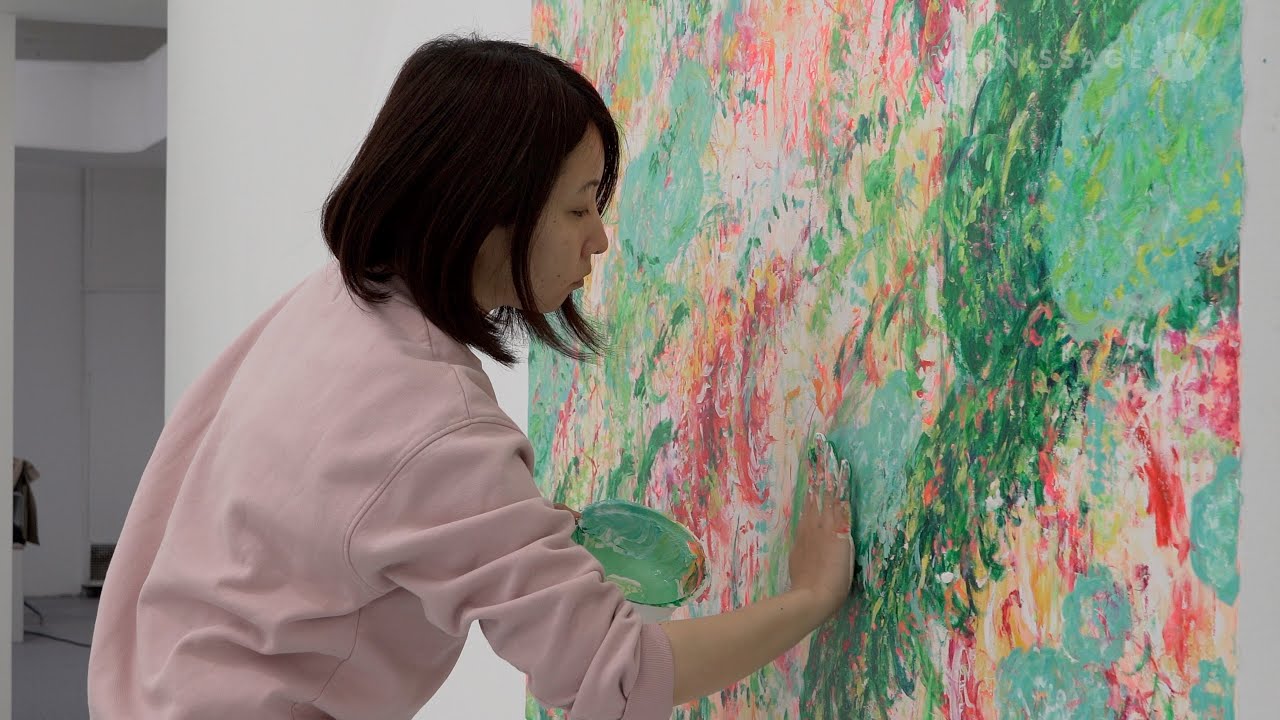
Museo Nacional Thyssen-Bornemisza, Madrid (May-September 2025) First Spanish exhibition. Twenty-nine works spanning 2001-2025. Live painting performance.
Hangaram Art Museum, Seoul (December 2023-March 2024) “Dreams in My Hand.” Comprehensive Korean presentation.
Long Museum, Shanghai (May-August 2023) “Close to Your Treasure.” First major Chinese institution show.
Chiba Prefectural Museum of Art, Japan (2020) “Magic Hand.” Homecoming exhibition in birth prefecture.
Museum Jan van der Togt, Amstelveen, Netherlands (2019) “Fumble in colors, tiny discoveries.”
Danubiana Meulensteen Art Museum, Slovakia (2012) “Where the smell comes from.” Early European museum recognition.
Kunsthal Rotterdam, Netherlands (2011) “Colours in My Hand.” Breakthrough museum presentation.
56th Venice Biennale (2015) Swatch Art Pavilion participation. International visibility surge.
Gallery Representation
Primary: Gallery Delaive, Amsterdam (since 2006). Exclusive worldwide representation for sixteen years.
Additional: KONIG GALERIE, Berlin; Gallery Target, Tokyo; Baro Galeria, Porto
Museum Collections
Works acquired by institutions in Netherlands, Slovakia, Japan, China, South Korea, Spain.
Specific acquisition details often undisclosed (private sales to museum foundations).
Provenance Patterns
Primary market: Gallery Delaive controlled initial sales through 2022. Direct studio-to-gallery-to-collector pipeline.
Secondary market: Asian auction houses drive highest prices. Christie’s Hong Kong, Phillips Hong Kong, SBI Art Auction Tokyo account for most six-figure sales.
Cataloguing: Gallery Delaive maintains comprehensive online catalogue with reference numbers (e.g., AR19-008, ARP09-043).
Published catalogue raisonne: “Ayako Rokkaku Works 2006-2021” (Arjen Ribbens, Amsterdam, 2023).
Market & Reception
Auction Performance
Total sales value: $63.8 million+ (lifetime, all lots)
Sell-through rate: 76% (2024 H1 data)
Ranking: Sixth best-selling Japanese artist all-time (as of 2024)
Market concentration: Eight of top ten results achieved in 2022. Explosive growth year.
Geographic distribution: Japanese auctions account for 50% of top sales. Hong Kong significant secondary market.
Price Bands by Format
Large canvases (140+ cm): $200,000-$1,300,000+
Medium canvases (100 x 140 cm): $50,000-$500,000
Cardboard works: $10,000-$100,000
Limited edition prints: $500-$10,000
Ceramics/sculptures: $5,000-$50,000
Recent Records (2022-2024)
Three auction records set in 2022 alone. Market momentum extraordinary.
Works frequently sell for multiples of high estimate (2-7x common).
Fresh-to-market paintings (1-3 years old) command premium prices. Unusual pattern indicating strong collector confidence.
Authentication & Condition
Signature: Typically signs in Japanese (ロッカクアヤコ or 六角彩子) on reverse or lower corners.
Dating: Includes year. Gallery Delaive pieces have reference numbers on stretcher labels.
Condition issues: Acrylic generally stable. Cardboard works more vulnerable to damage, warping.
Forgery risk: Growing market attracts fakes. Finger-painted technique difficult to replicate convincingly. Gallery Delaive certificates essential for provenance.
Influence & Legacy
Upstream Influences
Jackson Pollock: Discovered through textbooks. Recognized “energy” in abstract painting. Inspired physical approach.
Cy Twombly: Gestural marks, spontaneous line work. Visited works in American museums.
Claude Monet: Early works show thick impasto, dotted brushstrokes. Impressionist influence in color theory application.
Henri Matisse: High-chroma color palette, fauvism influence in non-naturalistic color choices.
Takashi Murakami: Provided platform (Geisai). Kawaii aesthetic context. But diverged from his production methods.
Children’s drawings: Self-stated influence. Admires imagination, rule-breaking, emotional directness.
Manga culture: Japanese comics inform figure style. Big eyes, elongated proportions, expressive line quality.
Downstream Impact
Contemporary finger-painters: Legitimized direct-application technique for gallery market. Removed “amateur” stigma.
Asian contemporary art market: Demonstrated Japanese artists beyond Murakami/Nara could achieve seven-figure auctions.
Performance painting: Made live painting sessions commercially viable gallery/fair events.
Gendered practice: Female artist using body-based technique in male-dominated abstract tradition. Reclaimed gestural painting as feminine practice.
Cross-Domain Echoes
Fashion collaborations: Works adapted to textiles, apparel. Color palette translates to fabric design.
Ceramic design: Hand-painted Royal Delft ceramics (limited editions). Three-dimensional application of signature style.
Glass sculpture: Murano glass pieces. Translated two-dimensional imagery to transparent forms.
Installation art: Recent fabric and wool mountain structures. Expanding beyond painting into spatial work.
Critical Reception
Early reception focused on kawaii/manga connections. Positioned as “cute” or “childlike.”
Recent criticism recognizes complexity. Emotional ambiguity in figures. Technical sophistication in color relationships.
Performance aspect increasingly central to discourse. Painting-as-event, body-as-tool frameworks.
Market success sometimes overshadows critical analysis. Six-figure prices attract collector attention but risk reducing work to investment commodity.
How to Recognize a Rokkaku at a Glance

1. No brushstrokes. Look for finger-drag marks, palm smears, fingertip dots. If you see brush bristle tracks, it’s not Rokkaku.
2. Color intensity maxed out. If palette feels restrained or muted, look elsewhere.
3. Figures with manga eyes. Oversized, often expressing multiple emotions simultaneously. Long, sometimes distorted limbs.
4. Asymmetrical composition with all-over distribution. No single resting point for eye. Energy pushes to canvas edges.
5. Pink-green-yellow-blue palette core. These four hues appear in nearly every work. If it’s mostly earth tones, not Rokkaku.
6. Soft edges where colors meet. Finger-blending creates atmospheric transitions. Hard edges rare.
7. Signature in Japanese characters (ロッカクアヤコ or 六角彩子). Typically reverse of canvas or lower corners.
8. Cardboard support or unusual surfaces (Louis Vuitton cases). Canvas common but not exclusive.
9. Typical canvas sizes: 100 x 140 cm or 75 x 145 cm. Large formats (180+ cm) also common.
10. Gallery Delaive reference numbers on stretcher labels (format: AR/ARP + year + number).
11. Tactile surface quality. Paint application creates physical texture. Flat, smooth surfaces not characteristic.
12. Floating spatial logic. Figures don’t obey gravity. No clear ground plane or horizon line.
FAQ on Ayako Rokkaku
How does Ayako Rokkaku paint?
She applies acrylic paint directly with her bare hands and fingers, no brushes. She dips fingers into paint and creates marks through dragging, smearing, dotting, and stippling. Recently started wearing gloves for toxin protection while maintaining the same technique.
Is Ayako Rokkaku self-taught?
Yes, completely. She never attended art school or received formal training. Started painting at twenty in 2002 while experimenting with materials at an amateur artist event in Tokyo. Discovered her finger-painting method spontaneously and developed her signature style independently.
What art movement is Ayako Rokkaku associated with?
She’s connected to contemporary Japanese art and has Superflat influence through Takashi Murakami‘s Geisai platform. However, her gestural acrylic painting technique relates more to abstract expressionism and naive art than strict Superflat graphics.
What is Ayako Rokkaku’s auction record?
Her record is over $1.3 million, set at SBI Art Auction Tokyo in July 2022 for a 2017 untitled canvas. She’s the sixth best-selling Japanese artist all-time with total auction sales exceeding $63.8 million. Most top prices achieved during 2022.
What surfaces does Ayako Rokkaku paint on?
Primarily linen and cotton canvas, but also salvaged cardboard, vintage Louis Vuitton suitcases, and wooden panels. Cardboard remains significant because its warm, absorbent texture accepts paint differently. She particularly enjoys working on large-format canvases measuring several meters wide.
Where does Ayako Rokkaku live and work?
She moves between Berlin, Porto, Tokyo, and Amsterdam. Born in Chiba, Japan in 1982. Gallery Delaive offered her Amsterdam studio space in 2006. She describes herself as a global citizen, maintaining studios in multiple cities simultaneously.
What colors does Ayako Rokkaku use most?
Hot pinks, lime greens, sky blues, and sunflower yellows dominate her color palette. She uses high color saturation with warm temperature bias. Complementary colors placed adjacently create vibrant color contrast but blend at edges.
Who represents Ayako Rokkaku?
Gallery Delaive in Amsterdam served as her exclusive worldwide representative from 2006 through 2022. She’s also represented by KONIG GALERIE in Berlin and Gallery Target in Tokyo. Gallery Delaive maintains comprehensive catalogue records of her works with reference numbers.
What influenced Ayako Rokkaku’s style?
Jackson Pollock‘s energy and Cy Twombly’s gestural marks inspired her approach. Claude Monet‘s impressionist technique influenced early works. Children’s drawings, manga culture, and kawaii aesthetics shape her imagery. She discovered Pollock and Twombly through textbooks and museum visits.
How much do Ayako Rokkaku paintings cost?
Large canvases (140+ cm) range from $200,000 to over $1.3 million. Medium canvases typically sell for $50,000-$500,000. Cardboard works fetch $10,000-$100,000. Limited edition prints cost $500-$10,000. Prices have increased dramatically since 2021.
Conclusion
Ayako Rokkaku transformed finger-painting from child’s play into museum-worthy contemporary art. Her tactile approach to painting mediums eliminates the barrier between artist and canvas, creating works that radiate physical energy.
From salvaged cardboard in Tokyo parks to seven-figure auction results, her trajectory proves authenticity resonates with collectors. The self-taught Japanese painter developed a signature composition style that floats between figuration and abstract marks.
Her influence extends beyond painting. Bronze sculptures, Murano glass pieces, and live performance sessions expand her practice into three-dimensional and temporal spaces.
What started as spontaneous marks on cardboard evolved into a globally recognized artistic language. Those oversized eyes and rainbow backgrounds? They’re not just cute. They’re complex emotional records left by bare fingers dragging through wet paint.
The visceral immediacy remains her signature.