Breaking faces into geometric fragments sounds impossible until you see Pablo Picasso’s revolutionary portraits. Learning how to paint a cubist portrait transforms your understanding of traditional portraiture by showing multiple perspectives simultaneously on a single canvas.
Cubism emerged in the early 1900s as artists rejected centuries of realistic representation. This movement challenged everything artists knew about perspective and form.
Most painters struggle with cubist techniques because they require abandoning traditional approaches to facial structure. Yet mastering these methods opens doors to exciting creative possibilities that pure realism cannot provide.
This guide walks you through essential materials, planning strategies, and step-by-step painting processes.
You’ll discover how to fragment facial features while maintaining recognizable portraits, develop your personal cubist style, and apply contemporary approaches to this historic painting technique.
Essential Materials and Setup

Canvas and Surface Preparation
Choose a medium-textured canvas that can handle multiple paint layers. Cotton canvas works well for beginners, while experienced painters might prefer the durability of linen.
Prime your surface thoroughly with gesso to create proper tooth for paint adhesion. Apply two thin coats rather than one thick layer.
Consider working on a wood panel if you prefer a completely smooth surface. Some cubist painters find the rigid support better for precise geometric edges.
Paint Selection and Color Theory
Limited palettes work exceptionally well for cubist portraits. Start with just five colors: titanium white, ivory black, raw umber, yellow ochre, and cadmium red medium.
Color theory becomes crucial when working with restricted palettes. Understanding how to mix secondary colors from your primaries gives you more control.
Earth tones dominate most analytical cubist works. Think burnt sienna, raw sienna, and various grays mixed from your base colors.
Monochromatic color schemes can simplify your first attempts. Working in browns and grays helps you focus on form and structure rather than color relationships.
Brushes and Tools for Geometric Precision
Flat brushes create the clean edges essential for cubist work. Get several sizes from 1/4 inch to 1 inch wide.
Filbert brushes help soften transitions between planes. The rounded edge works perfectly for subtle modeling within geometric shapes.
Liner brushes define precise contours and separation lines between fragmented elements.
Consider using palette knives for mixing colors and applying thick paint. The flat edge creates interesting textural effects on geometric planes.
Studio Setup and Lighting
Position your subject at eye level to minimize foreshortening. Cubist portraits work best when you can see multiple angles clearly.
Set up multiple light sources if possible. Different lighting angles help you understand the various planes of the face.
Keep reference materials nearby – photos taken from different viewpoints around your subject. These become crucial for the fragmentation process.
Planning Your Cubist Portrait Composition
Subject Selection and Reference Photos
Choose subjects with strong bone structure. Angular faces translate more naturally into cubist interpretation than soft, rounded features.
Take photos from at least five different angles: straight on, both three-quarter views, and both profiles. Include some shots from slightly above and below eye level.
Black and white references often work better than color photos. They help you see value relationships more clearly without color distractions.
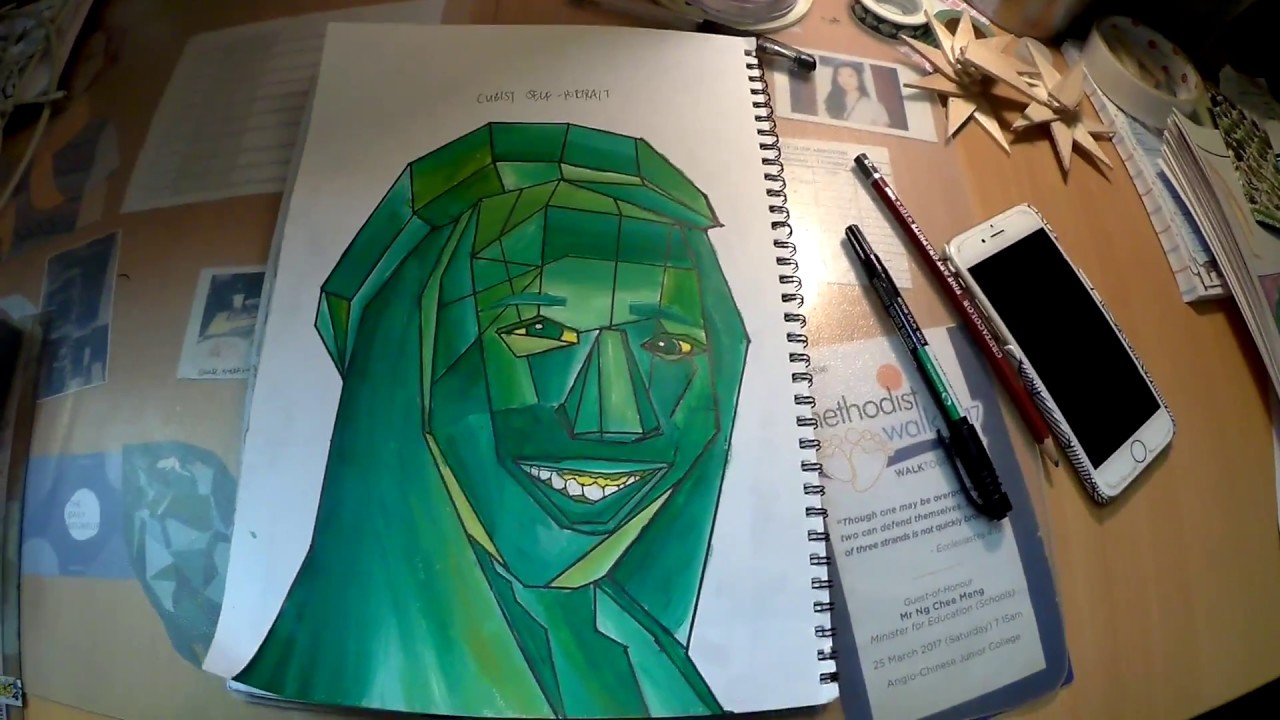
Study the underlying geometric shapes in your subject’s face. Look for triangles in the nose area, rectangles in the forehead, and diamond shapes around the cheekbones.
Initial Sketching and Layout Design
Start with loose gesture drawing to capture the subject’s essential character. Don’t worry about accuracy yet.
Break the face down into basic geometric components. Think of the head as a series of intersecting planes rather than smooth curves.
Map out your major shapes before adding details. The eye socket becomes a triangle, the nose a series of angled planes, the mouth a geometric slit.
Plan how different viewpoints will overlap and intersect. This is where cubism gets tricky – you’re showing multiple perspectives simultaneously.
Color Scheme Development
Analytical cubism typically uses muted, earthy tones. Think raw umber, burnt sienna, and ochre mixed with white and black.
Complementary colors can add visual interest without overwhelming the geometric structure. Try subtle orange-blue or red-green relationships.
Keep your color intensity low initially. Bright, saturated colors can fight against the structural elements you’re trying to emphasize.
Plan which planes will be lighter and which darker. This creates depth even within the flattened cubist space.
Step-by-Step Painting Process

Creating the Foundation Layer
Block in your major shapes with thin paint first. Use turpentine or medium to keep the paint workable.
Establish your darkest and lightest values early. These anchor points help you judge all the middle tones correctly.
Don’t worry about details yet. Focus on getting the overall structure and proportions right first.
Work from general to specific – big shapes first, then progressively smaller elements. This prevents you from getting lost in unnecessary details.
Developing Facial Features Through Fragmentation
Transform the eyes into geometric elements. One eye might show frontal view while the other appears in profile.
The nose becomes a series of angled planes. Break it into triangular and rectangular components rather than modeling it smoothly.
Fragment the mouth across multiple viewpoints. Part might appear straight-on while another section shows the profile view.
Use directional lines to connect fragmented elements. These linear connections help unify the composition.
Building Depth Through Overlapping Planes
Layer transparent glazes over your base colors to create depth between intersecting planes. This technique comes from traditional oil painting methods.
Vary your edges – some planes should have sharp, defined borders while others merge softly into adjacent areas.
Use temperature shifts to push some planes forward and pull others back. Warmer colors advance, cooler colors recede.
Overlap geometric shapes to create spatial relationships. This overlapping is crucial for the cubist illusion of depth.
Adding Details and Final Touches
Refine your edge quality throughout the painting. Some transitions need to be sharp and definitive, others soft and blended.
Add linear elements that define the structure. These might be thin painted lines or areas where two color planes meet.
Check your overall balance. The fragmented elements should feel unified despite their geometric nature.
Step back frequently to assess the whole composition. It’s easy to overwork individual sections and lose sight of the bigger picture.
Final Assessment and Adjustments
Look for areas where the geometric fragmentation might be too busy or too simple. Cubist portraits need the right amount of complexity.
Adjust contrast levels between different planes. Some areas might need more separation, others might need to merge more subtly.
Consider adding subtle texture with dry brush techniques or palette knife work. This can help differentiate between various geometric planes.
Know when to stop. Cubist portraits can easily become overworked if you keep adding unnecessary elements.
Advanced Techniques and Style Development

Analytical Versus Synthetic Cubist Approaches
Analytical cubism breaks down forms into geometric fragments while maintaining muted colors. This approach, pioneered by Pablo Picasso and Georges Braque, focuses on deconstruction.
Synthetic cubism rebuilds forms using bold shapes and brighter colors. Think collage-like elements and more decorative patterns integrated into the portrait structure.
You can combine both methods within a single portrait. Start analytically by fragmenting the face, then add synthetic elements like patterned clothing or background shapes.
The analytical approach works better for serious, contemplative portraits. Synthetic techniques suit more playful or experimental interpretations.
Personal Style Integration
Develop your color signature by consistently using specific hue combinations across multiple works. Henri Matisse did this brilliantly with his fauvism influence.
Your mark-making patterns become as important as your color choices. Some painters use thick, gestural strokes while others prefer precise, clean edges.
Study how Paul Cézanne influenced cubist development. His geometric simplification of natural forms laid groundwork for the entire movement.
Consistency in fragmentation style helps viewers recognize your work. Do you prefer angular, sharp divisions or softer, more organic geometric breaks?
Problem-Solving Common Issues
Muddy colors often result from overmixing on the canvas. Keep your brush strokes deliberate and avoid overworking painted areas.
Maintaining facial recognition while fragmenting features requires careful balance. Keep at least one key feature relatively intact – usually an eye or the mouth.
Visual flow between fragments needs attention. Use repetition of colors or shapes to connect disparate elements across the composition.
Emphasis helps guide the viewer’s eye through complex geometric arrangements. Create a clear focal point even within fragmented compositions.
Color Temperature and Spatial Relationships
Warm colors advance while cool colors recede – use this principle to create depth within flattened cubist space. Push certain geometric planes forward with warmer hues.
Color saturation affects spatial perception. Higher saturation brings elements forward, muted colors push them back.
Mix tertiary colors to create sophisticated color relationships between geometric planes. These complex colors feel more natural than pure primaries or secondaries.
Analogous color schemes create harmony within fragmented compositions. Try working with colors that sit adjacent on the color wheel.
Contemporary Cubist Portrait Applications

Modern Tools and Digital Integration
Digital sketching apps help you plan complex fragmentation before touching paint. Try different arrangements quickly without wasting materials.
Use your smartphone to photograph subjects from multiple angles simultaneously. This creates the reference material cubist portraits require.
Mixed media approaches incorporate collage elements, found materials, or digital prints into painted surfaces. This reflects contemporary art’s boundary-pushing nature.
Some artists scan their initial sketches and manipulate them digitally before transferring back to canvas. This hybrid approach opens new creative possibilities.
Scale and Format Variations
Large-scale cubist portraits create dramatic impact in gallery settings. The fragmented elements become almost architectural in their presence.
Small intimate studies allow for detailed exploration of specific facial features. Work in series to develop your fragmentation vocabulary.
Consider multiple panel works where each panel shows different viewpoints of the same subject. This extends cubism’s multiple-perspective concept literally.
Square formats often work better than rectangles for cubist portraits. The equal dimensions complement the geometric fragmentation approach.
Series Development Approaches
Thematic consistency across a series helps viewers understand your artistic intent. Work with the same model from different angles or lighting conditions.
Progressive fragmentation shows increasing abstraction across multiple works. Start realistic and gradually increase geometric interpretation.
Color progression through a series creates visual interest while maintaining conceptual unity. Move from monochromatic to full color across several pieces.
Document your process through photography. Contemporary audiences appreciate seeing artistic development and decision-making.
Exhibition and Presentation Considerations
Lighting for geometric compositions requires careful attention. Avoid harsh shadows that compete with painted geometric elements.
Frame selection should complement rather than fight the artwork’s angular nature. Simple, clean frames work best with complex cubist compositions.
Gallery spacing between cubist works needs more room than traditional portraits. Viewers need space to visually process the fragmented information.
Consider artist statements that explain your cubist approach. Contemporary audiences often appreciate understanding the artist’s conceptual framework.
Integration with Other Painting Styles
Abstract elements can enhance cubist portraits without overwhelming the representational content. Think Wassily Kandinsky’s geometric abstractions.
Expressionist color adds emotional intensity to cubist structures. Bold, non-naturalistic colors can strengthen the portrait’s psychological impact.
Some contemporary artists blend cubist fragmentation with photorealism in certain areas. This creates interesting visual tension between styles.
Surrealist elements like impossible spatial relationships can push cubist portraits into more experimental territory.
Digital Age Adaptations
Social media presentation requires consideration of how cubist works appear on small screens. High contrast helps fragmented elements remain visible.
Digital reproduction can actually enhance cubist works’ geometric clarity. Clean, sharp edges translate well to digital formats.
Consider creating time-lapse videos of your painting process. The geometric construction sequence fascinates contemporary audiences.
Online portfolio presentation should group cubist works together to show stylistic consistency and artistic development over time.
FAQ on How To Paint A Cubist Portrait
What materials do I need to start painting cubist portraits?
You need basic painting mediums like acrylic painting or oil painting supplies. Flat brushes work best for geometric edges.
Use a limited color palette of five colors maximum. Canvas or wood panels provide good surfaces for precise geometric work.
How do I break down a face into geometric shapes?
Study your subject’s bone structure and identify basic geometric forms. The forehead becomes rectangles, cheekbones form triangles, and the jaw creates angular planes.
Fragment familiar features like eyes and mouth across multiple viewpoints. Practice seeing curves as series of straight lines and angles.
What’s the difference between analytical and synthetic cubism for portraits?
Analytical cubism deconstructs faces using muted earth tones and complex fragmentation. Pablo Picasso’s early portraits exemplify this approach.
Synthetic cubism rebuilds forms with brighter colors and simplified shapes. Think collage-like elements and decorative patterns integrated into portraits.
How do I maintain facial recognition while fragmenting features?
Keep at least one key feature relatively intact – usually an eye or the mouth. This anchors the viewer’s recognition of the subject.
Use consistent proportional relationships between fragmented elements. The overall head shape should remain recognizable despite geometric treatment.
What colors work best for cubist portraits?
Earth tones dominate traditional cubist work – raw umber, burnt sienna, ochre, and various grays. Monochromatic color schemes help beginners focus on structure.
Complementary colors add visual interest without overwhelming geometric elements. Keep color intensity low initially to maintain focus on form.
How do I create depth in a flattened cubist composition?
Use warm colors to advance certain planes and cool colors to recede others. Overlapping geometric shapes creates spatial relationships within flattened space.
Value contrasts between adjacent planes help define depth. Vary edge quality – some sharp, others soft – to create spatial illusion.
Should I work from photos or live models?
Take multiple reference photos from different angles – front, profile, three-quarter views. Cubist portraits require seeing the subject from various perspectives simultaneously.
Live models help you understand three-dimensional form better. However, photos provide the multiple viewpoints essential for cubist fragmentation.
How do I develop my personal cubist style?
Study masters like Pablo Picasso, Georges Braque, and Paul Cézanne. Notice their different approaches to fragmentation and color.
Develop consistent mark-making patterns and color signatures. Your unique approach to geometric division becomes your artistic voice within cubist tradition.
What common mistakes should I avoid?
Muddy colors from overmixing paint on canvas. Keep brush strokes deliberate and avoid overworking areas.
Over-fragmentation makes faces unrecognizable. Balance geometric treatment with readable facial elements to maintain portrait quality.
How long does it take to complete a cubist portrait?
Simple analytical portraits take 4-6 hours for experienced painters. Complex multi-viewpoint works require 10-15 hours across multiple sessions.
Drying time affects oil painters more than acrylic painting users. Plan accordingly when building up geometric layers and overlapping planes.
Conclusion
Mastering how to paint a cubist portrait requires patience and willingness to abandon traditional representational approaches. This geometric fragmentation technique challenges conventional painting styles while opening new creative possibilities.
Your journey begins with understanding basic composition principles and geometric breakdown of facial features. Practice fragmenting simple shapes before attempting complex portraits.
Color harmony becomes crucial when working with limited palettes and multiple viewpoints. Earth tones and muted colors help maintain visual unity across fragmented elements.
Contemporary artists continue pushing cubist boundaries by incorporating digital tools and mixed media approaches. Your personal style develops through consistent practice and experimentation with different fragmentation methods.
The geometric abstraction of cubist portraiture connects directly to broader abstract art movements. Understanding these historical connections enriches your artistic development and conceptual framework.
Remember that cubist portraits balance recognizable features with innovative geometric interpretation. This tension creates the visual interest that makes cubist work compelling across generations.